
Did Google misread the gaming market when it launched Stadia?
Google shut Stadia in January 2023 after years of low user numbers, high infrastructure costs, and a technical model that forced every game to be ported to Linux.
That combo kept the catalog thin, scared off developers, and made streaming too expensive per player.
In short, Stadia failed because it couldn’t grow users, couldn’t secure enough exclusive or easy-to-port games, and never found a sustainable business model inside Google’s fast-iteration culture.
Core Reasons Behind Google’s Decision to Shut Down Stadia

On September 29, 2022, Google admitted that Stadia “hasn’t gained the traction with users that we expected.” That line showed up in an official blog post, three years after the service launched in November 2019 with big promises about bringing console-quality gaming to any screen. The numbers weren’t pretty. UK Competition and Markets Authority data put Stadia at 0–5% of monthly active cloud gaming users in 2022. That’s down from 5–10% the year before.
But weak adoption was only part of it. Stadia ran on a Linux-based OS, which meant every single game needed a custom port. Developers couldn’t just upload their existing Windows or console builds. That created a massive friction point and kept the catalog thin compared to platforms that could pull from Steam or console ecosystems. Running the service wasn’t cheap either. Streaming AAA games eats compute power, bandwidth, and storage at scale. Google dropped tens of millions securing titles like Red Dead Redemption 2 and Cyberpunk 2077, but those checks couldn’t fix the deeper problem: attracting both players and developers to a closed platform with no real install base.
Internal doubts surfaced early. In February 2021, Google shut down Stadia Games and Entertainment, the internal studio that was supposed to build exclusive content. The service hung on for 19 more months before the final shutdown on January 18, 2023.
Why it failed:
- User numbers stayed tiny (0–5% global market share by 2022)
- Linux requirement blocked third-party ports and stunted catalog growth
- Infrastructure costs were high, revenue was low
- No killer exclusives, and most developers just didn’t bother
Market Performance Issues That Led to the Stadia Shutdown
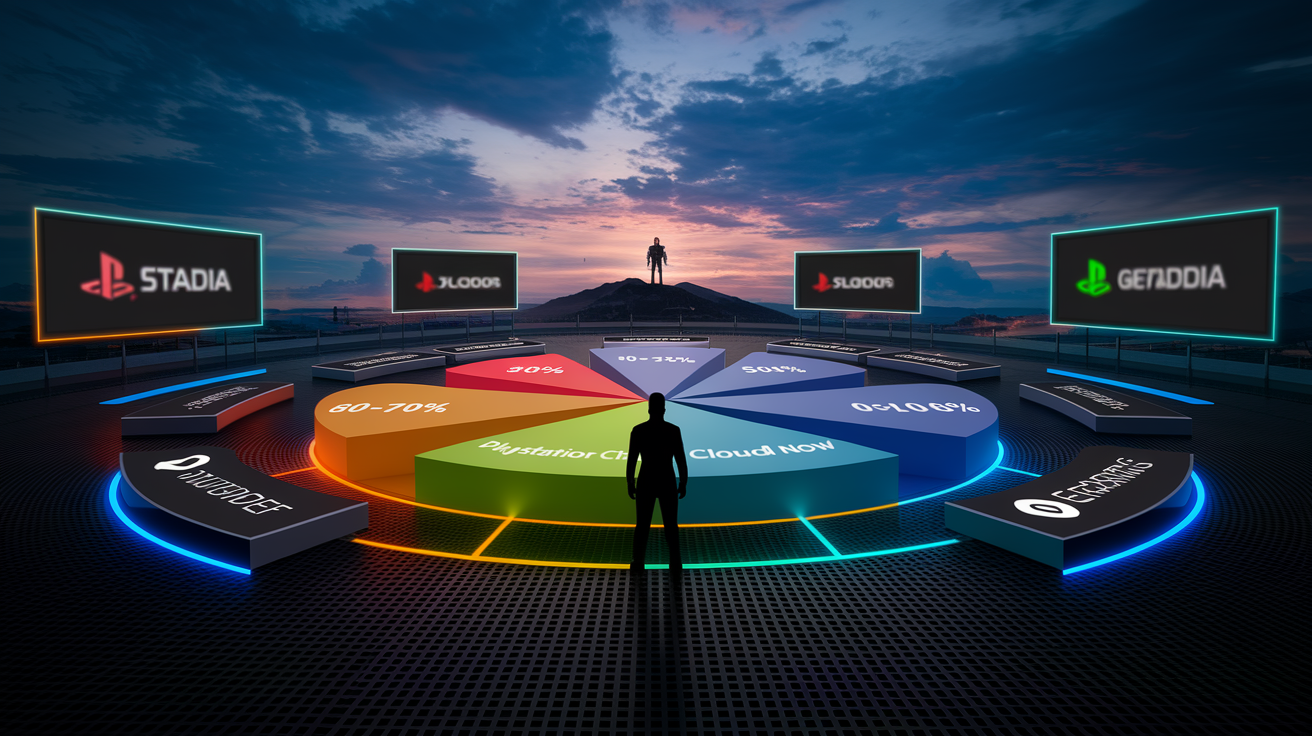
Stadia walked into a cloud gaming market that looked open in 2019. By 2022, it was a bloodbath. CMA data showed Microsoft’s xCloud owning 60–70% of global monthly active users. PlayStation Cloud Gaming and NVIDIA GeForce Now each grabbed 10–20%. Stadia sat at 0–5%, even trailing Amazon Luna. A year earlier, the picture was different. Microsoft held 20–30%, PlayStation 30–40%, GeForce Now 20–30%, Stadia 5–10%. Then Game Pass went full throttle, and Microsoft swallowed most of the growth. Stadia’s slice just disappeared.
The competitive gap wasn’t technical. Competitors bundled cloud access into stuff people already used. Game Pass subscribers could stream hundreds of titles they owned. GeForce Now let players hit their Steam libraries. PlayStation folded cloud streaming into subscription tiers. Stadia made you buy every game again on a separate storefront. You had to compete for wallet share against platforms people trusted, with no library advantage, no pricing hook, and no exclusive worth switching for.
Where Stadia couldn’t compete:
- Catalog: Tiny compared to Game Pass or GeForce Now’s Steam access.
- Bundling: Others integrated cloud into existing subscriptions. Stadia sold games one by one or via a $9.99/month Pro tier that didn’t guarantee much.
- Ecosystems: Xbox and PlayStation had console owners and loyal audiences. Stadia had nobody.
- Trust: People doubted Google would stick around after watching the company kill product after product. Xbox and PlayStation were proven.
- Value: Game Pass included cloud as a bonus. Stadia Pro still made you buy most top titles separately.
Google hoped to grab new players who didn’t want consoles or PCs. Instead, they competed for attention from gamers who already owned those platforms, already had libraries, and saw zero reason to rebuy content on an unproven service. By the time the shutdown call came, Stadia’s market position was too weak to justify keeping the lights on.
Technical and Infrastructure Constraints That Affected Stadia’s Adoption

Stadia’s streaming tech actually worked. You could play Red Dead Redemption 2 or Cyberpunk 2077 on a laptop, phone, or browser without high-end hardware. When conditions were right, it felt close to native. But “when conditions were right” was the catch. Players in areas with spotty broadband or data caps got stuttering, resolution drops, and input lag that turned fast games into a mess. Google’s data center footprint was smaller than Azure or AWS, so latency spiked for anyone far from a server hub.
Operating costs made the technical challenges worse. Streaming AAA games at high res and frame rates burns compute, bandwidth, and storage. Every hour of gameplay cost Google money. Unlike traditional platforms where you own the hardware, Google carried the full compute and delivery expense. That cost structure needed either huge user volume to spread the load, premium pricing to cover it directly, or both. Stadia got neither. The cloud delivery strength became a financial anchor.
| Technical Constraint | Impact |
|---|---|
| Linux OS requirement for game ports | Shrank the catalog. Publishers skipped Stadia instead of investing in custom builds |
| Regional latency and data center gaps | Input lag and inconsistent performance hurt competitive titles and retention |
| High per-user infrastructure costs | Needed massive scale to work. Low adoption made it unsustainable |
| Variable network conditions and ISP throttling | Player experience depended on home internet quality, limiting who could use it reliably |
Developer, Publisher, and Content Limitations Affecting Stadia’s Viability
Every game on Stadia needed a dedicated port. The platform ran on custom Linux instead of Windows or familiar console architectures. Developers couldn’t just upload existing builds. For big publishers with porting teams, it was extra work that had to compete with other priorities. For smaller indie studios, the cost and time often didn’t make sense, especially when the user base stayed small.
Google threw money at the problem. The company spent tens of millions securing day-and-date releases like Assassin’s Creed and Cyberpunk 2077. But those were one-off deals, not ecosystem momentum. Independent developers said the offers felt low for the effort required. Many just said no. Stadia needed a steady content flow to keep players engaged and attract new ones. The pipeline stayed thin.
On February 1, 2021, Google shut down Stadia Games and Entertainment. That was the internal studio meant to build exclusives and showcase what the platform could do. Closing it signaled Google wasn’t willing to make long-term publishing investments. Without exclusives or a strong third-party lineup, Stadia’s library looked like a curated subset of what you could already get elsewhere. With fewer sales, no cross-buy, and the risk of betting on an unproven platform.
The Catalog Problem
The library never hit critical mass. Launch was modest. Growth was slow. By the time Game Pass was adding dozens of titles monthly and GeForce Now enabled entire Steam library access, Stadia’s updates felt incremental. The Linux requirement meant popular indie titles and smaller releases never showed up. Gaps frustrated anyone looking for variety. Big publishers focused on platforms with bigger audiences. Small user base discouraged developer investment, which limited content, which kept the user base small. Google’s internal studio closure killed the one lever they controlled directly. That left Stadia dependent on third parties with no reason to prioritize a struggling platform. Even when Google paid for ports, deals rarely included marketing or long-term roadmaps. Releases felt random instead of building toward something coherent.
Financial and Organizational Factors Driving Google’s Shutdown Decision

Streaming AAA games at scale meant nonstop spending on compute, bandwidth, storage, and content deals. Cloud gaming shifts infrastructure cost to the platform. Every session, every hour, every concurrent user was a real-time expense. Google’s model—selling games individually or through a $9.99/month Pro subscription with a limited library—generated modest revenue per user while costs stayed high and content deals drained cash.
Financial pressure collided with an organizational misfit. Running a gaming platform needs a publisher mindset: long dev cycles, multi-year content commitments, close developer relationships, patience with slow revenue ramps. Google’s culture favors rapid iteration, quick product-market fit validation, and engineering-led problem solving. Stadia needed patient capital and deep operational commitment in an industry where Google had no legacy, no loyal customers, and limited know-how. Leadership looked at the gap between required investment and realistic return. They concluded the economics didn’t work and cut losses instead of pouring more money into a product that didn’t fit the company’s strengths or priorities.
By mid-2022, the math was clear. Stadia’s user base was flat. Market share had collapsed to 0–5%. Competitors with stronger ecosystems and deeper pockets were pulling away. Google faced a choice: double down with billions more—build first-party studios, sign exclusive deals, expand data centers, fund aggressive user acquisition—or admit the window had closed.
Main financial and organizational blockers:
- Cost structure: High per-user infrastructure and content costs versus low, slow revenue made the economics unsustainable.
- Culture clash: Google’s engineering culture didn’t support the long-term, publisher-style investments a competitive gaming platform needs.
- Publisher inexperience: The company lacked experience managing developer relations, exclusive pipelines, and multi-year content roadmaps at scale.
- User growth stalled: Slow adoption and shrinking market share (5–10% in 2021 to 0–5% in 2022) killed the path to profitability.
Shutdown Timeline, Refunds, and Customer Impact of the Stadia Closure

Google handled the shutdown with an eye toward limiting customer backlash. On September 29, 2022, they announced the wind-down and promised refunds for all hardware bought through the Google Store—controllers, Chromecast Ultra bundles, Premiere Edition kits—plus every game and add-on purchased through the Stadia store. Players kept access to their libraries and could keep playing until the final shutdown on January 18, 2023. Nearly four months to finish games and move to other platforms.
Refunds were processed automatically for most people. Google covered transaction fees and logistics. The policy was unusually generous compared to typical platform shutdowns, where digital purchases often just vanish. By eating the refund cost, Google dodged the PR disaster of leaving paying customers with worthless libraries. But it also highlighted the size of the financial write-off needed to close things cleanly.
| Date | Event |
|---|---|
| November 19, 2019 | Stadia public launch with Premiere Edition and Pro subscription |
| February 1, 2021 | Closure of Stadia Games and Entertainment (internal studio) |
| September 29, 2022 | Google announced shutdown, refund policy and timeline |
| January 18, 2023 | Final shutdown, all player access cut off |
| By January 18, 2023 | All hardware and software refunds completed |
How Stadia’s Technology Lives On After the Shutdown

Google didn’t scrap the underlying tech when it killed Stadia as a consumer product. They repositioned the platform’s infrastructure for enterprise partners and cloud service customers. The encoding, low-latency networking, and virtualization work built for Stadia can support other interactive streaming uses—virtual desktops, cloud workstations, partner-operated gaming services—where Google provides infrastructure instead of running a consumer platform. That pivot let them salvage value from the engineering investment without the burden of a direct-to-consumer gaming business.
The shutdown fit a familiar Google pattern. Services that don’t hit expected traction get cut, regardless of technical quality. Stadia joined a long list of discontinued products, reinforcing user doubts about the company’s commitment to consumer services outside advertising and productivity tools. For the cloud gaming industry, Stadia’s closure was a warning. Strong technology can’t overcome ecosystem barriers, content gaps, and the challenge of displacing entrenched competitors in a market where users already own libraries and trust established brands.
Final Words
Stadia closed because it couldn’t reach enough players while running costly cloud infrastructure and securing games. Google announced on September 29, 2022 that Stadia “hasn’t gained the traction with users that we expected.”
With 0–5% market share in 2022, limited Linux ports, and big publishing costs, the business was unsustainable. Google refunded purchases and ended the service on January 18, 2023.
If you’re still asking why did google shut down stadia, the short answer is low user traction, technical and catalog limits, and high operating costs. The tech and lessons now help Google Cloud and partners—a useful legacy.
FAQ
Q: Is Google Stadia coming back?
A: Google Stadia is not coming back. Google announced on September 29, 2022 that the service would close, and Stadia shut down January 18, 2023; the technology was repurposed, not relaunched for consumers.
Q: Is Fortnite returning to Google Play?
A: Fortnite returning to Google Play depends on Epic and Google; after Stadia’s closure Fortnite stayed available on Android via Epic’s installer and the Samsung Galaxy Store, not the Play Store—check Epic or Google for updates.
Q: Did Stadia refund everyone?
A: Stadia refunded everyone who bought hardware from the Google Store and all software purchases on Stadia; Google completed those refunds before the service ended on January 18, 2023.
Q: What replaced Stadia?
A: Nothing directly replaced Stadia; Google repurposed its streaming tech for cloud and enterprise projects, while consumer cloud gaming continued with rivals like Microsoft’s xCloud, GeForce Now, and PlayStation Cloud.