What if your private messages were readable only on two devices — and no one else could ever see them?
End-to-end encryption does exactly that, keeping plaintext on your device and the recipient’s device only.
This post breaks down the complete process step by step: how keys are made and exchanged, how session keys encrypt messages locally, how ciphertext travels safely through servers, and why features like forward secrecy and the Double Ratchet matter.
Read on to learn how E2EE protects content, what still leaks, and what to check next.
Core Process Behind How End-to-End Encryption Works
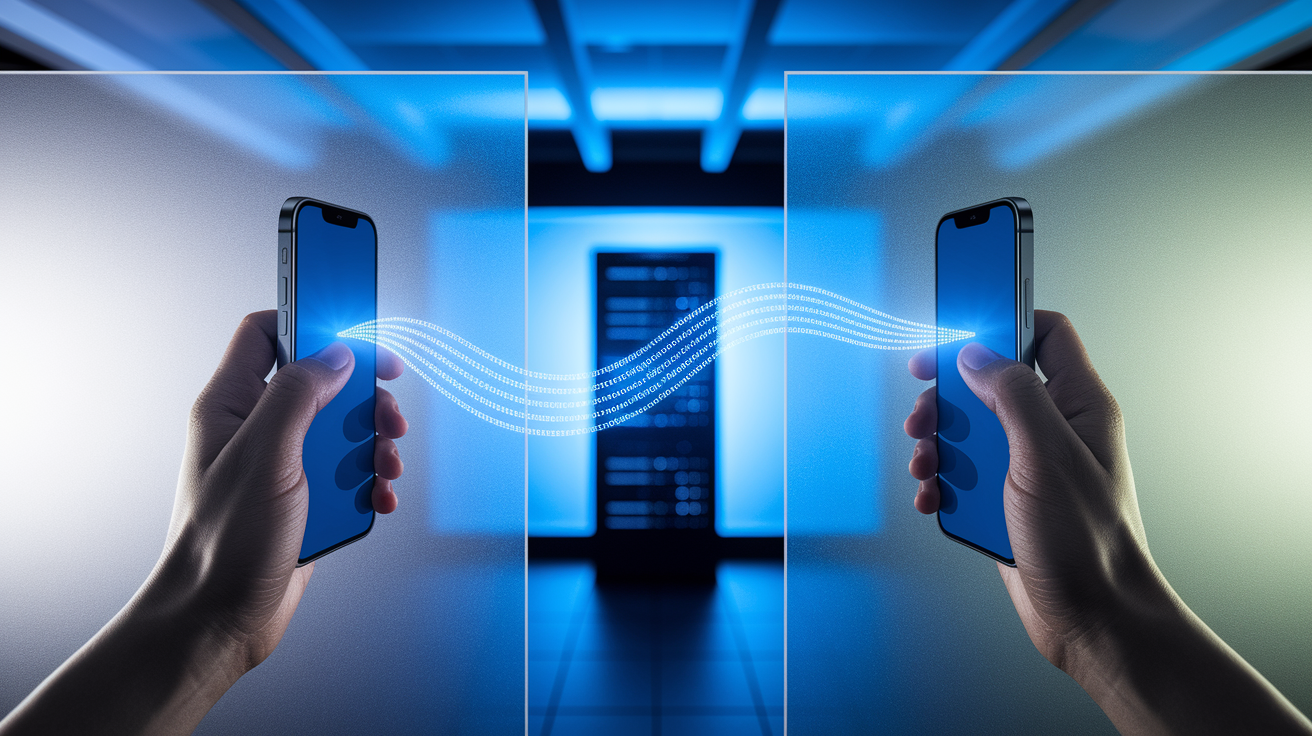
End-to-end encryption (E2EE) makes sure plaintext messages stay readable in exactly two places: your device and the recipient’s device. That’s it. No one in between can peek at the actual content during transmission or when it’s sitting on a server. Not the messaging company. Not your ISP. Not government watchers. This protection works because the cryptographic keys never leave the endpoints. Your devices are the only spots where readable text exists.
E2EE relies on two kinds of keys. There’s a public key anyone can see and share, plus a private key that stays locked on your device. When you send a message, your app grabs the recipient’s public key and uses it to encrypt the text locally. The encrypted message moves through servers as unreadable ciphertext. Because servers don’t have the private key needed for decryption, they can’t turn that ciphertext back into readable text. Even if they wanted to. Even if a court ordered them to.
Here’s what the data path looks like: Sender Device [encrypts with recipient public key] → Encrypted ciphertext → Server/relay [can’t decrypt] → Encrypted ciphertext → Recipient Device [decrypts with recipient private key]. Encryption happens before you hit send. Decryption happens after the message arrives. The middle part stays fully protected.
The recipient’s device holds the matching private key and uses it to reverse the encryption, bringing back the original plaintext. Since the private key never travels over the network and only lives on the recipient’s hardware, the system resists interception attacks. Even if someone compromises a server, message content stays hidden.
The full E2EE process breaks down into five steps:
- Key generation – Your device creates a unique public/private key pair and stores the private key securely on that device.
- Key exchange – The sender pulls the recipient’s public key through a directory or secure handshake protocol.
- Session key creation – The app sets up a temporary symmetric encryption key using the exchanged public keys (usually via Diffie-Hellman or something similar).
- Local encryption – Your device encrypts the plaintext message with the session key before any transmission happens.
- Ciphertext transmission and decryption – The encrypted message travels through middlemen who can’t decrypt it. The recipient’s device uses its private key or session key to decrypt and show the plaintext.
Cryptographic Foundations Enabling End-to-End Encryption

Asymmetric encryption is the backbone here. It uses two mathematically linked keys: one public, one private. The public key encrypts data or verifies signatures. The private key decrypts data or creates signatures. This design solves a real problem: two people who’ve never met can swap encrypted messages without first sharing a secret over an insecure channel. Each person publishes a public key and keeps the private key on their device. Even if someone intercepts the public key, they can’t derive the private key from it.
Diffie-Hellman (DH) and elliptic curve Diffie-Hellman (ECDH) protocols let two devices calculate a shared secret using only public information exchanged over the network. Each side contributes a public value derived from its private key. Through math operations, both sides reach the same symmetric key without ever transmitting that key directly. Servers in the middle see only the public values and can’t reconstruct the shared secret. Passive eavesdropping won’t break the encryption.
After the shared secret gets established, the system switches to symmetric encryption for the actual message payload. Asymmetric operations are slow and computationally expensive, so apps only use them to negotiate a session key. That’s a single shared symmetric key both endpoints know. Symmetric algorithms like AES can encrypt tons of data quickly, which makes real-time chat and video practical. You get security from the hard-to-break key exchange, plus speed from efficient bulk encryption.
Four core roles in this cryptographic model:
- Shared-key speed – Symmetric encryption handles messages way faster than asymmetric methods, which matters for high-throughput apps.
- Asymmetric negotiation – Public/private key operations establish initial trust and create the symmetric session key securely.
- Key durability – Long-term identity keys (asymmetric) stick around across sessions. Session keys (symmetric) are temporary and get rotated often.
- Endpoint-only private key storage – Private keys never leave the device. Server compromise or network taps don’t expose the keys needed for decryption.
Algorithms and Message Protection Methods Used in E2EE

Symmetric ciphers do the heavy lifting for message encryption because they deliver the speed you need for real-time communication. AES (Advanced Encryption Standard) is the most widely deployed cipher. Apps use configurations like AES-256-GCM (Galois/Counter Mode) that combine encryption and authentication in one operation. ChaCha20-Poly1305 offers an alternative that works well on mobile and low-power devices because it performs better on hardware without dedicated AES acceleration. Both ciphers produce ciphertext that’s computationally infeasible to decrypt without the correct symmetric key.
Message authentication codes (MACs) verify that ciphertext hasn’t been tampered with during transmission. A MAC is a short cryptographic tag computed from the message and a secret key. The recipient recomputes the tag and compares it to the received value. If someone modifies even a single bit of the ciphertext, the MAC check fails and the message gets rejected. This stops attackers from flipping bits or injecting malicious payloads into encrypted traffic. You get integrity alongside confidentiality.
Digital signatures confirm the sender’s identity and prove the message hasn’t been altered since signing. The sender uses their private key to create a signature over the plaintext (or a hash of it). The recipient verifies the signature using the sender’s public key. If verification succeeds, the recipient knows the message came from the claimed sender and wasn’t modified in transit. Signatures complement encryption. Encryption hides content. Signatures prove origin.
Forward Secrecy and the Double Ratchet in End-to-End Encryption

Forward secrecy ensures that if someone steals a long-term private key, they can’t expose past message content. Traditional encryption ties all messages to a single key pair. If that key leaks, every historical ciphertext can be decrypted. Forward secrecy breaks this link by generating temporary session keys for each conversation or message, then deleting those keys after use. Even if an attacker later steals the device and extracts the long-term identity key, previously transmitted ciphertexts stay secure because the temporary keys no longer exist.
The Double Ratchet algorithm, used in the Signal Protocol, continuously updates encryption keys with each message sent and received. It combines a Diffie-Hellman ratchet (which creates a new shared secret whenever the conversation direction changes) and a symmetric-key ratchet (which derives fresh message keys from the current chain). This ratcheting process means if today’s keys get compromised, yesterday’s messages stay hidden (backward secrecy) and tomorrow’s messages stay hidden too (forward secrecy). The X3DH (Extended Triple Diffie-Hellman) handshake establishes the initial shared secrets by combining the sender’s and recipient’s identity keys, ephemeral keys, and prekeys into a root key that feeds the Double Ratchet.
| Feature | Purpose |
|---|---|
| Forward Secrecy | Protects past messages even if long-term keys are later compromised. Ephemeral keys get deleted after use. |
| Double Ratchet (Key Rotation) | Updates encryption keys with each message. Compromise of one key doesn’t expose other messages in the conversation. |
| X3DH Handshake | Initializes a secure shared secret using multiple Diffie-Hellman operations before the first message is sent. |
Comparing End-to-End Encryption with Other Encryption Models
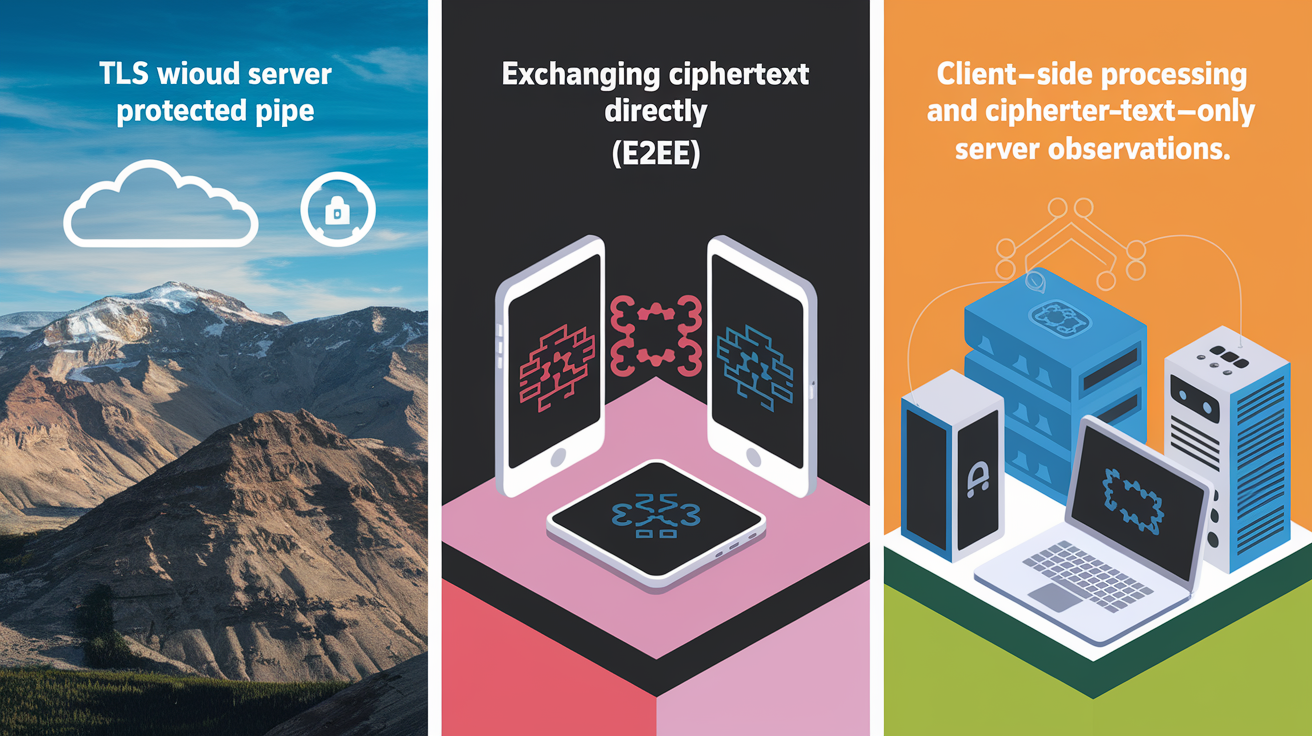
Transport Layer Security (TLS) protects data traveling between your device and a server by encrypting the connection. When you visit a website over HTTPS, TLS stops eavesdroppers from reading the traffic. But once data reaches the server, TLS decryption happens and the server sees the plaintext. If the server gets compromised, misconfigured, or gets hit with a legal order, all content passing through it is exposed. TLS secures the pipe, not the endpoints.
End-to-end encryption shifts trust away from middlemen and onto the two devices in the conversation. The server relaying E2EE messages only ever sees ciphertext. It can’t decrypt messages even if administrators want to or courts order it. This model removes the service provider from the trust equation. You’re protected against server breaches, insider threats, and lawful but unwanted data requests. The trade-off? Legitimate access (for compliance, moderation, or account recovery) becomes harder because the provider has no decryption capability.
Metadata—timestamps, sender and recipient identifiers, message sizes, IP addresses—typically stays visible to servers and network observers even when E2EE protects message content. A messaging platform knows who talked to whom and when. They can infer social graphs and communication patterns from this information. Traffic analysis can reveal relationships, locations, and behaviors without reading a single message. Additional protections like onion routing (Tor) or padding schemes are needed to hide metadata, but most E2EE apps don’t implement these by default.
Three points comparing plaintext access across models:
- TLS: User and server both see plaintext. Middlemen between user and server see only ciphertext.
- Server-side encryption: Server encrypts data at rest but holds the keys. Administrators and attackers with server access can decrypt stored content.
- End-to-end encryption: Only sender and recipient devices see plaintext. Servers, network observers, and platform operators see only ciphertext and can’t decrypt.
Real-World Implementations of End-to-End Encryption
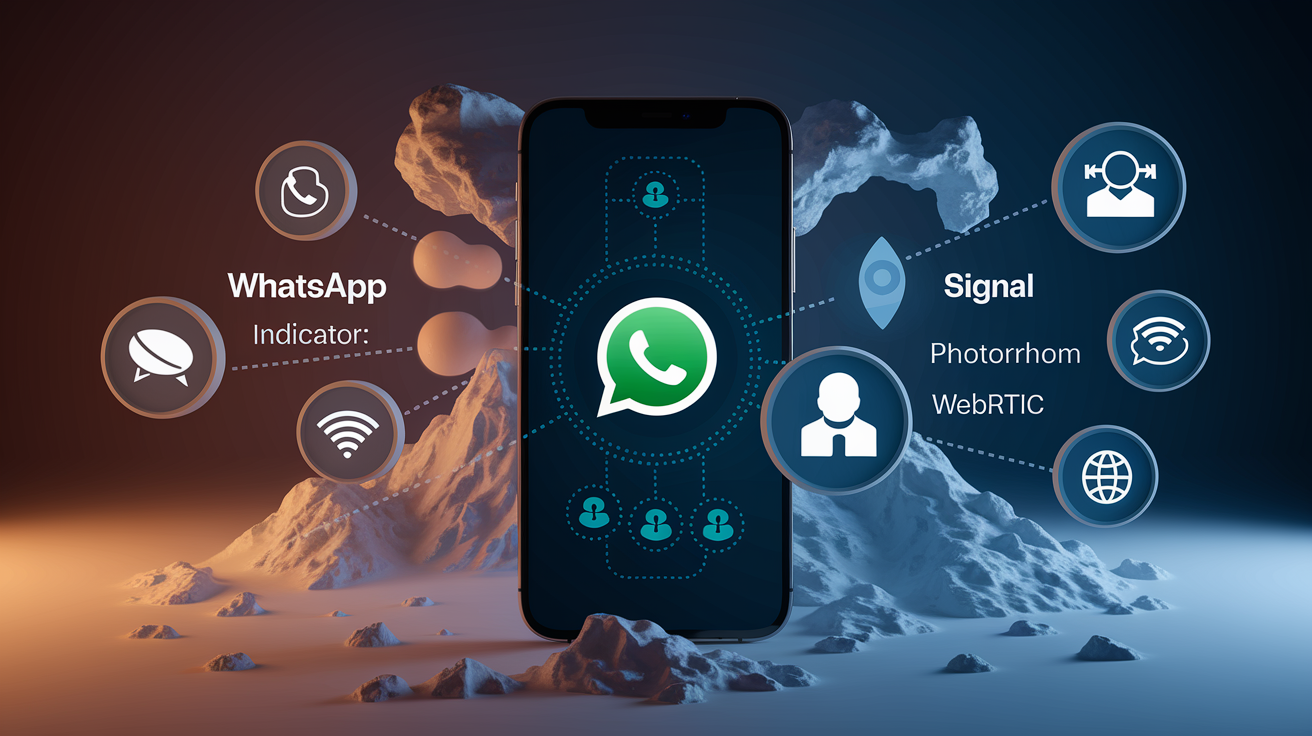
Popular messaging apps like WhatsApp and Signal implement E2EE using the Signal Protocol, which combines X3DH for initial handshakes and the Double Ratchet for ongoing message encryption. These apps support asynchronous messaging. You can send an encrypted message to someone who’s offline. The server stores the ciphertext until the recipient’s device comes online and retrieves it. The protocol uses prekeys (public keys the recipient uploads in advance) so the sender can encrypt the first message without waiting for the recipient to be active.
Real-time voice and video encryption relies on Secure Real-time Transport Protocol (SRTP) extended with E2EE key management. WebRTC, the browser standard for peer-to-peer media, supports encrypted media channels using DTLS (Datagram TLS) to negotiate session keys and SRTP to encrypt the audio and video streams. Because media flows directly between devices (or through relay servers that can’t decrypt), E2EE in video calls prevents the platform from accessing call content. Latency and bandwidth constraints make real-time E2EE trickier than text messaging, but modern codecs and protocols handle it transparently.
Multi-device synchronization requires secure key transfer so your phone, tablet, and desktop can all decrypt the same conversation. Apps typically use a secure pairing process—scanning a QR code or verifying a short code—to authenticate the new device and transfer keys over an E2EE channel. Some implementations store encrypted message history on the server, encrypted with keys derived from your devices. Adding a new device re-encrypts and syncs that history after verification.
Four typical app workflows using E2EE:
- WhatsApp: Uses the Signal Protocol for all messages and calls. Prekeys stored on servers allow asynchronous encryption. Cloud backups (if enabled) often aren’t E2EE by default.
- Signal: Open-source Signal Protocol. Supports disappearing messages and sealed sender (hides sender metadata from server). Offers encrypted backups protected by user-chosen passphrase.
- WebRTC-based video: Browser or app negotiates DTLS keys for peer-to-peer SRTP. Media encrypted end-to-end when relay servers act only as packet forwarders.
- Email with PGP/S/MIME: Each user manages their own key pair. Sender encrypts email body with recipient public key. Less seamless than messaging apps but provides E2EE for email.
Key Management and Device Security in End-to-End Encryption
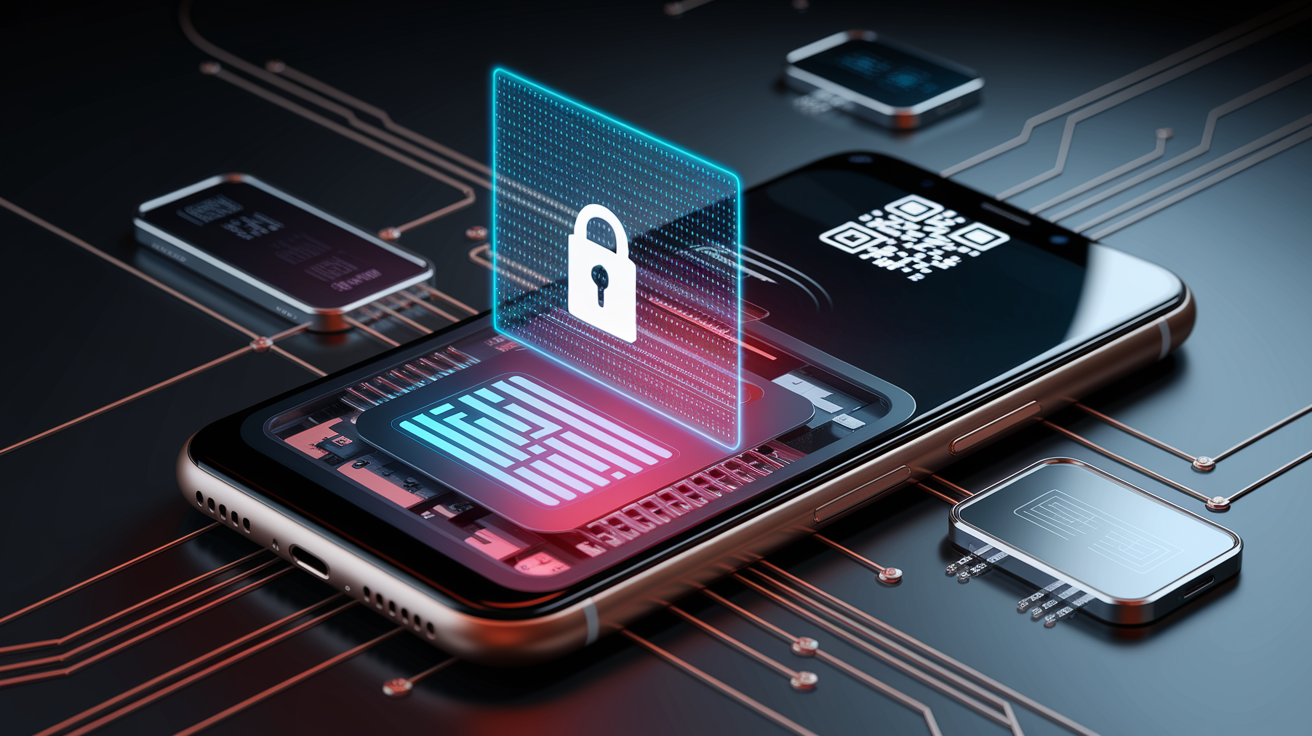
End-to-end encryption depends entirely on the security of the endpoint devices. If someone gains physical access to an unlocked phone, installs malware that logs keystrokes, or exploits an operating-system vulnerability to extract private keys, E2EE offers no protection. The plaintext is visible before encryption or after decryption on the compromised device. Device integrity is the foundation. Strong encryption can’t compensate for weak device controls.
Threats to private keys include malware that reads memory, physical theft of unlocked devices, and forensic extraction tools used by law enforcement or attackers. Secure storage mechanisms reduce these risks. Mobile operating systems offer secure enclaves (dedicated hardware like Apple’s Secure Enclave or Android’s Keystore) that isolate private keys from the main CPU and require biometric or PIN authentication before releasing key material. Trusted execution environments (TEEs) run sensitive cryptographic operations in isolated processor modes, preventing untrusted code from accessing keys even if the main OS is compromised.
Multi-device setups require transferring private keys or session keys to new devices without exposing them in transit. Apps use secure pairing flows—QR codes, numeric verification codes, or cryptographic challenges—to authenticate the new device over an already-trusted channel (often an existing E2EE session on another device). Once authenticated, keys are transferred encrypted and stored in the new device’s secure enclave. Poorly implemented transfers or cloud-synced keys without strong encryption can undermine E2EE by creating copies of private keys in less-protected locations.
| Method | Key Protection Level |
|---|---|
| Secure Enclave / Keystore | High. Keys isolated in hardware, released only after biometric/PIN. Resistant to OS-level malware. |
| Encrypted File Storage | Medium. Keys encrypted at rest with device password. Vulnerable if device is unlocked or password weak. |
| Plain File Storage | Low. Keys stored unencrypted. Trivial to extract if device is accessed physically or via malware. |
Group Messaging and End-to-End Encryption Models

Group chat encryption introduces complexity because a single message must be readable by multiple recipients, each holding different private keys. Early approaches encrypted the same message separately for each member, creating network overhead that grows linearly with group size. Sender keys solve this by having the sender generate a single symmetric group key, encrypt the message once with that key, then encrypt the group key separately for each member using their public keys. Each recipient decrypts the group key with their private key, then decrypts the message with the group key.
Identity keys authenticate each group member, proving they’re who they claim to be and preventing imposters from joining. Ephemeral keys provide forward secrecy within the group by rotating the group key regularly or whenever membership changes. When a member leaves, the group key is replaced and re-encrypted for the remaining members, preventing the departed user from decrypting future messages. This rotation ensures group conversations maintain forward secrecy and limit the window of exposure if a device is later compromised.
Five advantages of sender-key architectures:
- Scalability – Encrypting once and distributing the same ciphertext to all members reduces bandwidth and processing compared to per-recipient encryption.
- Consistent delivery – All members receive the same ciphertext, which simplifies server logic and reduces message duplication.
- Forward secrecy – Rotating group keys when membership changes or at regular intervals limits exposure from key compromise.
- Member authentication – Identity keys ensure each participant’s public key is verified, preventing man-in-the-middle attacks within the group.
- Efficient key updates – Only the group key metadata needs re-encryption for each member. The message payload is encrypted once.
Privacy Limitations and Metadata Exposure in E2EE
End-to-end encryption protects message content—the plaintext of what you write, say, or share. But it doesn’t hide metadata, the information about the communication itself. Metadata includes sender and recipient identifiers (phone numbers, usernames, email addresses), timestamps of when messages were sent and delivered, message sizes, and sometimes the recipient’s IP address or device type. Service providers and network observers collect this metadata as part of normal operations. It stays visible even when content is fully encrypted.
Metadata leakage happens because routing and delivery require servers to know where to send each message. A messaging platform must record which account sent a message to which recipient account and at what time in order to deliver it. These logs can reveal social graphs (who talks to whom), communication frequency, and activity patterns. Law enforcement and intelligence agencies routinely request metadata because it can establish associations, timelines, and behaviors without requiring access to message content.
Traffic analysis (observing the size, timing, and volume of encrypted messages) can infer information about the content. A sudden spike in messages between two users might indicate an urgent conversation. The length of a voice call reveals how long people spoke even if the audio is encrypted. Sophisticated adversaries can correlate encrypted traffic with external events (news stories, location data, public posts) to deduce what was discussed. Techniques like message padding (adding random data to obscure true message length) and traffic shaping (sending dummy messages to mask real patterns) can mitigate traffic analysis, but few consumer apps implement them because they increase bandwidth and complexity.
Legal, Regulatory, and Policy Context of End-to-End Encryption

Backdoors are intentional weaknesses inserted into encryption systems to allow a third party (typically law enforcement or a government agency) to decrypt messages without the sender’s or recipient’s private keys. The backdoor debate centers on whether enabling lawful access justifies the security risks of weakening encryption. Security experts widely agree that any backdoor can be exploited by malicious actors, not just authorized parties. Creating a “golden key” that only trusted entities can use is technically impractical because keys can be stolen, leaked, or reverse-engineered. And defining who is “trusted” varies by jurisdiction and changes over time.
End-to-end encryption aligns with privacy regulations like the European Union’s General Data Protection Regulation (GDPR), which requires data controllers to implement appropriate technical measures to protect personal data. E2EE minimizes the data a service provider can access, reducing the scope of potential breaches and limiting liability. But the same properties that protect privacy complicate compliance monitoring. Companies can’t scan messages for illegal content, enforce acceptable-use policies, or respond to data-subject access requests when they can’t decrypt the data. This creates tension between privacy obligations and content-moderation or child-safety requirements.
Regulatory pressure points include lawful-access mandates, content-moderation laws, and export controls on encryption technology. Some governments propose legislation requiring platforms to scan messages before encryption or provide decryption capabilities upon lawful request. Others restrict the export or use of strong encryption, classifying it as a controlled technology. Privacy advocates argue these measures undermine the fundamental security that E2EE provides, while law enforcement agencies contend that “going dark” prevents investigation of serious crimes.
Three regulatory challenges:
- Lawful access vs security – Mandating backdoors weakens encryption for all users and creates exploitable vulnerabilities that benefit criminals and hostile states.
- Content moderation – E2EE prevents platforms from scanning for illegal or harmful content, forcing reliance on user reports or metadata analysis.
- Cross-border enforcement – Encryption regulations vary by country. Global platforms face conflicting legal requirements that can’t all be satisfied simultaneously.
File Transfer, Backups, and Cloud Storage with End-to-End Encryption
End-to-end encrypted file transfer works by encrypting files on the sender’s device before uploading them to a server or peer. The recipient downloads the encrypted file and decrypts it locally using a shared key established through an E2EE handshake. Services like Signal and some secure file-sharing platforms apply this model, ensuring the server stores only ciphertext and can’t access file contents. The encryption key is transmitted through the messaging channel (already E2EE), not stored on the server. Even a full server compromise doesn’t expose the files.
Encrypted backups present a key-management challenge. If the backup is encrypted with a key stored only on your device, losing that device means permanent loss of the backup. Cloud backup solutions address this by either encrypting backups with a user-chosen passphrase (which the provider never sees) or by syncing encryption keys across the user’s trusted devices. Services that store backups encrypted with provider-held keys don’t offer true E2EE for those backups. Because the provider can decrypt them, law enforcement or attackers who compromise the provider can as well.
Client-side encryption (true E2EE) means the service provider never possesses the decryption key. Your device performs encryption before upload and decryption after download. Server-side encryption means the provider encrypts data at rest using keys it controls. This protects against physical theft of storage hardware but not against insider threats, legal orders, or server breaches. Many cloud storage services advertise “encryption” without clarifying whether it’s client-side or server-side, leading users to assume stronger privacy protections than actually exist.
Four major risks of cloud backups without client-side encryption:
- Provider access – The service can read, analyze, or share backup contents with third parties or governments.
- Breach exposure – A server compromise exposes all stored backups if the provider holds decryption keys.
- Legal orders – Courts can compel providers to hand over decrypted backups, bypassing E2EE protections on live messages.
- Insider threats – Employees with administrative access can decrypt and exfiltrate backup data without user knowledge.
Threats, Attacks, and Hardening E2EE Systems
Man-in-the-middle (MITM) attacks target the initial key exchange by intercepting public keys and substituting the attacker’s keys. If Alice and Bob don’t verify each other’s identity keys out-of-band, an attacker can impersonate Bob to Alice and Alice to Bob, decrypting and re-encrypting all messages in transit. E2EE apps mitigate this with key fingerprint verification—a short hash of each user’s public key displayed as a QR code or numeric string. Users compare fingerprints over a trusted channel (in person, video call, phone call) to confirm they hold the correct keys. Automated key verification via key transparency logs offers a scalable alternative by publishing all public keys in an append-only ledger that clients can audit for unexpected changes.
Side-channel attacks exploit information leaked through implementation details rather than breaking the cryptographic algorithms directly. Timing attacks measure how long decryption operations take to infer information about keys. Padding attacks manipulate message length to probe decryption behavior. Countermeasures include constant-time cryptographic implementations (where operation duration doesn’t vary with input), message padding to uniform lengths, and rate limiting to prevent rapid probing. These defenses add complexity and performance overhead but are necessary to close gaps that sophisticated attackers can exploit.
Key transparency systems, pioneered by services like WhatsApp and under development for broader ecosystems, publish all public identity keys in a cryptographically verifiable log. Clients monitor the log for their own keys and alert users if a key changes unexpectedly (which could indicate a compromise or MITM attempt). Transparency logs can’t prevent MITM attacks but make them detectable and auditable, raising the cost and risk for attackers. This approach mirrors certificate transparency in the web PKI, where all TLS certificates are logged publicly to catch rogue or misissued certificates.
| Threat | Mitigation |
|---|---|
| Man-in-the-Middle (MITM) during key exchange | Out-of-band key fingerprint verification (QR codes, numeric codes). Key transparency logs to detect unexpected key changes. |
| Side-channel leaks (timing, padding) | Constant-time cryptographic operations. Uniform message padding. Rate limiting to prevent rapid probing attacks. |
| Device compromise / malware | Secure enclaves for key storage. Trusted execution environments. Regular OS and app updates. Endpoint detection and response tools. |
Final Words
We walked through how end-to-end encryption works: keys are generated on devices, public keys are shared, session keys are derived, messages are encrypted locally, relays carry ciphertext, and only recipients decrypt.
We also covered asymmetric vs symmetric roles, common ciphers and MACs, forward secrecy and the Double Ratchet, group messaging models, device security, metadata limits, and practical tradeoffs.
If you want to know how does end to end encryption work in practice: enable E2EE, keep devices patched, verify contacts’ keys, and you’ll get stronger privacy with minimal fuss.
FAQ
Q: Why would someone put you on end-to-end encryption?
A: Someone would put you on end-to-end encryption to ensure only your device and the recipient’s device can read messages, protecting conversations from servers, carriers, and third-party eavesdroppers.
Q: Why is Meta removing end-to-end encryption?
A: Meta is removing or delaying end-to-end encryption in some contexts because it cites safety and regulatory concerns—especially child protection and law‑enforcement access—saying it needs time to balance privacy and user safety.
Q: Can end-to-end encryption be hacked?
A: End-to-end encryption can be hacked indirectly: strong cryptography is hard to break, but attackers can exploit device compromise, software bugs, weak keys, or social engineering to access plaintext.
Q: Can the other person see end-to-end encryption?
A: The other person—if they’re an intended recipient—can see message plaintext on their device; outside parties and servers cannot, though apps often show a lock or label indicating the chat is E2EE.