Is OpenAI’s Sora a polished demo or the start of real text-to-video for creators and studios?
Sora OpenAI Video Model converts text prompts into up to one-minute clips with camera motion, consistent subjects across frames, and flexible durations and aspect ratios—so designers, filmmakers, and developers can prototype scenes without a full shoot.
It matters because Sora changes how visual stories are made, raises safety and provenance questions, and follows staged access and red-teaming; this post explains what Sora can do, who it affects, and what to check next.
Understanding What the OpenAI Sora Video Model Does

OpenAI’s Sora video model turns text prompts into actual moving video. You describe a scene, and it creates up to a minute of footage, complete with camera movement, lighting changes, and subjects that stick around from frame to frame. Instead of single images, you’re getting full sequences.
The model runs on a diffusion system built into a transformer architecture. It treats visual data like small patch tokens, similar to how text models break down words. This lets Sora handle different video lengths, resolutions, and aspect ratios without needing separate systems for each format.
Sora borrows recaptioning tricks from earlier image models to better follow what you’re asking for. It can look ahead across many frames at once, which keeps subjects consistent even when they temporarily leave the shot. That’s why you get coherent sequences instead of choppy clips that fall apart.
Beyond basic text-to-video, the model does several other things. Early access went to red teamers (for safety testing) and a handful of visual artists, designers, and filmmakers who gave creative feedback. No public release date or pricing appeared during the initial rollout.
What Sora can do:
- Generate complete videos from text descriptions
- Animate still images
- Extend videos to make them longer
- Fill in missing or damaged frames in existing footage
- Work with multiple durations, resolutions, and aspect ratios in one system
Technical Breakdown of the Sora Text-to-Video Model

Sora’s built on diffusion-based video generation with a transformer backbone. Images and videos get broken into small spatial patches that the model treats like tokens. This patch-token setup means the system can train on and output different aspect ratios and resolutions without separate pipelines for each shape. Recaptioning creates richer, more detailed training captions that help the model understand complex prompts.
The architecture processes many frames together rather than one at a time. This temporal context helps maintain visual continuity and subject persistence, cutting down on the flickering and drift you’d see in earlier video models. The diffusion process gradually refines noisy patches into coherent frames, guided by your text prompt and the learned relationships between spatial and temporal features.
| Component | Function | Impact on Output |
|---|---|---|
| Diffusion engine | Iteratively denoises patch tokens from random noise to coherent video frames | High visual quality and smooth temporal transitions |
| Transformer backbone | Processes spatial and temporal relationships between patch tokens using attention mechanisms | Long-range coherence and multi-shot continuity |
| Patch tokens | Unified representation of video and image data as small spatial units | Flexible output formats (duration, resolution, aspect ratio) |
| Multi-frame foresight | Processes many frames together to maintain subject and scene consistency | Characters and objects remain stable even when temporarily off-screen |
Output Quality and Video Characteristics of OpenAI’s Sora
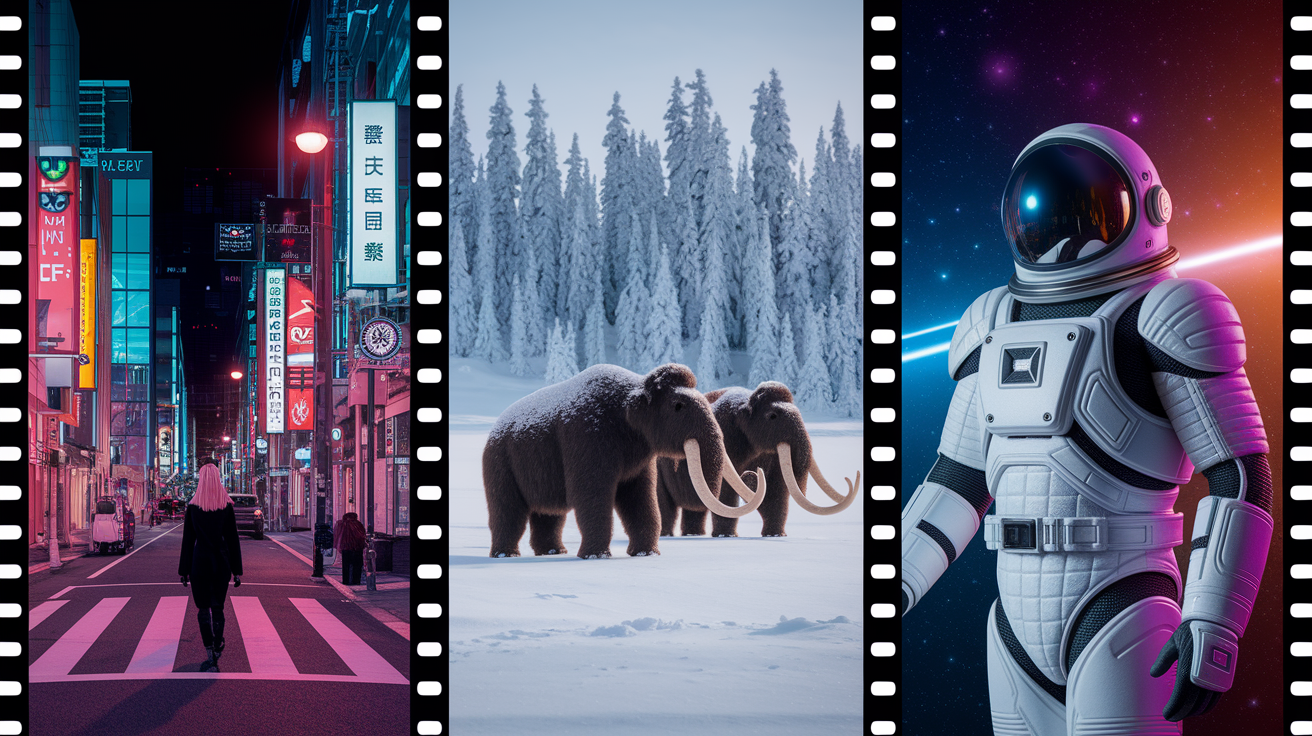
Sora handles multiple durations, resolutions, and aspect ratios. You can get short clips or full one-minute sequences. The model keeps subjects and visual style intact even when objects move out of view, then come back later in the same shot. That persistence matters for creating coherent narratives and realistic camera work without jarring subject changes or continuity breaks.
The outputs range widely in style. Photorealistic close-ups, surreal compositions, stylized animation. The model handles cinematic looks including 35mm film aesthetics, drone perspectives, and stop-motion textures. Temporal consistency is generally strong, with fewer reality-warping artifacts than what you’d see in earlier video models.
Example outputs include:
- A stylized woman walking down a neon-lit Tokyo street at night
- Several giant wooly mammoths walking through a snowy meadow
- Movie-trailer style 30-year-old spaceman shot on 35mm film
- Drone footage of Big Sur cliffs and an Amalfi Coast church panorama
- Photorealistic close-ups of a bird’s eye and a human eye
- Fantastical scenes like short fluffy monsters and a papercraft coral reef
Sora’s flexibility shows in how it renders both everyday vignettes and surreal compositions. The model excels at single-shot sequences with consistent lighting, motion, and subject identity.
Limitations and Failure Modes of the Sora Video Model
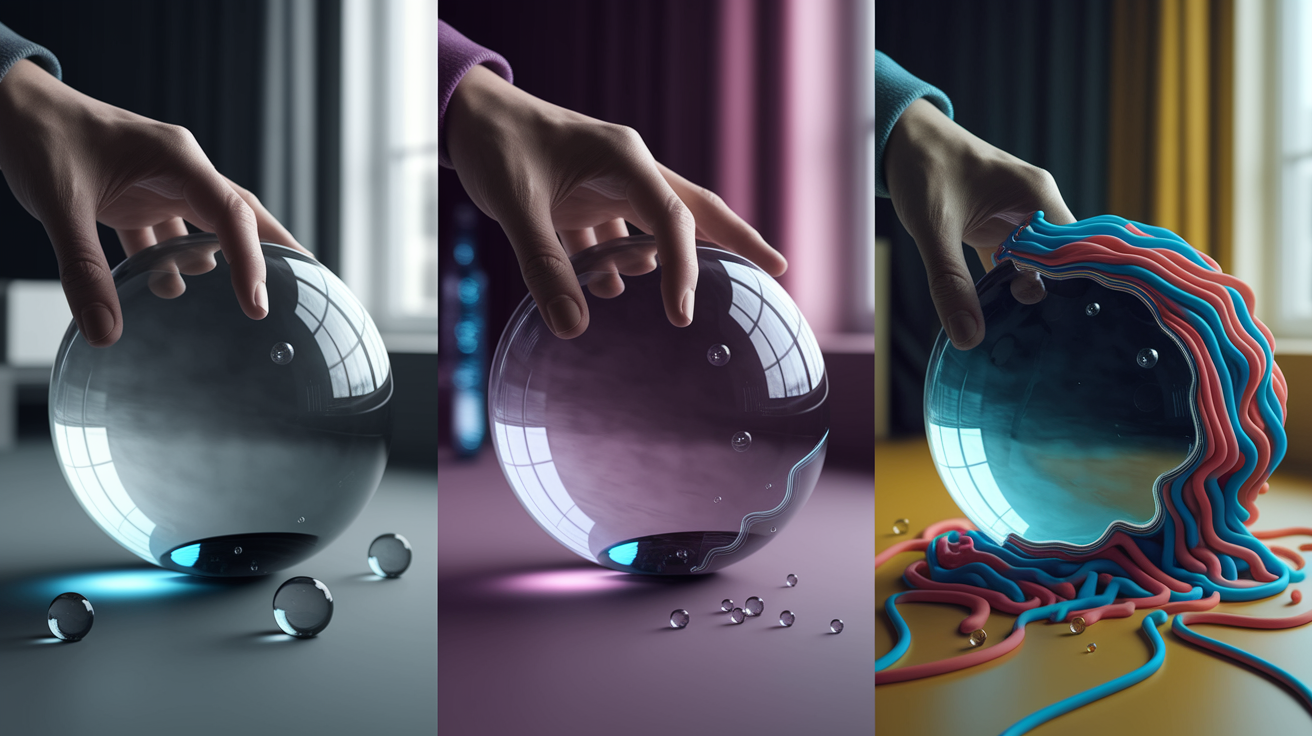
Sora still makes mistakes. Fewer reality-deforming errors than prior models, but it’s far from perfect. The model struggles with accurate physical simulation. Sometimes rigid objects render as flexible, or you get physically implausible motion. Cause-and-effect relationships aren’t reliably modeled, so actions like biting or precise camera movements won’t always produce the expected results. A glass won’t shatter on cue, bite marks won’t appear on food.
Spatial reasoning is weak. Sora can mix up left and right, struggle with consistent spatial details, and occasionally fail to maintain correct object orientation. In dense or complex scenes, entities can spontaneously appear or disappear. Objects may unnaturally morph during interactions.
Common failure modes:
- Physically implausible motion and inaccurate object interactions
- Imperfect causality (actions don’t produce expected consequences)
- Spatial errors and left/right confusion
- Entity persistence problems (animals or people appearing or disappearing mid-scene)
- Object morphing during interactions
- Difficulty with multi-actor interactions, leading to humorous or unrealistic results
- Temporal precision gaps (specific event timing is unreliable)
- Complex scene errors that compound when multiple subjects interact
These limitations make Sora more reliable for stylized, single-subject, or loosely choreographed scenes than for tightly scripted physical interactions or precise action sequences. The model’s training on large-scale video data is still early compared to language model training. More scaling should reduce these errors over time.
Safety Features Built Into Sora’s Video Generation System

Sora includes multiple safety controls to block disallowed content and reduce misuse risks. The system reuses text and image classifiers from prior models to screen prompts before generation and to review frames after they’re created. These classifiers check for violations of content policies, including hate speech, violence, and harmful stereotypes. Red-team testing focuses on misinformation, hateful content, bias, and other potential harms. Feedback refines the safety stack.
The model includes plans for provenance and attribution features. A detection classifier is under development to identify videos generated by Sora. Future deployments are planned to include C2PA metadata, a standard for embedding information about content origin and editing history. These measures help viewers distinguish generated content from recorded footage and support accountability.
OpenAI works with policymakers, educators, and artists to evaluate uses and risks. Human moderation teams handle incidents like bullying or harmful content that automated systems miss. Parental controls and wellbeing polling are mentioned in later iterations, reflecting an evolving approach to user safety.
| Safety Method | Purpose | Deployment Stage |
|---|---|---|
| Text and image classifiers | Block disallowed prompts and screen generated frames for policy violations | Active during generation and before output presentation |
| Red teaming | Identify harm vectors, bias, misinformation, and misuse scenarios | Conducted before and during early access rollout |
| C2PA metadata and detection classifiers | Enable provenance tracking and identification of generated videos | Planned for future deployment (not active at initial release) |
| Human policy engagement | Gather feedback from educators, policymakers, and artists to shape governance | Ongoing throughout development and access expansion |
Access, Availability, and Timeline for the OpenAI Sora Video Model

Sora’s rollout followed a staged access model. The original Sora model launched in February 2024, with early access limited to red teamers and a selected group of visual artists, designers, and filmmakers. Sora 2 was announced on September 30, 2025, bringing improved physics simulation, synchronized audio, and the ability to handle multi-shot sequences with persistent characters. The Sora 2 launch included a new iOS social app that rolled out in the United States and Canada through an invite-based system, along with web access via sora.com.
ChatGPT Pro users could access an experimental higher-quality version called Sora 2 Pro on the web and later in the app. Initial access was free with generous limits subject to compute constraints. There were hints that users might eventually pay “some amount” for extra generations if demand exceeded capacity. No public pricing structure appeared during the rollout. API release plans were announced but not detailed.
The Sora product was discontinued on April 26, 2026. The Sora API followed on September 24, 2026. Users were advised to export their content via the platform’s export page before the final shutdown, after which all data would be permanently deleted. Purchased ChatGPT or Sora credits remained usable and could be applied to Codex after the discontinuation.
| Date | Event | Access Level | Details |
|---|---|---|---|
| February 2024 | Original Sora release | Red teamers and selected creators | Early access, no public rollout |
| September 30, 2025 | Sora 2 launch | Invite-based (US/Canada), ChatGPT Pro tier | iOS app, web access at sora.com, API planned |
| April 26, 2026 | Web and app discontinuation | Service ended | Export window offered before final data deletion |
| September 24, 2026 | API discontinuation | Service ended | All remaining API access shut down |
Real-World Use Cases Powered by Sora’s Video Model
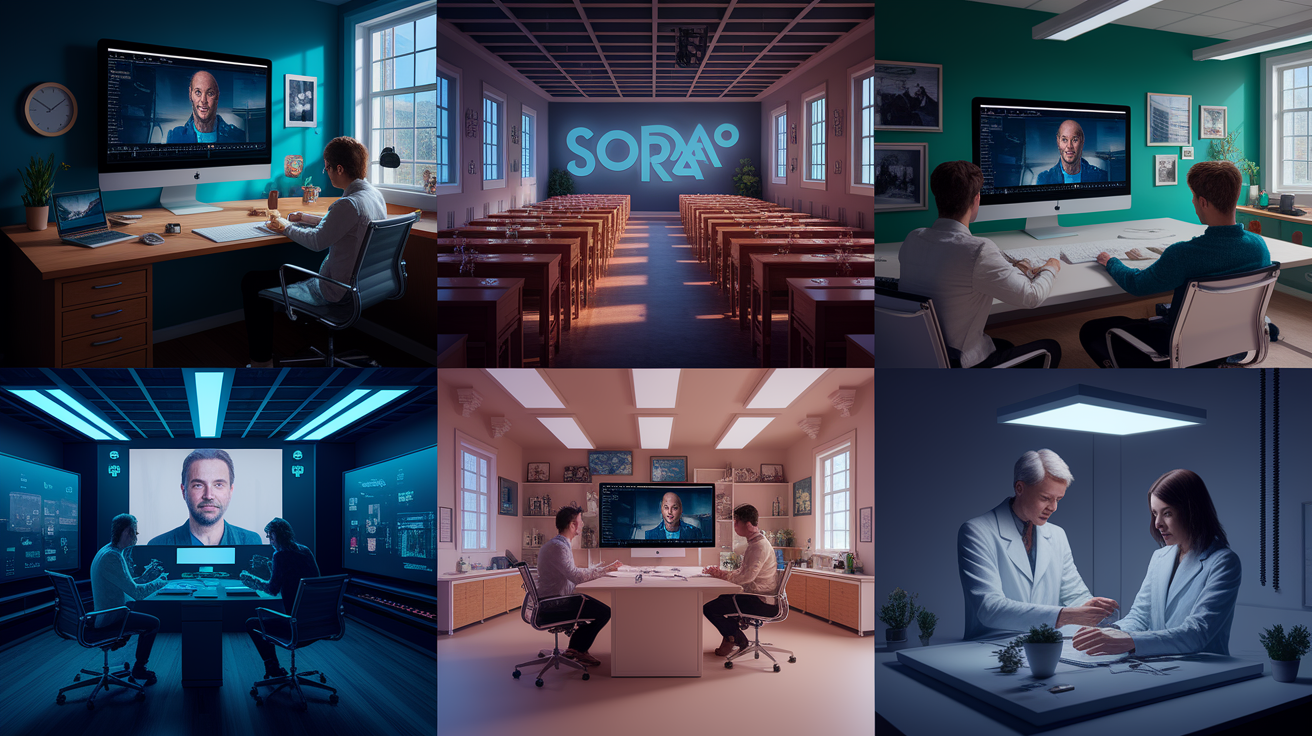
Sora targets creative professionals, researchers, and safety teams. Filmmakers and visual effects artists can use it for previsualization, storyboarding, and rapid prototyping of cinematic shots without needing full production resources. The ability to generate stylized and photorealistic scenes makes it useful for creating concept videos, animatics, and mood boards that communicate visual ideas quickly.
Educational content creators can produce illustrative sequences that would be expensive or impossible to film. Historical reconstructions, surreal visual metaphors. Sora’s “characters” feature lets you inject real likenesses and voices into generated scenes after a one-time identity verification recording. This opens use cases like personalized messaging, social content creation, and co-creative video remixing within a customizable feed.
Application categories:
- Cinematic production (storyboarding, short-form content, VFX augmentation, stylized animation)
- Education and training (historical reconstructions, illustrative sequences, visual metaphors)
- Marketing and creative prototyping (concept videos, mood boards, rapid iteration)
- Social and co-creative content (personalized videos, likeness injection, remixing within feeds)
- Research and simulation (training simulation-aware AI, testing physics models, exploring failure modes)
Prompt Engineering and Control Techniques for Sora Video Generation

Sora’s recaptioning system improves how closely the model follows detailed instructions. Prompt quality matters. The model supports multi-shot prompts with persistent characters, so a single text input can describe multiple camera angles or scenes while maintaining consistent subjects and environments. You can animate still images, extend sequences, and control stylization by referencing specific looks like 35mm film, stop-motion, or anime.
Effective prompts include cues for subject behavior, style, lighting, and environment. Specifying “large-format digital sensor emulation” or “50mm spherical hero lens” helps guide the cinematic texture. Instructions like “winter cool daylight” or “early medieval” set mood and era. Motion intent is also controllable, such as “triple axle” or “backflip on a paddleboard,” though complex physical interactions remain error-prone.
Best practices for constructing prompts:
- Structure multi-shot sequences with clear scene breaks and consistent subject references
- Include lighting cues (time of day, natural vs. artificial, intensity, color temperature)
- Specify motion intent and subject actions explicitly (e.g., “shout in the snow,” “perform a triple axle”)
- Reference style and format (35mm, 4K, stop-motion, anime, photorealistic close-up)
- Use subject persistence hints (describe characters or objects that should remain across shots)
- Add temporal instructions (shot duration, pacing, event sequence) when precision is needed
Multi-shot Prompt Structuring Techniques
Multi-shot prompts describe several connected scenes in a single input, maintaining a persistent world state across cuts. You might describe a character walking into a room, then cut to a close-up of their face, then switch to an over-the-shoulder view of what they see. Sora uses its transformer architecture and multi-frame foresight to carry forward character appearance, lighting conditions, and environmental details from one shot to the next. This technique works best when each shot is clearly delineated and when subject and setting continuity is reinforced through repeated references in the text.
Comparing OpenAI’s Sora With Other Video AI Models
Sora distinguishes itself from prior video models by reducing object morphing and physics errors. Earlier diffusion video models often deformed reality to satisfy prompts, producing surreal artifacts like objects that melt, teleport, or change identity mid-scene. Sora emphasizes obeying physical laws and modeling failure modes, so a bounced basketball stays a basketball rather than warping into another shape. This makes it more reliable for realistic and cinematic content, though it still struggles with precise physical interactions and spatial reasoning.
The model’s controllability and multi-shot fidelity are also notable. Earlier models typically produced short, single-perspective clips. Sora handles intricate multi-shot instructions with persistent characters and environments. The addition of synchronized audio in Sora 2 separates it from image-to-video tools that require separate sound design workflows.
Sora positions itself as a substantial leap in world-simulation capability. Internally, it’s described as comparable to a “GPT-3.5 moment for video.” This framing emphasizes the model’s improved understanding of physical motion and scene dynamics rather than purely aesthetic generation.
Comparative advantages:
- Higher realism and fewer object-morphing artifacts than earlier diffusion video models
- Improved physics adherence (objects maintain identity and behave more plausibly)
- Better subject and scene continuity across longer sequences
- Multi-shot fidelity with persistent characters and environments
Sora generates up to 1-minute text-to-video clips, can animate still images, extend sequences, and fill missing frames using a diffusion transformer with patch tokens and multi-frame foresight. This article walked through those capabilities and the model’s technical design.
We also covered output quality, common failure modes, safety controls, access history, and practical prompt tips so creators know what to expect and how to get reliable results.
If you’ll experiment, keep safety limits in mind; the sora openai video model can speed prototyping and storyboarding, and it’s worth testing on small projects.
FAQ
Q: How does Sora AI make its videos?
A: Sora AI makes videos by converting text prompts into motion using a diffusion-based transformer that represents frames as patch tokens, uses recaptioning and multi-frame foresight to keep continuity, and produces up to one-minute clips.
Q: How much does a Sora video cost OpenAI to make?
A: The cost to OpenAI to make a Sora video is not publicly disclosed; production expenses vary with compute, duration, and tuning, and estimates suggest substantial GPU hours per minute for high-resolution outputs.
Q: What kind of AI model is Sora?
A: Sora is a text-to-video diffusion model with a transformer backbone; it uses patch-token representation, recaptioning for better instruction following, and multi-frame foresight to preserve temporal consistency across frames.
Q: What is the best OpenAI model for video generation?
A: The best OpenAI model for video generation is Sora, OpenAI’s diffusion-transformer text-to-video system (Sora 2 offered higher fidelity), built for one-minute clips, animating stills, and extending sequences.