
Is Anthropic’s Claude Opus really the AI flagship companies should trust for mission‑critical work?
This post cuts through the marketing to show what the Anthropic Claude Opus model can actually do, who should use it, and where it matters most.
We cover core capabilities, long context windows, multimodal inputs, adaptive reasoning, and production‑grade code generation.
You’ll also see benchmark results, real-world workflow wins, and concrete next steps for teams considering Opus.
If you need frontier AI for deep analysis, long-running agents, or high-stakes automation, this guide tells you whether Opus is worth the switch.
Overview of Claude Opus and Its Core Purpose

Claude Opus is Anthropic’s most advanced model in the Claude 3 lineup. It’s built for organizations that need frontier AI for complex reasoning, big analysis projects, and sophisticated multimodal work. Think of it as the flagship: it handles the toughest AI jobs, from building production software and running multi-day enterprise workflows to advanced research and autonomous agent systems. Anthropic also offers Sonnet (balanced performance) and Haiku (speed), but Opus is what you reach for when task complexity and reliability matter more than cost or speed.
The model shines in scenarios requiring extended context understanding, precise instruction following, and synthesis across multiple formats. Opus fits professional and enterprise environments where output quality can’t be compromised. It takes text, image, and document inputs, so it can process technical diagrams, legal briefs, financial spreadsheets, and patent workflows all in one go.
Anthropic positions Opus for “frontier design” challenges: tasks that push what generative AI can do autonomously. Building complete software systems from scratch. Orchestrating multi-tool agent workflows that run for hours or days. Performing high-stakes analysis in regulated industries like finance, healthcare, and law. The architecture emphasizes safety, auditability, and enterprise governance, making it suitable where errors carry real consequences and human oversight needs to stay minimal without sacrificing reliability.
Key Features and Technical Capabilities of Claude Opus

Claude Opus brings advanced capabilities that set it apart from earlier Claude models and competing frontier systems. At its core, it combines deep reasoning with adaptive compute allocation. The model adjusts cognitive effort dynamically: straightforward queries get fast responses, multi-step reasoning challenges get more compute allocated to work through the problem systematically. This adaptive thinking improves both speed and cost efficiency across different workloads.
The model supports a 1,000,000 token context window. You can ingest and reason over massive volumes of information in one session. Critical for analyzing entire codebases, processing multi-document legal discovery, or maintaining state across long-running agent workflows. Paired with a maximum single output of 128,000 tokens, Opus can produce comprehensive artifacts (complete application code, detailed research reports, multi-section strategic documents) without requiring iterative prompting or manual stitching of partial responses.
Opus does multimodal processing that goes beyond simple image captioning. The model interprets technical diagrams, chemical structures, screenshots of software interfaces, and high-resolution visual data with precision. This unlocks workflows like automated code review from UI mockups, data extraction from scanned forms, and autonomous navigation of graphical interfaces. Visual understanding pairs with strong performance on tasks requiring spatial reasoning, chart interpretation, and cross-modal synthesis.
On coding, Opus is optimized for professional software engineering. It generates production-ready code, refactors legacy systems, detects subtle bugs in complex pull requests, and maintains context across multi-file changes. The model supports background execution for long-running coding tasks, enabling autonomous work on refactors, migrations, or test generation while developers focus elsewhere. Opus also demonstrates strong performance on tool use and orchestration, coordinating sub-agents, executing multi-step workflows with external APIs, and recovering gracefully from tool failures that halt less capable models.
Major capabilities:
- Adaptive reasoning and compute allocation – scales effort based on task complexity
- 1,000,000 token context window – processes large codebases, document sets, and long conversations
- Multimodal input and analysis – handles text, images, diagrams, and structured documents
- Production-grade code generation – writes, refactors, and debugs software at professional quality
- Agent orchestration and tool use – coordinates multi-tool workflows with reduced error rates
Performance Benchmarks and Evaluation Data
Claude Opus consistently ranks at or near the top of public and vendor-specific benchmarks measuring reasoning, coding ability, multimodal comprehension, and long-context consistency. On coding tasks, Opus 4.7 (the latest generally available variant as of April 2026) achieved a 13% higher resolution rate than its predecessor on a 93-task coding benchmark, solving four tasks that neither Opus 4.6 nor Sonnet 4.6 could complete. On CursorBench, a measure of coding autonomy and creative problem solving, Opus 4.7 cleared 70% of tasks compared to 58% for Opus 4.6. Meaningful gains in open-ended software development.
In agent and workflow benchmarks, Opus 4.7 tied for the top overall score of 0.715 across six modules on an internal research-agent evaluation, with particular strength in long-context consistency. The model scored 0.813 on the General Finance module, outperforming Opus 4.6’s 0.767. On complex multi-step workflows, Opus 4.7 delivered a 14% improvement over Opus 4.6 while using fewer tokens and producing one-third the tool errors. Critical reliability gain for production agent deployments.
Visual and multimodal performance improved sharply across Opus releases. On the XBOW visual acuity benchmark, Opus 4.7 scored 98.5%, a dramatic leap from Opus 4.6’s 54.5%. This enables new classes of autonomous tasks such as penetration testing workflows that depend on precise interpretation of UI elements and technical diagrams. In real-world evaluations, partners including CodeRabbit reported a recall improvement of more than 10% on code review tasks while maintaining stable precision. Databricks observed 21% fewer errors on office document question answering tasks when Opus worked with source material.
| Benchmark Name | Category | Relative Performance |
|---|---|---|
| 93-task coding benchmark | Software engineering | +13% vs Opus 4.6; solved 4 novel tasks |
| CursorBench | Coding autonomy | 70% pass rate (vs 58% for Opus 4.6) |
| Research-agent (6 modules) | Agent workflows | Tied top score 0.715; best long-context consistency |
| XBOW visual acuity | Multimodal | 98.5% (vs 54.5% for Opus 4.6) |
| BigLaw Bench (Harvey) | Legal reasoning | 90.9% at high effort; improved table/edit handling |
| Databricks OfficeQA Pro | Document QA | 21% fewer errors vs Opus 4.6 |
Multimodal Abilities and Context Handling

Claude Opus processes text, images, and structured documents within a unified input stream. You can perform cross-modal reasoning without separate preprocessing or tooling. Upload screenshots, diagrams, PDFs, spreadsheets, and presentation files, and Opus will interpret visual elements, extract tabular data, and synthesize insights across formats. Particularly valuable in workflows where information is scattered across heterogeneous sources (technical specifications in PDFs, reference data in Excel, process diagrams in PowerPoint) and must be analyzed as a coherent whole.
The 1,000,000 token context window supports extended conversations, large document ingestion, and long-running agent sessions without loss of fidelity. Opus can maintain state across multi-day projects, process entire Git repositories in one pass, or handle comprehensive legal discovery spanning thousands of pages. Anthropic has implemented Context Compaction, a beta feature that summarizes older portions of a conversation as token limits approach. This preserves continuity in workflows that exceed even the million token threshold, allowing agents and users to sustain context in indefinite sessions without manual intervention or fragmentation.
Multimodal performance extends to high-resolution visual understanding. Opus 4.7 interprets chemical structures, circuit diagrams, architectural blueprints, and other technical visuals with the precision required for professional and scientific workflows. In penetration testing scenarios, the model has demonstrated the ability to navigate software UIs autonomously, identify interactive elements, complete forms, and execute multi-step procedures across graphical applications. These capabilities are underpinned by improvements in visual acuity (moving from 54.5% to 98.5% on the XBOW benchmark between Opus 4.6 and 4.7) that make the model suitable for tasks previously limited to human operators with domain expertise.
Pricing and Access Options for Claude Opus
Claude Opus is available through multiple access tiers and deployment options designed to serve individual professionals, teams, and enterprise organizations. You can interact with Opus via the Claude web interface under Pro, Max, Team, or Enterprise subscription plans. Or integrate the model into custom applications and workflows through Anthropic’s API. For organizations requiring managed infrastructure, governance controls, and compliance tooling, Opus is also accessible through Microsoft Foundry on Azure, Amazon Bedrock, and Google Cloud Vertex AI.
API pricing for Claude Opus 4.7 (the latest generally available variant as of April 2026) is set at $5 per 1 million input tokens and $25 per 1 million output tokens when using standard multi-region inference. Organizations that require US-only inference can opt for that routing at a 1.1x multiplier on both input and output rates. Anthropic offers two cost reduction mechanisms that can significantly lower total spend for high-volume users: prompt caching delivers up to 90% savings by reusing repeated context across requests, and batch processing provides up to 50% savings by deferring non-urgent workloads to off-peak capacity.
- Claude Pro and Max subscriptions – include Opus access for individual users with usage limits
- Team and Enterprise plans – provide shared access with admin controls and organization-scoped permissions
- API and SDK integration – enables programmatic access via Anthropic’s platform or cloud provider marketplaces
- Premium pricing beyond 200,000 tokens – applies to extended context usage in certain deployment configurations
For Enterprise customers, Opus is deployed with additional governance, security, and auditability features. Microsoft Foundry on Azure provides end-to-end tooling for moving from experimentation to production, managed infrastructure, operational controls, and compliance frameworks required for high-stakes industries such as finance, healthcare, and government. Claude Design (a research preview tool powered by Opus 4.7 for design and prototyping workflows) is available to Pro, Max, Team, and Enterprise subscribers but is disabled by default for Enterprise organizations until explicitly enabled by administrators.
Practical Use Cases and Real‑World Applications

Claude Opus is deployed across industries and functions where intelligence, precision, and reliability are critical. In software engineering, teams use Opus to generate production-ready code from natural language requirements, refactor legacy systems, and perform autonomous bug detection in complex pull requests. Development platforms including Replit, Bolt, and Warp have reported measurable productivity gains, with some workflows moving from multiple hours of manual iteration to single conversation completions. Opus supports background coding, allowing it to execute long-running tasks such as test generation, dependency migration, or codebase-wide refactoring while engineers focus on higher-level design.
Financial services and legal firms use Opus for high-stakes analysis and document workflows. The model processes multi-document discovery sets, drafts contracts, performs due diligence reviews, and answers complex questions grounded in regulatory filings or case law. On the BigLaw Bench evaluation developed by Harvey, Opus 4.7 achieved 90.9% accuracy at high effort, with improved reasoning on review tables and ambiguous document edits. Performance that meets the bar for deployment in professional legal practice. In finance, Opus analyzes earnings reports, builds financial models, and extracts structured data from unstructured sources such as investor presentations and regulatory disclosures.
Research and scientific workflows benefit from Opus’s multimodal capabilities and long-context handling. Researchers use the model to interpret technical diagrams, extract data from scientific papers, generate hypotheses, and draft comprehensive literature reviews. In life sciences, Opus has been applied to patent analysis workflows that require cross-referencing chemical structures, regulatory documents, and prior art across hundreds of pages. The model’s ability to maintain context over extended sessions allows it to assist with multi-day research projects without losing track of findings or methodology.
Enterprise and operational use cases span a wide range of business functions. Marketing teams use Opus to generate collateral, build interactive prototypes, and draft presentations. Operations teams deploy it for process automation, data extraction, and cross-application workflows. Claude Design (powered by Opus 4.7) enables rapid prototyping of user interfaces, pitch decks, and marketing materials, with users reporting that tasks previously requiring a week of briefs, mockups, and review rounds can now occur in a single conversation. The model also supports autonomous agent workflows that orchestrate multiple tools, APIs, and sub-agents to complete complex, long-running tasks with minimal human oversight.
Common applications:
- Production software development – autonomous code generation, refactoring, testing, and bug fixing
- Legal and contract analysis – document review, drafting, regulatory compliance, and due diligence
- Financial modeling and research – earnings analysis, data extraction, and multi-document synthesis
- Scientific research assistance – literature review, hypothesis generation, and technical diagram interpretation
- Design and prototyping – UI mockups, presentations, marketing materials, and interactive prototypes
- Agent orchestration – multi-tool workflows, long-running tasks, and autonomous process automation
Comparison of Claude Opus, Sonnet, and Haiku
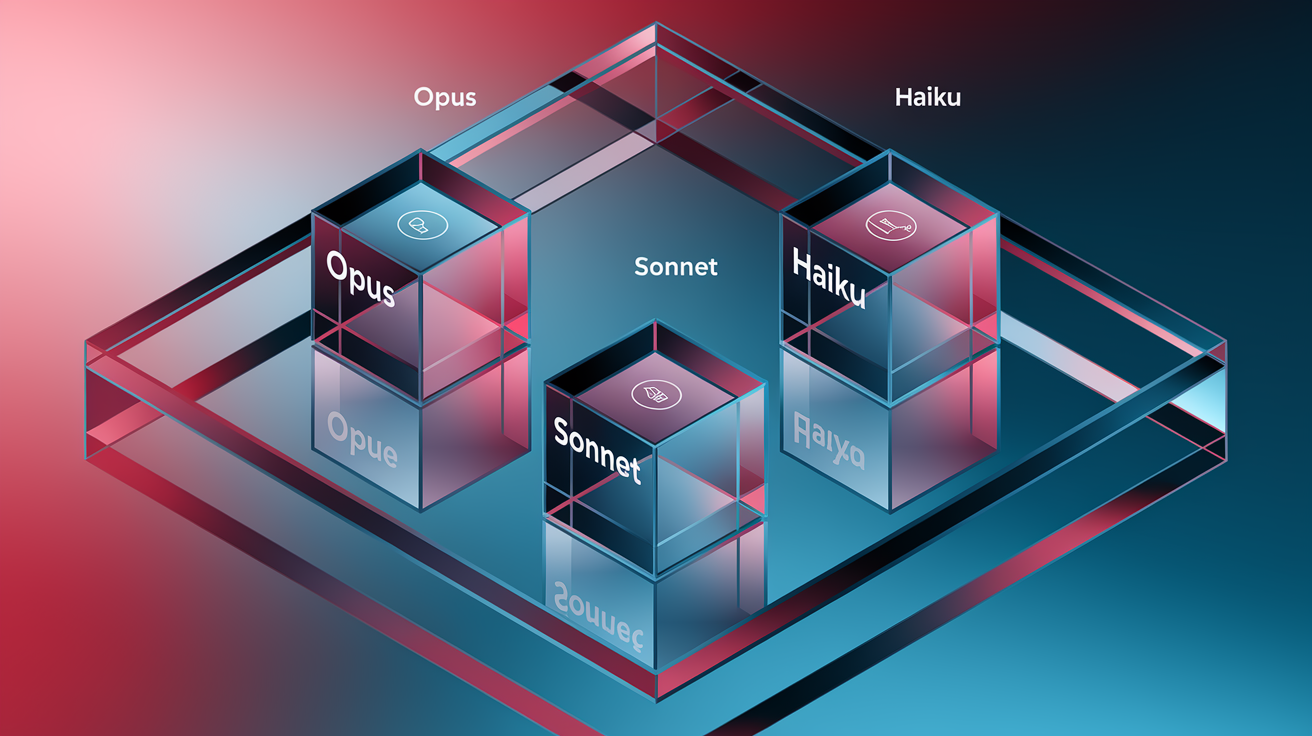
Anthropic’s Claude 3 family includes three distinct models. Opus, Sonnet, and Haiku, each optimized for different performance, cost, and latency trade-offs. Opus sits at the top of the lineup and is designed for tasks that demand the highest level of reasoning, consistency, and multimodal capability. It delivers frontier intelligence and is the best choice when output quality, reliability, and depth of analysis are the primary concerns. Sonnet occupies the middle tier, offering a balance between capability and cost efficiency, and is suitable for a broad range of business and development tasks that don’t require Opus’s full reasoning power. Haiku is optimized for speed and affordability, making it the preferred option for high-volume, low-complexity interactions such as content moderation, simple data extraction, and real-time customer support.
Performance differences across the three models are measurable and significant. Opus consistently outperforms Sonnet and Haiku on benchmarks that test coding, reasoning, multimodal understanding, and agent workflows. On tasks such as complex multi-step workflows, Opus 4.7 delivered a 14% improvement over Opus 4.6 while Sonnet remained unable to solve certain tasks entirely. Visual acuity also diverges sharply. Opus 4.7’s 98.5% score on the XBOW benchmark far exceeds what Sonnet or Haiku can achieve. Pricing reflects these capability gaps: Opus commands the highest per-token rates, Sonnet is priced in the middle, and Haiku offers the lowest cost per million tokens, making it economical for use cases where intelligence can be traded for throughput.
| Model | Strengths | Ideal Use Cases | Relative Pricing |
|---|---|---|---|
| Opus | Frontier reasoning, multimodal precision, long-context consistency, agent orchestration | Production code, research, legal/financial analysis, sophisticated agents, high-stakes workflows | Highest ($5 input / $25 output per 1M tokens for Opus 4.7) |
| Sonnet | Balanced performance, good reasoning, cost efficiency, reliable for most business tasks | General coding, content generation, data analysis, customer support, automation | Mid-tier (typically 60–70% of Opus pricing) |
| Haiku | Speed, low latency, lowest cost, suitable for high-volume simple tasks | Content moderation, basic extraction, real-time chat, high-throughput classification | Lowest (typically 10–20% of Opus pricing) |
Limitations and Considerations When Using Claude Opus

Claude Opus, despite its frontier capabilities, carries constraints that users and organizations must weigh when selecting it for production workloads. The most immediate limitation is cost. At $5 per million input tokens and $25 per million output tokens for Opus 4.7, the model is significantly more expensive than Sonnet or Haiku. For high-volume applications or use cases with tight budget constraints, this pricing can become prohibitive quickly. While prompt caching and batch processing offer meaningful savings (up to 90% and 50%, respectively), these mechanisms require workflow changes and may not be applicable to all use cases.
Opus’s deep reasoning can also introduce latency and over-analysis in scenarios that don’t require frontier intelligence. Tasks that Sonnet or Haiku could complete in seconds may take longer with Opus as the model allocates additional compute to explore edge cases or alternative interpretations. This behavior is beneficial for complex problems but inefficient for straightforward queries. Anthropic provides effort controls (low, medium, high, max) that allow developers to tune the reasoning intensity, but finding the right setting for each task requires experimentation and monitoring.
Access and deployment constraints also apply. Opus is available only through paid subscription plans or API usage. No free tier for the model. Enterprise deployments often require integration with managed platforms such as Microsoft Foundry, Amazon Bedrock, or Google Cloud Vertex AI, adding infrastructure complexity and vendor lock-in considerations. Beta features such as Context Compaction and certain multimodal capabilities remain in preview, meaning they may change or experience reliability issues in production. Organizations deploying Opus in regulated industries must also account for governance, auditability, and compliance requirements that extend beyond the model itself and into the surrounding tooling and infrastructure.
Final Words
In the action, Claude Opus is Anthropic’s top-tier Claude 3 model built for deep reasoning, long-context work, and multimodal tasks. The post covered its core features, benchmark results, multimodal strengths, pricing and access, practical use cases, comparisons with Sonnet and Haiku, and its limitations.
That matters for teams balancing capability against cost and scale. We gave practical next steps for access and things to watch when deploying.
If you’re weighing advanced AI for research or enterprise work, the anthropic claude opus model offers strong capability with clear trade-offs – and it’s ready to try.
FAQ
Q: Is Opus an Anthropic model?
A: The Opus model is an Anthropic model, the highest-tier Claude 3 offering built for complex reasoning, long-context work, multimodal inputs, and enterprise AI applications.
Q: Is Claude 3 Opus better than GPT 4?
A: Claude 3 Opus being better than GPT-4 depends on the task; Opus excels at long-context, multimodal, enterprise reasoning, while GPT-4 may match or lead on other benchmarks, so test both for your use case.
Q: Does Google own 14% of Anthropic?
A: Google owning 14% of Anthropic is reported by public sources, but stake figures can change; check Anthropic or Google filings and official announcements for the latest, authoritative percentage.
Q: What is Claude Opus good for?
A: Claude Opus is good for complex reasoning, long-context analysis, multimodal (text and image) tasks, coding assistance, research drafting, data extraction, and enterprise workflows needing reliable, deep analysis.