
Can a newer model match GPT-4 on reasoning while cutting costs enough to be worth switching?
Mistral Large is a 123B dense transformer with a 32,000-token context window, strong coding and reasoning benchmarks, and pay-as-you-go API access that undercuts some commercial alternatives.
This post breaks down performance numbers, API pricing, and technical specs in plain terms.
You’ll get the facts on where Mistral Large wins, where it falls short, and the next steps for testing or deployment.
Core Overview of the Mistral Large Model

Mistral Large is the flagship LLM from Paris-based Mistral AI. It’s built for complex enterprise work, agentic systems, and large-context retrieval where you actually need things to work right. Think analytical reasoning, instruction following, code generation, and multilingual understanding that competes with the top proprietary models. If you’re running production environments where accuracy and low-latency inference matter, this is the tier you’re looking at.
The model handles English, French, Spanish, German, and Italian natively, plus decent coverage across dozens of other languages. Its architecture is tuned for long-context handling (up to 32,000 tokens), which makes it particularly good for RAG workflows where you’re feeding entire documents or extended dialogues and can’t afford to lose critical details. Mistral Large performs well on coding tasks and shows strong results on math and analytical reasoning benchmarks. In early 2024 comparisons, it often placed second globally among API-accessible models, trailing only GPT-4.
Here’s what sets it apart:
- Advanced reasoning and instruction-following across multi-step workflows
- Strong code generation, review, and debugging for mainstream programming languages
- Native multilingual proficiency with best-in-class performance in several European languages
- 32,000-token context window optimized for RAG and extended document analysis
- Flexible deployment options: API access, Azure integration, and on-premises weights for sensitive use cases
- Competitive inference efficiency relative to similarly sized parameter-dense models
Technical Specifications and Architecture Characteristics

Mistral Large 24.11, the latest version as of January 2025, is a 123-billion-parameter dense transformer model. It uses an optimized attention mechanism and tokenizer that cut down on computational overhead during training and inference. The architecture builds on lessons from earlier Mistral releases (the sparse mixture-of-experts model Mixtral 8x7B and the lighter Mistral 7B), but scales up to dense parameters for tasks requiring nuanced reasoning and deeper world knowledge.
The model employs efficiency strategies like improved prompt handling, function-calling precision, and tighter JSON-output adherence compared to earlier versions. These optimizations let it maintain high throughput on enterprise-scale deployments while supporting complex multi-turn dialogues and structured API responses. The tokenizer improvements also contribute to faster processing of code and multilingual text, reducing token counts for common programming patterns and non-English sentences.
| Specification | Details |
|---|---|
| Parameters | 123 billion (dense architecture) |
| Context Window | 32,000 tokens |
| Native Languages | English, French, Spanish, German, Italian; extended coverage for 80+ languages (code-specialized variant) |
| Function Calling | Supported; platform-wide rollout in progress on Azure |
| Fine-Tuning | Available “in the coming weeks” (as of January 2025 announcements) |
Performance Benchmarks Across Key Domains

Mistral Large ranks as the second-highest-performing model available via API in early 2024 benchmark aggregations, behind only GPT-4. On MMLU (Massive Multitask Language Understanding), a widely cited reasoning and knowledge test, Mistral Large scores competitively with leading proprietary systems. It also performs strongly on HellaSwag, ARC Challenge, and TriviaQA, demonstrating broad knowledge recall and commonsense reasoning.
On coding benchmarks, Mistral Large achieves high pass rates on HumanEval and MBPP (Mostly Basic Python Programming). The model maintains solid accuracy on GSM8K, a grade-school math reasoning benchmark, in few-shot scenarios, and records a “majority vote accuracy of 4” on a Math benchmark. These results put it ahead of most open-weight models and within range of top commercial alternatives.
Multilingual performance has been tested across French, German, Spanish, and Italian using standard evaluation sets. Mistral Large outperforms earlier Mistral models and LLaMA 2 70B on these languages, though direct comparisons to GPT-4 and Gemini Pro multilingual scores are limited due to incomplete public disclosure. Long-context benchmarks show that the 32K-token window lets the model handle extended RAG prompts without significant degradation in retrieval accuracy. That’s critical for enterprise document analysis and conversational agents that reference prior exchanges.
Typical Use Cases for Mistral Large
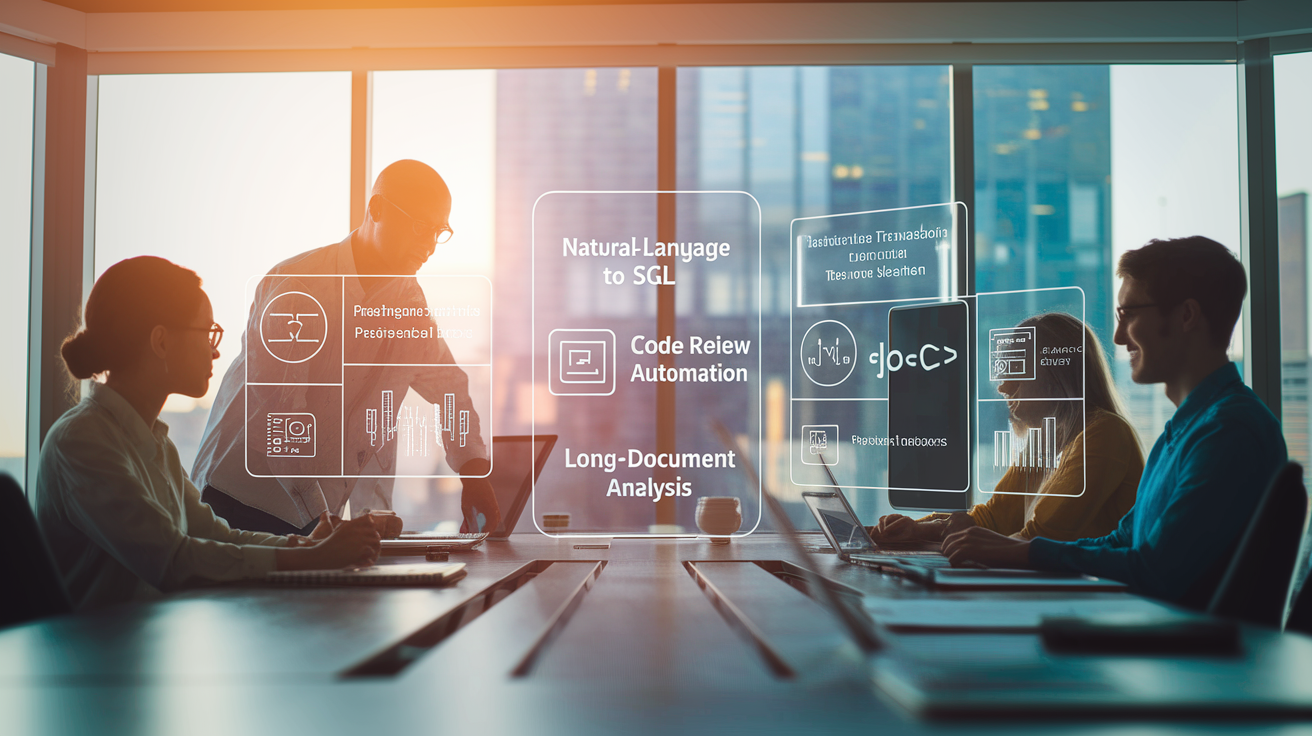
Mistral Large gets deployed in enterprise settings for complex agentic workflows that require precise instruction following, structured outputs, and multi-step reasoning. Examples include internal analytics pipelines that generate SQL queries from natural-language requests, code-review automation that flags logic errors and suggests refactorings, and customer-support agents that pull context from large knowledge bases to answer technical questions accurately.
The model also supports creative and analytical applications like legal document summarization, multilingual content translation and localization, and real-time debugging assistance in integrated development environments. Its ability to handle long contexts makes it well-suited for processing contracts, research papers, and technical manuals in a single prompt without chunking or summarization losses.
Common use cases include:
- Retrieval-augmented generation for large-context enterprise search and Q&A
- Code generation, completion, and automated testing across 80+ programming languages
- Multilingual customer support and chatbot systems
- Agentic workflows requiring function calling and JSON-structured outputs
- Long-document analysis, summarization, and compliance review
Pricing, Deployment Options, and Inference Considerations
Mistral Large is available via pay-as-you-go API billing on platforms including Azure and Mistral AI’s La Plateforme. On Azure, input tokens are priced at $8 USD per million tokens, and output tokens cost $24 USD per million tokens (equivalent to approximately €7.3 and €22 per million tokens, respectively). These rates apply to the mistral-large-latest endpoint, which is billed through the Azure Marketplace and eligible for Microsoft Azure Consumption Commitment (MACC) credits. New Google Cloud customers using Vertex AI Model Garden receive $300 in free credits to test Mistral Large 24.11 and other models.
Deployment options include fully managed Model-as-a-Service (MaaS) on Azure and Google Cloud, where infrastructure, scaling, and security are handled by the cloud provider. There’s also self-hosted setups where customers with sensitive use cases can deploy the model in their own environment using provided weights. Azure deployments must be created in East US 2 or Sweden Central regions, though the resulting API endpoint can be called from other regions after manual connection. Google Cloud supports deployment via Vertex AI Model Garden and Google Cloud Marketplace, with integration into LangChain and Genkit for orchestrating multi-step agent workflows.
Inference performance on Mistral Large benefits from optimized tokenization and attention mechanisms that reduce per-token latency. The model’s architecture allows high throughput on standard GPU clusters, and providers report improved response times compared to earlier Mistral releases. For high-frequency tasks like code completion, the specialized Codestral 25.01 variant delivers over 2.5 times faster generation and completion speeds than its predecessor, using a more efficient architecture and tokenizer tuned for fill-in-the-middle and incremental code suggestions.
Comparison With Other Leading Large Models
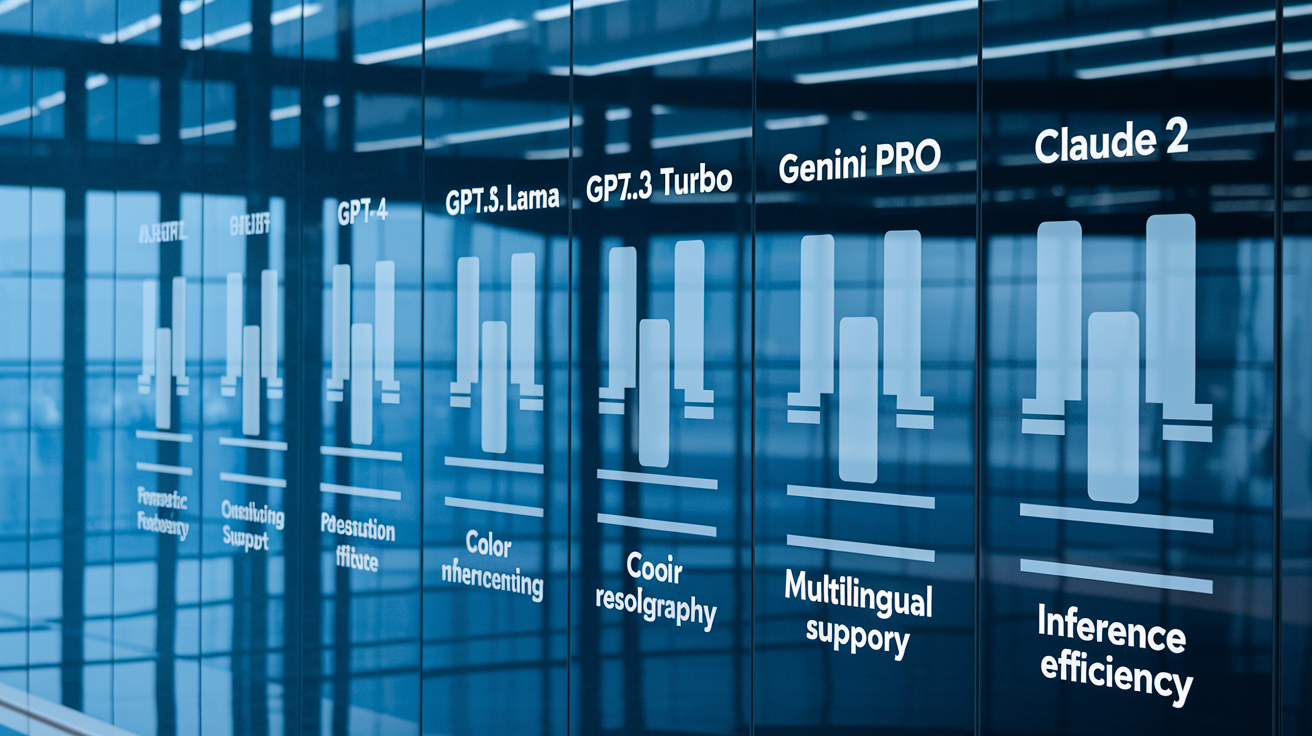
Mistral Large competes directly with OpenAI’s GPT-4 and GPT-3.5 Turbo on reasoning and coding benchmarks. GPT-4 holds a slight edge on aggregate scores across diverse tasks, but Mistral Large matches or exceeds GPT-3.5 Turbo on most evaluations and offers a more competitive price point for high-volume API usage. Function-calling precision and JSON-output reliability are cited as areas where Mistral Large has closed the gap with GPT-4 in recent updates, making it viable for structured agent workflows that previously favored OpenAI’s platform.
Compared to Meta’s LLaMA 2 70B, Mistral Large demonstrates stronger performance on multilingual benchmarks and long-context retrieval tasks. LLaMA 2 is open-weight and free to deploy, but Mistral Large’s 123B parameter scale and optimized inference stack provide higher accuracy on complex reasoning and code-generation tasks. The trade-off is cost and deployment complexity. LLaMA 2 can be self-hosted without API fees, while Mistral Large is primarily accessed via paid endpoints (though on-premises weights are available for enterprise customers).
| Model | Strength | Notes |
|---|---|---|
| GPT-4 | Highest aggregate benchmark scores | More expensive per token; broader task coverage |
| LLaMA 2 70B | Open-weight, free to self-host | Lower multilingual and reasoning performance than Mistral Large |
| Gemini Pro 1.0 | Multimodal capabilities | Less detailed public multilingual benchmark data; different use-case focus |
Against Google’s Gemini Pro 1.0 and Anthropic’s Claude 2, Mistral Large offers competitive reasoning and coding scores with tighter control over system-prompt handling and structured outputs. Gemini Pro includes multimodal features (image understanding) that Mistral Large doesn’t natively support, while Claude 2 is often favored for creative writing and conversational tone. Mistral Large’s niche advantages lie in multilingual performance (particularly for European languages) and inference speed for long-context RAG applications, where its 32K-token window and optimized retrieval architecture reduce the need for external chunking or summarization steps.
Final Words
In the action, we defined Mistral Large as a high‑performance LLM focused on reasoning, coding, multilingual work, and long‑context tasks.
We summarized its architecture and efficiency wins, reviewed benchmarks, outlined typical enterprise and creative use cases, and covered pricing and deployment choices.
If you need a next step, test it in a small pilot to see real workload gains. The mistral large model is worth evaluating — it’s capable, efficient, and ready for practical use.
FAQ
Q: What is the largest model of Mistral AI?
A: The largest model of Mistral AI is Mistral Large, the company’s flagship high‑capability large language model designed for reasoning, coding, multilingual tasks, and long‑context use.
Q: Is Mistral a large language model?
A: Mistral is a large language model developed by Mistral AI, built for instruction following, reasoning, and generation across multiple languages and long contexts.
Q: What is Mistral Large good for?
A: Mistral Large is good for high-performance reasoning, code generation, multilingual tasks, long-document analysis, AI agents, and scalable enterprise deployment and workflows.
Q: How much does Mistral Large cost?
A: The cost of Mistral Large depends on access method—API, cloud, or private deployment—and varies by usage and vendor; contact Mistral or your provider for current pricing and volume discounts.