
What if the next big advance in AI isn’t faster chat, but models that actually think through hard problems?
OpenAI’s O3 does that: it’s trained to keep long reasoning chains correct, not just sound conversational.
O3 trims about 20% of major errors versus O1, posts big benchmark gains, and adds multimodal, tool-driven workflows, useful for developers, researchers, and teams needing reliable multi-step results.
If you work on code, proofs, or visual problems, trying O3 or O3-pro on tougher tasks is a clear next step.
Overview of the O3 Model

OpenAI’s O3 is a reasoning model built for accuracy on hard, multi-step tasks. It comes after O1 and beats both O1 and GPT-4 by leaning into extended chain-of-thought processing and more consistent behavior when working through long reasoning sequences. GPT-4 handles general language well. O1 brought stepwise thinking. O3 goes further, delivering steadier, more error-resistant reasoning chains. It’s designed for structured problem-solving at a level earlier models couldn’t hold across multiple turns.
Performance jumps over O1 and GPT-4 show up in accuracy, consistency, and depth. O3 cuts major errors by about 20% compared to O1 on difficult real-world tasks, with strong gains in programming, business consulting, and creative ideation. On standardized benchmarks, O3 hits 69.1% on SWE-bench Verified versus O1’s 48.9%. It scores 88.9% on AIME 2025 versus O1’s 74.3%, and 83.3% on GPQA Diamond (PhD-level science questions) versus O1’s 78%. These improvements come from an order-of-magnitude increase in reinforcement-learning compute and a training process that treats reasoning as something scalable, not just a prompting trick.
Real-world uses enabled by O3 include advanced code editing, verified software engineering, multi-step mathematical proofs, visual reasoning from low-quality images, and agentic workflows that combine web search, Python execution, file analysis, and image manipulation. The model can interpret blurry whiteboards, rotate and zoom into diagrams mid-reasoning, and chain multiple tool calls to produce structured deliverables in under a minute.
O3 enhances five core capabilities:
- Structured reasoning keeps logical coherence across long, branching problem chains.
- Code generation accuracy achieves competitive-programming Elo ratings (2,706) and high solve rates on real-world engineering tasks.
- Multi-step planning reasons about when and how to use tools, then executes sequences autonomously.
- Factual consistency through better error detection and self-correction during generation reduces hallucination rates.
- Complex problem solving tackles frontier benchmarks like EpochAI Frontier Math (25.2%, versus under 2% for typical AI systems) and ARC AGI (88% on high-compute tests).
Core Capabilities and Reasoning Improvements

O3 handles long reasoning chains by retaining context stability and applying error-checking at each step. Unlike prompt-based chain-of-thought approaches, O3 integrates reasoning directly into its training loop through reinforcement learning at scale. This lets the model plan, backtrack, and refine answers within a single inference pass. On tasks requiring dozens of logical steps (competitive programming or multi-stage theorem proving) O3 maintains coherence where earlier models would drift or compound errors.
Specific upgrades include a reasoning monitor that flags unsafe or factually suspect chains in real time and a multimodal reasoning pipeline that keeps raw images in memory throughout the chain-of-thought. O3 can zoom, rotate, or revisit image regions as part of its analysis, enabling accurate interpretation of scientific figures, hand-drawn diagrams, and low-resolution photos. On visual benchmarks, O3 scores 82.9% on MMMU (college-level visual problem solving) and 86.8% on MathVista, both substantially ahead of O1.
| Capability | Description | Practical Benefit |
|---|---|---|
| Long-context coherence | Maintains logical thread across dozens of reasoning steps without drift | Handles complex proofs, multi-file code edits, and extended analysis without losing track |
| Tool-augmented reasoning | Decides when to call Python, web search, file operations, or image tools mid-chain | Autonomously solves tasks that require combining search results, code execution, and visual interpretation |
| Visual chain-of-thought | Retains and manipulates images during reasoning (zoom, rotate, crop) | Accurately interprets diagrams, charts, and low-quality photos that text-only models can’t parse |
| Error detection and correction | Internal monitor flags logical inconsistencies and unsafe content during generation | Reduces hallucinations and prevents dangerous outputs before they reach the user |
Performance Benchmarks and Testing Data

O3 sets new records on several widely tracked benchmarks. On SWE-bench Verified, which measures real-world software engineering problem-solving without custom scaffolding, O3 achieves 69.1% accuracy. On the AIME 2025 math competition (when equipped with Python tools), O3 reaches 88.9% pass@1 accuracy. On GPQA Diamond, a set of PhD-level science questions designed to resist memorization, O3 scores 83.3%.
Beyond standard academic benchmarks, O3 shows strong performance on frontier tasks. On EpochAI’s Frontier Math (where typical AI systems score below 2%) O3 reaches 25.2%. On ARC AGI, a test of abstract reasoning and generalization, O3 scores 76% on the semi-private low-compute holdout and 88% on high-compute testing, exceeding the commonly cited 85% human-level threshold. External evaluations show O3 makes 20% fewer major errors than O1 on difficult, real-world tasks, with particular strength in programming, business consulting, and creative ideation.
Benchmark categories where O3 shows measurable gains include:
- Coding accuracy with SWE-bench Verified (69.1%), Aider Polyglot Code Editing (outperforms O1), and Codeforces Elo (2,706).
- Math reasoning with AIME 2024 (91.6%), AIME 2025 (88.9%), and EpochAI Frontier Math (25.2%).
- Logic and abstraction with ARC AGI low-compute (76%), ARC AGI high-compute (88%).
- Long-context retrieval and visual reasoning with MMMU (82.9%), MathVista (86.8%), CharXiv-Reasoning (78.6%).
Release Information and Version Timeline
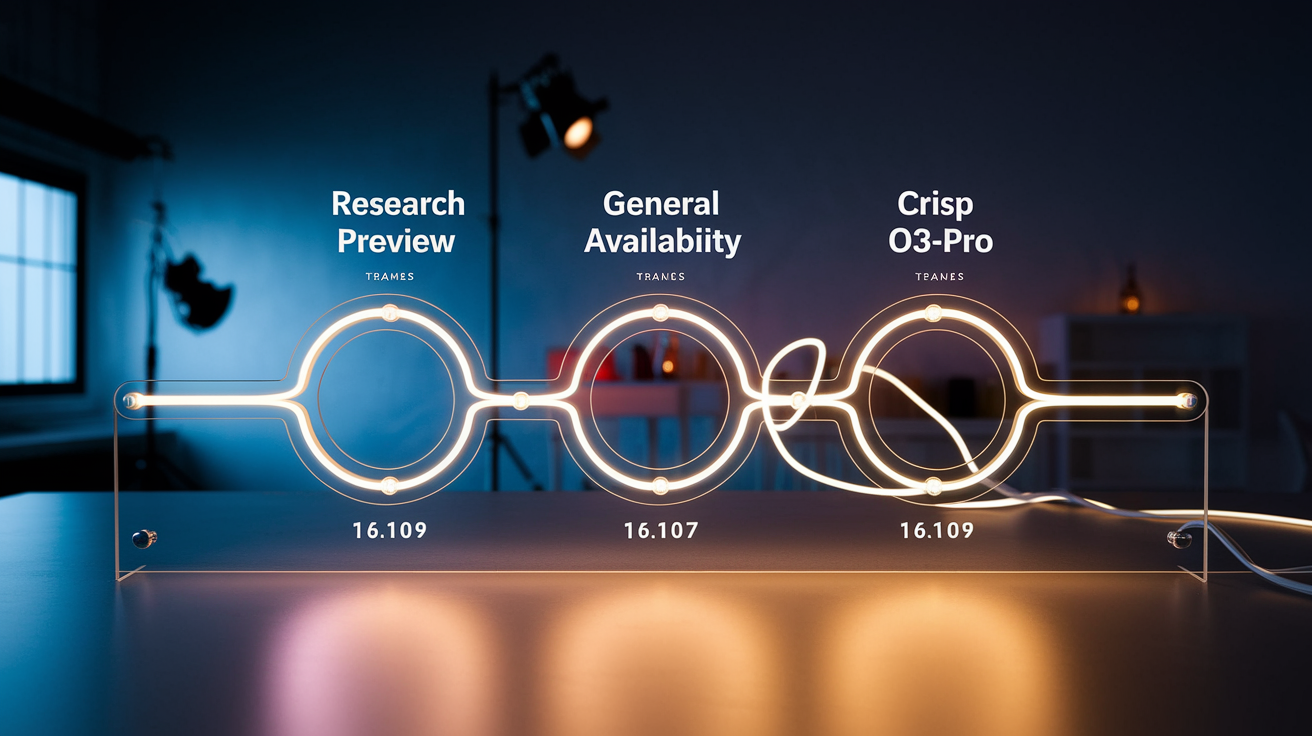
O3 was first previewed during OpenAI’s December 2024 event, following the September 2024 release of O1. The model became generally available on April 16, 2025, alongside O4-mini. O3-pro, a higher-compute variant with full tool access and top-end reasoning performance, debuted on June 10, 2025. An 80% API price cut for O3 was announced the same day.
Before reaching general availability, O3 underwent months of internal revision, including a brief consideration to fold it into a planned GPT-5 release. Public access expanded in phases. ChatGPT Plus, Pro, and Team users received O3 and O4-mini on the announcement date. Enterprise and Edu users followed one week later. Free-tier users gained access to O4-mini through the “Think” composer option.
The rollout timeline includes three key stages:
- Research preview on December 20, 2024 (O3 preview announcement) with limited public safety testing.
- General availability on April 16, 2025 (O3 and O4-mini released to ChatGPT and API users).
- Pro variant and pricing update on June 10, 2025 (O3-pro launch and 80% API price reduction for O3).
Pricing and Access Details

O3’s initial API pricing was set at $10 per million input tokens and $40 per million output tokens. On June 10, 2025, OpenAI reduced these rates by 80%, bringing the cost down to $2 per million input tokens and $8 per million output tokens. O3-pro, the highest-reasoning variant, launched at $20 per million input tokens and $80 per million output tokens. O4-mini, the cost-efficient alternative, debuted at $1.10 per million input tokens and $4.40 per million output tokens.
Access channels include ChatGPT subscriptions and the API. ChatGPT Plus, Pro, and Team users see O3 and O4-mini in the model selector, replacing O1 and O3-mini. O3-pro appears for Pro and Team users, replacing O1-pro. Free users can try O4-mini via the “Think” option. Developers access O3, O3-pro, and O4-mini through the Chat Completions API and Responses API. Some organizations require verification before accessing the models. Rate limits across subscription plans remain unchanged from prior models.
Comparisons to Previous Models (O1, GPT-4, GPT-4 Turbo)

O3 prioritizes reasoning depth and accuracy over the broad conversational fluency of GPT-4. Where GPT-4 handles general language tasks efficiently, O3 allocates more compute to multi-step problem-solving, making it slower but more reliable on complex tasks. O1 introduced extended thinking but lacked the multimodal integration, tool use, and reinforcement-learning scale that define O3. At equal latency and cost, O3 delivers higher ChatGPT performance than O1. Allowing O3 to think longer further increases accuracy.
GPT-4 Turbo optimizes for speed and broad applicability, excelling at summarization, conversation, and quick-turnaround tasks. O1 added stepwise reasoning but without autonomous tool access or visual chain-of-thought. O3 combines the reasoning introduced in O1 with tool autonomy, multimodal capabilities, and a training process that treats reasoning as a scalable, trainable skill rather than a prompting workaround.
| Model | Strengths | Weaknesses | Ideal Use Case |
|---|---|---|---|
| O3 | Highest reasoning accuracy, multimodal chain-of-thought, autonomous tool use | Slower, higher cost, longer latency on complex tasks | Advanced coding, multi-step proofs, research assistance, visual reasoning |
| O1 | Extended thinking, improved over GPT-4 on structured tasks | No tool autonomy, no multimodal reasoning, lower benchmark scores than O3 | Math problems, logic puzzles, tasks requiring stepwise planning without tools |
| GPT-4 Turbo | Fast, broad language capabilities, efficient on general tasks | Less reliable on complex multi-step reasoning, no integrated chain-of-thought training | Summarization, conversation, quick content generation, general-purpose language tasks |
Practical Use Cases and Applications

O3 excels in domains that require accuracy, multi-step planning, and the ability to combine different types of information. In software development, it can autonomously edit code across multiple files, run tests, interpret error logs, and refine solutions, achieving 69.1% on SWE-bench Verified without custom scaffolding. In mathematics, O3 handles competition-level problems and complex proofs, scoring 88.9% on AIME 2025 and 91.6% on AIME 2024.
Research assistance benefits from O3’s ability to interpret scientific figures, parse dense technical documents, and reason through multi-stage experiments. Visual reasoning tasks (interpreting whiteboards, diagrams, or low-quality photos) work well with O3’s ability to rotate, zoom, and revisit images during analysis. For business and consulting, O3 makes 20% fewer major errors than O1 on real-world tasks, particularly in structured decision support and data analysis. Creative ideation also shows gains, as O3 can generate, evaluate, and refine ideas through extended reasoning chains.
Five application categories where O3 delivers measurable improvements:
- Advanced programming for competitive coding, verified software engineering, multi-file code editing.
- Mathematical problem-solving for competition math, theorem proving, symbolic computation.
- Scientific research for PhD-level question answering, figure interpretation, experiment design.
- Visual reasoning for chart analysis, whiteboard interpretation, low-quality image parsing.
- Structured decision support for business analysis, consulting workflows, multi-criteria evaluation.
Limitations and Known Constraints

O3 reduces hallucinations and improves consistency compared to earlier models, but it doesn’t eliminate errors entirely. On ambiguous or underspecified prompts, the model can still generate plausible-sounding but incorrect answers. Safety training and the reasoning monitor improve refusal accuracy on dangerous requests, but edge cases remain. When enabling web browsing, O3 can sometimes find exact answers online. Mitigations include blocked domains and a monitor that flags suspicious rollouts, but reproducibility in the API may differ from the ChatGPT UI due to different search backends.
Latency and cost remain trade-offs. O3-pro can take several minutes per request on complex tasks, making it impractical for high-throughput or real-time applications. O3 and O4-mini offer better performance per inference cost than their predecessors, but the compute requirements for extended reasoning still exceed GPT-4-class models. Tool-enabled benchmark results aren’t directly comparable to evaluations without tool access. Models with Python interpreters and web search perform materially better, so raw scores should be interpreted in context. ARC AGI results cited in early previews came from a December 2024 demonstration version. Updated public results for the released O3 are pending.
How to Access and Start Using O3

Access to O3 begins with an OpenAI account and the appropriate subscription or API plan. ChatGPT Plus, Pro, and Team users can select O3 or O4-mini from the model picker in the ChatGPT interface. Free users can try O4-mini through the “Think” option. Developers access O3 via the Chat Completions API and Responses API by specifying the model name in API calls. Some organizations require verification before gaining access.
To start using O3 through the API:
- Obtain API credentials by generating an API key from the OpenAI platform dashboard.
- Select the model by specifying “o3” or “o4-mini” in the model parameter of your API request.
- Configure reasoning settings using the reasoning effort parameter (low, medium, high) to control how much compute the model applies. Higher settings increase latency but improve accuracy.
- Enable tools if needed for tasks requiring web search, Python execution, or file analysis. Enable built-in tools in the API call (support for built-in tools is rolling out, so check current API documentation for availability).
Final Words
In action, O3 raises reasoning accuracy and stability across long chains – clear improvements over O1 and GPT‑4. The piece walked through core capabilities, technical upgrades, benchmark gains, release timeline, pricing, comparisons, real-world uses, limits, and how to start.
If you’re evaluating advanced reasoning or heavy code/math tasks, plan tests with the openai o3 model when API access opens, and factor in costs and prompt clarity. It’s a practical step forward that should make complex work faster and more reliable.
FAQ
Q: What is the OpenAI o3 model?
A: The OpenAI o3 model is a reasoning‑optimized, next‑generation model built for higher accuracy in multi-step thinking, better long-chain consistency, and stronger performance on complex reasoning and coding tasks.
Q: Why did OpenAI get rid of o3?
A: OpenAI removed o3 because the company said it consolidated models or replaced o3 with newer offerings; check OpenAI’s official announcements for the confirmed reason and any migration guidance.
Q: Is o3 the smartest AI model?
A: The o3 model is not automatically the smartest; it excels at structured reasoning and multi-step tasks, but “smartest” depends on the task, benchmarks, and specific model trade-offs.
Q: What is the difference between OpenAI o3 and GPT?
A: The difference between OpenAI o3 and GPT is that o3 prioritizes deep chain-of-thought reasoning, error detection, and long-context stability, while GPT models aim for broader general-purpose language capabilities.