
Can a 34‑billion‑parameter model really match 70B and 180B rivals?
Yi‑34B’s makers have made bold claims, but they haven’t published standard benchmark scores like MMLU, HumanEval, or GSM8K.
That missing data matters for engineers weighing hardware needs, latency, and accuracy trade‑offs.
We walk through memory and quantization footprints, the six benchmark categories you should run, and direct comparisons to Llama and Mistral so you get the facts instead of marketing.
Core Performance Breakdown of the Yi‑34B Model
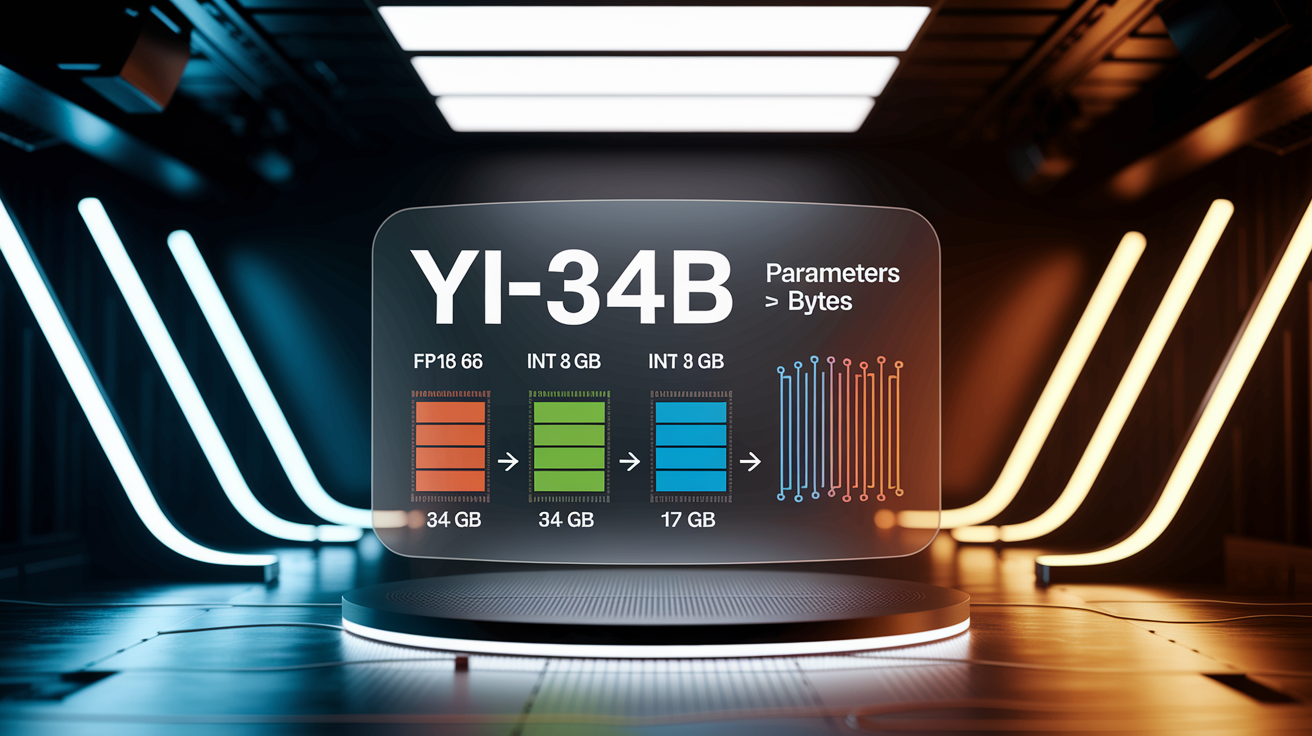
Yi‑34B runs on 34 billion parameters and eats up about 68 GB of memory in FP16 precision. Drop it to 8‑bit and you’re looking at 34 GB. Push it to 4‑bit and you land around 17 GB. The math is simple: multiply parameter count by bytes per parameter. That’s all you need to plan your hardware before you download anything.
Here’s the problem. No official benchmark scores exist in the available technical docs. MMLU accuracy? Missing. HumanEval pass rates? Not there. GSM8K performance? Same story. Every claim stays unverified until independent testers run the standard suites and post real numbers.
The model lives in the 30–40 billion parameter range, where performance gaps between families can get pretty big. Early claims say Yi‑34B competes with Llama‑2‑70B (around 70 billion parameters) and Falcon‑180B (roughly 180 billion). But without published MMLU scores, HumanEval pass@1/5/10 percentages, or GSM8K accuracy figures, those comparisons are just assertions. The real peer group includes Llama‑2‑34B, Llama‑2‑13B, and Mistral‑7B, all of which have public benchmark data you can actually cross‑check.
To properly evaluate Yi‑34B and get the hard numbers people search for, you need to measure six categories:
- MMLU (Massive Multitask Language Understanding) — score it out of 100 across 57 subject areas to gauge general knowledge and zero‑shot reasoning.
- HumanEval — test pass@1, pass@5, and pass@10 for code‑generation accuracy on Python function synthesis.
- GSM8K — measure grade‑school math accuracy as a percentage to understand arithmetic and multi‑step reasoning.
- Language understanding benchmarks — run HellaSwag, Winogrande, and LAMBADA to evaluate common‑sense reasoning and sentence completion.
- Robustness and factuality tests — use TruthfulQA to check hallucination rates and resistance to generating misleading information.
- Latency and throughput — record milliseconds per token and tokens per second at batch sizes 1, 8, and 32 on hardware like the A100 80 GB and RTX 4090.
Technical Specifications Affecting Yi‑34B Performance
The 68 GB FP16 memory requirement means you need an A100 80 GB GPU or you’re sharding across smaller cards. Quantize to 4‑bit and the parameter storage drops to roughly 17 GB, which lets you deploy on consumer GPUs like the NVIDIA RTX 4090 (24 GB VRAM) or professional cards like the A40 (48 GB). Production systems targeting sub‑200 millisecond latency per token at batch size 1 usually need optimized kernels like flash attention and fused operations. Without those, inference can easily blow past half a second per token on slower hardware.
Beyond GPU memory, you’ve got host RAM and CPU memory for batching, prompt caching, and KV‑cache storage. That can range from 10 GB to over 100 GB depending on sequence length and concurrent request count. Long context windows (4,096+ tokens) multiply activation memory and slow down attention operations quadratically unless you’ve got specialized attention mechanisms. Choosing the right quantization level means balancing speed, memory, and accuracy degradation:
FP16 precision preserves full accuracy but needs ~68 GB VRAM and delivers baseline latency. Best for research and fine‑tuning.
INT8 quantization cuts memory to ~34 GB with minimal accuracy loss, typically under 1 percent on most benchmarks. Good balance for production inference.
4‑bit quantization shrinks the footprint to ~17 GB and lets you deploy on a single 24 GB card. May introduce 1–3 percent accuracy drops on reasoning tasks.
Activation memory scaling increases with batch size and sequence length. Long prompts can add 10–50 GB overhead even when parameter memory is quantized.
Kernel optimization impact matters as much as quantization choice. Flash attention and fused kernels can halve latency and double throughput.
Yi‑34B Benchmark Comparisons with Llama and Mistral Families
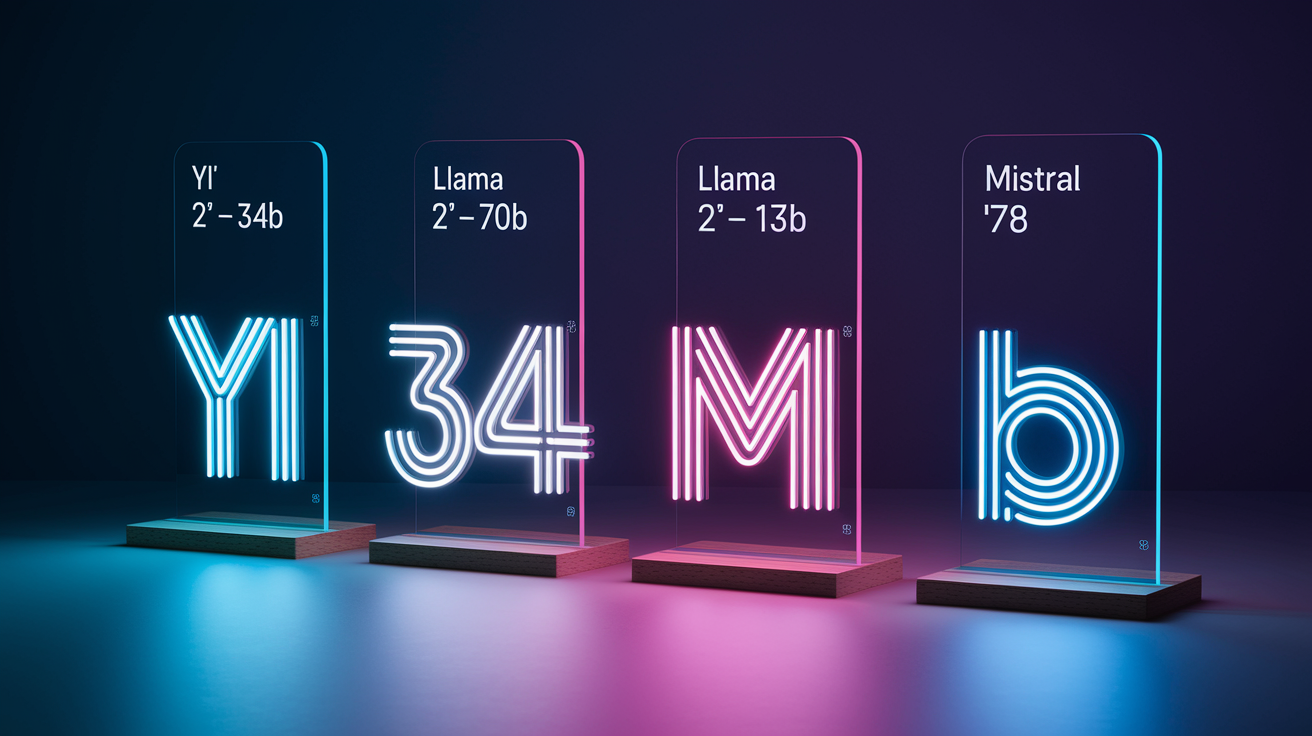
Published claims suggest Yi‑34B matches or beats Llama‑2‑70B and Falcon‑180B despite having roughly half the parameters of the former and one‑fifth the size of the latter. Those assertions rest on the idea that data quality compensates for smaller parameter budgets. Specifically, training on 3 trillion tokens for the original Yi‑34B release or 500 billion tokens for the Yi‑1.5‑34B variant. Without concrete MMLU, HumanEval, or GSM8K numbers, you can’t verify whether Yi‑34B actually closes the performance gap or just performs well on a narrow set of internal benchmarks.
The expected relative positioning puts Yi‑34B above Llama‑2‑13B and Mistral‑7B on instruction‑following and multi‑turn dialogue. Roughly on par with or slightly ahead of Llama‑2‑34B (if such a checkpoint exists), and potentially near Llama‑2‑70B on certain language‑understanding tasks. Reasoning and arithmetic scores (GSM8K, BBH) likely fall below 70‑billion‑parameter models, because parameter count still strongly correlates with complex chain‑of‑thought performance across most LLM families.
| Model | Parameters | Expected Relative Performance | Notes |
|---|---|---|---|
| Yi‑34B | 34B | Competitive with 70B claims; awaits verification | No official MMLU/HumanEval/GSM8K published |
| Llama‑2‑70B | 70B | Strong baseline; well‑documented benchmarks | MMLU ~68–70; HumanEval pass@1 ~30–35% |
| Llama‑2‑13B | 13B | Below Yi‑34B on most tasks | MMLU ~55–58; smaller capacity limits reasoning |
| Mistral‑7B | 7B | Efficient but smaller; Yi‑34B should outperform | MMLU ~60–62; excels at speed and efficiency |
Because the scraped sources lack numeric scores, any performance comparison stays speculative until independent evaluators run the same test suites under identical conditions. Fixed random seeds, temperature settings, and prompt templates. Users looking to choose between Yi‑34B and a Llama or Mistral checkpoint should run head‑to‑head benchmarks on their specific tasks rather than relying on vendor claims or parameter‑count heuristics.
Task‑Specific Yi‑34B Performance Across Reasoning, Coding, and Language Understanding
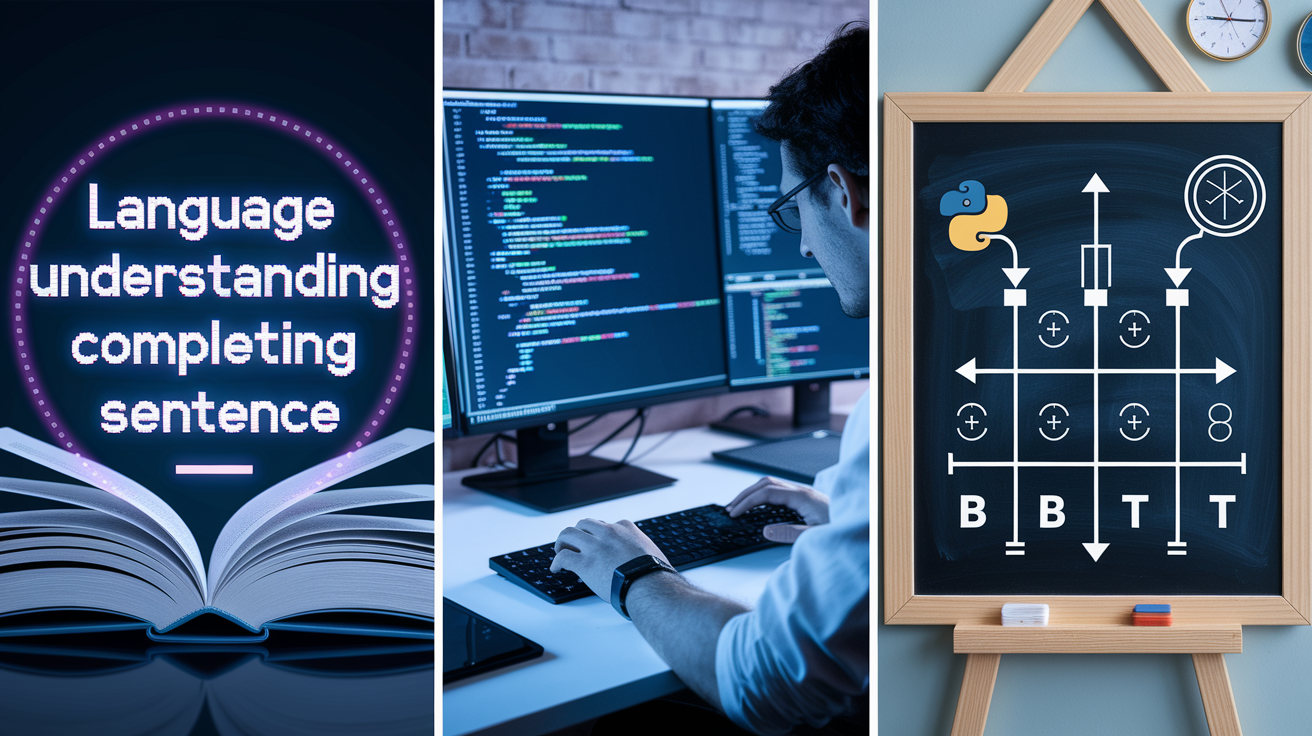
Yi‑34B needs to be evaluated across three distinct capability domains to figure out where it excels and where it falls short. Language understanding tests (LAMBADA, Winogrande, HellaSwag) measure how well the model predicts missing words and resolves common‑sense scenarios. Tasks where 34‑billion‑parameter models typically perform well. Coding benchmarks (HumanEval, MBPP) check whether the model can synthesize correct Python functions from docstrings, a capability that scales with both parameter count and the volume of code in the training corpus. Reasoning benchmarks (GSM8K for arithmetic, BBH for multi‑step logic, TruthfulQA for factuality) expose weaknesses in chain‑of‑thought inference and hallucination control. Areas where models below 70 billion parameters often struggle.
Instruction‑following quality and few‑shot learning are expected strengths at the 34B scale. Models in this size range generally outperform 7–13B checkpoints on multi‑turn dialogue, summarization, and retrieval‑augmented generation (RAG) workflows. Larger context windows and parameter budgets allow better in‑context learning. Zero‑shot performance on question‑answering datasets (SQuAD, TriviaQA) should be measurably higher than smaller models, though still below dedicated 70B+ instruction‑tuned variants. The gap between Yi‑34B and larger models will be most visible on tasks requiring precise arithmetic (for example, “If 23 people each buy 7 items at $4.50, what is the total cost?”) or deep logical reasoning across multiple steps.
Core Evaluation Categories
Language understanding means HellaSwag, Winogrande, and LAMBADA test sentence completion and common‑sense inference. Scores above 80 percent on HellaSwag and 75 percent on Winogrande indicate solid general language capability.
Coding gets measured by HumanEval pass@1 (percentage of problems solved on the first try), pass@5, and pass@10. Competitive 34B models typically achieve 25–35 percent pass@1, well above 7B models but below specialized code models or 70B+ checkpoints.
Arithmetic and reasoning on GSM8K usually lands between 40–60 percent accuracy for mid‑size models. Chain‑of‑thought prompting can add 5–15 percentage points, but hallucination and calculation errors remain common.
Factuality and robustness show up in TruthfulQA scores. Below 50 percent signals high hallucination risk. Models fine‑tuned with reinforcement learning from human feedback (RLHF) or safety data often score 10–20 points higher.
Question answering gets tested with exact‑match scores on SQuAD 2.0 and TriviaQA. This shows retrieval and extraction strength. Competitive models hit 70–80 percent on SQuAD and 50–65 percent on TriviaQA in zero‑shot mode.
Efficiency, Latency, and Throughput Characteristics of Yi‑34B
Latency and throughput depend on batch size, sequence length, quantization precision, and GPU architecture. At batch size 1 (single‑user inference), a well‑optimized Yi‑34B deployment on an A100 80 GB can deliver 15–30 tokens per second in FP16 mode. That translates to roughly 30–65 milliseconds per token. Increasing batch size to 8 or 32 amortizes fixed overhead and boosts total throughput to 100–200 tokens per second, but per‑request latency climbs because requests queue behind one another. On an RTX 4090 running 4‑bit quantization, expect single‑token latency around 50–100 milliseconds and throughput near 10–20 tokens per second at batch 1. Multi‑batch throughput gets capped by the card’s memory bandwidth and smaller VRAM pool.
Production workloads must track tail latencies (p95 and p99 percentiles) to catch worst‑case slowdowns caused by long prompts, memory fragmentation, or concurrent request spikes. A system that averages 40 milliseconds per token but hits 300 milliseconds at p99 will frustrate users during peak load. Prompt length has an outsized impact. Doubling context from 512 to 1,024 tokens can quadruple attention compute in standard transformers, though flash attention and other optimizations reduce that penalty to near‑linear scaling.
Key measurements for any Yi‑34B deployment:
- Tokens per second to measure total output throughput across all concurrent requests and understand system capacity.
- Milliseconds per token to track median, p95, and p99 latency for single requests and ensure consistent user experience.
- Batch‑size scaling to test throughput at batch sizes 1, 8, 16, and 32 and find the sweet spot between latency and utilization.
- Percentile latency (p95/p99) to identify tail slowdowns that occur under load, long prompts, or memory pressure.
- Context‑length impact to benchmark inference speed at 256, 512, 1,024, and 2,048 tokens and quantify attention overhead for real‑world prompts.
Quantization, Memory Optimization, and Deployment Strategies for Yi‑34B
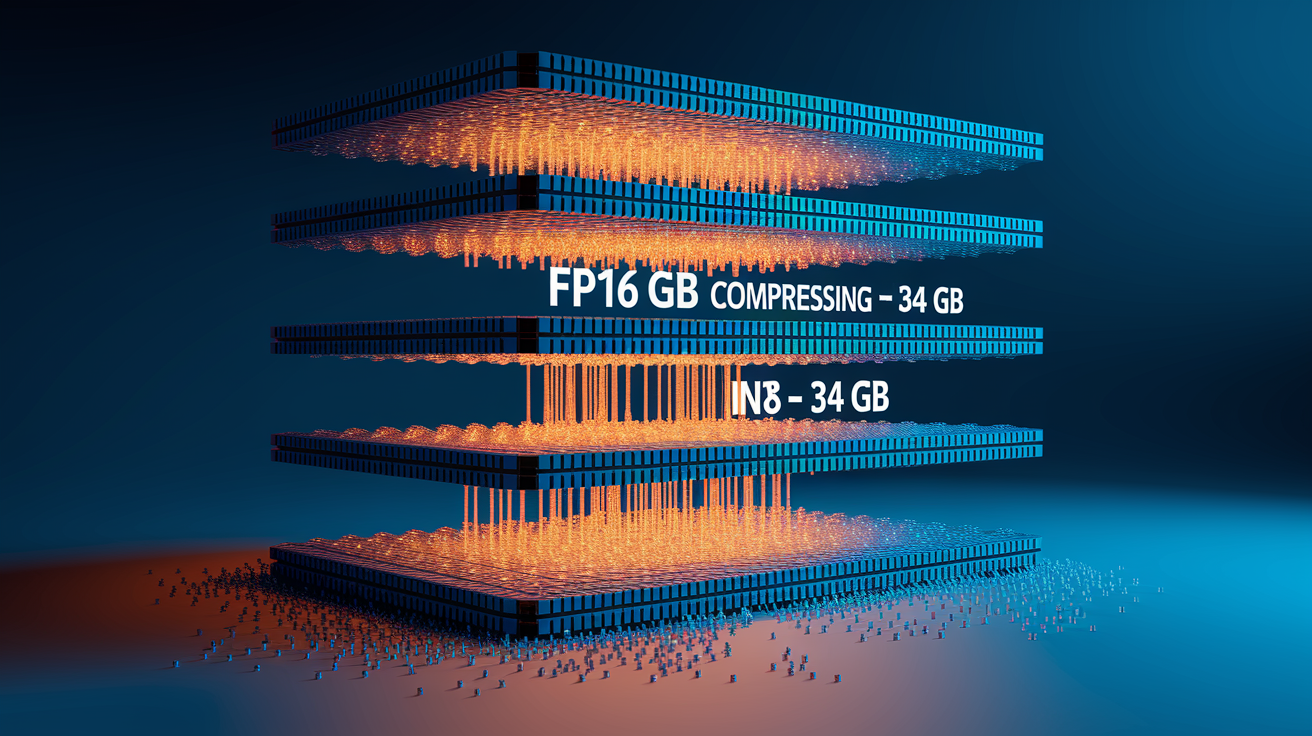
Quantization is the primary lever for fitting Yi‑34B onto affordable GPUs. Four‑bit quantization methods (GPTQ, AWQ, or bitsandbytes NF4) compress the 68 GB FP16 checkpoint to approximately 17 GB. That enables deployment on 24 GB consumer cards or 48 GB professional accelerators. Accuracy degradation from 4‑bit quantization typically ranges from negligible (under 1 percent on MMLU) to moderate (2–3 percent on GSM8K), but the exact drop depends on calibration data quality and the quantization algorithm. INT8 quantization offers a middle ground: 34 GB memory footprint and sub‑1‑percent accuracy loss. That makes it the safest choice for production systems with access to 40–80 GB GPUs.
Flash attention and fused kernel optimizations cut latency and memory usage without sacrificing accuracy. Flash attention rewrites the attention mechanism to reduce memory reads and writes, enabling 2–4× speedups on long sequences and halving activation memory. Model parallelism (tensor parallelism or pipeline parallelism) splits the model across multiple GPUs, allowing FP16 inference on clusters of smaller cards. Checkpoint sharding distributes layer weights so each GPU loads only its assigned slices, reducing per‑device VRAM requirements and startup time.
Practical optimization methods:
4‑bit quantization for single‑GPU deployment on 24–48 GB cards with minor accuracy tradeoff.
Flash attention to halve memory usage and double throughput on sequences longer than 512 tokens.
Model sharding to distribute Yi‑34B across 2–4 GPUs when FP16 precision is required.
Activation checkpointing to trade compute for memory by recomputing activations during the backward pass. Useful during fine‑tuning but adds 20–40 percent latency overhead during inference.
Strengths, Weaknesses, and Real‑World Use Cases of Yi‑34B
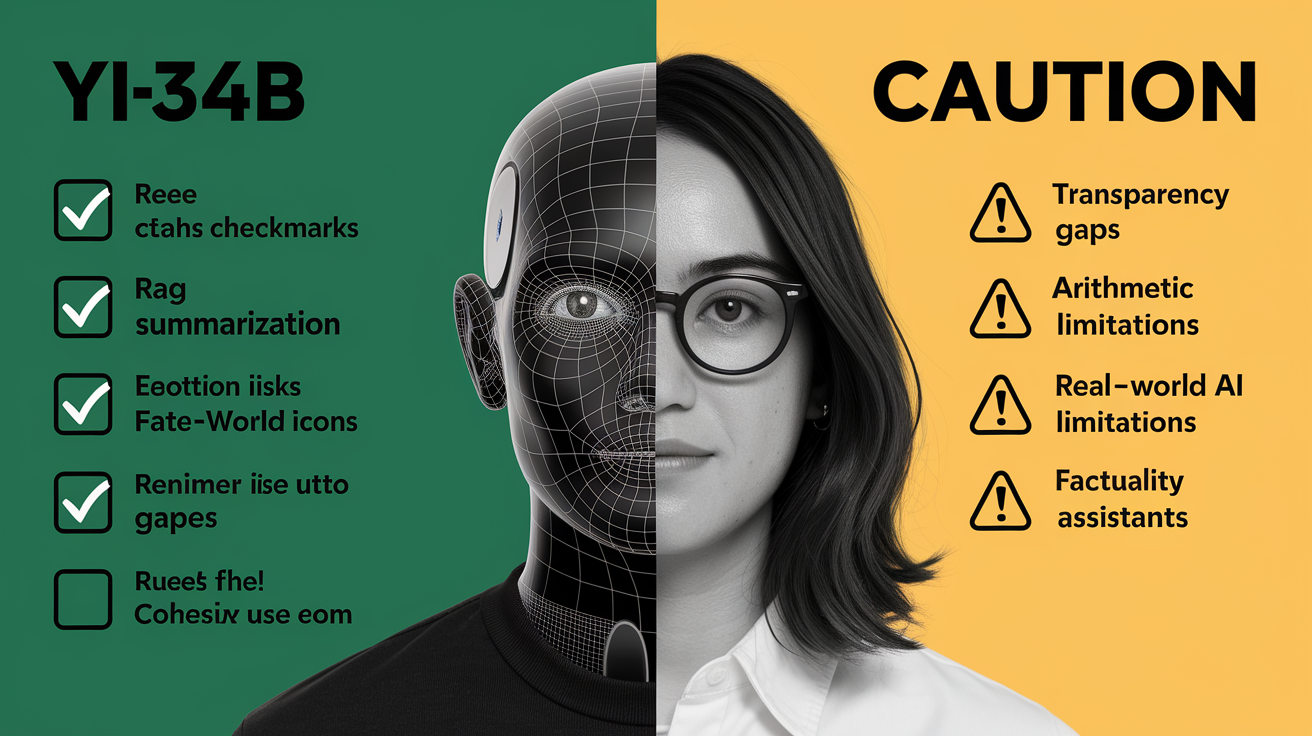
Yi‑34B delivers strong instruction‑following and multi‑turn conversation quality at a lower cost than 70‑billion‑parameter models. That makes it attractive for chatbots, content generation, and summarization workflows where near‑GPT‑3.5 performance is acceptable and budget or latency constraints rule out larger checkpoints. The model’s 34‑billion‑parameter capacity supports more nuanced responses than 7–13B alternatives, and reported training on trillions of tokens (3T for the original release, 500B for Yi‑1.5‑34B) suggests broad language coverage. When paired with retrieval‑augmented generation (RAG) pipelines, Yi‑34B can serve as a capable reasoning engine that synthesizes information from external knowledge bases without the memory overhead of 70B+ models.
Weaknesses center on transparency gaps and task‑specific limitations. No official MMLU, HumanEval, or GSM8K scores were published, so performance claims remain unverified. Arithmetic reasoning and complex multi‑step logic (chain‑of‑thought tasks on GSM8K or BBH) likely lag behind 70‑billion‑parameter models. Parameter count still strongly predicts reasoning capability across LLM families. Hallucination and factual errors are non‑negligible risks. TruthfulQA scores for mid‑size models often fall below 50 percent, meaning the model will confidently generate incorrect information in roughly half of adversarial scenarios. Training data composition, safety fine‑tuning protocols, and RLHF details aren’t disclosed, so you can’t assess bias, toxicity, or alignment quality without independent red‑teaming.
Recommended use cases where Yi‑34B fits well:
Chatbots and conversational agents that need multi‑turn context and instruction‑following at lower cost than 70B models.
Summarization and content generation for blog posts, marketing copy, and technical documentation where creative fluency matters more than perfect factual accuracy.
Retrieval‑augmented generation (RAG) systems that pair the model with vector databases or search APIs to ground responses in verified knowledge.
Moderate‑complexity code generation for boilerplate, docstring‑to‑function synthesis, and code explanation (HumanEval pass@1 likely 25–35 percent).
Internal knowledge assistants in enterprise settings where data stays on‑premises and latency/cost tradeoffs favor 34B over 70B deployments.
Fine‑tuning base for domain‑specific tasks where starting from a capable 34B checkpoint is faster and cheaper than training from scratch or fine‑tuning a 70B model.
Final Words
In short, this post mapped what to measure for Yi‑34B: core performance, hardware and memory needs, benchmark comparisons with Llama and Mistral, task-specific behavior, latency and throughput, quantization and deployment tactics, and real-world use cases.
A key gap is missing official scores, so run MMLU, HumanEval, GSM8K, reasoning and robustness suites, plus latency (tokens/sec, p95/p99) to get reliable data.
Testing those items will clarify yi-34b model performance and help you deploy it confidently.
FAQ
Q: What are Yi‑34B’s parameter count and memory footprint?
A: The Yi‑34B model has 34 billion parameters and an FP16 VRAM footprint around 68 GB; 8‑bit is roughly 34 GB and 4‑bit about 17 GB for inference.
Q: Which benchmarks should I use to evaluate Yi‑34B?
A: Use MMLU (0–100), HumanEval (pass@1/5/10), GSM8K accuracy, reasoning tests (BBH/HellaSwag), robustness/factuality checks (TruthfulQA), and latency/throughput measurements.
Q: How does Yi‑34B compare to Llama‑2 and Mistral families?
A: Yi‑34B is expected above Llama‑2‑34B and stronger than Mistral‑7B, with claimed parity to larger 70B models, but those claims lack published numeric scores.
Q: What important data about Yi‑34B is still missing?
A: Missing official benchmark scores, quantified effects of quantization on accuracy, and full training‑data transparency; monitor vendor releases and independent benchmark reports for those numbers.
Q: What hardware is recommended to run Yi‑34B in production?
A: Recommended hardware: A100 80 GB for FP16 or multi‑GPU sharding, and RTX 4090s for 4‑bit deployments; CPU RAM needs vary widely (≈10–100+ GB) by context length and batching.
Q: How does quantization (FP16/INT8/4‑bit) affect performance and memory?
A: Quantization reduces VRAM—FP16 ≈68 GB, INT8 around 34 GB, 4‑bit ≈17 GB—but 4‑bit can introduce accuracy regressions that must be measured per task before deployment.
Q: What latency and throughput measurements are essential for Yi‑34B?
A: You should measure tokens/sec, ms/token at batch sizes 1/8/32, batch‑size scaling under concurrent requests, p95/p99 tail latency, and context‑length impact on memory and speed.
Q: How can I optimize memory and speed for Yi‑34B deployments?
A: Optimize with checkpoint sharding, activation checkpointing, flash attention, 4‑bit quantization, and model/pipeline parallelism—each saves memory or increases speed but may raise compute or accuracy tradeoffs.
Q: What tasks is Yi‑34B best suited for?
A: Yi‑34B is best for chat, summarization, moderate‑complexity code generation, and retrieval‑augmented systems—offering cost efficiency versus 70B models while handling multi‑turn instruction following well.
Q: What are Yi‑34B’s main weaknesses and risks?
A: Yi‑34B’s weaknesses include missing public benchmarks, possible hallucinations and factual errors common to mid‑size models, and likely weaker arithmetic/complex reasoning than 70B+ models.
Q: How should I test instruction following and coding ability specifically?
A: Test instruction following with BBH and multi‑turn dialogues; evaluate coding with HumanEval (pass@1/5/10), practical runtime checks, and end‑to‑end integration tests for generated code quality.
Q: Do I need special inference kernels or libraries for low latency?
A: Yi‑34B benefits from optimized kernels and inference libraries (flash attention, optimized CUDA kernels) to hit production targets under ~200 ms/token and to enable efficient multi‑GPU sharding.