
Is Falcon 180B truly “open” or a public model with strings attached?
Released by the Technology Innovation Institute in September 2023, Falcon 180B is a 180 billion-parameter pretrained model whose weights are on Hugging Face and AWS but licensed under TII License 1.0, which restricts hosted services.
At launch it topped Hugging Face’s pretrained leaderboard, placing near PaLM-2 Large and clearly above GPT-3.5 on general tasks, though not at GPT-4’s level.
This post walks through architecture, benchmarks, hardware needs (FP16 vs int4), licensing limits that affect hosted APIs, and concrete next steps for teams weighing self-hosting versus AWS deployment.
Comprehensive Overview of Falcon 180B Release Information

The Technology Innovation Institute dropped Falcon 180B in September 2023. It’s a 180 billion parameter language model, and you could grab the weights right away through Hugging Face or AWS. When it launched, Falcon 180B sat at the top of Hugging Face’s leaderboard for pretrained open models. Only GPT-4 ranked higher overall.
Here’s where things get interesting. The model uses TII License Version 1.0, which is basically Apache 2.0 with some extra restrictions tacked on. The earlier Falcon 40B used plain Apache 2.0, but this version adds limits on how you can host and deploy it commercially. You can use it for business purposes, just not in every scenario.
Getting access works two ways: download directly from Hugging Face or spin it up through AWS. You can pull the weights for your own servers or use Amazon’s cloud setup. There’s no API-only tier, so you’re handling deployment yourself or going through AWS partnerships.
What you need to know:
- September 2023 release from Technology Innovation Institute
- 180 billion parameters, full precision
- TII License Version 1.0 (not standard Apache)
- Available on Hugging Face and AWS
- Public access, but hosting has rules
Falcon 180B Model Architecture and Parameter Specifications
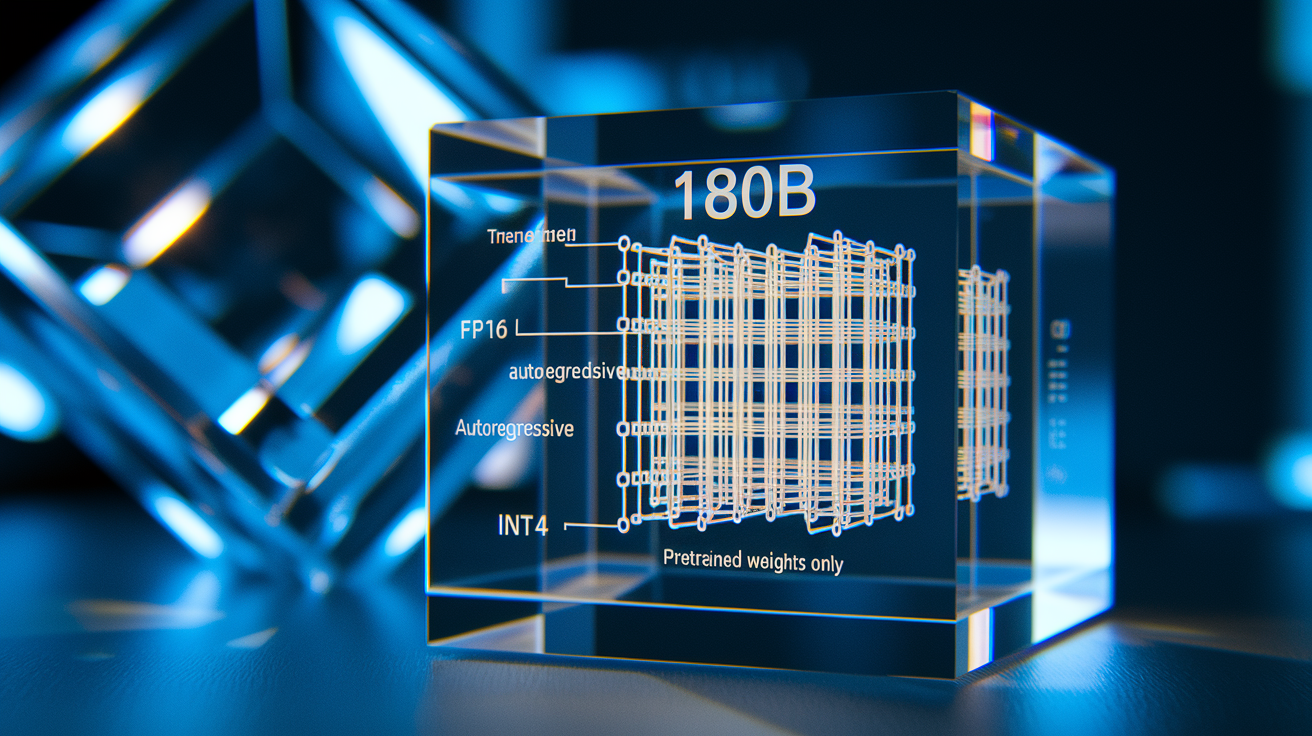
Falcon 180B packs 180 billion trainable parameters into a transformer architecture built for autoregressive language work. What you’re getting is pretrained weights only. No instruction tuning, no RLHF. That puts it roughly where Google’s PaLM-2 Large sits, while running bigger than Llama 2’s 70 billion parameter version.
The Falcon family started with the 40 billion parameter Falcon 40B back in mid-2023, released under Apache 2.0. Jumping to 180 billion took AWS infrastructure and represented one of the bigger publicly funded training runs outside the major tech companies. The design choices focus on general language capability rather than specialized tasks. That’s why you’re getting pretrained weights without domain tuning.
| Architecture Component | Details |
|---|---|
| Total Parameters | 180 billion (pretrained only) |
| Model Family | Falcon series (follows Falcon 40B) |
| Transformer Type | Autoregressive decoder |
| Precision Options | FP16, int4 quantization |
Falcon 180B Training Environment and Infrastructure Footprint

TII trained Falcon 180B on AWS infrastructure, using Amazon’s compute and storage through the whole cycle. Public funding covered the training effort, which separates this from privately funded models from big tech companies. That public funding let TII release the weights without needing API fees or subscriptions, though the license still creates commercial controls through hosting restrictions.
But here’s what you don’t know: dataset composition, filtering methods, source breakdowns. TII hasn’t published token counts, language distribution, data cleaning processes, or how much code versus natural language went into the mix. This gap makes it tough to reproduce results or predict how it’ll handle specific domains without testing it yourself.
Falcon 180B Hardware Requirements and Inference Constraints
You’ll need about 640 gigabytes of GPU memory to run this at half precision (FP16). That typically means eight NVIDIA A100 80GB GPUs clustered together. Quantize it down to int4 and you’re looking at roughly 320 gigabytes, doable with eight A100 40GB units or equivalent hardware. These requirements mean you need multi-GPU server infrastructure or a cloud budget that can handle sustained workloads.
Keeping it running online with the necessary GPU allocation costs around $20,000 monthly at standard cloud provider rates. That’s a real barrier compared to API access to proprietary models, where you pay for actual usage instead of reserved capacity. You’re trading control and data privacy for fixed infrastructure overhead.
Your hardware choices depend on request volume, latency targets, and budget. Lower precision quantization sacrifices minor accuracy for reduced memory and faster throughput. Test int4 performance against your actual use cases before committing to full FP16 infrastructure. Many applications don’t notice quantization losses.
Hardware planning:
- FP16: ~640 GB GPU memory (eight A100 80GB recommended)
- Int4: ~320 GB GPU memory (eight A100 40GB minimum)
- GPU types: NVIDIA A100 series for production
- Cloud hosting: around $20K monthly for persistent allocation
Falcon 180B Licensing Terms, Compliance Factors, and Hosting Restrictions

The TII License Version 1.0 takes Apache 2.0 and adds behavioral restrictions plus explicit limits on hosted services. These changes mean Falcon 180B doesn’t meet the Open Source Initiative’s definition of open source, even though the weights are publicly available. You can use it commercially in applications and products, but you can’t offer managed inference or fine-tuning APIs to external users without negotiating separately with TII.
Commercial deployment in proprietary applications, internal tools, and integrated products is fine under standard terms. The restrictions target cloud hosting providers and companies building shared inference platforms, not enterprises using Falcon 180B in their own products. So a company embedding Falcon 180B in a customer chatbot operates within bounds, while offering “Falcon 180B as a service” to third-party developers needs TII approval.
Cloud providers face unique compliance challenges because the model trained on AWS infrastructure and remains available through AWS services. The license structure potentially favors AWS relationships by making competitors negotiate separate terms before offering comparable hosted access. If you’re planning multi-cloud strategies or vendor-neutral deployments, verify licensing status with TII before committing to hosted offerings on non-AWS platforms.
Hosted-Use Definition
The TII License Version 1.0 defines prohibited hosted use as “any use of the Work or a Derivative Work to offer shared instances or managed services based on the Work, any Derivative Work (including fine-tuned versions of a Work or Derivative Work) to third party users in an inference or finetuning API form.” This targets API providers, managed ML platforms, and inference-as-a-service businesses. It doesn’t apply to internal use, embedded applications, or products where Falcon 180B operates as a component rather than an exposed service.
Falcon 180B Performance Benchmarks and Model Ranking Position
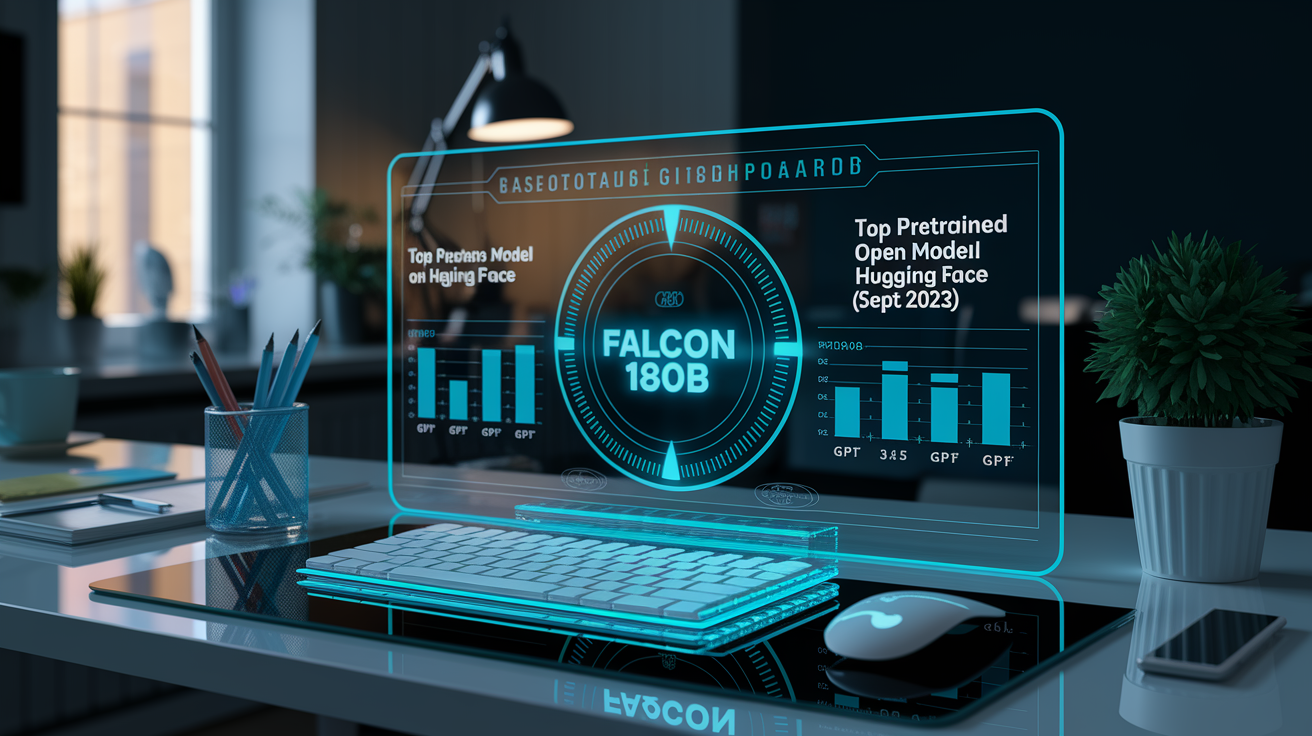
Falcon 180B launched as the top-ranked pretrained open model on Hugging Face’s public leaderboard in September 2023. Performance sits near Google’s PaLM-2 Large across general language tasks, consistently above GPT-3.5 and below GPT-4 on most standard benchmarks. Since this is pretrained only, these scores reflect raw language modeling without instruction tuning or task optimization. Fine-tuned variants could close performance gaps with proprietary models.
Benchmark comparisons focus on leaderboard rankings rather than specific numeric scores because TII didn’t publish detailed evaluation results across common datasets like MMLU or HumanEval. The missing granular benchmark data limits reproducibility and makes it hard to predict performance on narrow domain tasks without running your own evaluations.
Performance positioning:
- Versus GPT-4: “not far behind” but clearly lower on aggregate benchmarks
- Versus GPT-3.5: outperforms on most general language tasks
- Versus PaLM-2 Large: described as same tier performance
- Pretrained only: scores represent base capability without instruction tuning
- Data gaps: no published numeric results for MMLU, HumanEval, other standard tests
Falcon 180B Use Cases, Multilingual Ability, and Application Scenarios
Falcon 180B handles general language tasks somewhere between GPT-3.5 and GPT-4, making it viable when licensing control and data residency matter more than marginal performance differences with frontier proprietary models. The pretrained-only setup favors completion, generation, and reasoning over instruction-following scenarios, though fine-tuning can adapt it to specific interaction patterns. If you’ve got the compute resources for multi-GPU inference clusters, you get a high-capability model without routing sensitive data through external APIs.
Multilingual capability exists but isn’t documented in public materials. No published language distribution from training data or performance breakdowns across non-English tasks. General transformer architectures typically handle major European languages and widely represented Asian languages reasonably well when those languages appeared in pretraining, but you’ll need to test Falcon 180B’s specific strengths across language families for production use.
Primary applications:
- Long-form content summarization with controllable output length
- Multilingual text processing (strength varies, requires testing)
- Semantic search and document embedding generation
- Prompt-driven text generation for content creation and transformation
Falcon 180B Deployment Options and Integration Pathways

You’ve got two main ways to deploy Falcon 180B: direct download from Hugging Face for self-hosting or managed hosting through AWS infrastructure. Hugging Face provides model weights in standard formats compatible with popular ML frameworks. AWS offers preconfigured environments that handle infrastructure provisioning and scaling. Self-hosting needs multi-GPU servers and expertise in distributed inference. AWS-hosted options simplify deployment but create vendor lock-in and potential licensing complexity for hosted service use cases.
Self-hosting means handling GPU memory allocation, model sharding across devices, and quantization strategy before running inference requests. If you don’t have existing ML infrastructure, you’re looking at significant setup overhead: server procurement, networking configuration, monitoring tooling. The 640 gigabyte memory requirement for FP16 inference rules out single-GPU deployments and most consumer hardware. You need existing HPC resources or budget for dedicated inference clusters.
AWS-hosted deployment simplifies infrastructure management but creates dependency on a single cloud provider and raises licensing compliance questions for companies planning to offer hosted services to external users. The overlap between AWS as training provider and AWS as hosting platform creates potential conflicts when competitors want equivalent hosting capabilities on alternative cloud platforms.
Integration With Popular Frameworks
Falcon 180B weights ship in formats compatible with Hugging Face Transformers and PyTorch, the two most widely adopted frameworks for large language model deployment. Standard Transformers pipeline methods support inference workflows, though distributed deployment across multiple GPUs needs additional configuration using libraries like DeepSpeed or Hugging Face Accelerate. ONNX portability is uncertain because no official ONNX export or optimization guidance appears in release documentation. That potentially limits deployment on edge devices or non-PyTorch production environments.
Falcon 180B Fine-Tuning Workflow, LoRA Adapters, and Best Practices
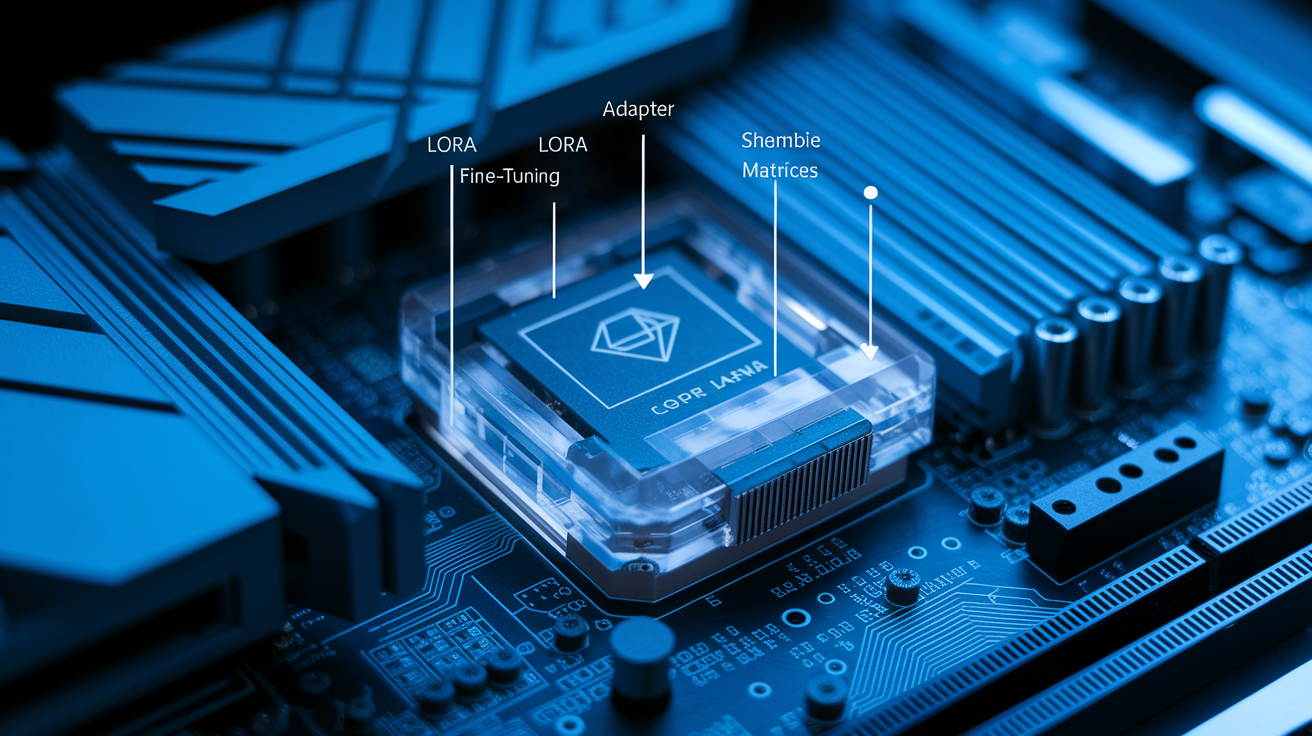
Fine-tuning Falcon 180B follows standard transformer adaptation workflows but needs careful attention to licensing restrictions when deploying fine-tuned models in hosted service contexts. The TII License prohibits offering fine-tuned derivatives through shared inference APIs without explicit permission. That limits commercial fine-tuning scenarios to internal use cases and embedded applications. Verify your intended deployment model against license terms before investing compute resources in training runs.
Low-rank adaptation methods like LoRA offer the most practical fine-tuning approach because they reduce memory requirements and training time compared to full-parameter updates. LoRA freezes the pretrained weights and trains small adapter matrices that modify model behavior without storing duplicate 180 billion parameter checkpoints. This efficiency gain matters significantly at Falcon 180B’s scale, where full fine-tuning can require multi-node GPU clusters and extended training windows.
Fine-tuning planning:
- LoRA: most practical method for parameter-efficient fine-tuning at 180B scale
- Dataset selection: curate task-specific data addressing gaps in pretrained capabilities
- License compliance: confirm deployment context (internal, embedded, or hosted service) before fine-tuning
Falcon 180B Safety, Alignment Practices, and Risk Mitigation

Public release documentation doesn’t detail specific safety measures, alignment techniques, or red-teaming results applied during development. The pretrained-only release means no reinforcement learning from human feedback or constitutional AI methods have constrained model outputs. Safety considerations fall to downstream implementers. If you’re deploying Falcon 180B in user-facing contexts, plan for content moderation layers, output filtering, and monitoring systems to detect and mitigate harmful generations.
The TII License includes behavioral use restrictions that implicitly function as alignment guardrails by prohibiting certain applications, though these legal constraints operate outside the model itself and depend on compliance rather than technical controls. You can’t rely on the license to prevent misuse in practice. Robust deployments need architectural safeguards: prompt injection defenses, output validation, and abuse detection systems independent of licensing terms.
Falcon 180B Comparison With Other Leading LLMs
Performance positioning puts Falcon 180B between GPT-3.5 and GPT-4 on general language benchmarks, with comparable capability to Google’s PaLM-2 Large. This competitive standing makes it one of the strongest openly available pretrained models as of late 2023, though the gap with GPT-4 remains measurable across reasoning-heavy tasks and complex instruction following. When you’re evaluating model selection, weigh this performance difference against the control, data residency, and cost structure benefits of self-hosted deployment versus API-based access to proprietary alternatives.
Licensing creates the sharpest difference between Falcon 180B and models like Llama 2. Llama 2 released under a custom Meta license with fewer hosting restrictions but behavioral use limitations targeting competitors. Llama 2’s license prohibits use by services exceeding 700 million monthly active users. Falcon 180B’s TII License restricts managed inference offerings regardless of scale. Neither qualifies as true open source under OSI definitions, but the restriction categories differ enough to affect distinct commercial scenarios.
Market positioning reflects compute access as much as model capability. Falcon 180B’s training on AWS infrastructure and primary availability through AWS services creates potential advantages for organizations already committed to Amazon’s cloud ecosystem while introducing friction for multi-cloud or vendor-neutral strategies. Llama 2 maintains broader hosting availability across cloud providers. GPT-4 operates exclusively through OpenAI’s API with no self-hosting option. The choice between these models often hinges on infrastructure constraints and licensing compatibility rather than pure performance metrics.
Final Words
Released in September 2023, Falcon 180B is a 180‑billion‑parameter model that shipped as a leading pretrained open LLM. This article summarized the release date, model weights availability, TII License v1.0, and access via Hugging Face and AWS.
We covered architecture and training context, hardware and inference costs, benchmarks versus GPT‑3.5/PaLM‑2/GPT‑4, deployment paths, fine‑tuning constraints, and safety and licensing trade‑offs.
Use the falcon 180b release details here to decide whether to self‑host, negotiate hosted permissions, or rely on managed services. It’s capable and practical.
FAQ
Q: How much memory does Falcon 180B need?
A: The Falcon 180B needs about 640 GB of GPU RAM for FP16 inference (roughly 8× A100 80GB); quantized int4 inference drops to about 320 GB (8× A100 40GB).
Q: How big is the Falcon 180B?
A: The Falcon 180B is a 180‑billion‑parameter model released by TII in September 2023; model weights are publicly available via Hugging Face and hosted on AWS.