
Controversial: Slack’s team-era didn’t start with the February 2014 public launch most people cite.
Its first big move came in August 2013, when Slack opened an invite-only preview for teams.
Day one brought about 8,000 invitation requests, rising to roughly 15,000 within two weeks.
That private rollout, born from Tiny Speck’s internal chat, gave the team time to fix scaling, search, and sync before opening to everyone.
Thesis: August 2013 is the key date for Slack’s team launch—the moment it began reshaping how teams communicate.
Key Launch Dates for Slack’s Introduction to Teams

Slack opened up to teams through a preview release in August 2013, but it started life a year earlier as an internal chat tool at Tiny Speck, a gaming company. The preview wasn’t open to everyone. You needed an invite. On day one, 8,000 people asked for access. Two weeks later, that number hit 15,000. This invite-only period ran for over six months, giving the team time to test features with maybe 6 to 10 companies and refine things based on what early users actually said.
The public launch happened in February 2014. Anyone could create a workspace without waiting for an invitation. By then, the platform had moved past the experimental phase and was ready to handle team collaboration at scale. Searchable message logs, multi-device sync, simple file sharing—all of it was already there.
Key Slack Timeline Moments:
- 2012: Internal tool built at Tiny Speck to fix team communication problems
- May 2013: External testing with a handful of companies (6 to 10 total)
- August 2013: Preview release announced, invite-only period starts with 8,000 day-one requests
- February 2014: Public launch opens Slack to all teams, no invitation needed
Slack’s Conceptual Origins and Early Design Philosophy

Slack stands for Searchable Log of All Communication and Knowledge. That name tells you what the product was trying to do from the start. The tool came out of Tiny Speck, a game development company that decided to pivot away from its gaming project and realized the internal chat system it’d built for coordination was more valuable than the game itself. The team had been juggling email, Skype, SMS, and random private social channels before switching to their homegrown solution. The difference in workflow speed and clarity was immediate.
That internal experience shaped Slack’s early design. Conversations should be organized by topic, not by person. Everything should be searchable so teams could pull up decisions and context even months later. The channel-based structure kept discussions focused and made onboarding new team members easier—they could read past messages to understand ongoing projects without asking the same questions over and over. The system worked by creating a persistent, organized log instead of relying on scattered one-to-one messages or buried email threads.
Early testers confirmed this approach worked. A 120-person company that joined the external testing group in May 2013 exposed scaling problems the team hadn’t anticipated. That forced rapid iteration on performance and sync reliability. Feedback from those first companies helped prioritize features like cross-device synchronization and robust search indexing, which both became selling points when Slack moved to a wider release. The philosophy was simple: make communication faster, more organized, and easier to reference later. Exactly the problems teams face when they outgrow email but haven’t found a better alternative.
Slack’s Early Adoption Metrics and Growth Milestones
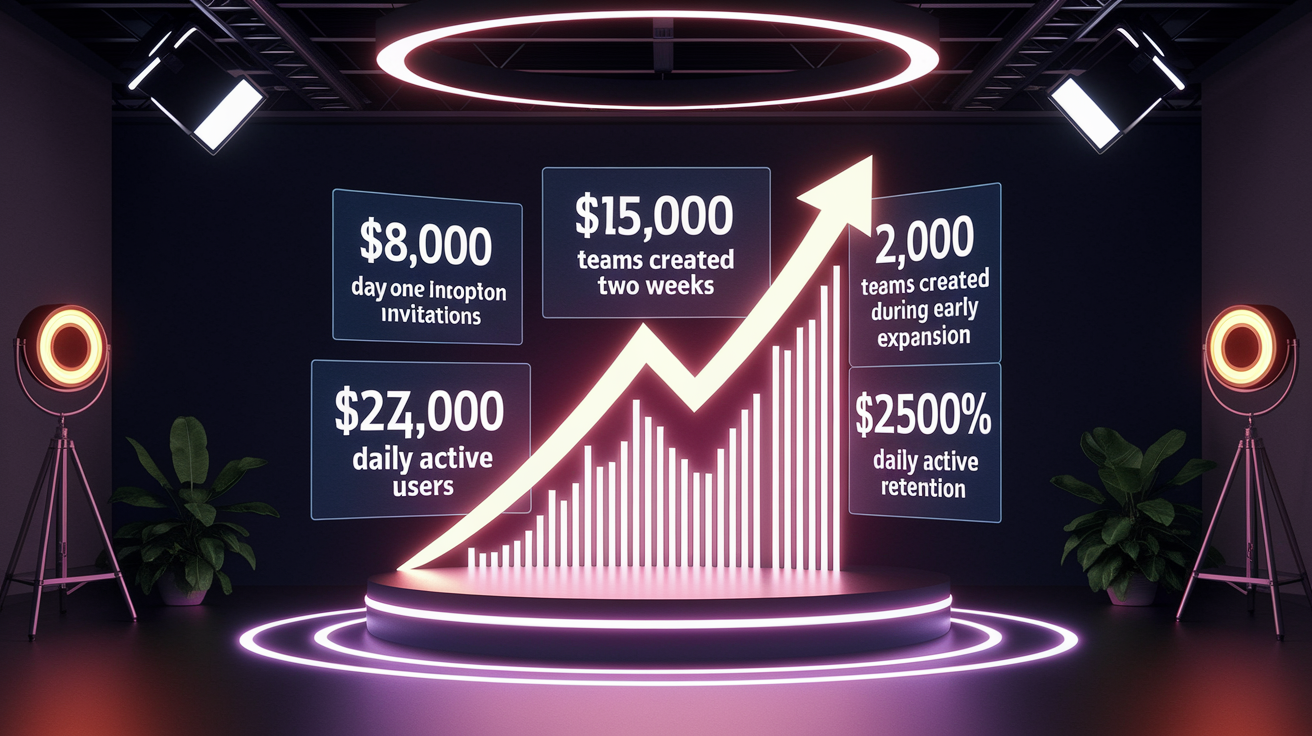
When Slack announced its preview release in August 2013, the team expected modest initial interest. Instead, 8,000 people requested invitations on day one. Before the team had even finished their coffee, thousands of requests were piling up. Within two weeks that number nearly doubled to 15,000. The private beta lasted more than six months. During that time, the company added teams in batches to manage server load and product iteration speed. By the time the public launch arrived in February 2014, Slack was processing around 8,000 customer support tickets and 10,000 tweets per month. That volume required a support team of three people at launch and later grew to 18 full-time staff plus six dedicated to 24/7 Twitter coverage.
Growth after the public launch was driven by a bottoms-up adoption model. Individual teams could sign up without waiting for IT approval. Of the roughly 220,000 teams created during the early expansion period, about 30,000 became active users. That translated to approximately 250,000 daily active users with an average team size of 8 to 9 members. Slack identified a retention signal it called the “magic number”: teams that exchanged 2,000 messages had a 93% likelihood of remaining active. For a 50-person team, reaching 2,000 messages took about 10 hours. For a 10-person team, roughly one week. That metric became the core activation goal and helped the product team prioritize features that encouraged early message volume, like easy file sharing and mobile sync.
| Year | Slack Milestone |
|---|---|
| 2012 | Internal tool developed at Tiny Speck to solve team communication problems |
| May 2013 | External testing begins with 6 to 10 companies |
| August 2013 | Preview release announced; 8,000 invite requests day one, 15,000 within two weeks |
| February 2014 | Public launch; operational load includes 8,000 Zendesk tickets and 10,000 tweets monthly |
| Early 2015 | ~30,000 active teams, ~250,000 daily active users, average team size 8 to 9 members |
| Adoption metric | 2,000 messages exchanged = 93% customer retention rate |
Early Slack Features That Shaped the Launch for Teams

At launch, Slack focused on three things that competitors either executed poorly or ignored: high-quality search, reliable multi-device synchronization, and simple file sharing. Search was designed to retrieve not just message text but also shared documents and links, turning every conversation into a searchable archive that replaced the need to dig through email attachments or local folders. Synchronization meant users could start a conversation on desktop, pick it up on mobile during a commute, and resume exactly where they left off without missing context or hunting for the right thread.
File sharing was deliberately streamlined. Users could drag a file into any channel, paste an image directly into the message box, or link to cloud storage with minimal friction. Channels themselves became the organizing principle for team communication, replacing the scattered mix of email threads, private messages, and ad-hoc group chats that most teams relied on before Slack. Early integrations with tools like Google Drive and Trello allowed teams to pull external updates directly into relevant channels, reducing the need to switch between apps. These features weren’t revolutionary individually. But together they created a workflow that felt faster and less chaotic than email or legacy chat tools.
Core Features Available at Slack’s Team Launch:
- Channels: Topic-based organization that kept conversations focused and searchable
- Search: Full-text retrieval across messages, files, and shared links
- File sharing: Drag-and-drop, paste, and cloud-storage linking with minimal steps
- Early integrations: Connections to Google Drive, Trello, and other common team tools
- Multi-device sync: Resume conversations on any device without losing context or scroll position
Slack’s Expanding Feature Set After Launch and Its Impact on Team Collaboration

Voice & Video Calling
Slack introduced voice calls in March 2016, letting teams jump from text-based channels into live audio conversations without leaving the platform. Video calling followed in December 2016, initially available to paid users and supporting up to 15 participants per call. These features addressed a common pain point: teams using Slack for chat still had to switch to Skype, Google Hangouts, or Zoom for face-to-face discussions, which broke the workflow Slack was designed to streamline.
Shared Channels & Slack Connect
Shared channels launched in September 2019, enabling different organizations to collaborate in the same channel without switching platforms or forwarding message screenshots. Slack Connect, introduced in June 2020, expanded that capability by letting teams message and share files with up to 20 organizations in a single channel. By the time the feature matured, 77% of Fortune 100 companies were using Slack Connect to collaborate with external partners, vendors, and clients. This feature turned Slack from an internal communication tool into a cross-company collaboration layer, reducing email volume for external coordination and speeding up decision cycles.
Huddles & Modern Collaboration Tools
Slack Huddles arrived in June 2021 as a lightweight audio feature designed for unscheduled, drop-in conversations. Users could start a huddle in any channel without scheduling a meeting or sending calendar invites. Huddles became the fastest-adopted feature in Slack’s first decade, reflecting a shift toward more spontaneous, less formal communication as remote and hybrid work became standard. Around the same time, Slack introduced Workflow Builder, which has since generated more than 1.3 billion workflows, and Canvases, a collaborative document feature that has produced over 18 million canvases. These tools extended Slack beyond messaging into lightweight project coordination and knowledge management, keeping more work inside the platform and reducing reliance on separate documentation and automation tools.
Integrations and Ecosystem Growth Supporting Slack’s Team Launch

Slack’s integration strategy was central to its early adoption by teams. Workers switch between an average of nine apps per day, and Slack positioned itself as a hub that reduced that friction by pulling updates, notifications, and actions from external tools directly into channels. Early integrations with Gmail, Google Drive, Microsoft Office 365, Trello, and Zapier allowed teams to centralize workflows without abandoning the tools they already relied on. This approach made Slack easier to adopt incrementally. Teams could start using it for chat while keeping their existing project management, file storage, and email systems in place.
By the time the Slack App Directory matured, it included over 2,600 apps, and more than 1,000,000 developers had built on the Slack platform. Integration depth became a competitive moat: teams that connected Slack to their core tools were less likely to churn because switching would mean rebuilding those integrations elsewhere. Later additions like Zoom Phone integration in 2019 and Microsoft Teams calling integration in April 2020 showed Slack’s willingness to interoperate even with direct competitors, reinforcing its positioning as a neutral collaboration layer rather than a walled garden.
Key Early Slack Integrations:
- Google Workspace: Gmail, Google Drive, Calendar
- Microsoft Office 365: Outlook, OneDrive, SharePoint
- Trello: Project board updates pushed into Slack channels
- Zapier: Custom automation connecting Slack to hundreds of other apps
Slack’s Market Growth After Launch: Funding, Enterprise Adoption, and Product Reach

Slack’s user growth translated quickly into investor confidence. By April 2017, the platform had reached 8 million daily active users and raised $200 million at a $3.8 billion valuation. Five months later, in September 2017, SoftBank led a $250 million Series G round that pushed the valuation to $5 billion. The funding reflected not just user volume but sticky enterprise adoption: teams that hit the 2,000-message retention threshold rarely left, and larger companies were signing up despite running Microsoft apps across the rest of their organization.
Enterprise adoption became especially notable as a parallel-adoption story. Roughly 63% of companies using Microsoft apps also ran Slack in some departments, often because individual teams preferred Slack’s interface and integration ecosystem even when corporate IT mandated Microsoft tools. This bottoms-up growth bypassed traditional enterprise sales cycles, letting Slack expand within large organizations without requiring CIO-level approval up front. The product’s ability to coexist with Microsoft infrastructure became a strategic advantage, particularly as shared-channel features matured and allowed cross-company collaboration without forcing external partners onto a single platform.
Slack went public through a direct listing in June 2019, opening at a market value of $19.5 billion. Two years later, in July 2021, Salesforce acquired Slack for $27.7 billion, positioning the platform as a core component of Salesforce’s enterprise collaboration strategy. The acquisition marked a shift from independent startup to enterprise-platform layer, but the product’s core identity—fast, searchable, integration-friendly team communication—remained intact. At that point, Slack had moved from a tool for small teams to a fixture in Fortune 100 companies, all within less than a decade of its August 2013 preview release.
Final Words
In the action, the post highlights two pivots: Slack’s August 2013 preview and its public launch in February 2014 as the moments that moved it from an internal tool to a team platform.
- 2012: internal tool at Tiny Speck
- May 2013: external testing with a few companies
- Aug 2013: preview release (8,000 invites day one)
- Feb 2014: public launch for teams
If you need a single date for when did slack launch for teams, it was February 2014, the start of rapid growth that still shapes team chat today.
FAQ
Q: Why did Teams overtake Slack?
A: The reason Teams overtook Slack is Microsoft bundled Teams with Office 365, offering tighter enterprise integration, lower marginal cost, and stronger admin controls, so many large organizations adopted it as the default.
Q: When did people start using Slack?
A: People started using Slack as an internal tool in 2012, moved to internal use by March 2013, began external testing in May 2013, previewed in August 2013, and launched publicly in February 2014.
Q: Why don’t people like Slack?
A: People don’t like Slack because it produces notification overload and distraction, can be expensive for paid tiers, fragments conversations across channels, and sometimes makes search or onboarding feel awkward.
Q: Who is Slack’s biggest competitor?
A: Slack’s biggest competitor is Microsoft Teams, which competes through Office 365 bundling, enterprise admin features, and wide adoption; other competitors include Google Chat and Zoom in specific use cases.