
Did GitHub invent version control?
No — Git was released in 2005, but when GitHub launched in 2008 it changed how teams share code by offering hosted Git repositories, pull requests, and a browser UI that made distributed workflows simple.
That change turned Git from a developer tool into a social platform for collaboration.
By December 2008 GitHub hosted about 27,000 public repositories, showing fast adoption.
This post explains what happened in 2008, who it affected, why it mattered, and what it means for your workflow today.
Clear Explanation of GitHub’s Launch and Its Role in Version Control

GitHub launched in 2008 as a web-based hosting service for Git repositories. It didn’t create version control itself. Git, the distributed version control system underneath, came from Linus Torvalds in April 2005 after BitKeeper pulled free licenses from Linux kernel developers. GitHub built a platform on top of Git to make repository hosting and code sharing work through a browser.
The timeline’s simple: Git showed up in April 2005 as a command-line tool for distributed version control. GitHub arrived three years later in 2008 to add managed hosting, pull requests, and social coding features around that tool. By December 2008, GitHub was already hosting around 27,000 public repositories compared to Bitbucket’s roughly 1,000. The Ruby and Rails communities drove most of that early growth.
People confuse GitHub with inventing version control because GitHub became the most visible face of Git. The platform popularized pull requests (which came from Git’s native git request-pull mechanism) and made distributed workflows accessible to developers who’d been stuck on centralized systems like Subversion or CVS.
Why this confusion happens:
- GitHub became synonymous with Git hosting and open source collaboration after 2008.
- The pull request model GitHub formalized became how developers contribute to projects.
- GitHub’s interface made version control concepts visible for non-experts.
- Lots of developers learned Git through GitHub’s platform instead of command-line Git directly.
Deep Timeline of GitHub’s Early Origins and Founding

Tom Preston-Werner, Chris Wanstrath, and PJ Hyett founded GitHub during informal development and beta phases leading up to the 2008 public launch. The founding team bootstrapped everything, working from cafés and negotiating hosting support in May 2008 to keep costs down. This lean approach let them maintain control and focus on developer experience instead of investor demands.
Early growth happened fast. The Ruby and Rails communities embraced both Git and GitHub’s collaboration model right away. The platform’s focus on user-centric repository namespacing (projects tied directly to user accounts) and clean, developer-focused UI set it apart from existing code hosting options. In-person conference presence and grassroots evangelism at developer meetups accelerated word-of-mouth adoption during the first year.
Founding milestones:
- Tom Preston-Werner, Chris Wanstrath, and PJ Hyett collaborated as co-founders with complementary technical skills.
- Private beta testing occurred with select developer communities before public launch.
- The GitHub.com domain went live publicly in 2008, offering free public repository hosting.
- Ruby and Rails developers adopted the platform immediately after launch, creating a network effect.
- By December 2008, GitHub was hosting around 27,000 public repositories, demonstrating first-year traction.
Version Control History Leading Up to GitHub’s Launch

Version control systems evolved from the 1970s through the 2000s, creating the foundation for GitHub’s 2008 arrival. Early centralized systems like Source Code Control System (SCCS, released publicly in February 1977) used strict file locking. Only one developer could edit a file at a time. Revision Control System (RCS) followed in 1982, introducing reverse deltas to improve storage efficiency. Concurrent Versions System (CVS) arrived in 1986 with a client-server model and concurrent checkouts, letting multiple developers work simultaneously with merging workflows.
The distributed version control revolution began in 2005 when BitMover revoked free BitKeeper licenses for Linux kernel developers in April. Linus Torvalds designed and released Git within weeks, emphasizing distributed workflows, snapshot-based storage in a directed acyclic graph (DAG) structure, and fast branching and merging. Mercurial and Bazaar also launched in April 2005, creating a competitive DVCS landscape. These systems allowed developers to work with full repository clones locally, commit changes offline, and push updates to remote repositories without constant server connectivity.
By 2008, Git had matured enough to support large projects. Developer familiarity with distributed workflows was growing beyond early adopters. Subversion (released as version 1.0 in 2004) remained dominant in enterprise environments, but DVCS systems were proving their value in open source communities. GitHub entered this ecosystem when Git was technically stable but lacked accessible hosting and collaboration infrastructure for teams who wanted more than command-line operations and self-hosted servers.
| System | Release Year | Key Feature |
|---|---|---|
| SCCS | 1977 | Strict file locking (one editor at a time) |
| RCS | 1982 | Reverse deltas for storage efficiency |
| CVS | 1986 | Client-server model with concurrent editing |
| Subversion | 2004 | Atomic commits and versioned directories |
| Git | 2005 | Distributed clones and DAG-based snapshots |
| Mercurial | 2005 | Distributed workflows with simpler learning curve |
How GitHub Implemented Git-Based Version Control at Launch

GitHub supported Git from day one by providing web-based repository hosting with full Git protocol compatibility for cloning, pushing, and pulling changes. The platform emphasized writable forks and simplified permission models. Any developer could fork a public repository, make changes locally, and propose those changes back to the original project without needing write access. This workflow removed the traditional barrier where only trusted contributors could commit directly to a project.
GitHub formalized the pull request concept derived from Git’s native git request-pull mechanism. It added a web interface for reviewing proposed changes, discussing code line by line, and merging contributions with a single click. The platform’s UI made commits, branches, and history browsable without requiring command-line expertise, lowering the entry barrier for developers new to distributed version control. Early GitHub also provided basic project management features like issue tracking and wikis, integrating collaboration tools directly alongside code hosting.
The technical implementation supported standard Git operations over SSH and HTTPS. Developers could use existing Git command-line tools or GUI clients while benefiting from GitHub’s hosting infrastructure. Repositories could be cloned, branched, and managed identically to self-hosted Git servers, preserving the distributed model where each clone contained full project history. GitHub’s hosting removed the operational burden of running Git servers while maintaining the flexibility and offline capabilities that made DVCS systems attractive.
Core Git features GitHub supported at launch:
- SSH access for authenticated Git operations (clone, push, pull, fetch).
- HTTPS-based Git protocol support for easier firewall and proxy compatibility.
- Forking workflow allowing developers to create writable copies of any public repository.
- Web UI for browsing commits, diffs, branches, and repository history without command-line tools.
- Pull request formalization with review and merge interfaces built on Git’s request-pull concept.
GitHub’s Launch Milestones and Early Adoption Timeline
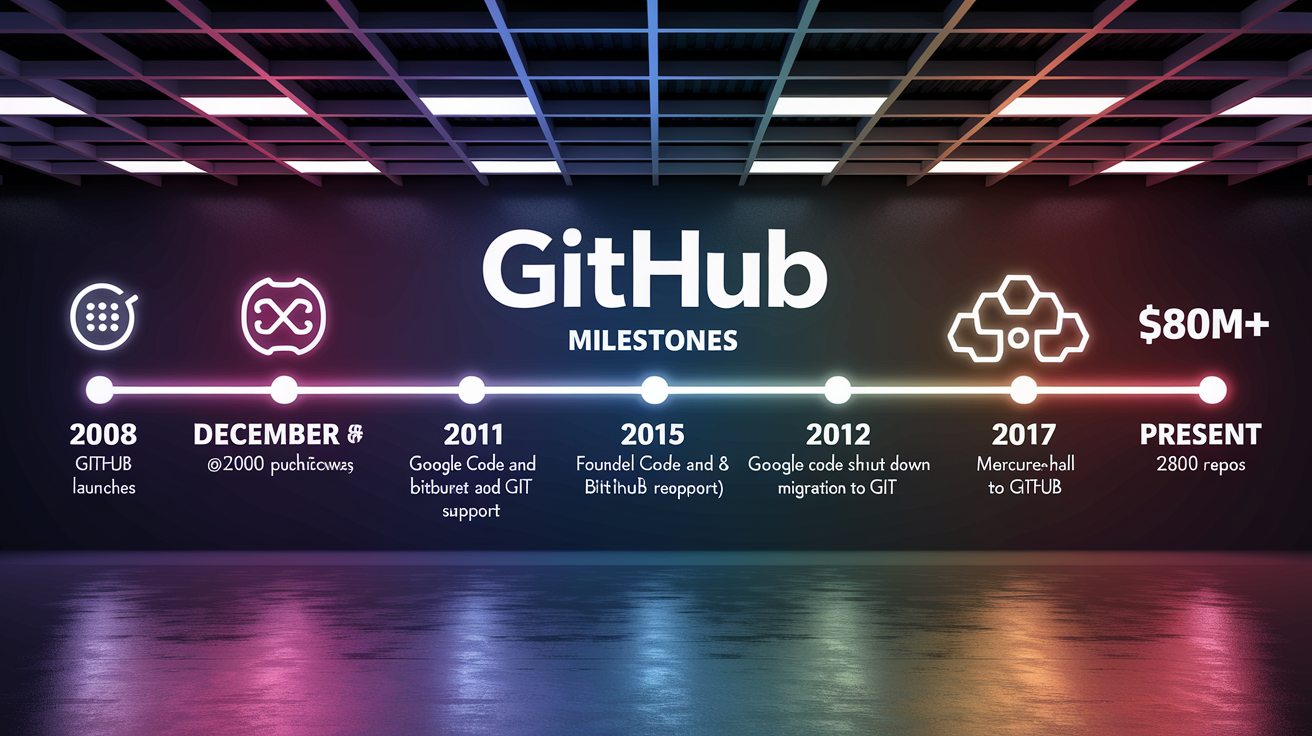
GitHub’s public launch in 2008 triggered rapid repository growth concentrated initially in the Ruby and Rails communities, where early adopters evangelized the platform at conferences and meetups. The hosting model offered free public repositories and charged for private repositories, aligning incentives with open source development while creating a sustainable business model. By December 2008, GitHub was hosting around 27,000 public repositories compared to Bitbucket’s roughly 1,000, establishing early market leadership in Git hosting.
Competitive dynamics shifted when Google Code and Bitbucket added Git support in 2011, which industry observers marked as a turning point against Mercurial’s adoption prospects. Google Code’s 2015 shutdown and recommendation that projects migrate to GitHub further consolidated GitHub’s position as the default platform for open source collaboration. Corporate adoption accelerated as major projects like Android (already using Git) and enterprise teams began standardizing on Git workflows, often using GitHub or GitHub Enterprise for hosting.
| Year | Milestone |
|---|---|
| 2008 | GitHub publicly launched as a Git hosting platform |
| December 2008 | GitHub hosted ~27,000 public repositories vs Bitbucket’s ~1,000 |
| 2011 | Google Code and Bitbucket added Git support, marking decline of Mercurial |
| 2012 | Founders considered but declined $100 million A-round offers from top-tier VC firms |
| 2015 | Google Code shut down and directed projects to migrate to GitHub |
| 2017 | Python project migrated from Mercurial to Git |
| Present | Over 280 million public repositories hosted on GitHub |
Comparing GitHub’s 2008 Launch to Other Hosting Platforms
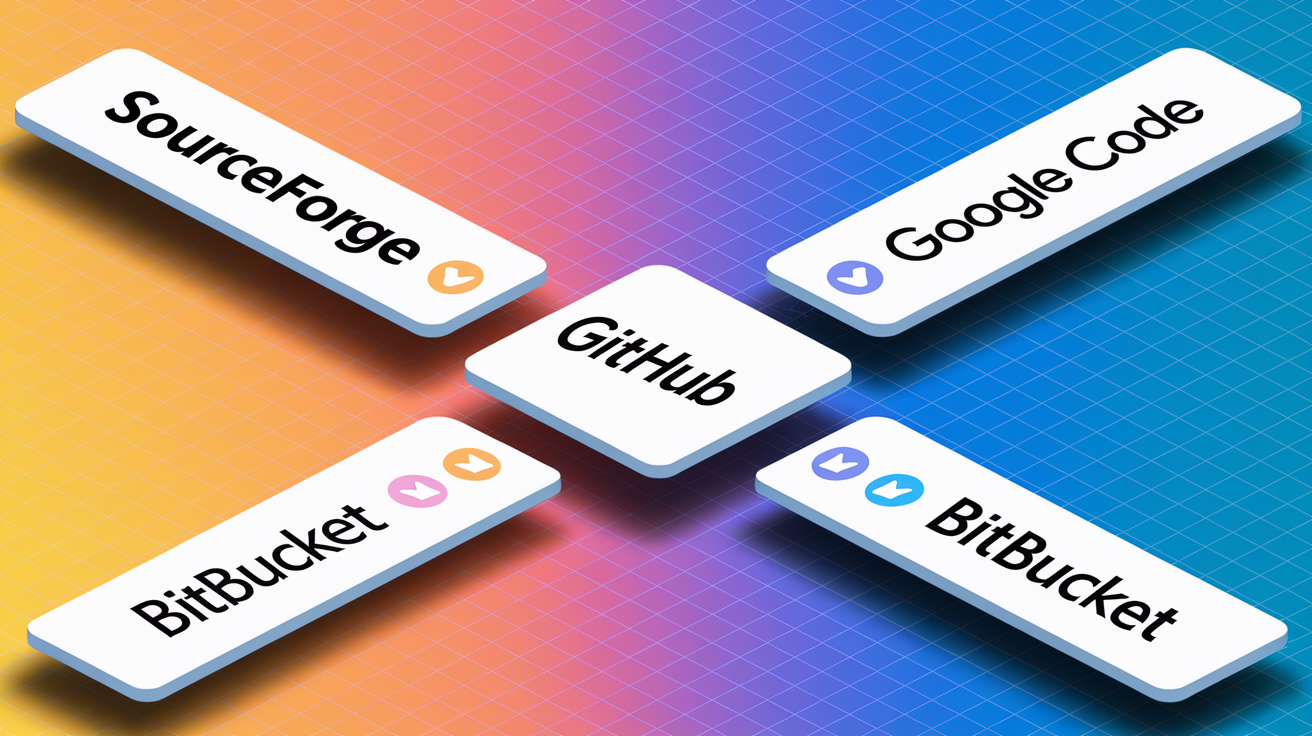
In 2008, GitHub entered a competitive landscape dominated by SourceForge (focused on centralized VCS and file distribution), Google Code (supporting Subversion and Mercurial), and Bitbucket (which originally launched in 2008 focusing on Mercurial hosting). SourceForge lacked native support for distributed version control workflows and maintained a project-centric rather than user-centric model, requiring developers to request project creation and navigate heavier administrative processes.
Bitbucket’s initial Mercurial focus reflected the 2005-era competition between DVCS options. But when Bitbucket added Git support in 2011, the move signaled Git’s growing dominance. Google Code’s later addition of Git support in 2011 came after GitHub had already established network effects through community adoption and superior developer experience. The platform’s 2015 shutdown and migration guidance toward GitHub demonstrated the consolidation that occurred in the Git hosting market within seven years of GitHub’s launch.
Key platform differences in 2008:
- SourceForge required project-level ownership structures and lacked DVCS support at launch.
- Google Code supported Subversion and Mercurial but not Git initially, missing the distributed workflow that developers increasingly preferred.
- Bitbucket focused on Mercurial hosting in 2008, entering the Git space three years after GitHub’s launch.
- GitHub offered user-centric namespacing, pull-based permissions, and Git-native workflows from day one, differentiating through design taste and developer experience rather than feature checklists.
How GitHub’s Launch Impacted Developer Collaboration

GitHub’s 2008 launch changed how developers approached open source contribution by replacing the pre-Git patch workflow (checkout, generate GNU diff patch, upload to ticketing system or email, maintainer manually fetches and applies) with a streamlined fork and pull request model. The old process was slow and error-prone, requiring contributors to generate patches outside the version control system and maintainers to manually integrate changes. GitHub’s interface made forking a single click, allowed contributors to work in full Git branches with history, and gave maintainers visual diff tools and merge buttons.
The platform popularized “social coding” by treating repositories as user-owned entities that could be followed, starred, and explored through a browsable interface. User-centric namespacing meant developers built personal portfolios of public work visible to potential employers and collaborators, creating incentives for open contribution beyond altruism. Clean UI and developer-focused design (authentic to the community rather than enterprise CTO-driven feature lists) made version control concepts accessible to designers, technical writers, and adjacent roles who previously found command-line-only workflows intimidating.
Grassroots evangelism at conferences, especially within the Ruby and Rails communities, accelerated adoption through in-person demonstrations and workshops that taught Git and GitHub together as a unified workflow. Corporate training (including early work with Android and Google teams) helped translate open source collaboration patterns into enterprise development practices. The pull request model GitHub formalized became the standard mechanism for code review and contribution across industries, spreading beyond open source into private corporate repositories and eventually influencing competing platforms to adopt similar workflows.
Final Words
in the action: GitHub launched in 2008 as a Git repository host, not the inventor of version control. This piece covered Git’s 2005 origin, the founders and early timeline, how GitHub added web-based Git features, and why people often mix up Git and GitHub.
We also showed early growth numbers and the collaboration habits GitHub popularized.
If you’re asking when did github launch version control, the answer is 2008 — and that launch helped make collaborative coding easier and more social.
FAQ
Q: When was Git version control invented?
A: Git was invented in April 2005 by Linus Torvalds after BitKeeper access was revoked; it introduced a distributed model with fast branching, merging, and a DAG-based commit history.
Q: Why did Git replace SVN? Is anyone still using SVN?
A: Git replaced SVN because Git’s distributed model, faster branching/merging, and better merge workflows served large, distributed teams more efficiently. Some teams still use SVN for legacy or simple centralized workflows, but use has declined.
Q: Is there version control in GitHub?
A: GitHub provides Git-based version control hosting: it lets you host repositories, clone via SSH/HTTPS, fork projects, open pull requests, and manage commits and branches through a web UI and Git tools.