Most people think cloud computing just appeared one day, but Amazon started selling computing power like electricity in August 2006. That launch of Amazon Web Services changed how every company builds software today. Before AWS, businesses bought expensive servers that sat mostly idle. After AWS, they rented exactly what they needed and paid by the hour. Here’s how Amazon turned its internal infrastructure problems into a $10 billion business that now runs Netflix, Airbnb, and thousands of other services you use daily.
Amazon’s Cloud Services Launch: The 2006 Beginning

Amazon officially launched Amazon Web Services with Amazon Elastic Compute Cloud in August 2006. That’s when Amazon started cloud services as a commercial offering. The company introduced two foundational services that year: Amazon S3 (Simple Storage Service) and Amazon EC2 (Elastic Compute Cloud). These services formed the core infrastructure that would define modern public cloud computing and establish AWS as the first major commercial cloud platform.
Amazon S3 provided scalable object storage where developers could store and retrieve any amount of data from anywhere on the web, charged per gigabyte used. Amazon EC2 enabled users to rent virtual computers to run their own applications and software. No need to purchase physical servers anymore. Both services operated on a pay as you go model where customers only paid for the computing resources and storage they actually consumed, fundamentally changing how businesses approached IT infrastructure investment.
| Year | Service | Function |
|---|---|---|
| 2002 | Amazon.com Web Service | SOAP and XML interfaces for Amazon product catalog |
| 2004 | Simple Queue Service (SQS) | First official AWS service for message queuing |
| 2006 | Amazon S3 | Scalable object storage for data and files |
| 2006 | Amazon EC2 | On-demand computing capacity with virtual servers |
Before the full AWS platform launch in 2006, Amazon had actually released Simple Queue Service in 2004 as the first official AWS service, providing a managed message queuing system for distributed applications.
The Internal Origins Behind Amazon’s Cloud Platform

Around 2000, Amazon faced serious e-commerce scaling problems as its retail business grew rapidly. The company’s internal development environment had become tangled and inefficient. Software engineers were building separate database, compute, and storage resources for each new project instead of reusing or scaling existing infrastructure. Internal development teams expected projects to take 3 months, but building individual components like a database, compute layer, or storage system alone consumed 3 months each.
This operational chaos intensified when Amazon began developing Merchant.com, an e-commerce platform designed for third-party merchants including Target and Marks & Spencer.
The Merchant.com project exposed how poorly organized Amazon’s internal systems had become. It forced the company to transform its tangled development environment into well-documented APIs around 2000. This API based architecture dramatically improved development speed because teams could now call standardized services instead of building custom infrastructure components from scratch for every project.
Amazon’s leadership recognized that if these internal infrastructure tools solved their own operational problems so effectively, other companies likely faced similar challenges. They could benefit from these same capabilities offered as external services.
The 2003 Executive Retreat That Shaped Cloud Computing

At an executive retreat held at Jeff Bezos’ house in 2003, Amazon’s leadership team conducted a strategic analysis to identify the company’s core competencies beyond e-commerce. Andy Jassy, who was serving as Jeff Bezos’ chief of staff at the time, participated in discussions that examined what Amazon had become genuinely skilled at through years of operational experience.
The executive team concluded that Amazon had developed exceptional capabilities in running infrastructure services. Storage systems, database management, and computing resources at scale. This realization shifted the conversation from internal efficiency to external business opportunity. If Amazon could run infrastructure services better than most companies, why not offer those services to everyone else?
By Summer 2003, Amazon began conceptualizing these infrastructure services as an “operating system for the internet.” By Fall 2003, leadership concluded they could build all the key components of this internet operating system. They committed to a development effort that would span approximately 3 years, ultimately culminating in the 2006 AWS launch.
AWS Market Leadership and Enterprise Cloud Adoption
Amazon Web Services entered the market in 2006 with virtually no serious competition in the public cloud space. It took several years after the 2006 launch before major competitors like Microsoft, IBM, and Google responded with their own cloud offerings. This multi-year head start allowed AWS to refine its services, build customer trust, and establish market standards. By 2010, AWS had established itself as a major cloud computing player with a diverse customer base spanning startups, enterprises, and government organizations.
By 2016, AWS had captured over 30 percent of the cloud infrastructure market share according to Synergy Research data.
AWS’s market share exceeded the combined share of Microsoft Azure, IBM, and Google Cloud by a fair margin. This solidified its position as the undisputed market leader in cloud computing. Major businesses including Netflix, Dropbox, and Pinterest built their entire operations on AWS infrastructure. Netflix used AWS to scale its streaming service globally without investing in physical data centers in every market. They achieved significant cost savings by paying only for the computing resources needed during peak viewing hours. Airbnb similarly used AWS to handle massive traffic spikes during high-demand periods without maintaining expensive idle infrastructure during slower times.
The business reached a $10 billion annual run rate. Synergy Research validated AWS as the most successful cloud infrastructure company in the market.
The pay as you go cloud model eliminated large upfront capital expenditures that characterized traditional IT infrastructure. It transformed IT spending from capital expenditure to operational expenditure and fundamentally changed how CFOs planned technology budgets. AWS popularized DevOps practices and agile development methodologies across industries by providing tools and services that enabled continuous deployment, automated testing, and rapid iteration. The company’s influence extended to establishing cloud standards and best practices that competitors and customers alike adopted as industry norms.
Global Infrastructure and Platform Evolution
Traditional on-premises computing required significant upfront investment in physical hardware, dedicated data center space, cooling systems, backup power, and ongoing maintenance costs including security management and hardware replacement cycles. Cloud computing operates on a pay as you go model, eliminating these large capital expenditures. Virtualization technologies that emerged in the 1990s and became widely adopted in the 2000s enabled multiple virtual machines to run on a single physical server. This provided the technical foundation that made modern cloud computing economically viable and operationally flexible.
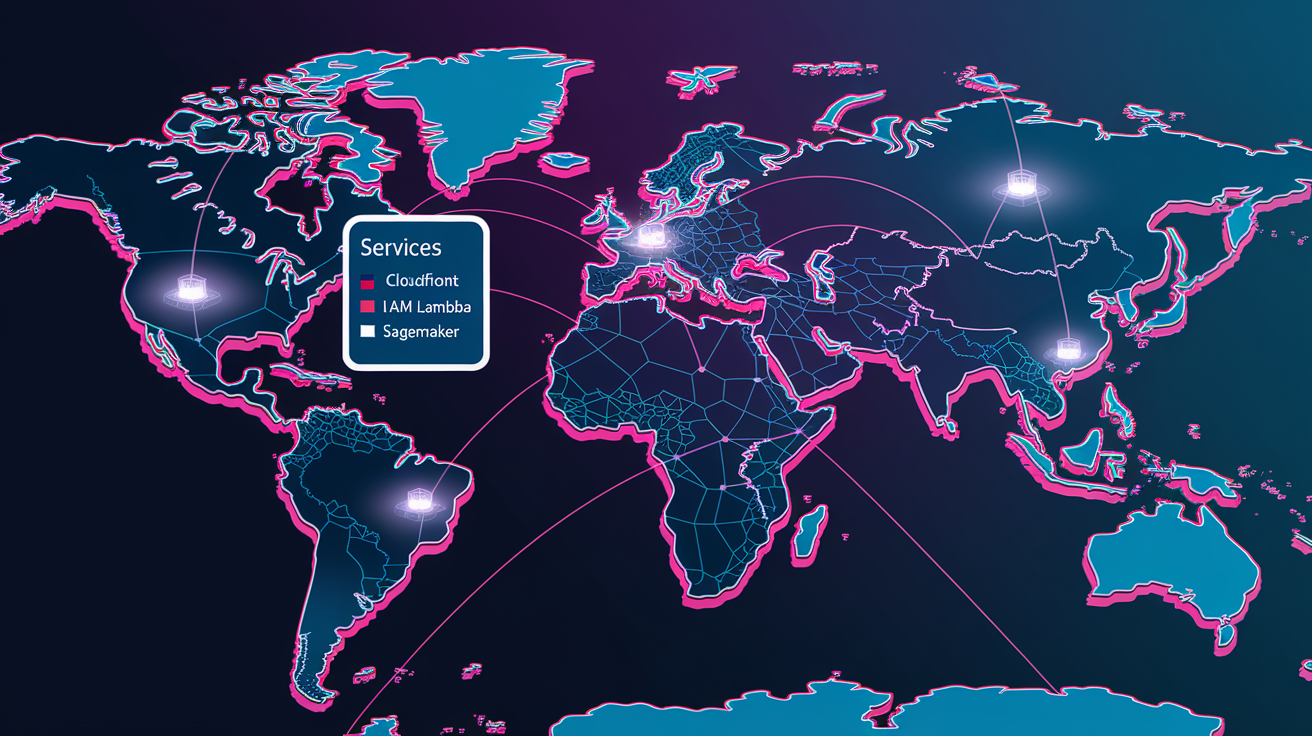
AWS established global data centers in different regions to allow customers to deploy applications closer to end users. This reduced latency and improved performance for geographically distributed customers. The regional deployment strategy also addressed data sovereignty requirements where regulations mandated that certain data remain within specific geographic boundaries. The platform evolved from its initial compute and storage offerings to a comprehensive infrastructure ecosystem spanning hundreds of distinct services.
Between 2006 and 2010, AWS expanded beyond storage and compute to include databases with Amazon RDS (Relational Database Service) for managed MySQL, PostgreSQL, and Oracle databases. Content delivery through Amazon CloudFront for faster global content distribution. Security through AWS IAM (Identity and Access Management) for granular access controls. Additional services during this period included SimpleDB for NoSQL data storage and Elastic Block Store for persistent block-level storage volumes.
During 2010 through 2015, AWS launched Amazon Redshift for data warehousing and analytics workloads. AWS Lambda for serverless computing that eliminated the need to provision or manage servers entirely. The AWS Marketplace was introduced to enable third-party vendors to offer complementary software and services, creating an ecosystem where customers could find pre-configured applications and tools. AWS launched Amazon SageMaker for machine learning capabilities, making advanced AI accessible to developers without specialized data science expertise. Amazon Aurora emerged as a MySQL and PostgreSQL compatible database built specifically for cloud infrastructure with better performance and reliability than standard implementations.
| Service Category | Key Services |
|---|---|
| Database Services | Amazon RDS, Amazon Redshift, Amazon Aurora, SimpleDB |
| Content Delivery | Amazon CloudFront (CDN) |
| Security & Identity | AWS IAM (Identity and Access Management) |
| Serverless Computing | AWS Lambda |
| Machine Learning | Amazon SageMaker |
| Marketplace Ecosystem | AWS Marketplace for third-party integrations |
AWS currently offers over 200 fully-featured services from data centers globally, demonstrating the platform’s maturity and comprehensive capabilities. The company earned compliance certifications including FedRAMP for U.S. government workloads, HIPAA for healthcare data, and PCI DSS for payment processing. This enabled adoption by government agencies and regulated industries. AWS implemented data privacy controls and regional data sovereignty options that allowed customers to specify exactly where their data physically resided. Service level agreements guaranteed specific uptime percentages with financial credits if AWS failed to meet reliability standards. This addressed enterprise concerns about cloud reliability and gave risk-averse organizations confidence to migrate critical workloads from on-premises infrastructure to cloud services.
Final Words
Amazon started cloud services in August 2006 with the official AWS launch, but the journey began years earlier with internal infrastructure challenges around 2000.
What started as a solution to Amazon’s own scaling problems became the foundation for modern cloud computing. The 2003 executive retreat vision of an “operating system for the internet” transformed into a platform serving millions of customers globally.
AWS’s multi-year head start, combined with rapid service expansion from basic compute and storage to over 200 services, established market leadership that continues today. The pay-as-you-go model and global infrastructure made enterprise cloud adoption practical and cost-effective.
That 2006 launch didn’t just create a new business line. It fundamentally changed how organizations build, deploy, and scale technology.
FAQ
Q: Who is AWS’ biggest competitor?
A: AWS’s biggest competitors are Microsoft Azure and Google Cloud Platform. By 2016, AWS held over 30 percent cloud market share, exceeding the combined share of Microsoft, IBM, and Google. It took several years after AWS’s 2006 launch before these major competitors responded with their own cloud platforms.
Q: Who is AWS owned by?
A: AWS is owned by Amazon and operates as a subsidiary of the company. Amazon Web Services officially launched in August 2006, building on internal infrastructure Amazon developed to solve its own e-commerce scaling problems beginning around 2000.
Q: Did Jeff Bezos make AWS?
A: Jeff Bezos led the strategic decision to create AWS at a 2003 executive retreat at his house, where leadership identified infrastructure services as a core competency. Andy Jassy, who served as Bezos’ chief of staff, became AWS CEO and led the development from concept through the 2006 launch.
Q: Why is AWS called cloud?
A: AWS is called cloud because it delivers computing resources over the internet on a pay-as-you-go model, eliminating the need for physical hardware ownership. The term “cloud computing” emerged as virtualization technologies from the 1990s-2000s enabled multiple virtual machines to run remotely on shared physical servers.