
Think a quarterly pen test keeps you safe? Think again.
Vulnerability management isn’t a once-and-done audit.
It’s an ongoing program that finds, scores, prioritizes, fixes, and verifies security gaps across apps, servers, cloud workloads, and devices.
With tens of thousands of new flaws published each year and exploit activity rising fast, teams from developers to security ops face a flood of risk they can’t ignore.
This post shows what vulnerability management is, why it matters, who it’s for, and how to build a continuous program that turns noisy scan data into prioritized action.
Core Definition and Purpose of Vulnerability Management

Vulnerability management is an ongoing cybersecurity discipline that identifies, evaluates, prioritizes, fixes, verifies, and tracks security weaknesses across everything an organization runs: endpoints, servers, cloud workloads, apps, network gear. It’s not a one-time audit or a pen test you schedule once a quarter. It’s an always-on process that hunts down exploitable gaps before attackers can use them.
The approach combines automated scanning, threat intel, risk scores, and remediation workflows to keep a live, accurate picture of where you’re exposed.
Here’s the scale: in 2023 alone, over 29,000 new vulnerabilities landed in the National Vulnerability Database (NVD), which has been cataloging flaws since 2005. But get this: a 2024 industry report showed that vulnerability exploitation jumped 180 percent year over year. Attackers are moving faster to weaponize fresh disclosures.
Despite the flood of CVEs, research shows only about 2.7 percent of critical-rated vulnerabilities actually get exploited in the wild. Which means you can’t just panic-patch everything labeled “critical.” You need context-aware prioritization, not knee-jerk reactions to every published flaw.
Modern vulnerability management leans on standardized classification to measure severity and likelihood. The Common Vulnerability Scoring System (CVSS) assigns each weakness a number from 0.0 to 10.0, bucketing them into low, medium, high, or critical. Meanwhile, the Exploit Prediction Scoring System (EPSS) estimates the odds a specific vulnerability will be exploited within the next 30 days. It’s intelligence that complements CVSS severity. Organizations also reference the Known Exploited Vulnerabilities (KVE) catalog, launched in 2021, which tracks CVEs that threat actors are actively using.
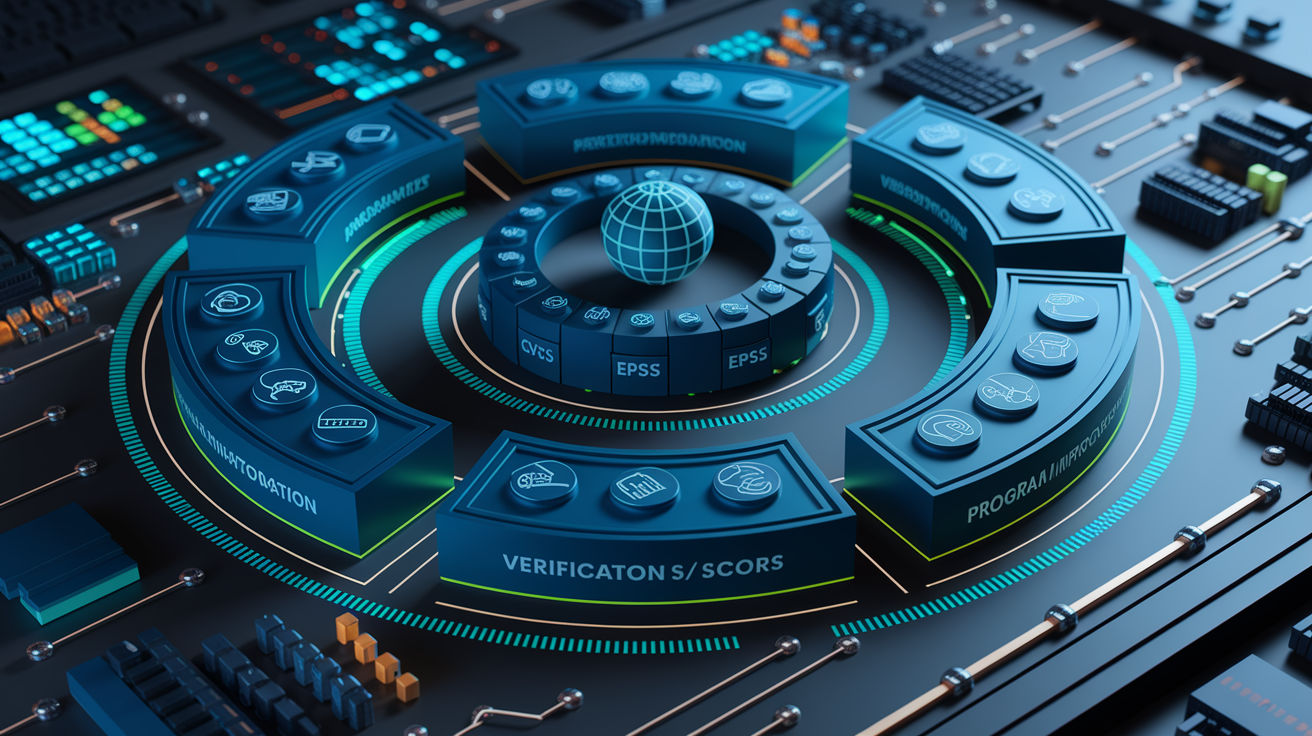
At the center, the vulnerability management lifecycle repeats in a loop:
Identify – Find assets and scan for known weaknesses everywhere.
Evaluate and Prioritize – Score vulnerabilities using CVSS, EPSS, and real-world context like internet exposure or access to sensitive data.
Treat – Fix via patches, reduce risk through compensating controls, or formally accept what’s left with documentation.
Verify and Monitor – Re-scan to confirm fixes stuck, then watch continuously for new exposures or configuration drift.
Key Components Within a Vulnerability Management Program

Before you can scan or remediate anything, you need infrastructure and data. Asset inventory is the foundation. Organizations must keep a complete, real-time catalog of endpoints, servers, VMs, containers, cloud workloads, unmanaged devices, shadow IT, IoT systems. Without full visibility, blind spots turn into unmonitored attack paths that adversaries will find.
Many programs combine internal asset discovery tools, cloud configuration management databases (CMDBs), and external attack surface management (EASM) platforms to get coverage across on-prem, hybrid, and multi-cloud setups.
Scanning comes in two types: authenticated and unauthenticated. Authenticated scanning uses credentials to dig deep into systems, spotting missing patches, insecure settings, and local vulnerabilities that external probes miss. Unauthenticated scanning mimics an attacker’s view, probing externally visible services without credentials to reveal internet-facing exposures and misconfigs. You need both for a full picture. A lot of organizations run continuous or daily scans instead of waiting for quarterly snapshots.
Core program pieces:
- Asset Inventory and Classification – Keep a dynamic inventory that tags assets by business importance, data sensitivity, and exposure level.
- Vulnerability Databases and Threat Intelligence – Pull feeds from the National Vulnerability Database (NVD), Common Vulnerabilities and Exposures (CVE) program, and Known Exploited Vulnerabilities (KVE) catalog to match discovered flaws with global threat data.
- Automated Scanning Infrastructure – Deploy internal and external scanners that handle authenticated and unauthenticated checks across endpoints, cloud APIs, containers, and network devices.
- Contextual Risk Enrichment – Layer business context (asset importance, data classification, compliance needs) onto raw scan results so you can prioritize what matters.
- Centralized Reporting and Workflow Integration – Connect scan outputs to ticketing systems, patch platforms, and security information and event management (SIEM) tools to track remediation and hold teams accountable.
Vulnerability Management Stages and Lifecycle Workflow
Identification
Identification means comprehensive asset discovery and vulnerability detection across your entire IT estate. Organizations deploy automated scanners that probe systems for known weaknesses, missing patches, misconfigs, and outdated software. Authenticated scans log in with read-only credentials to inspect installed packages, registry keys, and config files. Unauthentated scans test publicly accessible services and network perimeters.
Cloud environments need specialized scanning agents or agentless API integrations to assess serverless functions, managed databases, storage buckets, and infrastructure-as-code templates. External attack surface management (EASM) tools continuously crawl internet-facing assets to catch shadow IT, forgotten subdomains, and exposed admin interfaces that internal scans miss.
Asset classification during this stage tags each system with metadata: business unit, data sensitivity, compliance scope, criticality. That metadata feeds prioritization decisions later.
Evaluation and Prioritization
Once you’ve identified vulnerabilities, evaluation scores and ranks them to figure out what needs immediate attention. The Common Vulnerability Scoring System (CVSS) assigns a base score from 0.0 to 10.0, mapping to severity buckets: low (0.1–3.9), medium (4.0–6.9), high (7.0–8.9), and critical (9.0–10.0). CVSS metrics group into Base (inherent characteristics), Temporal (exploit maturity, remediation availability), and Environmental (organizational impact).
But raw CVSS scores alone can mislead. Remember, only about 2.7 percent of critical-rated CVEs get exploited in practice.
To sharpen prioritization, teams layer on the Exploit Prediction Scoring System (EPSS), which forecasts the probability a vulnerability will be exploited within the next 30 days based on observed attacker behavior and threat intelligence. Contextual factors refine rankings further: internet-facing exposure, access to sensitive data or credentials, lateral movement potential, and business criticality all bump a vulnerability’s real-world risk beyond its CVSS number.
Remediation and Mitigation
During remediation, security and IT teams pick one of three response paths. Remediation means applying vendor patches, upgrading to a fixed software version, or reconfiguring the system to eliminate the flaw completely. Automated patch management platforms can push critical updates on set schedules or emergency timelines, cutting down the exposure window.
When immediate patching isn’t realistic (compatibility concerns, maintenance windows, legacy system constraints), mitigation steps reduce exploitability without removing the vulnerability. Common mitigations: network segmentation to isolate affected systems, firewall rules that block attack vectors, disabling unnecessary services, or deploying intrusion prevention signatures.
In limited cases, organizations formally accept low-priority vulnerabilities, documenting the residual risk and compensating controls in a risk register to satisfy audit and compliance requirements. Service-level agreements (SLAs) typically mandate remediation timelines: critical vulnerabilities within 15 days, high within 30, medium within 90, and low vulnerabilities addressed when convenient.
Verification and Continuous Monitoring
After remediation or mitigation actions go live, verification confirms the fix worked and the vulnerability is gone. Teams re-scan affected systems to validate patches installed correctly, configs changed as intended, and the weakness no longer shows up in scan results.
Continuous monitoring extends beyond one-time validation. It runs 24/7/365 scanning and real-time configuration drift detection to catch new vulnerabilities introduced by software updates, infrastructure changes, or newly disclosed CVEs. Cloud workloads, containers, and serverless functions demand especially frequent monitoring, since deployment pipelines can introduce or reintroduce flaws within minutes.
Endpoint detection and response (EDR) platforms and cloud workload protection platforms (CWPP) provide runtime visibility, alerting teams if a vulnerability reappears or an exploit attempt is detected. Periodic penetration testing complements automated scans by simulating adversary tactics and checking that layered defenses hold under realistic attack conditions.
Reporting and Program Improvement
The final stage captures metrics, generates reports, and feeds lessons learned back into process improvements. Key performance indicators (KPIs) include mean time to remediate (MTTR) for critical vulnerabilities, overall patching rate (percentage of known flaws fixed within SLA), time-to-detect (how quickly new vulnerabilities are discovered post-disclosure), and average age of open vulnerabilities across the environment.
Dashboards consolidate these metrics for security leadership and executives, providing risk heatmaps, trend analysis, and exception tracking. Comprehensive reporting supports regulatory compliance audits (ISO 27001, HIPAA, PCI-DSS, SOC 2) by documenting vulnerability counts, remediation timelines, and risk-acceptance decisions.
Continuous improvement cycles analyze patterns like recurring misconfigs, slow patching in specific business units, or blind spots in asset discovery. They drive automation enhancements, policy updates, and cross-team collaboration. Governance frameworks, including Gartner’s pre-work guidance, recommend establishing clear program scope, roles and responsibilities, tool selection criteria, remediation SLAs, and authoritative asset-context sources before launching the lifecycle.
| Stage | Core Activities |
|---|---|
| Identification | Asset discovery, authenticated and unauthenticated scanning, cloud API assessment, EASM for external exposure |
| Evaluation and Prioritization | CVSS scoring (0.0–10.0), EPSS likelihood estimation, contextual risk factors (internet exposure, data sensitivity, lateral movement) |
| Remediation and Mitigation | Patch deployment, configuration hardening, network segmentation, firewall rules, risk acceptance with documentation |
| Verification and Monitoring | Re-scan after remediation, continuous 24/7/365 monitoring, EDR/CWPP runtime protection, periodic penetration testing |
Prioritization Models and Risk Scoring in Vulnerability Management

Effective prioritization balances objective severity metrics with contextual threat intelligence and business impact. The Common Vulnerability Scoring System (CVSS) provides a universal language for rating vulnerability severity, dividing each flaw into Base, Temporal, and Environmental metric groups.
Base metrics capture intrinsic characteristics: attack vector (network, adjacent, local, physical), attack complexity, privileges required, user interaction, and impact to confidentiality, integrity, and availability. Temporal metrics adjust the score based on exploit maturity (proof-of-concept available, functional exploit code, or weaponized malware) and the availability of official patches. Environmental metrics let organizations customize scores based on asset criticality, deployed compensating controls, and the presence of sensitive data.
But because only around 2.7 percent of critical-rated CVEs actually get exploited in the wild, relying solely on CVSS scores can overwhelm teams with false urgency.
To sharpen prioritization, security teams integrate the Exploit Prediction Scoring System (EPSS), which uses machine learning to estimate the probability that a specific CVE will be exploited within the next 30 days. EPSS draws on real-world exploit observations, underground forum chatter, proof-of-concept publication timelines, and attacker targeting patterns to generate a percentage likelihood.
When combined with CVSS, EPSS helps teams focus remediation effort on flaws that are both severe and actively targeted. Contextual factors refine the queue further: internet-facing exposure (web servers, VPNs, APIs), access to sensitive data (PII, financial records, secrets), lateral movement potential (domain controllers, jump hosts), and business continuity impact (payment systems, manufacturing control systems).
Comparing Scoring Systems
CVSS, EPSS, and contextual scoring each serve distinct but complementary roles. CVSS measures technical severity and potential impact if a flaw is successfully exploited. It answers “how bad could this be?” EPSS forecasts the likelihood an attacker will attempt exploitation in the near term. It answers “how likely is this to be targeted?”
Contextual scoring layers organizational risk onto these universal metrics, accounting for asset importance, exposure, data sensitivity, and existing defenses. It answers “what does this mean for our specific environment?”
Mature programs use all three lenses together. A high-CVSS vulnerability with low EPSS on an internal, non-critical test server may rank below a medium-CVSS flaw with high EPSS on an internet-facing production database. By triangulating severity, likelihood, and context, teams allocate remediation resources to the vulnerabilities that pose the greatest real-world risk.
Essential prioritization criteria:
Internet exposure and attack surface – Flaws on public-facing services rank higher than identical issues on isolated internal systems.
Exploit availability and active exploitation – Vulnerabilities listed in the Known Exploited Vulnerabilities (KVE) catalog or with published proof-of-concept code demand immediate action.
Impact to business operations – Vulnerabilities affecting revenue-generating applications, customer-facing services, or regulatory-critical systems receive elevated priority regardless of CVSS score.
Tools and Technologies Used in Vulnerability Management
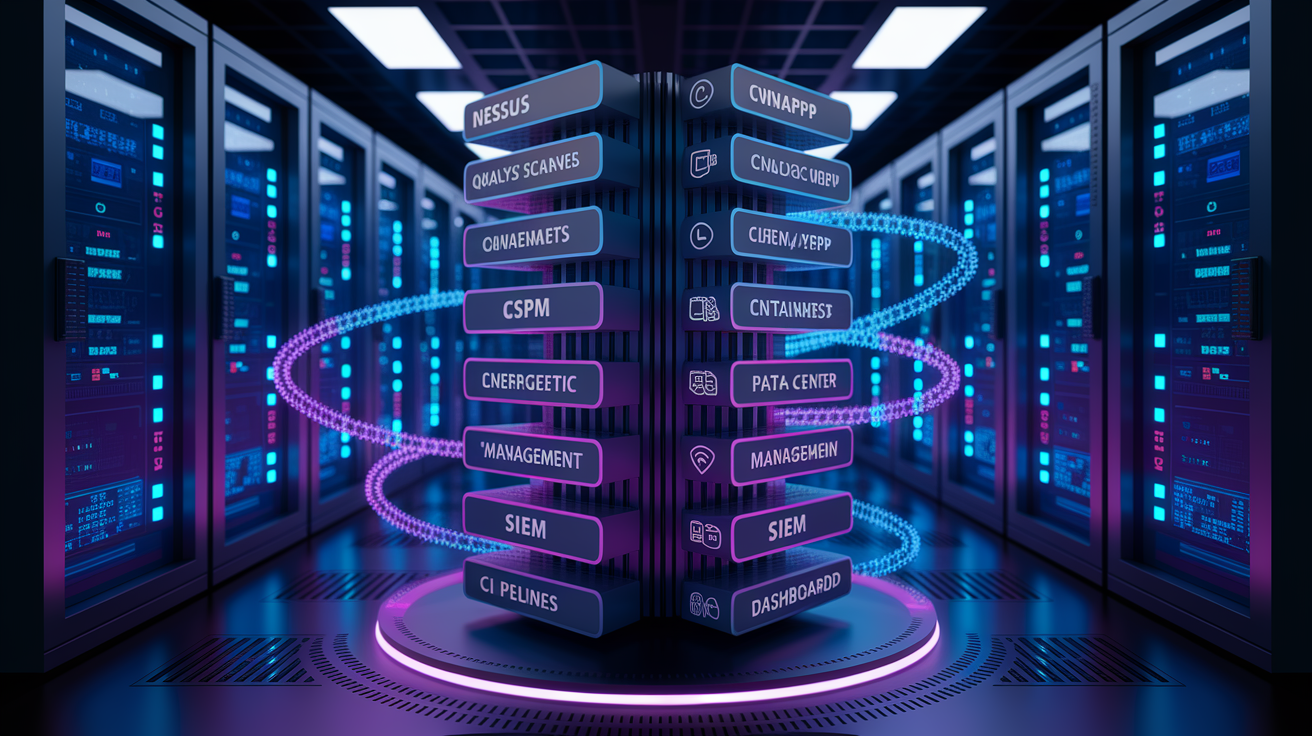
Organizations deploy a layered technology stack to support continuous vulnerability management across hybrid and multi-cloud environments. Vulnerability scanners form the core detection engine, with platforms such as Tenable Nessus, Qualys, and Rapid7 InsightVM performing authenticated and unauthenticated assessments of endpoints, servers, network devices, and web applications.
Cloud Security Posture Management (CSPM) solutions monitor cloud infrastructure for misconfigs: publicly accessible storage buckets, overly permissive IAM roles, missing encryption. Cloud Workload Protection Platforms (CWPP) use agents or kernel-level sensors inside virtual machines, containers, and serverless functions to detect runtime vulnerabilities, insecure libraries, and anomalous behavior.
Cloud-Native Application Protection Platforms (CNAPP) unify CSPM, CWPP, and Cloud Infrastructure Entitlement Management (CIEM) into a single control plane, providing 100 percent coverage of cloud estates with context-aware risk scoring.
Patch management solutions automate the deployment of vendor fixes across Windows, Linux, macOS, and third-party applications, enforcing remediation SLAs and reducing manual effort. Security Information and Event Management (SIEM) platforms aggregate vulnerability scan results alongside logs, alerts, and threat intelligence feeds, correlating discovered flaws with active attack indicators and enabling prioritized incident response.
Continuous integration and continuous deployment (CI/CD) pipelines integrate Software Composition Analysis (SCA) and Static Application Security Testing (SAST) tools to detect vulnerable open-source libraries and insecure code patterns before applications reach production. External attack surface management (EASM) platforms continuously crawl internet-facing assets, discovering shadow IT, forgotten subdomains, expired certificates, and exposed administrative interfaces that internal scans can’t see.
Advanced capabilities increasingly rely on automation and AI-driven remediation guidance. Modern CNAPPs and vulnerability platforms provide 24/7/365 scanning, attack-path analysis that maps how an attacker could chain multiple low-severity flaws into a critical breach, automated remediation rules that trigger patch deployments or firewall updates, and dashboards with downloadable compliance reports. Some platforms now use generative AI to produce step-by-step remediation instructions, Terraform or CloudFormation scripts to fix infrastructure-as-code misconfigs, and natural-language summaries of risk for executive audiences.
| Tool Type | Primary Use Case |
|---|---|
| Vulnerability Scanner | Detect known CVEs, missing patches, and misconfigurations across endpoints, servers, network devices, and web applications |
| CSPM (Cloud Security Posture Management) | Identify misconfigurations, overly permissive policies, and compliance drift in IaaS/PaaS environments |
| CWPP (Cloud Workload Protection Platform) | Agent-based runtime protection for VMs, containers, and serverless functions; detect vulnerabilities and anomalous behavior |
| CNAPP (Cloud-Native Application Protection Platform) | Unified platform combining CSPM, CWPP, CIEM, and API security for comprehensive cloud-native protection |
| Patch Management / SIEM | Automate vendor patch deployment; aggregate vulnerability data with logs and threat intelligence for prioritized response |
Comparing Vulnerability Management and Patch Management

Vulnerability management and patch management are related but distinct. Vulnerability management is the broader, continuous process that covers discovering assets, scanning for weaknesses, evaluating severity and exploitability, prioritizing remediation, verifying fixes, and reporting risk metrics across the entire attack surface. It addresses not only missing patches but also misconfigs, insecure default settings, weak credentials, exposed APIs, and architectural flaws.
The remediation decision tree includes three options: remediation (applying vendor patches or configuration fixes), mitigation (deploying compensating controls such as network segmentation or firewall rules), and acceptance (documenting residual risk when fixing is infeasible or cost-prohibitive).
Patch management is a narrower, operational subset focused specifically on acquiring, testing, and deploying vendor-supplied software updates across endpoints, servers, and applications. While patching is a critical remediation method, it’s only one tool in the vulnerability management toolkit.
For example, a zero-day vulnerability with no available patch may require mitigation through network isolation or intrusion prevention signatures until the vendor releases a fix. Legacy industrial control systems that can’t be patched without production downtime may require permanent compensating controls and continuous monitoring.
Effective vulnerability management programs integrate patch management as a key workflow but recognize that not every discovered flaw can or should be patched immediately.
Key distinctions:
Scope – Vulnerability management covers the full lifecycle (discover, assess, prioritize, remediate, verify, report); patch management focuses on deploying vendor fixes.
Remediation options – Vulnerability management uses patching, mitigation, and risk acceptance; patch management exclusively applies software updates.
Strategic vs. tactical – Vulnerability management is a strategic, risk-based discipline; patch management is a tactical, operations-driven activity that supports the broader strategy.
Real-World Vulnerability Management Examples and Workflows

A typical vulnerability management workflow starts with continuous or scheduled scanning. Automated scanners run 24 hours a day, 7 days a week, 365 days a year across endpoints, servers, cloud workloads, and network devices, generating a real-time inventory of discovered flaws. Each detected vulnerability gets a CVSS score, maps to the organization’s asset inventory, and is enriched with EPSS exploit-likelihood predictions and threat intel indicating whether the flaw is listed in the Known Exploited Vulnerabilities (KVE) catalog.
Security teams then prioritize the queue, pushing internet-facing, high-EPSS, or business-critical vulnerabilities to the top of the remediation backlog.
For high-priority flaws, the team kicks off remediation by deploying vendor patches through automated patch management platforms, scheduling maintenance windows for sensitive production systems, or applying configuration changes to eliminate the weakness. When immediate patching isn’t possible (due to legacy system constraints or change-control requirements), the team implements mitigation controls such as segmenting the vulnerable device onto an isolated VLAN, applying firewall rules to block exploit vectors, or enabling application allowlisting to prevent unauthorized code execution.
All actions are logged in a centralized vulnerability management platform, generating audit trails, updating ticket statuses, and triggering automated re-scans to verify that the vulnerability no longer appears. Periodic penetration tests complement automated scans by checking that layered defenses hold under adversary simulation, uncovering logic flaws and attack chains that scanners miss.
A complete end-to-end workflow:
- Discover and scan – Continuous automated scanning identifies vulnerabilities and updates the asset inventory in real time.
- Score and prioritize – CVSS severity, EPSS likelihood, contextual risk factors (exposure, data sensitivity, business impact) rank the remediation queue.
- Assign and track – Vulnerabilities are routed to responsible teams via ticketing systems with defined SLAs (critical within 15 days, high within 30).
- Remediate, mitigate, or accept – Patches are deployed, compensating controls are applied, or residual risk is formally documented.
- Verify and re-scan – Automated re-scans confirm the flaw is resolved; continuous monitoring watches for reintroduction or new exposures.
- Report and improve – Dashboards track MTTR, patching rates, and open vulnerability counts; lessons learned feed process automation and policy updates.
Measuring Success: Metrics, Reporting, and Continuous Improvement

Effective vulnerability management programs rely on quantitative metrics to measure performance, demonstrate risk reduction, and guide continuous improvement. Mean time to remediate (MTTR) tracks the average duration from vulnerability discovery to successful fix, with leading organizations targeting 15 days or less for critical-rated CVEs and 30 days for high-severity flaws.
Patching rate calculates the percentage of known vulnerabilities closed within defined SLAs, providing a simple health indicator for executive dashboards. Time-to-detect measures how quickly new vulnerabilities are identified after public disclosure or vendor notification, with continuous scanning enabling detection within hours rather than weeks. Vulnerability age distribution reveals how many open flaws have been sitting there for 30, 60, 90, or more than 180 days, spotlighting process bottlenecks or resource constraints that delay remediation.
Comprehensive reporting supports both operational oversight and regulatory compliance. Vulnerability management platforms generate real-time dashboards that visualize open vulnerability counts by severity, affected business units, remediation status (open, in progress, mitigated, accepted), and trend lines showing risk reduction over time.
Downloadable reports export detailed findings, remediation timelines, and exception documentation to satisfy audits for ISO 27001, HIPAA, PCI-DSS, and SOC 2 frameworks. Executive risk summaries translate technical metrics into business language, presenting breach-likelihood scores, financial exposure estimates, and compliance posture for board-level communication.
Continuous improvement cycles analyze patterns in vulnerability data to refine processes and automation. Governance frameworks such as Gartner’s pre-work guidance recommend establishing five foundational elements before launching a formal program: determine the scope (which assets, networks, and applications are in-scope), define roles and responsibilities (who scans, who prioritizes, who patches, who verifies), select and deploy vulnerability assessment tools, create or refine remediation policies and SLAs, and identify authoritative asset-context sources (CMDBs, cloud asset inventories, business-unit mappings).
Regular retrospectives evaluate whether SLAs are realistic, whether prioritization models accurately predict exploited flaws, and whether automation opportunities can reduce manual work.
Essential metrics for tracking program maturity:
Mean time to remediate (MTTR) – Average days from discovery to verified fix, segmented by severity (critical, high, medium, low).
Patching rate – Percentage of discovered vulnerabilities successfully remediated within SLA timelines.
Time-to-detect – Speed of vulnerability discovery post-disclosure, measuring scanning frequency and coverage.
Vulnerability age and backlog – Distribution of open flaws by age (0–30 days, 31–60, 61–90, 90+ days) to identify remediation bottlenecks.
Final Words
Vulnerability management is a continuous cycle—identify, evaluate/prioritize, treat, verify, report—and it matters because the NVD logged >29,000 new vulnerabilities in 2023 and real-world exploitation rose about 180% in 2024. Use CVSS (0–10) and EPSS to score and judge risk.
Start with a solid asset inventory, run authenticated and unauthenticated scans, pull threat feeds, and automate where you can. Track MTTR, patching rate, and vulnerability age.
If you still ask what is vulnerability management, it’s the practical process that keeps systems safer—when you run it regularly, it pays off.
FAQ
Q: What are the 5 steps of vulnerability management?
A: The five steps of vulnerability management are identify, evaluate/prioritize, remediate (or mitigate), verify, and report — a continuous lifecycle. Some frameworks condense this into four stages: identify, prioritize, treat, verify/report.
Q: What are the 4 types of vulnerabilities?
A: The four types of vulnerabilities are software flaws, configuration errors, hardware/firmware weaknesses, and human or process vulnerabilities like social engineering, poor procedures, or missing controls.
Q: What are the top 10 vulnerabilities?
A: The “top 10” vulnerabilities usually refer to the OWASP Top 10 web risks: Broken Access Control, Cryptographic Failures, Injection, Insecure Design, Security Misconfiguration, Vulnerable Components, Identification/Authentication Failures, Integrity Failures, Logging/Monitoring Failures, and SSRF.