What if a 14-billion-parameter model can beat much larger rivals on math and reasoning?
Phi-4 Microsoft Model does just that by prioritizing data quality and training tricks over sheer scale, plus a 15B multimodal variant that adds mid-fusion vision for charts and screenshots.
This post explains Phi-4’s architecture, why its benchmarks matter, and practical access options via Azure AI Foundry and Hugging Face.
Read on to see the tradeoffs, real performance numbers, and what teams should do next.
Core Details of Microsoft’s Phi-4 Model and What It Offers

Microsoft’s Phi-4 is a 14-billion-parameter model built for complex reasoning and math tasks. Instead of chasing size, the company went hard on training efficiency and data quality. They claim Phi-4 beats similarly sized models (and even bigger ones) on math benchmarks. The whole idea is what Microsoft calls the “size versus quality frontier”—get top-tier reasoning without needing massive hardware.
Training mixed high-quality synthetic data with carefully picked organic datasets. Add some post-training tweaks that boosted reasoning strength. Math competition problems are where Phi-4 really shines, making it a solid pick for teams that want advanced reasoning without the compute costs of frontier models. There’s a technical paper on arXiv with full benchmark numbers if you want the detailed comparison.
You can grab Phi-4 through Azure AI Foundry or Hugging Face. Azure gives you built-in safety tools like prompt shields, protected-material detection, and groundedness checks, all through one API that works with any catalog model.
What stands out:
- 14 billion parameters tuned for complex reasoning, not general-purpose scale
- Math and reasoning performance proven on competition-level problem sets
- Quality training data that combines synthetic examples, curated datasets, and post-training refinement
- Dual availability on Azure AI Foundry (with safety features) and Hugging Face (for open experiments)
- Responsible AI features like evaluations, adversarial-prompt detection, and real-time monitoring
- Size-efficiency balance that delivers strong reasoning with lower compute and latency versus frontier models
Technical Architecture of Phi-4 and Related Reasoning-Vision Models
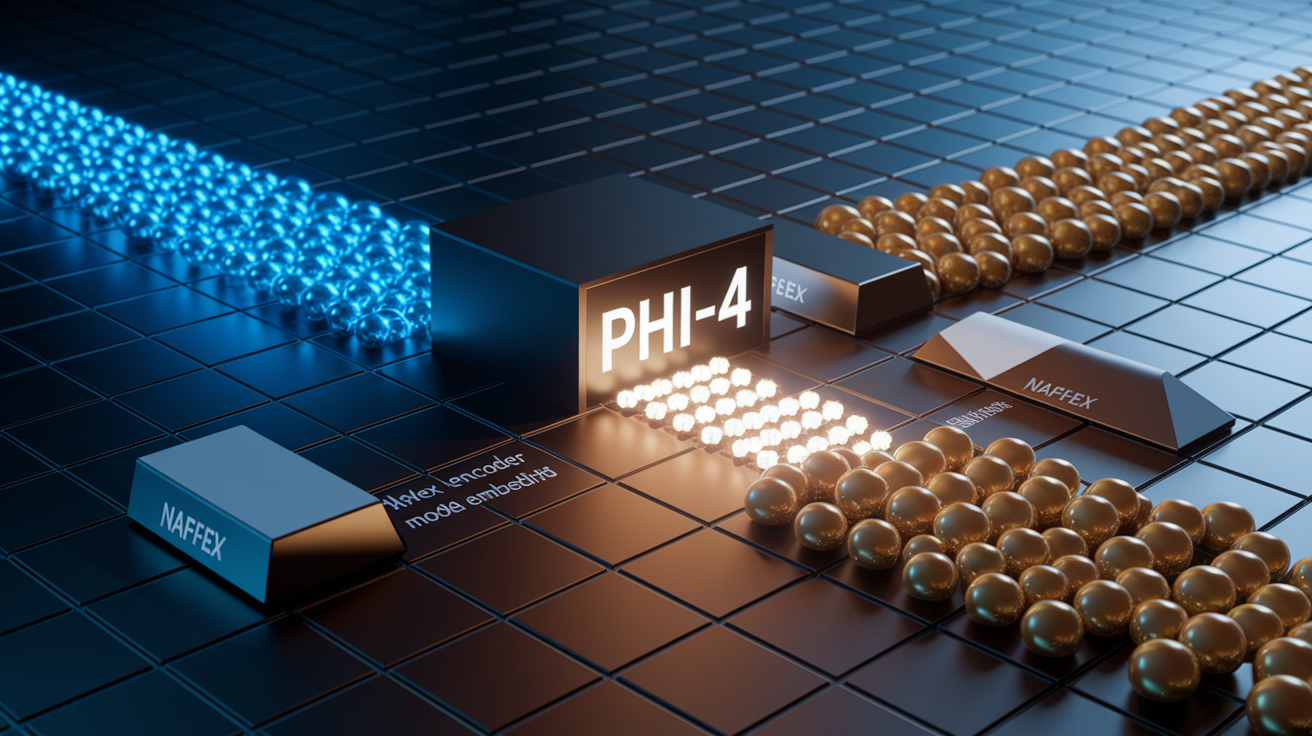
The Phi-4 family goes beyond pure language with Phi-4-Reasoning-Vision-15B, a 15-billion-parameter model trained on about 200 billion multimodal tokens. This builds on the core Phi-4-Reasoning backbone and adds a mid-fusion vision pipeline for text-plus-image inputs. Mid-fusion projects visual tokens from a pretrained encoder into the language model’s embedding space, keeping things compute-efficient while handling multimodal tasks. The design focuses on low-latency reasoning across structured visual formats—charts, diagrams, screenshots, handwritten math—while staying compact enough for interactive agent work.
Dynamic-resolution image processing helps the model handle high-res inputs without blowing up token counts. During development, Microsoft ran proxy experiments with 5-billion-parameter models to test cropping strategies, visual token budgets, and encoder choices. They compared token limits around 2,048 versus 3,600 and found that higher budgets (roughly 720p native resolution) gave measurable gains on benchmarks needing fine-grained perception, like GUI element grounding and high-res screenshot tasks.
Vision Encoder and Fusion Strategy
Microsoft picked SigLIP-2 Naflex as the vision encoder after systematic testing. Naflex is a dynamic-resolution variant that adapts to input dimensions instead of forcing fixed crops, which cuts information loss on non-square or weird-aspect-ratio images. Visual tokens get projected into the language model’s embedding space through a mid-fusion layer, so the model can attend over both text tokens and image features in shared representation. This fusion method proved more compute and memory efficient than early-fusion alternatives that just concatenate raw pixel grids. And it works with the pretrained Phi-4-Reasoning language backbone without breaking compatibility. The team tested multiple crop sizes—384×384 square tiles, larger 1,536×1,536 crops in S2 tiling variants—and found that dynamic-resolution encoders with multi-crop S2 processing delivered the best overall accuracy despite producing fewer average tokens per image.
Training Data Strategy Behind the Phi-4 Microsoft Model
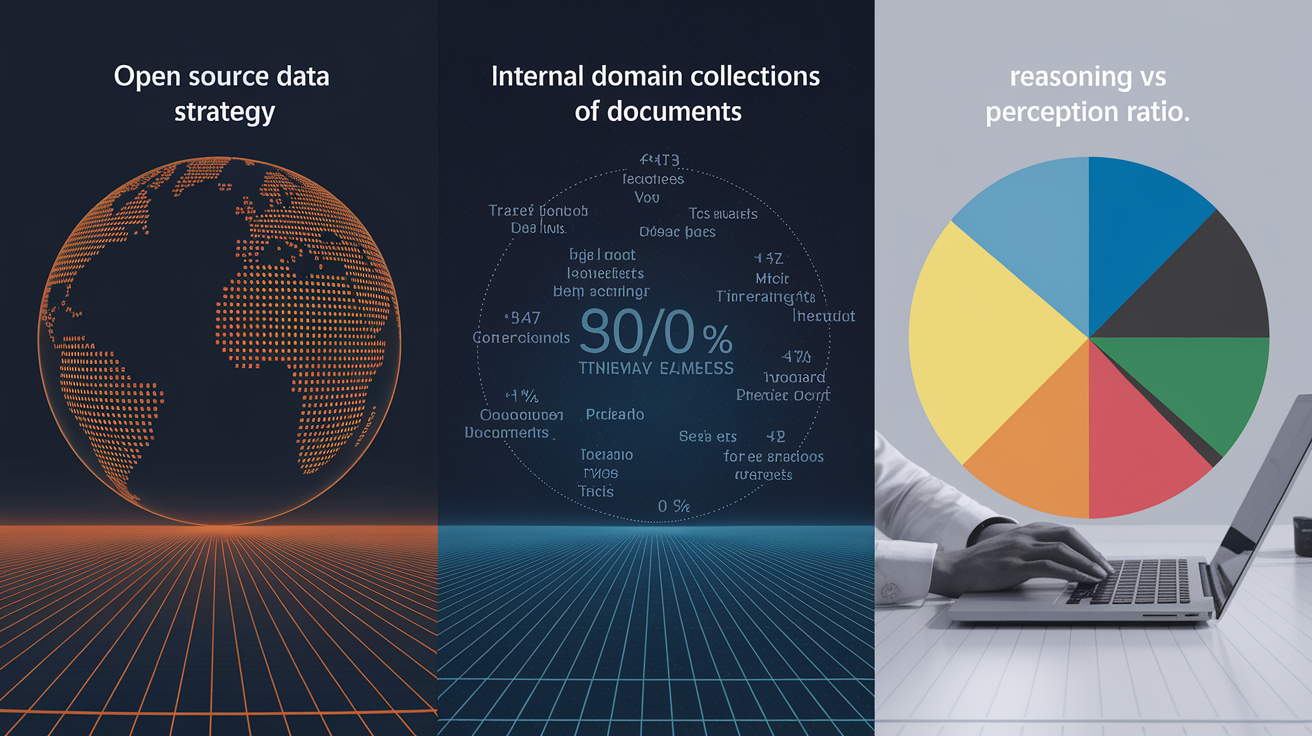
Phi-4’s performance comes down to data curation and quality control. Microsoft pulled from three main sources: heavily filtered open-source datasets (the bulk), high-quality internal and domain-specific collections, and targeted acquisitions like math problem sets and LaTeX-OCR samples from arXiv renderings. Every dataset got manual review, with annotators spending five to ten minutes per sample to classify quality and decide whether to fix it, exclude it, or accept it.
Remediation meant regenerating wrong answers with stronger language models, repurposing good images as seeds for synthetic captions and visual QA pairs, removing fundamentally broken datasets entirely, and fixing formatting or logic errors through programmatic passes. This hands-on process reduced label noise and improved signal-to-noise ratio in the final training corpus. Microsoft credits this as equally important as architectural choices.
The final multimodal training mix used about 20 percent reasoning samples (with chain-of-thought traces) and 80 percent non-reasoning perception-focused samples (direct captions, OCR, grounding tasks). Experiments on domain mixing—using a 5-billion-parameter proxy model—showed that increasing math and science data (up to three-times duplication) while holding computer-use data constant improved benchmarks across math, science, and GUI grounding tasks. Adding computer-use data didn’t hurt math or science performance, and vice versa, suggesting orthogonal skill development. Synthetic data played an augmentation role, generating text-rich images (charts, documents, diagrams, rendered equations) with corresponding grounded QA pairs to fill gaps in underrepresented visual formats.
Microsoft’s data curation workflow:
- Initial filtering to remove low-quality or irrelevant open-source records using automated heuristics and metadata checks.
- Manual review by annotators spending 5–10 minutes per sample to classify quality and flag issues.
- Remediation or exclusion based on review outcomes—regenerating answers, fixing formatting, or removing flawed datasets entirely.
- Synthetic augmentation to create additional text-rich visual examples (charts, diagrams, equations) with grounded QA pairs.
- Final composition balancing to hit the target 20/80 reasoning-to-perception ratio and cover math, science, GUI tasks, and general perception.
Performance Benchmarks and Evaluation Approach for Phi-4
Microsoft ran evaluations using Eureka ML Insights and VLMEvalKit frameworks with standardized settings: temperature 0.0, greedy decoding, and a max output token limit of 4,096 for Phi-4-Reasoning-Vision-15B. Third-party models were evaluated both with their recommended configs and under matched 4,096-token limits for fair comparison. The company ran its own benchmark tests instead of quoting leaderboard scores and plans to release evaluation logs publicly for reproducibility.
The mixed reasoning default mode—letting the model choose between chain-of-thought and direct responses based on task type—gave the best on-average accuracy across the benchmark suite. Only a small number of tasks benefited from forcing always-thinking or always-direct modes, suggesting that the 20/80 reasoning-perception training balance effectively taught the model when to apply multi-step reasoning and when to respond directly.
| Benchmark | Evaluation Setting | Notes |
|---|---|---|
| Math reasoning (competition tasks) | Temperature 0.0, greedy decoding, max 4096 tokens | Phi-4 shows strong performance on multi-step math problems; detailed scores in arXiv paper |
| GUI grounding (ScreenSpot-Pro) | Temperature 0.0, visual token budget ~3600 | High-resolution dynamic encoder delivers substantial gains on fine-grained element localization |
| High-resolution tasks (chart/diagram interpretation) | Naflex dynamic-resolution encoder, multi-crop S2 tiling | Outperforms fixed-crop baselines on tasks requiring detailed spatial reasoning |
| General language reasoning (MMLU-related) | Matched settings with third-party models, cross-checked with VLMEvalKit | Competitive with similarly sized models; see technical paper for numeric comparisons |
Comparing Phi-4 to Phi-3 and Larger Model Families
Phi-4 is a 14-billion-parameter model, with the multimodal variant Phi-4-Reasoning-Vision-15B sitting slightly larger. Earlier Phi models ranged from 1.3 billion (Phi-1) and 2.7 billion (Phi-2) to roughly 14 billion for Phi-3 and the initial Phi-4 language iterations. Microsoft positions Phi-4 as a step change in reasoning capability versus those predecessors, claiming it beats not only similarly sized models but also some larger alternatives on math and structured-reasoning benchmarks.
Phi-3.5-mini was optimized specifically for Windows Copilot+ PCs, targeting on-device deployment with tight latency constraints. Phi-4 extends that efficiency thinking to server and cloud contexts, where reasoning quality matters but massive frontier-model overhead isn’t practical. Competitors such as Qwen 2.5, Qwen 3, Kimi-VL, and Gemma 3 trained on datasets exceeding one trillion tokens, while Phi-4-Reasoning-Vision-15B used roughly 200 billion multimodal tokens—five to ten times less data—highlighting Microsoft’s emphasis on curation over volume.
The comparison shows several tradeoffs:
- Parameter efficiency: Phi-4 delivers reasoning gains without scaling to hundreds of billions of parameters.
- Data efficiency: Training on 200 billion multimodal tokens versus competitors’ trillion-token regimes reduces compute cost and time.
- Speed versus depth: Phi-4 offers faster inference than frontier models while staying competitive on complex reasoning tasks.
- Deployment flexibility: Available both as open weights (MIT license for the multimodal variant) and through Azure AI Foundry’s managed infrastructure.
- Benchmark positioning: Frontier models still lead on the most demanding benchmarks, but Phi-4 occupies a favorable point on the accuracy-versus-compute curve for teams that prioritize practical deployment over absolute top scores.
Deploying the Phi-4 Microsoft Model on Azure and Hugging Face

Phi-4 is available on Azure AI Foundry and Hugging Face, giving developers both managed cloud infrastructure and open-weight experimentation paths. Azure integration includes built-in evaluation metrics, prompt shields to block adversarial inputs, protected-material detection to prevent copyright violations, and groundedness detection to reduce hallucinations. All content-safety features work through a single API and can filter outputs from any model in the Azure catalog, not just Phi-4. Production monitoring adds quality and safety checks, adversarial-prompt detection, data-integrity monitoring, and real-time alerts for anomalous behavior.
The multimodal Phi-4-Reasoning-Vision-15B variant ships with an MIT license and open weights, published on Hugging Face, GitHub, and Microsoft’s AI Foundry for external experimentation. This openness lets researchers reproduce results, fine-tune on domain-specific data, and integrate the model into custom agent pipelines without vendor lock-in.
Integrating Phi-4 via Azure AI Foundry’s API:
- Create an Azure AI Foundry workspace and provision the Phi-4 model from the catalog (select deployment region and compute tier).
- Generate an API key from the workspace’s security settings and store it securely for authentication.
- Configure content-safety filters by enabling prompt shields, protected-material detection, and groundedness checks through the Foundry safety configuration panel.
- Set up monitoring and alerts using the production-monitoring dashboard to track latency, token usage, adversarial-prompt attempts, and quality metrics.
- Send inference requests via REST or SDK using the endpoint URL, API key, and a JSON payload containing the prompt (and image URLs for multimodal inputs).
- Review evaluation logs in Eureka ML Insights or export them for offline analysis to validate accuracy, measure hallucination rates, and iterate on prompt templates.
Runtime Modes, Prompt Control, and Developer Workflows for Phi-4
The reasoning-vision model supports three runtime modes: hybrid (default), think (always chain-of-thought), and nothink (always direct response). Hybrid mode lets the model decide when to produce multi-step reasoning and when to answer directly, balancing accuracy and latency. Think mode forces chain-of-thought for every query, useful when you need explainability or want to debug complex logic. Nothink mode skips reasoning traces entirely, reducing output tokens and inference time—perfect for sub-second GUI element grounding or rapid-fire captioning tasks.
Prompt tokens can override the default behavior. If the model tends to reason when you need speed, add an explicit instruction like “Answer directly without explanation.” If it skips reasoning on a math problem, try “Think step-by-step before answering.” The training mix—20 percent reasoning samples with chain-of-thought, 80 percent direct-response samples—taught the model to recognize task types, but explicit prompting gives developers fine-grained control when defaults miss.
The mixed approach came from experiments showing that forcing always-thinking or always-not-thinking hurt on-average accuracy. Only a handful of benchmarks benefited from locking the mode, suggesting that the 20/80 split is a reasonable starting point for most workflows. Teams deploying the model in production should measure latency and accuracy tradeoffs with their own task distributions and adjust prompting strategies or mode selection accordingly.
Recommended prompt strategies for effective Phi-4 usage:
- Use explicit mode control when task requirements clearly favor speed or depth (“Answer directly” for grounding; “Explain your reasoning” for math).
- Provide structured input formats such as numbered lists or labeled sections when working with documents, charts, or multi-image inputs to help the model parse content.
- Use few-shot examples by including one or two sample question-answer pairs in the prompt to guide output format and reasoning style.
- Test hybrid mode first to establish baseline performance, then compare forced-thinking and forced-direct modes to identify tasks where overriding defaults improves results.
Practical Use Cases and Applications Enabled by Phi-4

Phi-4’s compact size and reasoning focus make it well-suited for interactive applications that need structured thinking across text and images. Image captioning and visual question-answering benefit from the model’s strong perception and grounding, while OCR and multi-image change detection tap into its ability to parse text-rich visuals like invoices, forms, and screenshots. Chart and document quantitative extraction tasks—pulling numbers from tables or reading data points from graphs—showcase Phi-4’s blend of vision and arithmetic reasoning.
Visual math problem solving handles handwritten equations, geometry diagrams, and word problems that combine text and images. GUI grounding for computer-using agents is a standout application: the model’s high-resolution perception and fine-grained element localization let agents identify buttons, text fields, and interactive elements on desktop, web, or mobile interfaces. Microsoft designed the model to run on modest hardware, making it practical for real-time agent workflows that need low-latency responses instead of frontier-model compute budgets.
Six primary use-case categories:
- Document and screenshot analysis for extracting structured data from invoices, forms, receipts, and application UI snapshots.
- Visual question-answering and captioning across general images, diagrams, and charts.
- Math and science problem solving with diagrams, handwritten notes, or multi-step reasoning over visual inputs.
- GUI grounding and agent control to identify interactive elements and execute actions in software environments.
- Chart and table interpretation for quantitative data extraction and trend analysis.
- Multi-image reasoning such as change detection, comparison tasks, or visual sequencing problems.
Safety, Alignment, and Governance for the Phi-4 Microsoft Model

Microsoft incorporated safety datasets and refusal examples during training to align Phi-4 with responsible AI principles. The model card provides usage guidance, known limitations, and recommended deployment practices, warning that Phi-4 hasn’t been evaluated for high-risk domains like medical diagnosis, legal advice, or fully autonomous financial actions. Developers are responsible for evaluating accuracy, safety, and fairness in their specific downstream contexts before using the model in sensitive applications.
Azure AI Foundry layers additional safety tooling on top of the base model. Prompt shields detect and block adversarial inputs designed to jailbreak or manipulate outputs. Protected-material detection scans for copyrighted content in training data or generated text. Groundedness detection reduces hallucinations by checking whether generated claims align with provided context or retrieved documents. All three features work through a single API and can filter any model in the Azure catalog, not just Phi-4, making them reusable across multi-model deployments.
Production monitoring adds real-time safeguards: adversarial-prompt detection flags suspicious input patterns, data-integrity monitoring checks for distribution shifts or anomalous token usage, and alert systems notify teams when quality or safety metrics cross predefined thresholds. These layers don’t eliminate the need for domain-specific evaluation—teams deploying in regulated industries or high-stakes environments must still conduct their own audits and bias testing—but they provide a baseline defense against common risks and a framework for continuous oversight during live operation.
Final Words
In the action, Phi-4 is a 14B-parameter model tuned for math and complex reasoning, with multimodal variants. This piece covered core details, architecture, training data, benchmarks, comparisons, deployment paths, runtime modes, use cases, and safety tooling.
If you’re evaluating it, test on Azure or Hugging Face, run the benchmark settings described, and enable prompt shields and groundedness checks. Pick the runtime mode that matches your latency and accuracy needs.
The phi-4 microsoft model delivers compact, strong reasoning and vision abilities—worth testing in real projects.
FAQ
Q: What is Microsoft’s Phi‑4 model?
A: Microsoft’s Phi‑4 model is a 14B‑parameter language model optimized for complex reasoning and math, offering improved benchmark performance and available through Azure AI Foundry and Hugging Face.
Q: What makes Phi‑4 notable for reasoning and math?
A: Phi‑4’s strength for reasoning and math comes from targeted training, synthetic math datasets, and post‑training tweaks that boost performance on competition problems and related benchmarks.
Q: What parameter sizes and variants exist for Phi‑4?
A: Phi‑4’s core model is 14B parameters; related variants include Phi‑4‑Reasoning‑Vision at about 15B, optimized for multimodal reasoning and higher‑resolution visual tasks.
Q: How does Phi‑4’s architecture support multimodal reasoning?
A: Phi‑4’s architecture supports multimodal reasoning via a backbone built on Phi‑4‑Reasoning, dynamic‑resolution image handling, and tested visual token budgets to balance context and detail.
Q: What is the vision encoder and fusion strategy in Phi‑4‑Reasoning‑Vision‑15B?
A: The vision encoder and fusion strategy use a mid‑fusion design with a SigLIP‑2 Naflex encoder, projecting vision tokens into the reasoning backbone to mix visual and language signals effectively.
Q: What training data strategy did Microsoft use for Phi‑4?
A: Microsoft’s Phi‑4 training strategy mixed filtered open datasets, high‑quality internal data, and synthetic augmentations, focusing on rigorous manual review and a multimodal balance favoring perception data.
Q: What are the main steps in Microsoft’s data curation workflow?
A: Microsoft’s data curation workflow collects high‑quality sources, filters and samples, performs manual review, adds targeted acquisitions (math/LaTeX), then applies synthetic augmentation and final dataset mixing.
Q: How did Phi‑4 perform in benchmarks and evaluation?
A: Phi‑4 showed wins on complex reasoning and math benchmarks using standardized evaluation (temperature 0.0, greedy decoding, max 4096 tokens), with mixed‑reasoning settings giving the best average accuracy.
Q: How does Phi‑4 compare to Phi‑3 and larger model families?
A: Phi‑4 (14B) outperforms similarly sized and some larger models on reasoning tasks, while competitors trained on far larger token counts; Phi‑4 focuses on size‑quality improvements rather than sheer scale.
Q: How can I deploy Phi‑4 on Azure or Hugging Face?
A: You can deploy Phi‑4 via Azure AI Foundry or Hugging Face; Azure adds single‑API access, safety tooling (prompt shields, groundedness checks), monitoring, and model evaluation features.
Q: What runtime modes and prompt controls does Phi‑4 offer?
A: Phi‑4 offers three runtime modes—hybrid, think, and nothink—where reasoning mode uses chain‑of‑thought tokens and prompt tokens can override defaults to trade latency for depth.
Q: What practical applications is Phi‑4 suited for?
A: Phi‑4 suits visual question answering, OCR, chart and document extraction, visual math problem solving, multi‑image change detection, and GUI grounding for agents on modest hardware.
Q: What safety, alignment, and governance features are available for Phi‑4?
A: Phi‑4 includes safety dataset mixes, refusal examples, Azure prompt shields, protected‑material detection, groundedness checks, adversarial‑prompt detection, and real‑time monitoring; it isn’t cleared for high‑risk domain use.