Will OpenAI actually announce GPT-5 next month — or is that just wishful thinking?
OpenAI hasn’t published a firm release date, but public hints and internal testing point to late-stage work and possible near-term rollout.
This post cuts through the rumors to show what OpenAI has officially said, what evidence supports timing guesses, and which claims are still unverified.
You’ll get a clear timeline snapshot, likely features to expect, and practical next steps for developers, IT teams, and product managers.
Current Status of GPT-5 and Official Release Information

OpenAI hasn’t announced an official release date for GPT-5. There’s no formal launch timeline, no confirmed month, nothing tied to a specific calendar event. Sam Altman confirmed in early 2024 that GPT-5 was actively in training but made it clear the model wasn’t ready yet. Then in July 2025, Altman posted that GPT-5 would arrive “soon” and showed it off during a public appearance. He described watching it solve a problem he couldn’t answer himself, which left him with what he called a “weird feeling” about what the AI could do. Those are the most direct signals we’ve gotten from OpenAI, but still no firm date.
There are signs that a release might be close. Engineers reportedly started working on server capacity in late May 2025. Configuration strings like “gpt-5-reasoning-alpha-2025-07-13” have shown up in code repositories, pointing to active testing and versioning. Security teams are running red-teaming exercises to find vulnerabilities, and testers have access to internal builds. But OpenAI’s sticking to its usual approach: they won’t share release details until internal safety evaluations hit their targets and alignment reviews are done.
Here’s what you actually know if you’re tracking GPT-5: there are strong hints, preparation is visible, and leadership language suggests it’s coming soon. But no single formal announcement with a date exists. All the specific month-and-year predictions you see online? Unconfirmed.
GPT-5 Development Progress and Training Status

OpenAI confirmed GPT-5 entered training well before mid-2024. That process typically takes months of intensive compute work on specialized hardware clusters. Frontier model training at this scale isn’t just one big learning pass. It includes supervised fine-tuning, reinforcement learning from human feedback (RLHF), and newer reasoning-focused techniques designed to improve chain-of-thought behavior and multi-step problem solving.
Training infrastructure for GPT-5 reportedly includes NVIDIA H200 GPUs, which OpenAI started receiving in April 2024. They’re also preparing to integrate next-generation B100 and B200 accelerators as they become available throughout 2025. The compute runs on Microsoft’s AI supercomputing infrastructure, built specifically for workloads measured in exaFLOPs and petabyte-scale datasets. This level of hardware coordination takes months of preparation, scheduling, and optimization before any model can move from training to production.
Beyond raw compute, OpenAI’s internal pipeline includes adversarial testing, alignment checks, system card documentation, and phased rollout planning. Each stage is meant to catch failure modes like hallucinations, instruction-following breakdowns, bias amplification, and security risks before any public exposure. Only after these multi-layered evaluations reach acceptable thresholds does the company proceed to launch. That’s why training completion doesn’t equal immediate release, and why official timelines stay closely guarded until the final safety gates are cleared.
Historical Release Patterns of GPT Models
OpenAI’s major model releases have followed multi-year intervals shaped by advances in compute infrastructure, alignment research, and policy considerations. GPT-3 launched in June 2020 through a limited API and marked a leap in parameter count and zero-shot task performance. GPT-4 followed in March 2023, nearly three years later, bringing multimodal input capabilities, improved reasoning, and significantly better instruction following. Between those flagship releases, OpenAI shipped incremental updates like GPT-3.5 in late 2022, but reserved the integer version jumps for substantial architectural and capability shifts.
A few key facts:
GPT-3 released June 2020 with 175 billion parameters and API-only access. GPT-3.5 released November 2022 as the foundation for ChatGPT’s initial public version. GPT-4 released March 2023 with vision input, longer context windows, and improved safety tuning. The gap between GPT-3 and GPT-4 spanned roughly 33 months, reflecting the time required for compute scaling, safety work, and alignment iteration.
These intervals suggest major version releases aren’t annual events. They arrive when OpenAI concludes that the capability jump, safety controls, and infrastructure readiness align. That historical pattern provides context for understanding why GPT-5’s timeline remains uncertain even as development signals become visible.
Rumors and Industry Speculation About GPT-5

Industry speculation about GPT-5’s launch has ranged widely. Predictions place the release anywhere from late 2024 to mid-2026. These estimates stem from a mix of investor briefing leaks, remarks at AI conferences, infrastructure procurement timelines, and observation of OpenAI’s hiring and compute expansion. None of these predictions originate from official OpenAI channels, and many conflict with one another. Analysts tracking GPU shipment schedules, for example, pointed to NVIDIA B200 availability in 2025 as a possible gating factor. Others interpreted Sam Altman’s public comments in early 2024 as hinting at a shorter timeline.
One persistent rumor throughout 2024 suggested an August 2025 launch window. That speculation intensified in mid-2025 after an OpenAI research scientist reportedly said, “GPT-5 is coming,” and executive remarks described the model’s arrival as imminent. More recently, credible reports citing sources familiar with internal timelines have coalesced around August 2025 as a likely target. But no formal confirmation has validated that claim. These reports often reference the same closed-door testing activity and server preparation work that have become visible through code sightings and infrastructure updates.
You need to separate informed speculation from confirmed facts. Rumors can reflect real signals like executive hints, testing evidence, and procurement cycles. But until OpenAI issues a formal release statement, all date predictions remain unverified. The volume of speculation simply reflects the high interest in GPT-5 and the limited public information available about its launch schedule.
Expected Features and Capabilities of GPT-5
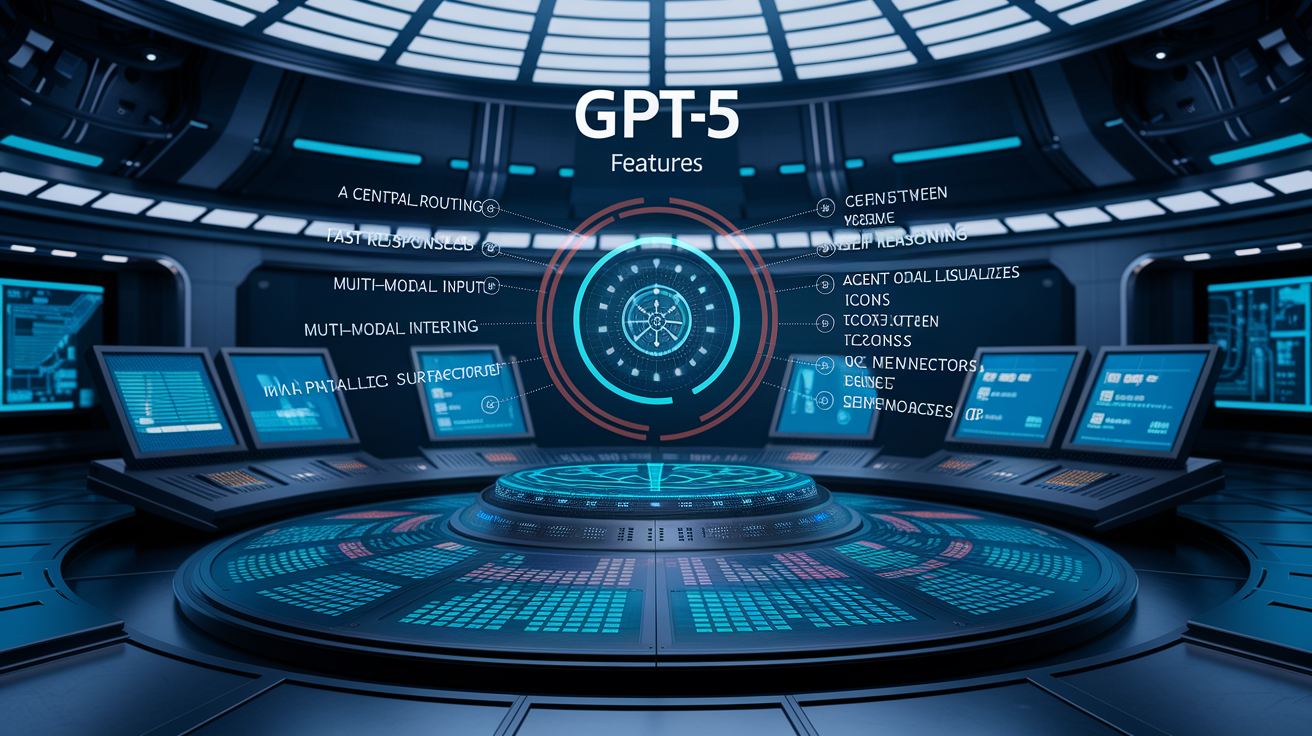
OpenAI has described GPT-5 as a unified system that integrates multiple capabilities rather than a single standalone model. Sam Altman characterized it as “a system that integrates a lot of our technology,” designed to combine the multi-modal strengths of the GPT-series with the reasoning breakthroughs of the o-series models. The goal is to create an adaptive architecture that can decide in real time whether to respond quickly with high throughput or engage slower, more deliberate chain-of-thought reasoning for complex queries. This unified approach represents a shift from shipping separate models for different use cases toward one system that routes intelligently based on task complexity.
Expected technical improvements include stronger performance on multi-step reasoning tasks, better long-context memory (with API context windows reported to reach up to 400,000 tokens), reduced hallucination rates, and more reliable instruction following across extended sessions. Multimodal handling is expected to improve, with tighter integration of text, image, and voice inputs. Multilingual support is anticipated to expand, with better performance in languages like Spanish, Hindi, Japanese, and Arabic alongside dozens of other major languages. Coding ability is also expected to see gains, particularly in debugging, architecture design, and multi-file reasoning.
GPT-5 is also expected to feature deeper integration with external tools and connectors. This would allow it to interact with CRMs, databases, calendars, and other business systems in an agent-like manner. The capability aims to reduce the need for expensive reasoning calls by offloading straightforward tasks to simpler connectors, reserving the full reasoning stack for genuinely complex problems. The result is a model designed not just for conversation but for multi-step workflows, automation, and large-document processing tasks that previously required stitching together multiple specialized models.
Key anticipated advancements:
Unified routing system that switches between fast responses and deep reasoning based on query complexity. Context windows up to 400,000 tokens in API configurations, enabling book-length document analysis. Native multimodal input handling with improved vision and voice capabilities. Agent-style task execution with built-in tool connectors to external systems. Significant reduction in hallucinations and contradictions across long sessions.
Summary of Verified Facts vs. Speculation

Verified information about GPT-5 includes confirmation that the model is in active development, undergoing testing, and subject to ongoing safety evaluations. OpenAI leadership has publicly stated that a release is coming “soon” and has demonstrated the model in controlled settings. Internal testing artifacts, including configuration strings and server preparation work, confirm that the model has reached late-stage development. But no official release date has been published. All specific timeline predictions circulating online, including the widely repeated August 2025 estimate, remain unconfirmed speculation based on secondary signals rather than formal announcements.
| Verified Facts | Speculative Claims |
|---|---|
| GPT-5 is in active training and testing | GPT-5 will launch in August 2025 |
| Sam Altman confirmed release is “soon” (July 2025) | Specific launch date will be announced at a public event |
| Configuration strings like “gpt-5-reasoning-alpha-2025-07-13” have appeared in code | GPT-5 will be available on all tiers simultaneously at launch |
| Server capacity preparation began in late May 2025 | Open-weights model will release before GPT-5 |
| GPT-5 will integrate o-series reasoning and GPT-series multimodal strengths | GPT-5 will achieve AGI-level performance on all benchmarks |
| No official release date has been published by OpenAI | Pricing and API access details are finalized and ready |
Final Words
We laid out what’s confirmed: GPT-5 is in active training, OpenAI hasn’t announced a release date, and safety reviews will determine the timing.
You saw development progress, historical release patterns, documented rumors, and likely features like improved multimodal reasoning and longer context memory.
Watch official OpenAI channels for the openai gpt-5 release date. Meanwhile, keep plans flexible and prioritize testing and safety checks—exciting times ahead.
FAQ
Q: When can we expect ChatGPT 5 and is GPT-5 available?
A: ChatGPT 5 does not have an official release date and is not publicly available. OpenAI said it was in training; they’ll announce availability after safety evaluations. Watch official OpenAI channels for updates.
Q: Is GPT-5 free?
A: GPT-5 being free is unknown until OpenAI publishes pricing. Past flagship models used paid tiers with limited free access, so expect paid options and possible trials unless OpenAI states otherwise.
Q: Who owns 49% of OpenAI?
A: No entity publicly owns exactly 49% of OpenAI; Microsoft is a major investor and exclusive cloud partner, but OpenAI has not disclosed precise ownership percentages or a 49% stake.