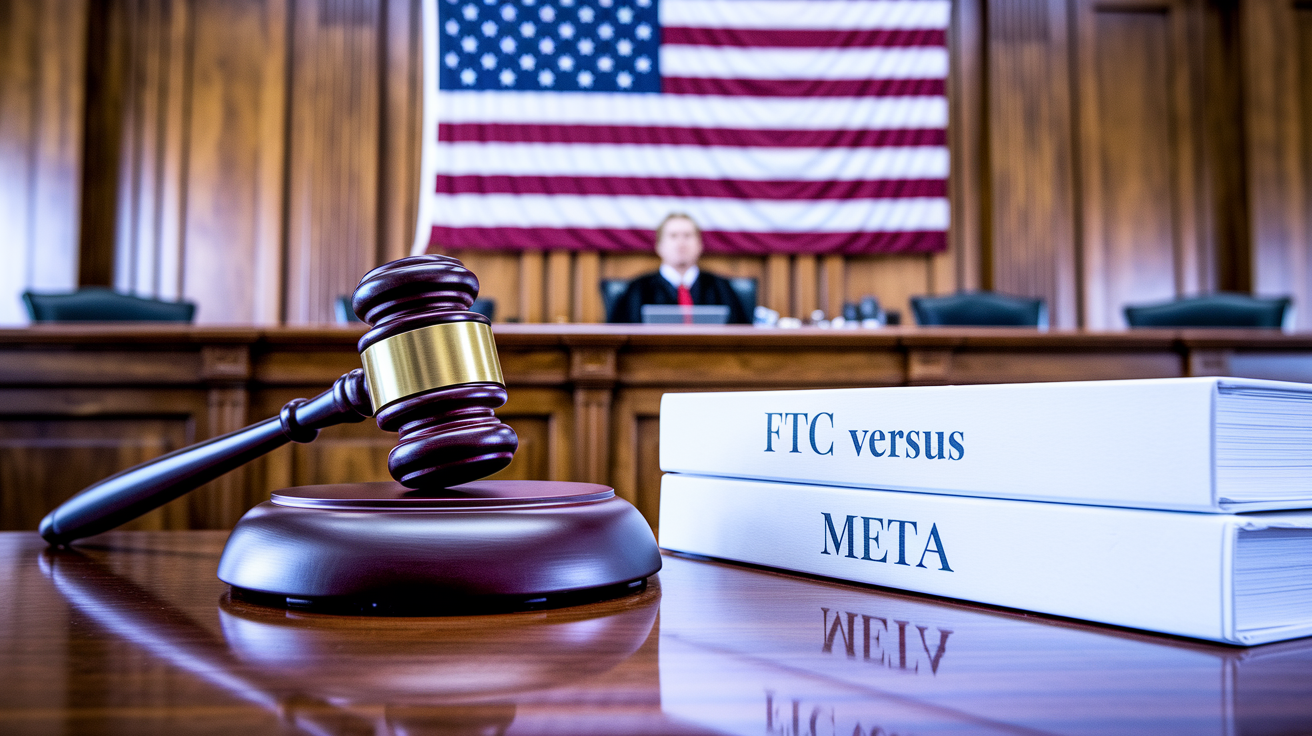
Can the government break up one of the world’s largest tech companies based on deals made more than a decade ago? That’s the question at the heart of the FTC’s antitrust case against Meta, which challenged the company’s 2012 Instagram and 2014 WhatsApp acquisitions. On February 18, 2025, a federal judge dismissed the case entirely, ruling the FTC failed to prove Meta currently holds a monopoly in social networking. The decision shows how fast moving competition, especially from TikTok, undermined the government’s claims that Meta illegally crushed rivals through strategic acquisitions.
Federal Antitrust Lawsuits Against Meta: Who Filed and What They Allege
The Federal Trade Commission filed antitrust charges against Meta in December 2020. 46 state attorneys general joined the bipartisan lawsuit, creating one of the biggest antitrust actions against a tech company in decades. They were targeting acquisitions that had reshaped social media years earlier.
The FTC claimed Meta monopolized personal social networking through anticompetitive acquisitions designed to wipe out future competition. Meta deliberately overpaid for potential competitors to stop them from growing into meaningful rivals, according to the agency’s complaint. Instead of competing on the merits of its platforms, the company used its financial firepower to buy market dominance.
Two major acquisitions got challenged: Instagram, purchased for $1 billion in 2012, and WhatsApp, acquired for $22 billion in 2014. The FTC argued these weren’t ordinary business deals but strategic moves to eliminate emerging threats before they could challenge Facebook’s position. Instagram was a fast growing photo sharing app with 30 million users at the time. WhatsApp was rapidly becoming the dominant messaging platform in international markets.
The case wound through the courts for nearly five years. Judge James Boasberg first dismissed the lawsuit in 2021, ruling the FTC hadn’t provided enough evidence to support its monopoly claims. The agency refiled with additional evidence, but the revised complaint met the same fate. On February 18, 2025, Judge Boasberg dismissed the case entirely. The FTC’s attempt to force Meta to divest Instagram and WhatsApp was over.
The dismissal centered on a fundamental finding: the FTC failed to prove Meta currently holds a monopoly in personal social networking. This ruling proved fatal because US law requires proof of ongoing anticompetitive behavior, not just past violations. Social media transformed dramatically between 2020 and 2025. TikTok’s explosive growth undermined the FTC’s argument that Meta controlled the market in a way that harmed competition.
Sherman Act Legal Framework Behind Meta’s Antitrust Case

The FTC’s case rested on the Sherman Act, passed by Congress in 1890 to prohibit activities that restrict interstate commerce and competition. Section 2 specifically prohibits monopolization. It’s illegal for companies to acquire or maintain monopoly power through anticompetitive conduct. The law was designed to prevent powerful corporations from using market dominance to eliminate competition rather than winning customers through better products.
Under Section 2, the FTC needed to prove two things: Meta possessed monopoly power in a defined market, and the company acquired or maintained that power through anticompetitive conduct. The law doesn’t require proof of direct consumer harm like higher prices or reduced quality. The focus is on whether a company’s behavior restricts competition itself. But there’s a critical requirement: the violation must be current or imminent. Past anticompetitive behavior alone can’t support an antitrust remedy if the company no longer engages in such conduct or no longer holds monopoly power.
This timing requirement became the weak point of the FTC’s case. Section 13(b) of the FTC Act limits the Commission’s authority to seek injunctions (like forced divestiture) to situations where a company is “violating, or about to violate” the law. The FTC argued Meta’s past acquisitions created lasting anticompetitive effects that continued harming competition in 2025. But Judge Boasberg ruled that even if the 2012 and 2014 acquisitions were anticompetitive when they occurred, the FTC had to prove Meta was currently maintaining a monopoly through ongoing anticompetitive conduct. The emergence of fierce competitors like TikTok made that showing impossible.
Microsoft Precedent and Meta’s Antitrust Defense Strategy

The United States v. Microsoft Corp. case, launched in 1998 and decided in 2001, established the modern framework for antitrust enforcement against tech companies. The Department of Justice proved Microsoft violated the Sherman Act when the company controlled 90% of desktop computer operating systems and used that dominance to force PC manufacturers to include Internet Explorer while making it difficult for users to install competing browsers. The court found Microsoft had maintained its operating system monopoly through anticompetitive tactics rather than superior technology.
Meta’s case presented a different legal challenge. The FTC alleged Meta engaged in anticompetitive behavior during the development of monopoly power, purchasing Instagram and WhatsApp while they were still small to prevent them from maturing into real competitors. This “buy or bury” strategy differed from Microsoft’s approach of using established monopoly power to crush competitors. The distinction mattered because it required the FTC to prove the acquisitions themselves were anticompetitive acts that created monopoly power, not that a monopolist abused existing dominance.
Meta’s defense strategy exploited this difference by showing the social media market had transformed completely since the acquisitions. The company argued it faced intense competition from platforms that didn’t even exist or were insignificant when it bought Instagram and WhatsApp. By showing the competitive landscape had fundamentally changed, Meta convinced the court that even if the acquisitions once threatened competition, the market had evolved in ways that made forced divestiture unnecessary. The defense successfully shifted focus from what Meta did in 2012 and 2014 to what the competitive environment looked like in 2025.
The Changing Social Media Landscape That Undermined the FTC Case

When the FTC filed its lawsuit in December 2020, TikTok barely registered in the court’s analysis. The first two judicial opinions addressing motions to dismiss never mentioned the platform. By the time Judge Boasberg issued his final ruling in February 2025, TikTok had emerged as Meta’s fiercest rival, completely reshaping the competitive dynamics the FTC claimed to understand. The Chinese owned app’s algorithm driven short video format attracted hundreds of millions of American users and fundamentally changed how people used social media.
A University of Chicago study provided crucial evidence of how easily consumers switched between platforms, directly contradicting the FTC’s claims about user lock in and high switching costs. Researchers tracked 6,000 users who were paid to stop using either Facebook or Instagram. Their usage of the restricted platform fell by two thirds, demonstrating that financial incentives could overcome any alleged network effects or switching barriers. When blocked from Meta apps, users primarily switched to YouTube first, then to the other Meta app they weren’t paid to avoid, then to TikTok. The study demolished the FTC’s argument that users faced significant barriers to leaving Meta’s platforms or that Meta had created insurmountable network effects that trapped users.
Social media underwent a profound transformation from friend based “social graph” platforms to algorithm driven content feeds. Facebook and Instagram both evolved from services where users primarily saw updates from friends and family to platforms that predominantly showed short videos from strangers, recommended by artificial intelligence. In the past two years alone, time Americans spent viewing friends’ content on Facebook fell by almost 25 percent. Time watching Reels (Meta’s TikTok competitor) more than doubled. This shift meant the personal social networking market the FTC tried to define had largely ceased to exist in its original form.
The FTC’s market definition proved fatally flawed. The agency excluded TikTok and YouTube as competitors, arguing they served different purposes than Meta’s personal social networking platforms. This narrow definition ignored how actual consumers used these services interchangeably. When given financial incentive to avoid Meta platforms, users seamlessly substituted YouTube and TikTok, proving these platforms competed directly for users’ time and attention. The court found the FTC’s exclusion of obvious competitors arbitrary and inconsistent with market reality.
While Meta commanded significant market share in digital advertising, these concerns became secondary once the court determined no social networking monopoly existed. The FTC had documented how Meta used API limitations and developer restrictions to control platform access, making it harder for competing services to integrate with Facebook and Instagram. The company also allegedly used its control over advertising tools to disadvantage rivals. However, without proof of monopoly power in a properly defined market, these practices couldn’t support antitrust liability under Section 2 of the Sherman Act.
Judge Boasberg captured the core problem with the FTC’s case in a striking observation: the social media landscape evolved so rapidly that “the Court has never even stepped into the same case twice.” He referenced the ancient Greek philosopher Heraclitus, who said you can’t step into the same river twice because new water constantly flows through it. Similarly, the social media market the FTC described in 2020 had been replaced by an entirely different competitive environment by 2025. New platforms, new features, new user behaviors.
Key competitive threats that emerged during the case:
TikTok’s algorithm driven short video format became the dominant social media paradigm, forcing Meta to completely redesign its core products. YouTube expanded aggressively into social features, including Shorts (its TikTok competitor), and became users’ first choice when switching from Meta platforms. Snapchat continued innovating with augmented reality features and maintained strong appeal among younger users. Platform interoperability and easy user switching demonstrated through research showing users readily moved between services when given modest financial incentives.
Judge Boasberg’s Ruling on Meta’s Market Position
On February 18, 2025, Judge James Boasberg ruled that Meta didn’t engage in prohibited anticompetitive behavior through its acquisitions of Instagram and WhatsApp. The five year legal battle came to a decisive conclusion. The ruling rejected all of the FTC’s claims and left no avenue for the agency to pursue its goal of breaking up the company through this particular case.
The fatal flaw centered on market power. Judge Boasberg ruled the agency failed to prove Meta currently holds a monopoly in the “personal social networking” market, which was absolutely essential to any claim under Section 2 of the Sherman Act. Without demonstrating that Meta possessed monopoly power at the time of the ruling, all other arguments became irrelevant. The judge found that even if Meta once dominated personal social networking, the emergence of TikTok, YouTube, and other platforms meant the company no longer controlled the market in a way that could support antitrust liability.
The FTC weakened its own case through an overly narrow market definition. By excluding TikTok and YouTube from the relevant market, the agency tried to create an artificial competitive landscape where Meta appeared dominant. But the court found this exclusion inconsistent with how actual consumers behaved. Evidence showed users viewed these platforms as substitutes for Meta’s services, switching to them readily when circumstances changed. The judge ruled that any market definition ignoring such obvious competitors failed to reflect competitive reality and couldn’t support antitrust claims.
Potential Remedies and Divestiture Demands in the Meta Case

The FTC sought an aggressive structural remedy: forcing Meta to divest both Instagram and WhatsApp, effectively reversing acquisitions completed more than a decade earlier. This would’ve required Meta to sell these platforms to independent buyers, restoring them as standalone competitors in the social networking market. Such a breakup would’ve represented one of the largest forced corporate restructurings in tech industry history, potentially creating three separate multi billion dollar companies where one currently exists.
Antitrust remedies generally fall into two categories: structural and behavioral. Structural remedies permanently change corporate structure through divestitures or breakups. Behavioral remedies impose ongoing restrictions on business practices. The FTC pursued the more aggressive structural approach, arguing that behavioral restrictions would be insufficient because Meta’s ownership of Instagram and WhatsApp itself constituted the anticompetitive harm. The agency claimed that no amount of restrictions on Meta’s conduct could restore the competition that would’ve existed if Instagram and WhatsApp had remained independent companies.
Despite the case’s dismissal, five years of intense legal scrutiny had real business impact. Meta’s market value grew dramatically from approximately $700 billion in 2020 to over $1.5 trillion by early 2025, suggesting the company thrived financially even under regulatory pressure. However, the pending antitrust case likely prevented Meta from making additional major acquisitions, particularly in the rapidly emerging artificial intelligence sector where new companies were raising billions in funding. The regulatory chilling effect may have constrained Meta’s growth strategy in ways that created more space for competitors to develop, even though the company ultimately won its legal battle.
Implications for Other Big Tech Antitrust Cases

Meta’s antitrust case represented just one front in a coordinated wave of enforcement actions launched around 2020 targeting Big Tech companies. Federal regulators and state attorneys general filed parallel cases against Google, Amazon, and Apple, arguing these companies had accumulated illegal monopoly power in their respective markets. The cases shared common themes about network effects, platform control, and acquisition strategies designed to eliminate emerging competitors.
The Department of Justice filed an antitrust suit against Apple in 2024, alleging the company monopolized the smartphone market through restrictions on competing technologies. The DOJ claimed Apple degraded the experience of non iPhone users by limiting cross platform text messaging features, prevented competing smartwatches from accessing key iPhone functionality, and restricted digital wallet competition to protect Apple Pay. The case argued Apple used its iOS operating system control to maintain smartphone dominance not through superior products but by making competing devices and services work poorly with iPhones.
The FTC filed a separate 2023 case against Amazon for alleged anticompetitive practices in online retail. The agency claimed Amazon discouraged third party sellers from offering products at lower prices on competing platforms by manipulating search rankings and Prime membership benefits to punish sellers who undercut Amazon’s prices elsewhere. Unlike the Meta case, Amazon’s market dominance in online retail platform services faces little serious dispute. The company processes nearly 40% of all US e-commerce and controls the infrastructure that millions of small businesses depend on to reach customers.
Meta’s dismissal sends mixed signals for these pending cases. It demonstrates that proving current monopoly power in fast moving technology markets is extremely difficult, potentially weakening similar arguments against Apple where fierce competition exists from Android devices. Courts may be skeptical of market definitions that exclude obvious competitors or fail to account for rapid technological change. On the other hand, cases like Amazon where market dominance is clearer and more stable may prove more successful. The Meta ruling suggests antitrust enforcement works better against companies with unambiguous monopolies in slower changing markets than against tech platforms facing dynamic competition from new entrants and evolving user preferences.
The Timeline of Legal Proceedings in Meta’s Antitrust Battle

The Meta antitrust case spanned nearly five years from December 2020 through February 2025, a period during which the social media landscape transformed in ways that ultimately doomed the FTC’s legal theory. What began as a coordinated federal state effort to break up one of the world’s most powerful tech companies ended with a complete dismissal and a judicial observation that the market had changed so fundamentally that the court “never even stepped into the same case twice.”
The case went through multiple iterations as the FTC struggled to prove monopoly power in an increasingly competitive market. After Judge Boasberg dismissed the initial complaint in 2021 for insufficient evidence, the agency refiled with additional data and economic analysis. But the refiled case faced the same problem: by the time it reached final judgment, the competitive landscape bore little resemblance to the market the FTC originally described. TikTok’s explosive growth between the first and final rulings changed everything.
Key dates in the legal proceedings:
December 2020: FTC files antitrust charges against Meta with 46 state attorneys general joining as co plaintiffs. June 2021: First dismissal by Judge James Boasberg, ruling FTC provided insufficient evidence of monopoly power. August 2021: FTC refiles amended complaint with additional economic evidence and refined market definitions. 2022 to 2024: Discovery and legal proceedings continue as TikTok grows from emerging competitor to Meta’s primary rival. 2024: Case arguments increasingly focus on changed competitive landscape and whether past acquisitions remain relevant. February 18, 2025: Final dismissal by Judge Boasberg, ending FTC’s attempt to force divestiture. Current status: Case dismissed with prejudice. FTC faces decision whether to appeal to Circuit Court.
Regulatory Impact Despite Meta’s Legal Victory

Five years of antitrust scrutiny created a chilling effect on Meta’s acquisition strategy that may have constrained the company’s competitive behavior even without a legal loss. The pending lawsuit likely prevented Meta from making additional major acquisitions, particularly in artificial intelligence where companies like OpenAI, Anthropic, and others were raising billions in funding and recruiting top talent. ChatGPT launched in November 2022 while Meta faced intense regulatory pressure, creating a new competitive front the company might’ve addressed differently without antitrust constraints.
Meta’s strategic response to AI competition revealed how regulatory pressure influences corporate behavior regardless of legal outcomes. The company open sourced its large language model, releasing Llama to the developer community rather than keeping it proprietary. This strategy is typically used by market underdogs trying to build ecosystems around their technology, not by dominant players protecting established advantages. The decision suggested Meta was actively managing antitrust risk by demonstrating openness and competition friendly behavior, even as it fought the FTC’s lawsuit in court.
The financial paradox of Meta’s antitrust battle is striking: the company’s market value grew from approximately $700 billion to over $1.5 trillion during the legal proceedings, more than doubling while under aggressive regulatory attack. This suggests the antitrust case may have failed in its primary legal objective while succeeding at a broader policy level. By preventing additional acquisitions and forcing Meta to compete rather than buy its way to dominance in new markets like AI, the regulatory pressure may have created exactly the competitive dynamic antitrust law seeks to protect. The case’s legacy may be measured not by its legal outcome but by the deals that never happened and the competitors that survived because Meta faced too much scrutiny to eliminate them.
Final Words
The meta facebook antitrust charges brought by the Federal Trade Commission ultimately failed because the social media market changed faster than the legal system could move.
Judge Boasberg’s February 2025 dismissal highlights a core challenge in tech antitrust enforcement: proving current monopoly power in markets that transform every few years.
TikTok’s rise, the shift to algorithmic feeds, and easy user switching between platforms demolished the FTC’s case that Meta controlled personal social networking.
For developers and tech teams, the takeaway is clear. Competition law still applies to Big Tech, but proving harm in fast-moving markets remains extremely difficult.
The regulatory pressure may have done more to constrain Meta’s behavior than any court order could have.
FAQ
Q: Who filed the antitrust lawsuit against Meta?
A: The Federal Trade Commission filed antitrust charges against Meta in December 2020, with 46 state attorneys general joining the lawsuit in a bipartisan effort to challenge the company’s alleged monopolistic practices.
Q: What acquisitions did the FTC challenge in the Meta antitrust case?
A: The FTC challenged Meta’s acquisition of Instagram for $1 billion in 2012 and WhatsApp for $22 billion in 2014, claiming these purchases eliminated future competition in personal social networking.
Q: What was the outcome of the FTC’s antitrust case against Meta?
A: Judge James Boasberg dismissed the case entirely on February 18, 2025, ruling that the FTC failed to prove Meta currently holds a monopoly in the personal social networking market.
Q: What law did the FTC use to challenge Meta’s acquisitions?
A: The FTC used Section 2 of the Sherman Act, passed in 1890, which prohibits monopolization through anticompetitive conduct and requires proving a company currently holds monopoly power.
Q: How did the Meta antitrust case differ from the Microsoft case?
A: The Microsoft case alleged anticompetitive behavior after establishing market dominance with 90% desktop share, while Meta’s case alleged anticompetitive conduct during the development of monopoly power through acquisitions.
Q: How did TikTok affect the Meta antitrust case?
A: TikTok’s emergence as Meta’s fiercest competitor undermined the FTC’s monopoly argument, demonstrating that new rivals could successfully compete in social networking despite Meta’s Instagram and WhatsApp acquisitions.
Q: What did the University of Chicago study reveal about Meta users?
A: The University of Chicago study found that when 6,000 users were paid to stop using Meta platforms, their usage fell by two-thirds and they easily switched to YouTube, TikTok, and Snapchat.
Q: How did Meta’s platforms change during the antitrust case?
A: Meta’s platforms transformed from friend-focused social networks to algorithm-driven feeds showing short videos from strangers, with time viewing friends’ content falling almost 25% while Reels viewing more than doubled.
Q: What remedies did the FTC seek against Meta?
A: The FTC sought structural remedies requiring Meta to divest Instagram and WhatsApp to restore competition, which would have represented one of the largest corporate breakups in tech history.
Q: Did the antitrust case impact Meta’s business decisions?
A: Five years of regulatory scrutiny likely prevented Meta from making additional major acquisitions, particularly in AI, and influenced the company to open-source its large language model despite legal victory.
Q: How does the Meta case affect other Big Tech antitrust lawsuits?
A: Meta’s dismissal demonstrates that proving current monopoly power in fast-moving tech markets is extremely difficult, potentially weakening similar arguments against Apple while strengthening clearer cases like Amazon’s online retail dominance.
Q: Why did the FTC’s market definition weaken their case?
A: The FTC excluded TikTok and YouTube as competitors from their market definition, a decision inconsistent with actual consumer behavior showing users easily substituted these platforms for Meta services.
Q: What did Judge Boasberg say about the changing social media market?
A: Judge Boasberg observed that social media evolved so rapidly that “the Court has never even stepped into the same case twice,” referencing how dramatically the competitive landscape transformed.
Q: How much did Meta’s market value change during the antitrust case?
A: Meta’s market value grew from approximately $700 billion in 2020 when the case was filed to over $1.5 trillion by the time of dismissal in 2025.