Is antivirus still enough to protect your business?
Antivirus catches known malware on single devices, but attackers now use fileless tricks, zero-days, and lateral movement.
That means a desktop scanner often misses real attacks.
For most businesses running remote workers, cloud services, or many servers, endpoint security, with behavioral detection, EDR, automated isolation, and centralized control, is the safer choice.
This post explains the core difference, who’s affected, and how to pick the right level of protection for your environment.
Core Comparison Overview to Understand Endpoint Security vs Antivirus
Antivirus software scans individual devices for malware, matching files against signature databases of known threats. Endpoint security platforms protect entire networks of endpoints (laptops, servers, smartphones, containers, cloud workloads) through behavioral analytics, automated response, data loss prevention, and centralized management. Here’s the core difference: antivirus handles known malware on single machines. Endpoint security addresses coordinated attacks, lateral movement, and data theft across distributed environments.
Signature-based antivirus is losing ground because attackers now use fileless malware, zero-days (bugs exploited before fixes exist), and advanced persistent threats that dodge static signatures. Security researchers see over 450,000 new threats daily. Hackers launch attacks roughly every 2 seconds. Traditional antivirus can’t reliably catch attacks that live in memory, exploit legitimate system processes, or spread laterally through networks without leaving signature-matched files.
Endpoint security platforms add endpoint detection and response (EDR), machine learning models that flag suspicious behavior, automated containment and rollback, traffic monitoring to block command-and-control channels, and unified dashboards managing thousands of endpoints from one console. These platforms support hybrid cloud infrastructure, container orchestration, and remote workforces. The global cost of data breaches hit $4.88 million in 2024 (a 10 percent jump), and 90 percent of successful cyberattacks stem from weak endpoints. Centralized, proactive protection isn’t optional anymore.
| Capability | Antivirus | Endpoint Security |
|---|---|---|
| Detection Method | Signature-based scanning | Behavioral analytics, AI/ML, signatures |
| Coverage Scope | Single device | Network-wide, cloud, containers, hybrid |
| Response Capability | Alert user, quarantine file | Automated isolation, rollback, sandboxing |
| Data Protection | None | DLP, encryption, traffic monitoring |
| Management Model | Per-device, manual | Centralized dashboard, policy enforcement |
| Threat Intelligence | Signature updates only | Real-time feeds, IOC correlation, forensics |
Detailed Breakdown of Antivirus Capabilities in the Endpoint Security vs Antivirus Discussion

Antivirus software scans files and processes on a single endpoint, comparing byte patterns against databases of known malware signatures. Match found? The software quarantines or deletes the file and logs the event. Real-time scanning inspects files as they’re opened or downloaded. Scheduled scans sweep the entire disk at configured intervals (daily, weekly). Most antivirus products include basic web protection that blocks known malicious URLs and email filters scanning attachments before users click.
Traditional antivirus struggles in modern environments because it relies almost entirely on manual remediation and can’t detect unknown threats. When a zero-day exploit or fileless attack runs in memory without dropping recognizable files, signature scans fail. The software alerts the user but offers no automated containment, no network visibility, no integration with enterprise security tools. Security teams must manually investigate logs, identify affected devices, apply fixes one by one. Antivirus doesn’t integrate deeply with SIEM (security information and event management) platforms or extended detection and response (XDR) workflows, leaving IT teams blind to coordinated, multi-stage attacks.
Major antivirus functions:
Real-time scanning inspects files, downloads, and executables as they’re accessed or executed.
Scheduled and on-demand scans sweep entire drives or selected directories for known malware.
Quarantine and file isolation prevent infected files from running or spreading.
Alert notifications for detected threats, outdated signatures, or required software updates.
Basic firewall and web protection blocks known malicious domains and inspects inbound/outbound connections.
Endpoint Security Capabilities That Go Beyond Traditional Antivirus

Endpoint security platforms replace per-device management with centralized dashboards that enforce policies, monitor telemetry, and respond to incidents across thousands of endpoints in real time. Continuous telemetry streams behavioral events (process starts, registry changes, network connections, file modifications) into correlation engines that assemble full attack timelines without requiring manual log analysis. Administrators can remotely isolate a compromised laptop, push patches to vulnerable servers, audit unmanaged devices from a single console. This centralized model cuts mean time to detect (MTTD) and mean time to contain (MTTR), replacing the manual, device-by-device approach antivirus requires.
Advanced detection methods include behavioral analytics, heuristics, and machine learning models trained to recognize attack patterns even when no known signature exists. These systems flag anomalies: a Word document launching PowerShell, a service account connecting to an external IP at 3 a.m., lateral movement across network segments. They automatically elevate these for investigation or remediation. Threat intelligence feeds continuously update indicators of compromise (IOCs) and adversary tactics, enabling proactive defense against campaigns that traditional antivirus can’t see. Some platforms simulate attacker behavior with offensive security engines that verify exploit paths and prioritize vulnerability remediation based on real-world attack feasibility.
Response and remediation capabilities include automated sandboxing of suspicious executables, network isolation to prevent lateral movement, process kill chains that terminate malicious activity trees, and filesystem rollback to undo ransomware encryption. Endpoint platforms extend protection to cloud workloads, Kubernetes containers, serverless functions, and hybrid environments where traditional antivirus agents can’t install or scale effectively. They monitor inter-container traffic, enforce micro-segmentation policies, detect command-and-control (C2) traffic hidden in encrypted channels. For organizations running dynamic cloud infrastructure, endpoint security provides the visibility, automation, and coverage that signature-based antivirus simply can’t deliver.
Feature-Level Endpoint Security vs Antivirus Comparison
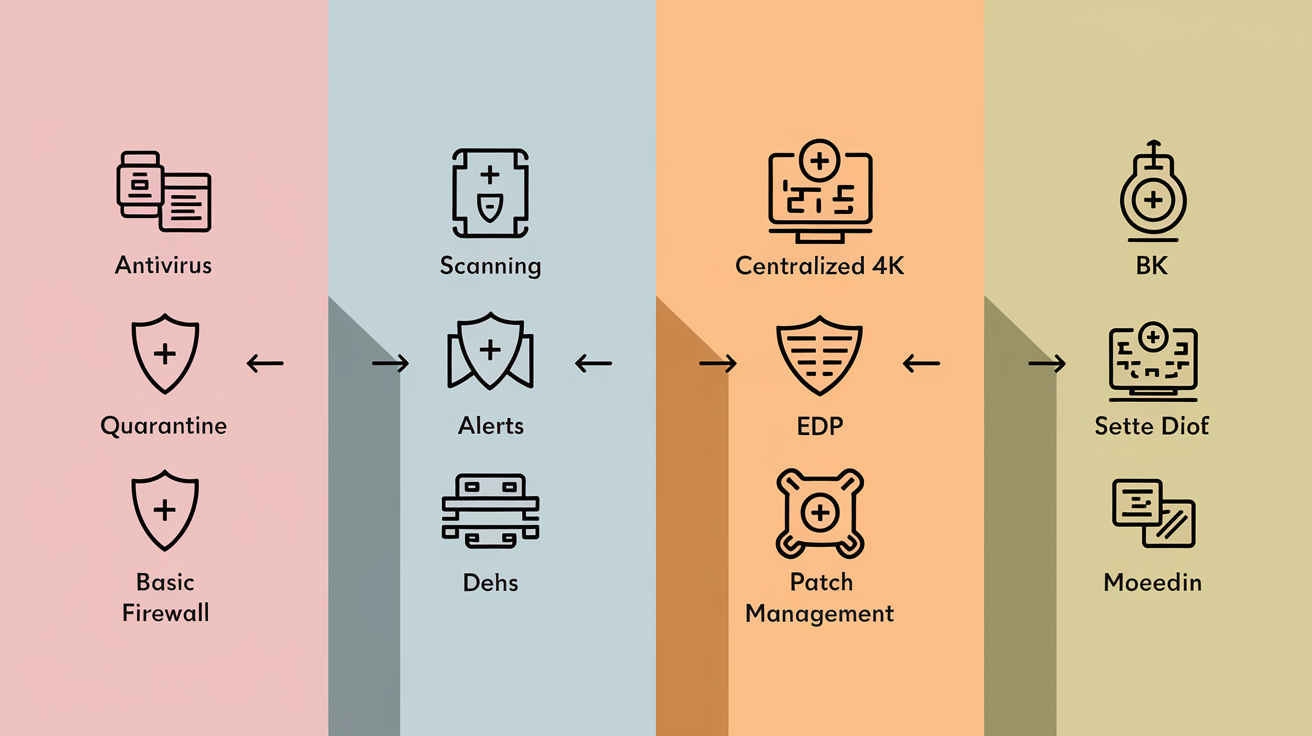
| Capability | Antivirus | Endpoint Security |
|---|---|---|
| Threat Detection | Signature databases, basic heuristics | Behavioral analytics, machine learning, threat intelligence feeds |
| Network Monitoring | None or limited firewall integration | Traffic analysis, lateral movement detection, C2 blocking, DNS filtering |
| Response & Mitigation | User alerts, manual quarantine | Automated isolation, sandboxing, process termination, rollback |
| Data Loss & Integrity | Malware scanning only | Data loss prevention, encryption, traffic flow monitoring |
| Management & Reporting | Per-device logs, manual aggregation | Centralized dashboards, real-time telemetry, policy enforcement |
Five technical differences define the endpoint security vs antivirus comparison:
Threat detection: Antivirus relies on signature databases updated periodically to match known malware patterns. Endpoint security adds behavioral detection that identifies anomalous process behavior, memory-only threats, and fileless attacks using machine learning models. When a legitimate system binary spawns an unexpected child process or accesses sensitive credential stores, behavioral engines flag the activity even if no malicious file signature exists.
Network traffic monitoring: Traditional antivirus inspects files locally and might integrate with basic host firewalls, but it doesn’t monitor network traffic, lateral movement between endpoints, or outbound connections to command-and-control servers. Endpoint security platforms analyze DNS queries, HTTP/HTTPS traffic, and inter-container communication to detect data exfiltration, block C2 channels, enforce network segmentation policies. Statistics show 30 percent of data breaches involve installed malware on devices connected to networks. Attackers launch new attacks roughly every 2 seconds, making network visibility essential.
Response and mitigation: When antivirus detects malware, it alerts the user or administrator and quarantines the file, but remediation (removing persistence mechanisms, restoring encrypted files, patching vulnerabilities) remains manual. Endpoint security automates containment by isolating affected hosts from the network, terminating malicious processes and their child tasks, sandboxing suspicious executables for analysis, rolling back filesystem changes caused by ransomware. Incident response time drops from hours to seconds.
Data loss and integrity controls: Antivirus focuses exclusively on detecting and removing malware. It doesn’t monitor data movement or enforce encryption policies. Endpoint security includes data loss prevention (DLP) that tracks sensitive file access, blocks unauthorized transfers to USB drives or cloud storage, encrypts data at rest and in transit. These capabilities protect intellectual property, customer records, and regulated data (critical when 68 percent of organizations have experienced at least one endpoint attack compromising data or IT infrastructure).
Centralized management and reporting: Antivirus generates per-device logs that must be manually aggregated and analyzed. Endpoint security platforms provide unified dashboards that correlate telemetry from all managed endpoints, servers, containers, and cloud workloads, producing real-time attack timelines and prioritized remediation queues. Security operations centers (SOCs) can remotely investigate incidents, push configuration changes, audit compliance status across thousands of devices without logging into each machine individually.
Use-Case Scenarios for Choosing Between Endpoint Security and Antivirus

Antivirus might suffice for individuals managing a single personal laptop with minimal exposure to corporate networks, sensitive data, or advanced threats. Users operating in isolated environments (air-gapped research stations or systems with strict application allowlists) who primarily face common malware from email attachments or web downloads can rely on signature-based scanning combined with cautious browsing. But air gaps aren’t foolproof. Unmanaged devices connecting to networks introduce significant risk. Even small businesses with tight budgets should consider endpoint security if employees work remotely, use personal devices for work, or access cloud services and SaaS applications.
Endpoint security is recommended when protecting more than 50 to 100 endpoints, when operating hybrid cloud or containerized infrastructure, or when regulatory compliance mandates data loss prevention, audit trails, and incident response documentation. Organizations with bring-your-own-device (BYOD) policies, remote workforces, or unmanaged endpoints require centralized visibility and automated response that antivirus can’t provide. Enterprises handling mission-critical data, intellectual property, or regulated information (healthcare records, financial transactions, personally identifiable information) face elevated risk and potential market value drops of 25 percent or more following a cyber incident.
Recommended solution paths by context:
Individual users: Traditional antivirus or consumer-grade endpoint protection for cost-effective, low-complexity malware defense on a single device.
Small and medium businesses (SMBs): Upgrade to endpoint security platforms when managing multiple endpoints, remote workers, cloud applications, or when compliance obligations require DLP and centralized audit logs. Managed endpoint protection services can reduce administrative overhead for IT teams without dedicated security staff.
Enterprise and regulated organizations: Deploy endpoint security with EDR, XDR, or managed extended detection and response (MXDR) capabilities, 24×7 SOC monitoring, incident investigation, automated remediation workflows, and integration with SIEM, threat intelligence platforms, and security orchestration, automation, and response (SOAR) tools.
Security Architecture and Integration Differences in Endpoint Security vs Antivirus

Endpoint security platforms integrate natively with SIEM systems, extended detection and response (XDR) frameworks, and security orchestration, automation, and response (SOAR) tools through APIs and standardized telemetry formats. Security teams consolidate alerts from endpoints, network devices, cloud workloads, and identity systems into a single pane of glass, correlating events across sources to detect multi-stage attacks. Automated workflows trigger containment actions (isolating endpoints, revoking credentials, blocking malicious IPs) without human intervention, reducing alert fatigue and freeing analysts to focus on high-priority investigations. Traditional antivirus solutions rarely offer robust API integration or structured telemetry feeds, limiting their usefulness in enterprise security operations centers.
Remote operations and agentless scanning capabilities further differentiate endpoint platforms from antivirus software. Administrators can perform forensic investigations, deploy patches, audit configurations across thousands of geographically distributed devices without disrupting business operations or requiring local console access. Some endpoint platforms claim agentless scanning with over 2,000 built-in configuration checks and the ability to scan 750-plus types of cloud secrets and access keys, scaling from single servers to large data centers with cross-operating-system compatibility. This remote management reduces operational overhead and accelerates incident response compared to the manual, per-device processes required by antivirus tools.
Centralized dashboards provide real-time visibility into asset inventory, vulnerability status, patch levels, active threats, and compliance posture. Security teams query endpoint telemetry to hunt for indicators of compromise (IOCs), track privilege escalation attempts, monitor data flows for anomalous behavior. Network discovery modules identify unmanaged endpoints and shadow IT, bringing rogue devices into compliance and closing visibility gaps. Consolidation benefits include reduced licensing complexity, simplified vendor management, unified reporting that satisfies audit and compliance requirements across regulatory frameworks.
Cost, Licensing Models, and Total Cost of Ownership in Endpoint Security vs Antivirus

Endpoint security pricing typically follows per-endpoint or per-user subscription models, with feature tiers separating basic antivirus from advanced EDR, XDR, and managed SOC services. Buyers should request detailed quotes specifying the number of covered endpoints, included modules (patch management, privileged access management, DLP, application control), API and SIEM integration capabilities, and service-level agreements (SLAs) for support and incident response. Some vendors offer per-server licensing for data center environments and separate pricing for cloud workload protection and container security. Managed endpoint detection and response (MXDR) adds 24×7 SOC monitoring and expert-led threat hunting, increasing monthly costs but reducing the need for in-house security analysts.
Total cost of ownership extends beyond subscription fees to include deployment time, administrative overhead, integration effort, and potential breach impact. Endpoint security platforms often reduce long-term costs through automated remediation, faster incident containment, reduced downtime. The average global cost of a data breach reached $4.88 million in 2024, a 10 percent increase. Organizations suffering endpoint compromises face regulatory fines, legal fees, customer notification expenses, brand damage. Investing in proactive, centralized protection can prevent incidents that dwarf the platform subscription cost. Conversely, antivirus software carries lower upfront licensing fees but might require more manual labor for patching, incident investigation, remediation, increasing operational expenses over time.
| Cost Component | Antivirus | Endpoint Security |
|---|---|---|
| Licensing Model | Per-device, annual subscription | Per-endpoint/per-user, tiered modules (AV, EDR, XDR, DLP, MXDR) |
| Endpoint Count Impact | Linear scaling, low per-seat cost | Volume discounts, higher per-seat cost offset by automation |
| Modules Included | Signature updates, basic scanning | EDR, patch management, DLP, encryption, PAM, app control, threat intelligence |
| SOC Services | Not included | Optional 24×7 MXDR, threat hunting, incident response |
Pros and Cons of Endpoint Security vs Antivirus Solutions

Antivirus pros and cons:
Lower upfront cost: Per-device licensing fees typically run lower than endpoint platform subscriptions, making antivirus accessible for individuals and very small businesses.
Simple deployment: Standalone agent installation requires minimal configuration and no integration with enterprise infrastructure.
Adequate for known threats: Signature-based scanning reliably detects and removes common viruses, trojans, and malware that match database entries.
Limited detection: Can’t reliably identify fileless malware, zero-days, advanced persistent threats, or attacks that exploit legitimate system processes.
Manual remediation: Alerts require human investigation and action. No automated containment, rollback, or network isolation capabilities.
Poor fit for cloud and containers: Traditional antivirus agents don’t scale effectively to dynamic cloud workloads, Kubernetes pods, or serverless functions.
Endpoint security pros and cons:
Broader coverage: Combines antivirus, EDR, DLP, patch management, application control, and network monitoring in a unified platform.
Automated remediation: Isolates compromised endpoints, terminates malicious processes, rolls back filesystem changes without manual intervention, reducing MTTD and MTTR.
Centralized reporting and management: Single dashboard for policy enforcement, telemetry correlation, vulnerability tracking, compliance auditing across all endpoints.
Stronger incident response: Forensic investigation tools, real-time attack timelines, threat intelligence integration, remote operations enable rapid, coordinated response.
Higher complexity: Requires skilled administrators to configure policies, tune detection rules, integrate with SIEM/SOAR tools, manage multi-module platforms.
Potentially higher resource use: Continuous telemetry collection and behavioral analytics can consume more CPU and memory than lightweight antivirus agents, though modern platforms optimize agent footprints.
When evaluating these trade-offs, prioritize your organization’s threat landscape, endpoint count, compliance obligations, and available IT resources. Antivirus offers simplicity and low cost for minimal risk scenarios. Endpoint security delivers the automation, visibility, and response capabilities required to defend against sophisticated, fast-moving threats.
Future Trends Shaping Endpoint Security vs Antivirus

AI-based detection models will increasingly replace static signature matching as threat actors adopt fileless malware, living-off-the-land techniques, and polymorphic code that evades traditional antivirus. Machine learning algorithms trained on millions of endpoint behaviors can identify subtle anomalies (unusual process lineage, privilege escalation attempts, abnormal data flows) before attackers complete their objectives. Anomaly detection powered by behavioral baselines and peer-group analysis will become standard in endpoint platforms, enabling security teams to catch zero-days and insider threats that signatures can’t see.
Cloud workload security, micro-segmentation, and automated SOC workflows will grow in relevance as organizations migrate to hybrid and multi-cloud infrastructures. Endpoint platforms will extend coverage to serverless functions, infrastructure-as-code pipelines, and ephemeral containers, enforcing least-privilege policies and detecting lateral movement across cloud boundaries. Sandbox evasion techniques (malware that detects virtual environments and alters behavior) will drive countermeasures like multi-stage detonation, bare-metal sandboxing, and deception technologies that lure attackers into monitored honeypots. Supply-chain attack mitigation will require deep visibility into software bill-of-materials (SBOM), dependency integrity checks, and runtime verification of code provenance. Capabilities far beyond the scope of signature-based antivirus.
Final Words
We showed that antivirus still catches known malware with signature scans, while endpoint security adds behavior-based detection, EDR, DLP, centralized management, and automated response. The post walked through capabilities, feature-level differences, integration, cost, use cases, and future trends.
Pick antivirus only for low-risk, single-device setups; choose endpoint security for larger, cloud or regulated environments to cut detection and response time.
We’ve laid out the trade-offs so you can decide quickly, and when you match needs to scale, the right endpoint security vs antivirus choice will make your systems safer and easier to manage.
FAQ
Q: Is endpoint security the same as antivirus?
A: Endpoint security is not the same as antivirus. Antivirus focuses on signature-based malware scans on devices; endpoint security adds behavioral analytics, EDR, DLP, cloud coverage, and centralized management for broader detection and response.
Q: Do I need both EDR and antivirus?
A: You may need both EDR and antivirus. Antivirus catches known threats; EDR finds fileless or unknown attacks and automates containment. Together they provide layered defense, especially for cloud, BYOD, or larger networks.
Q: What are the three main types of endpoint security?
A: The three main types of endpoint security are antivirus (signature-based protection), EDR (endpoint detection and response for behavioral threats), and EPP (endpoint protection platforms combining prevention, detection, DLP, and centralized management).
Q: What are the risks of endpoint security?
A: The risks of endpoint security include misconfiguration, performance impact, vulnerable agents, telemetry blind spots, high false-positive rates, and operational complexity that can delay detection and remediation.