Tesla went public on June 29, 2010, becoming the first American car company to hit public markets in 54 years. The $17 per share IPO raised $226 million and closed 40% higher on day one, proving investors saw electric vehicles as more than a niche experiment. That initial offering marked a turning point for both Tesla and the broader auto industry. Understanding the IPO details, early stock performance, and financing decisions that followed helps explain how a startup with zero profits grew into a company worth more than Ford, GM, and Chrysler combined.
Tesla’s IPO Date and Critical Public Offering Details

Tesla went public on June 29, 2010, trading on the NASDAQ exchange under the ticker symbol TSLA. It became the first American carmaker to complete an initial public offering since Ford in 1956. That’s a 54 year gap in domestic automotive IPOs.
The offering priced at $17 per share. Tesla sold 13.3 million shares to raise $226.1 million in total capital. On its first day of trading, the stock surged 40.53%, closing at $23.89 per share. This first day pop signaled strong investor appetite for electric vehicle technology. It demonstrated market confidence in Tesla’s growth potential despite the company’s lack of profitability at the time.
Goldman Sachs Group, Morgan Stanley, JP Morgan Chase & Co., and Deutsche Bank served as underwriters for the offering. Tesla had filed its S-1 registration statement with the Securities and Exchange Commission on January 29, 2010. That kicked off a five month process from filing to trading. The IPO’s historical significance extended beyond its capital raise. It reopened public markets to American automakers after more than five decades and validated electric vehicles as a credible investment category.
Tesla Motors was founded in 2003 by Martin Eberhard and Marc Tarpenning. Elon Musk joined as lead investor in 2004, funding $6.5 million of the company’s $7.5 million Series A round and taking the role of Chairman.
Tesla’s Stock Performance and Growth Milestones Since Market Debut

Tesla delivered returns exceeding 3,000% from its IPO through 2020, massively outpacing the S&P 500’s 167% return during the same period. This performance placed it among the most successful IPOs of the decade. Its stock became one of the most closely watched in the technology and automotive sectors.
Major valuation milestones punctuated Tesla’s growth trajectory. The company’s market capitalization crossed $1 trillion in November 2021, joining an elite group that included Apple, Amazon, and Microsoft. Between 2019 and 2021, Tesla stock rose over 1,300%. By mid 2020, Tesla’s market cap exceeded $170 billion, surpassing Toyota and exceeding the combined value of General Motors, Ford, and Fiat Chrysler Automobiles. The stock reached over $1,000 per share by 2020. As of August 28, 2025, Tesla shares trade at $345.98 per share.
Early product launches created momentum that lifted the stock. The Model S launched in 2012 and won Motor Trend’s 2013 Car of the Year award, validating Tesla’s premium sedan strategy. In 2014, Tesla revealed all wheel drive Model S variants with “Insane Mode” acceleration. That got upgraded to “Ludicrous Mode” later. The Model X SUV arrived in 2015 with distinctive Falcon Wing doors after numerous delays. That same year, Tesla rolled out Autopilot semi self driving technology. This positioned the company as a software and autonomy leader, not just a car manufacturer.
The Model 3 reveal in 2016 accumulated hundreds of thousands of preorders within days, proving mass market demand for affordable electric vehicles. Tesla merged with Solar City in 2016, expanding into energy storage and Solar Roof products. In 2017, Tesla unveiled the Tesla Semi for commercial trucking and announced a new Roadster with claimed 0 to 60 mph acceleration under two seconds. The Model Y crossover launched in 2020, targeting the fastest growing vehicle segment.
By 2021, Tesla operated four Gigafactories and delivered nearly one million cars that year. Manufacturing scale, combined with consistent delivery growth, shifted investor perception from speculative bet to proven automotive manufacturer. Stock volatility remained high throughout this period. Sharp reactions to production numbers, executive statements, and competitive developments were common.
| Year | Peak Price | Notable Milestone |
|---|---|---|
| 2010 | $35 | IPO year |
| 2011 | $35 | Early development phase |
| 2012 | $38 | Model S launch |
| 2013 | $193 | Model S wins Car of the Year |
| 2014 | $286 | Performance variants released |
| 2015 | $282 | Model X, Autopilot launch |
| 2016 | $265 | Model 3 reveal, Solar City merger |
| 2017 | $385 | Semi and Roadster announced |
| 2018 | $379 | Production scaling challenges |
| 2019 | $430 | Cybertruck unveiling |
| 2020 | $1,030 | Model Y launch, first stock split |
Tesla’s Stock Split History and Shareholder Impact
Stock splits increase the number of outstanding shares while proportionally reducing the per share price. Total company value stays unchanged. Tesla executed two splits to make shares more accessible to retail investors and improve trading liquidity.
The first split occurred on August 31, 2020, as a 5 for 1 split when the share price had crossed $2,000. After the split, Tesla’s stock price climbed over 40% within one month as newly accessible shares attracted retail buying. The second split executed on August 25, 2022, as a 3 for 1 split with shares trading around $900 pre split. For example, one share at $900 converted into three shares at $300 each, maintaining the same total value.
A 3 for 1 split maintains total shareholder value while tripling share count and cutting per share price to one third. Strategic purposes include retail investor affordability, increased market liquidity, and positive market signals about future growth expectations. Both the 2020 and 2022 splits saw stock rallies in the weeks before execution as traders anticipated increased accessibility. Institutional investors already holding large positions saw no value change, but retail participation increased noticeably after both splits.
Both splits broadened Tesla’s shareholder base and increased daily trading volume. The splits made options trading more accessible and allowed smaller investors to build positions without buying fractional shares. Still, the company’s total market value remained determined by business fundamentals, not share count.
Tesla’s Post-IPO Financing and Capital Structure Evolution

Immediately after going public, Tesla secured strategic investments to fund vehicle development and manufacturing expansion. Toyota invested $50 million for a 2.5% stake in May 2010, just before the IPO. In 2010 post IPO, Tesla received an additional $50 million from Toyota and $30 million from Panasonic. Both companies would become key manufacturing partners.
Major equity raises funded Tesla’s scaling phase. In 2016, Tesla raised $1.5 billion in post IPO equity backed by major banks. Tencent invested $1.7 billion in equity for a major strategic stake in 2017, bringing Chinese market expertise and connections. Tesla completed a $2 billion secondary equity offering in 2018 as Model 3 production ramped. In 2022, Tesla raised $20 million in additional post IPO equity.
Debt financing supported global manufacturing expansion, particularly Gigafactory Shanghai. Between 2017 and 2019, Tesla secured over $5 billion in debt financing from Chinese banks including Industrial and Commercial Bank of China and China Merchants Bank. In 2020, Tesla secured a $565 million facility from ICBC. Most recently, in October 2024, Tesla secured $783 million in post IPO debt from Société Générale.
This diversified capital structure allowed Tesla to build manufacturing capacity across multiple continents without diluting shareholders excessively. Combining equity from strategic partners, public offerings, and debt from international banks created flexibility. The mix of funding sources reflected Tesla’s evolution from startup dependent on equity to established manufacturer with access to traditional debt markets.
Comparing Tesla’s IPO to Historical Automotive Public Offerings
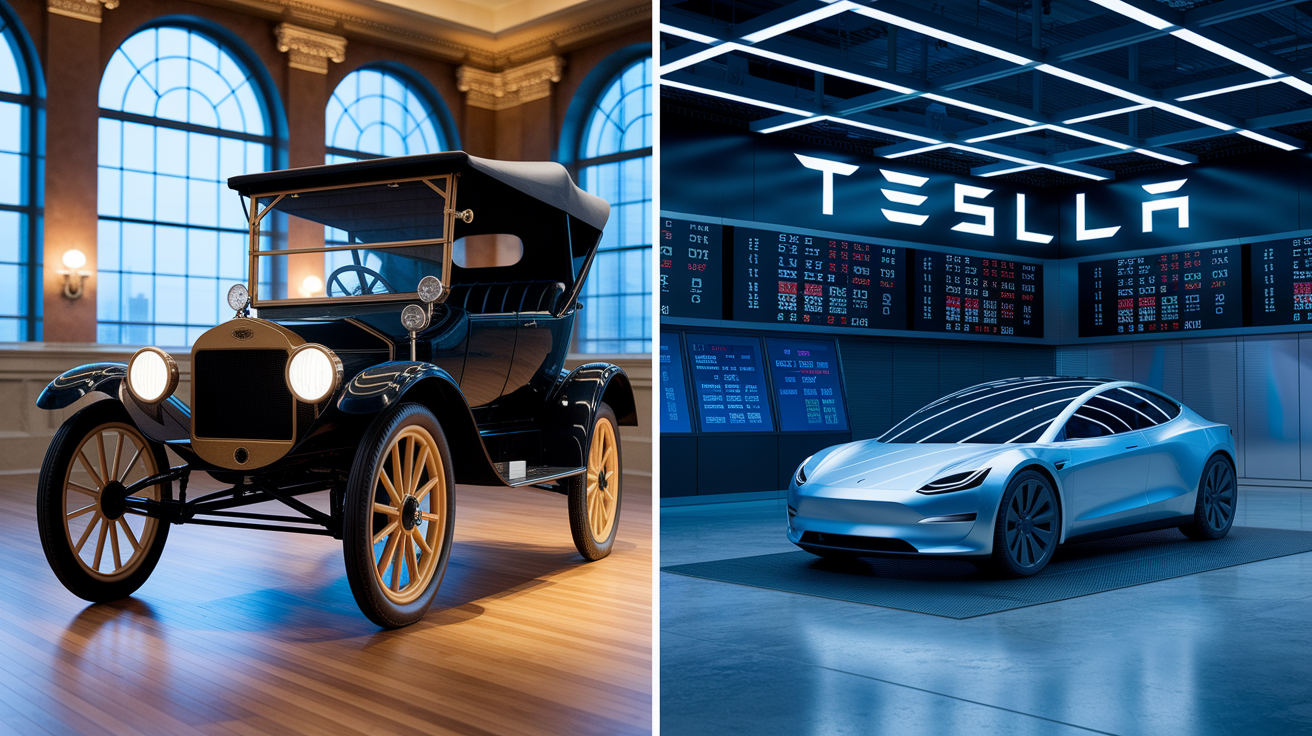
Tesla’s June 29, 2010 IPO marked the first time an American automaker accessed public markets since Ford in 1956. A 54 year gap. This drought reflected the capital intensive, low margin nature of traditional automotive manufacturing, which deterred new entrants and made public offerings rare.
Tesla’s eventual market capitalization exceeded $170 billion, surpassing Toyota individually and exceeding the combined value of General Motors, Ford, and Fiat Chrysler Automobiles. This valuation came despite Tesla selling just over 250,000 vehicles in 2019. That’s a fraction of the millions produced annually by legacy automakers. Traditional automotive valuations centered on volume, production capacity, and incremental profit per unit. Tesla’s valuation reflected different metrics entirely.
Investors valued Tesla as a technology company rather than a traditional automaker. The market priced in growth potential in electric vehicles, energy storage, autonomous driving software, and manufacturing innovation. Tesla’s vertically integrated approach, direct to consumer sales model, and over the air software updates positioned it closer to Apple or Google than to Ford or GM. This technology classification justified higher price to earnings multiples and enabled Tesla to raise capital at valuations that would have been impossible for a volume focused manufacturer producing comparable unit sales.
Final Words
Tesla went public on June 29, 2010, at $17 per share, raising $226 million and launching one of the most remarkable stock stories in market history.
Since that IPO date, shares have climbed over 3,000%, the company has executed two stock splits, and Tesla’s market cap has topped $1 trillion, surpassing every traditional automaker combined.
The company kept raising capital through strategic equity and debt deals to fund Gigafactories worldwide, turning early skepticism into sustained production growth.
For investors who held from day one, Tesla proved that betting on electric vehicle leadership and manufacturing scale could deliver returns few automotive stocks ever match.
FAQ
Q: How much is $10,000 invested in Tesla 10 years ago worth today?
A: $10,000 invested in Tesla 10 years ago (2015) would be worth approximately $122,600 today, based on Tesla’s stock appreciation from around $282 peak price in 2015 to $345.98 in August 2025, accounting for both stock splits.
Q: What if you invested $1,000 in Tesla 5 years ago?
A: $1,000 invested in Tesla 5 years ago (2020) would be worth approximately $3,360 today. Tesla’s stock price peaked around $1,030 in 2020 and currently trades at $345.98 as of August 2025, with a 3-for-1 split in 2022 affecting share count.
Q: How much did Elon Musk invest in Tesla in 2004?
A: Elon Musk joined Tesla as the lead investor in 2004, though the exact initial investment amount is not publicly disclosed in available records. Musk participated in early funding rounds before Tesla’s 2010 IPO, which raised $226.1 million at $17 per share.
Q: How much would $1,000 invested in Tesla IPO be worth today?
A: $1,000 invested in Tesla’s June 2010 IPO at $17 per share would be worth approximately $20,352 today. This accounts for Tesla’s 3,000%+ stock appreciation, current share price of $345.98 as of August 2025, and both stock splits (5-for-1 in 2020 and 3-for-1 in 2022).
Q: When did Tesla go public and on which exchange?
A: Tesla went public on June 29, 2010, on the NASDAQ exchange under ticker symbol TSLA. This marked the first American carmaker IPO since Ford in 1956, a 54-year gap in automotive public offerings.
Q: What was Tesla’s IPO price per share?
A: Tesla’s IPO price was $17 per share when it went public on June 29, 2010. The offering included 13.3 million shares and raised $226.1 million total, with shares closing at $23.89 on the first trading day (a 40.53% increase).
Q: How many stock splits has Tesla completed?
A: Tesla has completed two stock splits: a 5-for-1 split on August 31, 2020 when shares exceeded $2,000, and a 3-for-1 split on August 25, 2022 when shares traded around $900 pre-split. Both splits maintained total shareholder value while increasing share count.
Q: What was Tesla’s market capitalization compared to traditional automakers?
A: Tesla’s market capitalization exceeded $170 billion, surpassing Toyota individually and exceeding the combined value of General Motors, Ford, and Fiat Chrysler Automobiles. This occurred despite Tesla producing only 250,000 vehicles in 2019 compared to millions from traditional manufacturers.