Microsoft released Windows 95 on August 24, 1995, but most people missed the actual detail buried in the hype. The official launch came over a month after the software was technically finished on July 14, 1995, when Microsoft hit its Release to Manufacturing milestone. That gap wasn’t an accident. It gave the company time to orchestrate the most elaborate product launch tech had ever seen, complete with Rolling Stones licensing, a $300 million marketing blitz, and coordinated global midnight releases. Here’s what actually happened on launch day and why the timing mattered.
The Official Windows 95 Launch Date and Global Rollout

Microsoft released Windows 95 on August 24, 1995. It was one of the most anticipated product launches in tech history.
The official retail launch followed Windows 95’s Release to Manufacturing (RTM) milestone on July 14, 1995, when Microsoft finalized the English language version for production. That gap between RTM and retail gave computer manufacturers and software developers time to prepare while Microsoft coordinated what became the most elaborate product launch the tech industry had ever seen. RTM meant Windows 95 was technically finished over a month before anyone could buy it.
The main launch event happened at Microsoft Campus in Redmond, Washington. It drew 2,000 guests and 500 press members for an invite only media spectacle. Physical tickets featuring the original Windows Start Button granted admission to what attendees described as carnival like. The event featured special name tags with a redesigned Windows logo against the iconic clouds and blue sky background that would become synonymous with the operating system.
Microsoft orchestrated a coordinated global midnight launch that started in New Zealand and rolled westward across time zones.
International celebrations matched the scale of the Redmond event. The London launch took place at Equinox Nightclub in Leicester Square with television presenter Jonathan Ross hosting. In Sydney, Dame Edna Everage unveiled Windows 95 at one of 20 separate Australian events. Japan got a unique promotional tie in with Windows 95 Sapporo Black Label beer launching alongside the software.
The coordinated global rollout wasn’t universal. In Eastern Europe, pirated copies had circulated for months before the official launch. The midnight celebrations met with minimal excitement from users who’d already obtained unauthorized versions through unofficial channels.
Windows 95 Development History and Codename Chicago
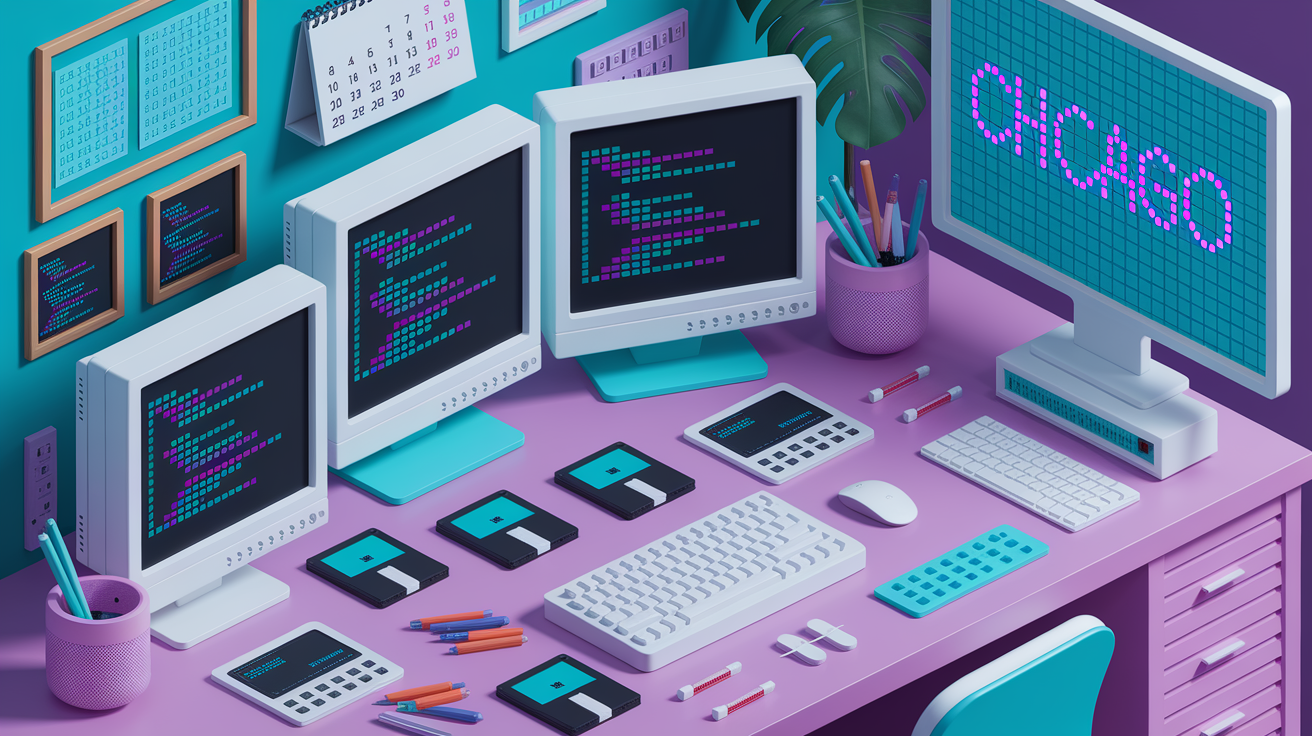
Project “Chicago” began as Microsoft’s internal codename for what would become Windows 95, initially targeting a June 1993 release as “Win93.”
Brad Silverberg sent an email on March 5, 1992, outlining the project’s mission to deliver systems software for high volume platforms. This early vision document laid the groundwork for a development process that would stretch years beyond the original timeline. Technical challenges and Microsoft’s expanding ambitions for the operating system pushed the release date back repeatedly, transforming a planned incremental update into something much bigger.
Microsoft launched an unprecedented preview program charging users $30 for early access to pre release versions.
This preview program attracted 400,000 participants in what became the largest beta test to date. Tech reporters spent months testing pre release versions before the launch, creating buzz while Microsoft collected feedback from real world usage. The company deliberately cultivated this community of early adopters as both testers and evangelists who would advocate for Windows 95 upon release.
The final product represented the first natively 32 bit Windows platform and a major departure from Windows 3.1. DOS remained underneath Windows 95 for backward compatibility with 16 bit software, but Microsoft hid the command line interface from regular users, creating the illusion of a unified graphical operating system.
Revolutionary Features and Technical Architecture of Windows 95

Windows 95 merged two former Microsoft operating systems, MS-DOS and Windows, into what appeared to users as a single integrated platform.
The shift to native 32 bit architecture marked a fundamental breakthrough. Previous Windows versions functioned essentially as graphical shells running on top of DOS, forcing users to juggle two separate environments. Windows 95 unified these disparate interface elements while maintaining the DOS foundation for compatibility purposes. It created a seamless experience that felt genuinely new.
Windows 95 introduced interface elements and technical improvements that transformed personal computing. Start button provided centralized access to programs and system functions. Taskbar displayed running applications and enabled quick switching between programs. Notification area (system tray) showed background processes and system status. Windows Explorer replaced File Manager with hierarchical folder navigation. Plug and Play automatic hardware detection and driver installation meant peripherals could connect without manual configuration. Long filename support extended beyond the 8.3 DOS naming limitation. Native 32 bit architecture improved performance and stability. Win32 API gave developers access to advanced operating system features. Registry system replaced scattered INI files with centralized configuration database. Unified desktop interface eliminated the Program Manager and desktop dichotomy.
These interface features remain part of modern Windows versions decades later. The Start button became so synonymous with Windows that Microsoft faced backlash when Windows 8 temporarily removed it in 2012. After the negative reception, Microsoft brought it back faster than a recalled product. The taskbar concept of showing running applications moved users decisively away from command line interfaces where programs ran invisibly in the background. Plug and Play technology meant peripherals could connect without manual configuration of IRQ settings and DMA channels, technical details that had previously intimidated casual users.
The improved multitasking capabilities gave each application its own protected memory space, reducing system crashes caused by poorly behaved programs. The Win32 API provided software developers access to powerful operating system features through a consistent programming interface, spurring a wave of Windows 95 specific software. Backward compatibility with 16 bit software and DOS applications remained crucial. Businesses relied on legacy programs they couldn’t immediately replace, but Microsoft successfully hid this complexity underneath the modern interface.
The Unprecedented Marketing Campaign Behind Windows 95
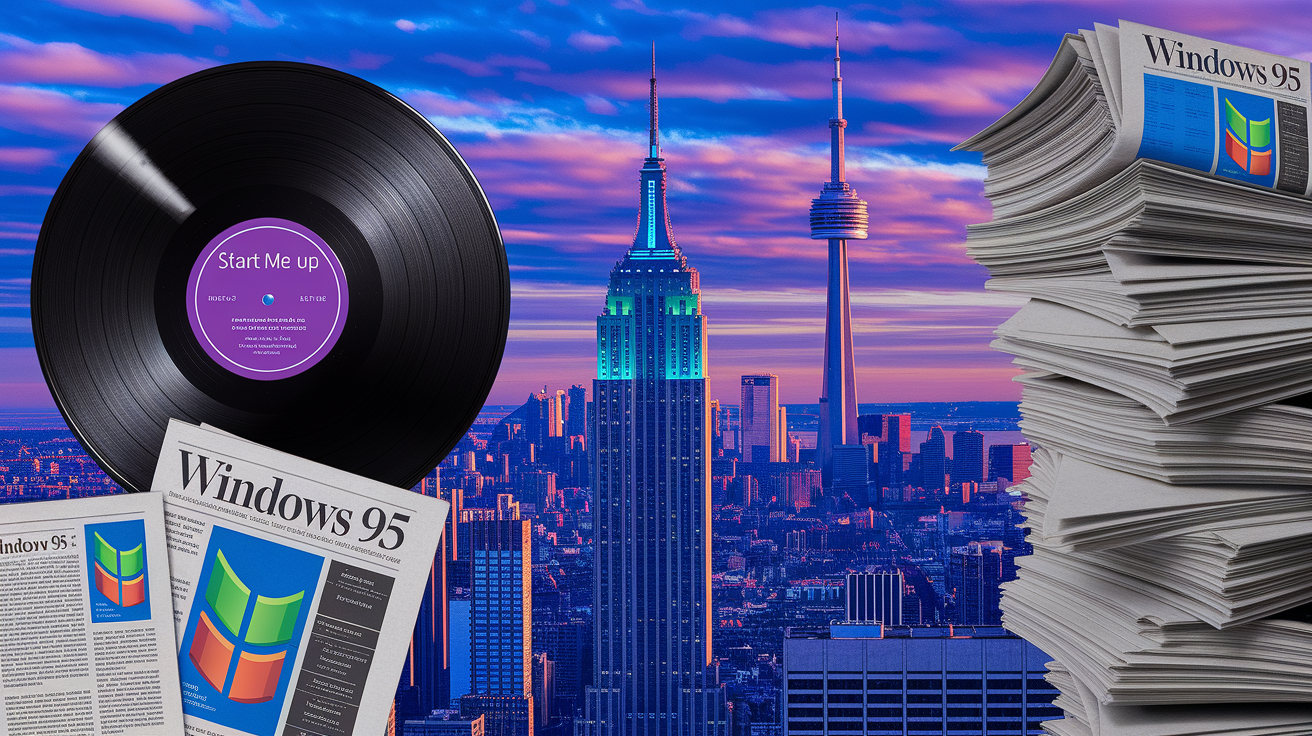
Microsoft’s marketing campaign for Windows 95 reached unprecedented scale with initial spending rumored at $300 million and total campaign estimates reaching $1 billion. Brad Chase led the marketing effort with a mission to “bring computers into the mainstream” and transform the product into “a consumer phenomenon.” This strategy reversed Microsoft’s traditional policy of silence and secrecy about new products, instead building anticipation through months of public promotion.
The Rolling Stones initially requested $12 million for licensing “Start Me Up,” eventually negotiating down to a rumored $3 million for use of their 1981 hit. Wieden+Kennedy, the ad agency behind Nike’s “Just Do It” campaign, created the “Start Me Up” concept that tied the song’s rebellious energy to the Start button. The licensing deal became one of the most expensive uses of a popular song in advertising history, though Microsoft considered it worthwhile for the instant brand recognition the Rolling Stones brought.
Microsoft executed global promotional stunts on a scale the tech industry had never witnessed. The Empire State Building lit up in Windows logo colors on launch night. A 100 meter banner draped over Toronto’s CN Tower displayed the Windows 95 logo. Giant Windows 95 logos appeared painted in fields visible from aircraft. Microsoft paid for 1.5 million copies of The Times newspaper distributed freely in the UK, twice the publication’s usual distribution. A VHS “Microsoft Windows 95 Video Guide” featured Friends stars Matthew Perry and Jennifer Aniston in a promotional video written by Seinfeld contributor Jonathan Gross, blending entertainment celebrity with technology marketing in a way that felt novel for 1995.
| Marketing Element | Details |
|---|---|
| Rolling Stones Licensing | “Start Me Up” song rights negotiated from $12 million ask to rumored $3 million |
| Newspaper Distribution | 1.5 million free copies of The Times, twice normal circulation |
| Empire State Building | Building illuminated in Windows logo colors for launch night |
| CN Tower | 100 meter Windows 95 banner draped over Toronto landmark |
| Celebrity Video Guide | VHS featuring Matthew Perry and Jennifer Aniston, written by Seinfeld contributor Jonathan Gross |
| Total Budget Estimate | $300 million initial spend, up to $1 billion total campaign |
Windows 95 System Requirements and Installation Options
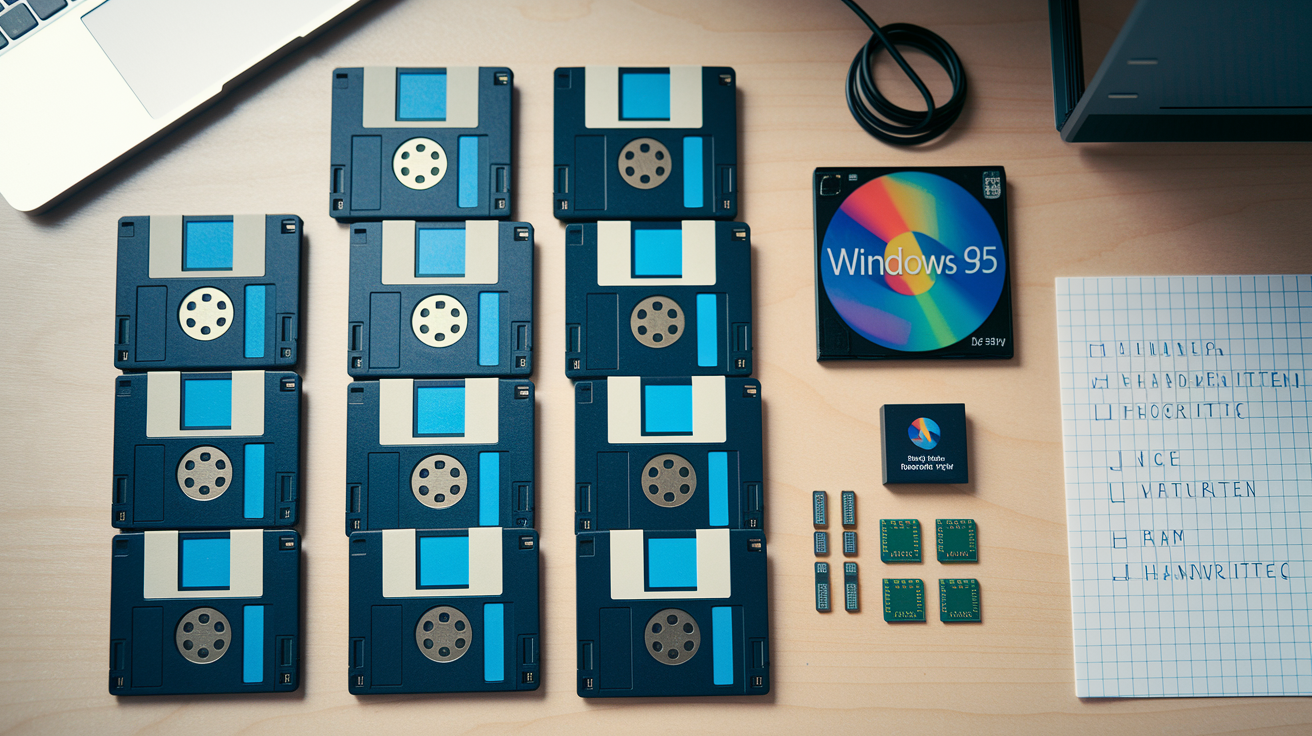
Windows 95 required specific hardware specifications that represented a significant step up from Windows 3.1 requirements.
The minimum specifications tested the limits of what qualified as acceptable performance. Users with bare minimum systems experienced sluggish operation, while those meeting recommended specifications enjoyed the responsive interface Microsoft intended. The jump in system requirements forced many users to upgrade their hardware, driving PC sales industry wide.
Processor requirements started at 386DX minimum, though 486 or higher was recommended for acceptable performance. RAM needed 4MB minimum, 8MB recommended for smooth multitasking. Hard disk space required 50 to 55MB of available space depending on installation options selected. Display needed VGA monitor capable of 640×480 resolution, though higher resolutions improved usability. Recommended specifications landed at 486DX2/66 or Pentium processor with 8 to 16MB RAM for optimal experience.
Microsoft offered Windows 95 in both floppy disk and CD-ROM versions. The floppy disk version required 13 DMF (Distribution Media Format) 1.68MB diskettes inserted sequentially during installation. The CD-ROM version included additional multimedia content, screensavers, and the Microsoft Network software. Upgrade paths existed from Windows 3.1 and MS-DOS, though clean installations on formatted drives generally produced more stable systems than upgrades preserving previous configurations.
Market Impact and Sales Performance of Windows 95
Windows 95 shipped one million copies worldwide in its first four days after launch, establishing immediate commercial dominance. IBM signed a contract to pre install Windows 95 just 15 minutes before the Redmond launch event began, bringing the final major holdout into Microsoft’s ecosystem. The timing of IBM’s capitulation demonstrated how thoroughly Microsoft had won the operating system war before the launch party concluded.
By 1998, Windows 95 commanded 57% market share with its successor Windows 98 holding 17%.
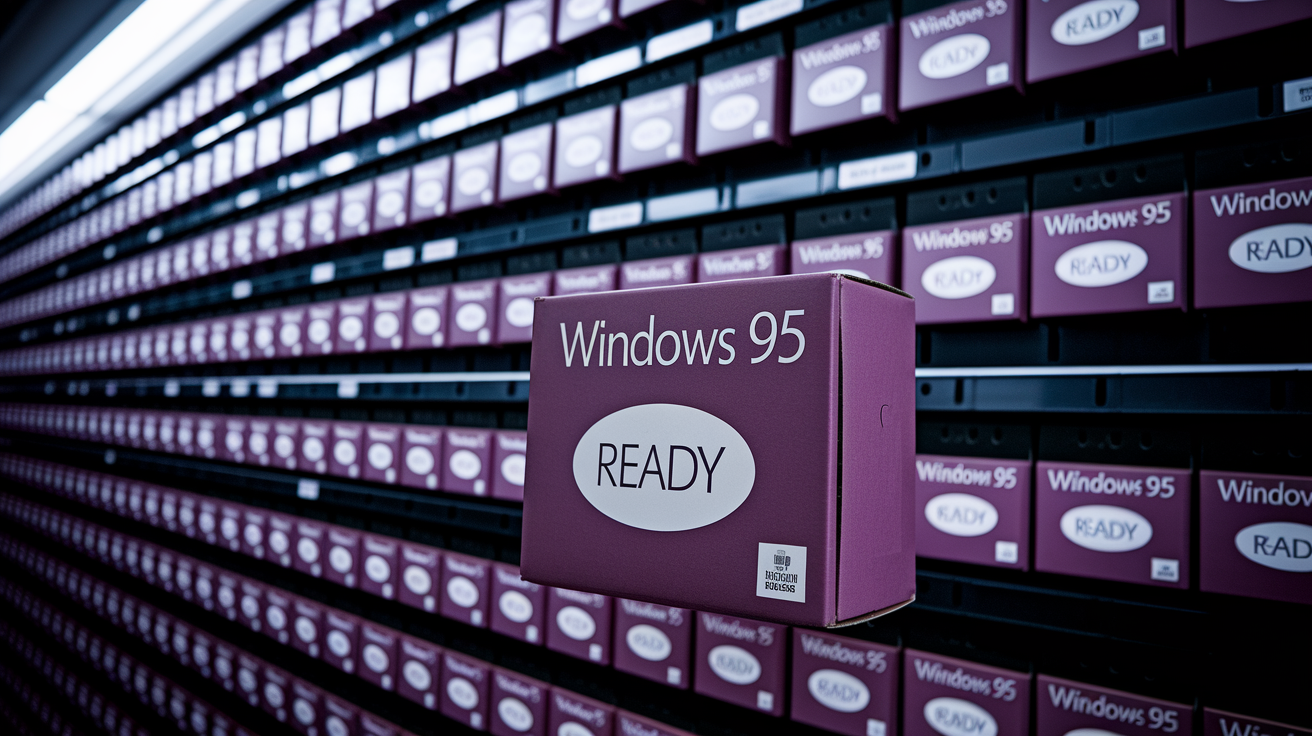
Software companies began labeling their products “Windows 95 Ready” by September 1994, nearly a year before launch, anticipating the platform shift. Microsoft Office was redesigned for the Windows 95 environment and ready before launch, giving Microsoft’s business software suite an advantage over competitors. The “Windows 95 Ready” branding became a seal of approval that consumers looked for when purchasing software, further cementing Microsoft’s platform control.
The launch effectively killed DOS based business software competition from established players like Lotus 1-2-3 and WordPerfect. These applications had dominated their categories throughout the DOS era, but their command line interfaces suddenly felt obsolete compared to Windows 95 native alternatives. WordPerfect’s DOS version disappeared from mainstream use within two years, while Lotus 1-2-3 ceded spreadsheet dominance to Microsoft Excel.
Windows 95 achieved market dominance before the launch party finished. The combination of pre launch anticipation, OEM pre installation agreements, and consumer demand created a self reinforcing cycle that competitors couldn’t break.
Windows 95 Product Lifecycle and Successor
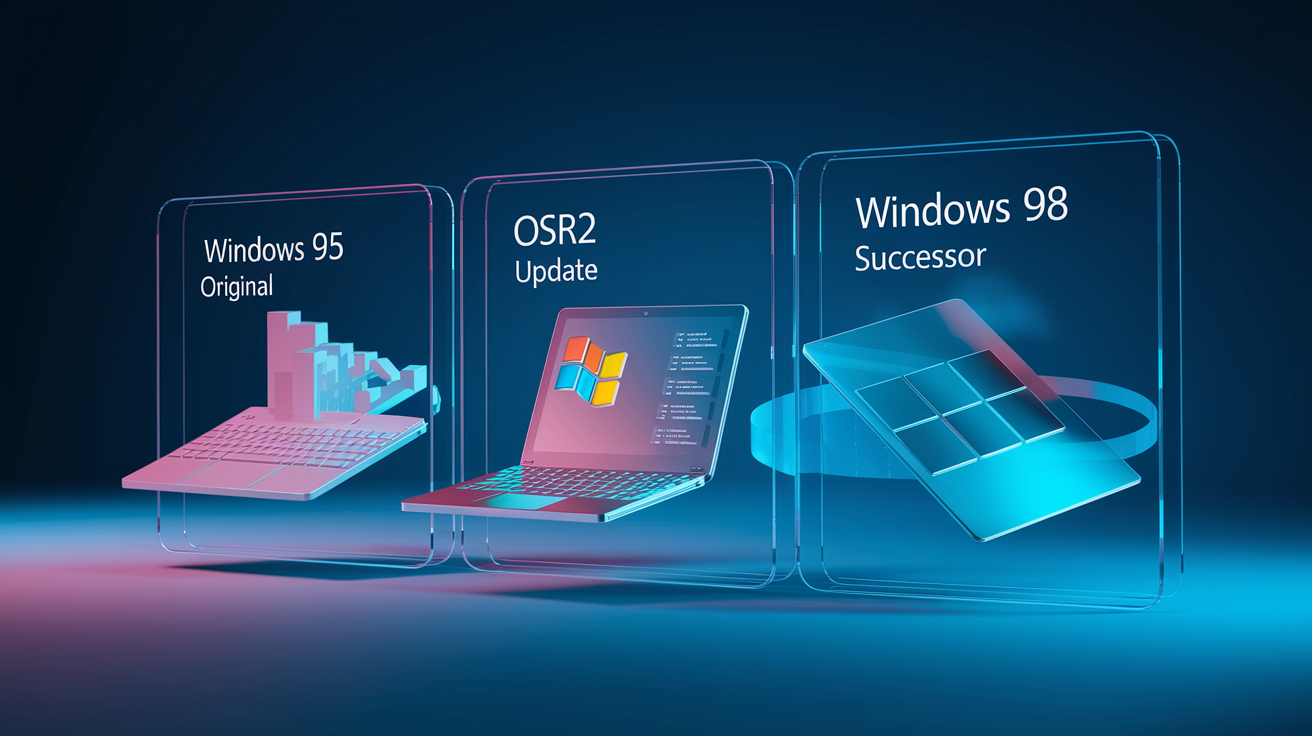
Microsoft released several OSR (OEM Service Release) versions throughout Windows 95’s lifecycle, with OSR2 in 1996 being the most significant update. OSR2 included Internet Explorer 3.0, FAT32 file system support allowing partitions larger than 2GB, and USB support. These features made it substantially different from the original retail release. These OEM Service Releases were only available to computer manufacturers for pre installation, creating a divide between retail purchasers and users who bought new computers with updated Windows 95 versions.
Service packs addressed bugs and added minor features, but Microsoft’s strategy of limiting major improvements to OEM releases frustrated retail customers who couldn’t access the better FAT32 file system or USB support without purchasing a new computer or obtaining OSR2 through unofficial channels. This two tier approach to updates differed from Microsoft’s later practice of making service packs universally available to all license holders.
Windows 98 succeeded Windows 95 in June 1998, integrating Internet Explorer more deeply into the operating system and refining the user interface that Windows 95 had established. Windows 98 represented an evolutionary rather than revolutionary update, building on Windows 95’s foundation with better hardware support and internet integration. Microsoft marketed it as “Works Better, Plays Better,” acknowledging that Windows 95 had already solved the fundamental interface problems.
Support for Windows 95 officially ended on December 31, 2000, marking a five year support window from launch to end of life. End of support meant Microsoft stopped providing security updates, bug fixes, and technical assistance, though the operating system continued functioning on existing installations. Users were encouraged to upgrade to Windows 98 or the newly released Windows ME, though many businesses remained on Windows 95 for years after support ended rather than undertake costly migration projects.
Historical Significance and Computing Legacy of Windows 95

Windows 95 remains one of the most important products in personal computing history, fundamentally changing how people interacted with computers. The launch represented the moment when PCs transitioned from business tools and hobbyist devices to mainstream consumer products found in living rooms and dens alongside televisions and stereos.
Microsoft’s stated goal to “bring computers into the mainstream” and create “a consumer phenomenon” succeeded beyond even the company’s ambitious projections.
Windows 95 moved users beyond the command line DOS interface to a fully integrated graphical operating system that didn’t require memorizing commands or understanding directory structures. The Start button, taskbar, and desktop paradigm established an interface model that persists in Windows 11 nearly thirty years later. Apple’s macOS and Linux desktop environments adopted similar conventions, demonstrating how thoroughly Windows 95’s design choices shaped modern computing expectations.
The cultural impact extended beyond the technology itself to the launch event’s place in business history. Windows 95 demonstrated how a software product could generate consumer excitement previously reserved for entertainment and fashion. The midnight launch parties, celebrity endorsements, and Rolling Stones soundtrack established a template for technology product launches that Apple later perfected with iPhone events. Even the event’s excesses, the billion dollar marketing spend, the Empire State Building lighting, the CN Tower banner, became case studies in product marketing courses.
Windows 95 bridges computing’s transition from the DOS era to the internet age. Users who remember installing it from 13 floppy disks or watching the Matthew Perry and Jennifer Aniston VHS guide now collect vintage Windows 95 machines as nostalgic artifacts. The operating system’s place in computing history is secure not just for its technical achievements but for the cultural moment it captured when computers stopped being intimidating boxes and became familiar appliances.
Final Words
Microsoft released Windows 95 on August 24, 1995, marking a turning point in personal computing history.
The operating system merged MS-DOS and Windows into one integrated platform, introduced the Start button and taskbar that we still use today, and moved millions of users beyond command-line interfaces.
With one million copies shipped in the first four days and a record-breaking marketing campaign, Windows 95 achieved what Microsoft set out to do: bring computers into the mainstream and transform the PC from a business tool into a consumer phenomenon.
The interface decisions made back in 1995 continue to shape how we interact with computers nearly three decades later.
FAQ
Q: When did Windows 98 get discontinued?
A: Windows 98 support ended on July 11, 2006, when Microsoft discontinued all updates, security patches, and technical support for the operating system. This marked the end of the Windows 9x family’s official lifecycle, occurring more than eight years after Windows 98’s initial June 1998 release.
Q: What is the most used operating system in the world?
A: The most used operating system globally depends on device type. For desktop computers, Windows maintains dominance with roughly 70% market share. However, when including mobile devices, Android leads worldwide due to smartphone prevalence, followed by Windows and iOS across all computing platforms combined.
Q: Was there a Windows 97?
A: There was no Windows 97 released by Microsoft. The company moved directly from Windows 95 (released August 24, 1995) to Windows 98 (released June 25, 1998), skipping any 1996 or 1997 numbered consumer releases. Microsoft focused on service packs and OEM Service Releases for Windows 95 during this period instead.
Q: When did Windows 95 go to end of life?
A: Windows 95 reached end of life on December 31, 2000, when Microsoft officially ended all support for the operating system. This conclusion came five years after the August 24, 1995 launch date, meaning users no longer received security updates, patches, or technical assistance from Microsoft after that date.