
Did Uber really launch its first city in San Francisco in 2010?
Yes, the public iPhone app went live in June 2010, the first time regular riders could tap a button and pay for a ride without calling a cab.
The company had registered UberCab in 2008 and spent almost two years testing SMS and GPS prototypes before switching to the native app.
Read on to see why San Francisco mattered, the legal pushback that followed, and the exact early milestones that made 2010 the launch year.
Key Facts About Uber’s First City Launch

Uber kicked off in San Francisco back in 2010, originally calling itself UberCab. The public iOS app went live in June 2010. That’s when things really started moving. San Francisco became the place where Uber’s founders showed that you could use a smartphone to get a ride instead of flagging down a cab on the street. It worked, and it changed how people think about getting around.
UberCab.com got registered in August 2008. The company officially incorporated as UberCab LLC on November 17, 2008. Those legal steps happened before anyone could actually request a ride, which tells you they spent a lot of time building the tech and lining up drivers before they opened the doors. The “Cab” branding didn’t last long. They shortened it to just Uber.
When people talk about Uber’s “first launch,” they’re talking about the moment paying customers could open the iPhone app in San Francisco and actually request a ride. Early testing used SMS and GPS, but the June 2010 app was the first time regular people could tap a button, get a car, and finish the trip without calling anyone or using cash. By the time San Francisco riders saw it in the App Store, Uber had already been building behind the scenes for nearly two years.
Uber’s Early Founding Timeline Leading to the First City Launch

Garrett Camp came up with the idea in December 2008 after he couldn’t find a cab in Paris. He started working on a prototype with engineers Oscar Salazar and Conrad Whelan through mid-2009. The first version used SMS dispatch and GPS tracking. Travis Kalanick joined as a co-founder after meeting Camp, then moved to San Francisco to help grow the operation. Ryan Graves came on board in January 2010 to run things day to day from San Francisco.
The original prototype was rough. By Fall 2009, it relied on drivers accepting ride requests through text messages, and the GPS tracking was basic at best. Camp and his team spent months fixing bugs and improving the experience. Eventually they switched to a native iOS app that showed nearby cars on a map and let riders tap to request a pickup. The June 2010 app launch came after about 18 months of technical work and driver recruiting.
Before going all in on San Francisco, Uber ran small tests in New York City with just three cars in early 2010. Those tests showed there was demand, but they also exposed problems around managing drivers and coordinating pickups in real time. The New York experiment proved the model could work, but it needed a denser network to deliver reliable service. So the team focused everything on one city first.
San Francisco made sense because Camp, Kalanick, and Graves all lived and worked there. The local taxi market was a mess. Chronic shortages, especially at night or when it rained, meant people were desperate for a better option. Being close to iPhone developers, the App Store, and Bay Area investors gave them technical help and funding access they wouldn’t have found as easily anywhere else.
Key moments from 2008 to 2010:
- August 2008: UberCab.com domain registered
- November 17, 2008: UberCab LLC incorporated
- Mid-2009: Prototype built using SMS dispatch and GPS
- Early 2010: Small test in New York City with three cars
- June 2010: Public iOS app launched in San Francisco
Why San Francisco Was Chosen as Uber’s First Launch City
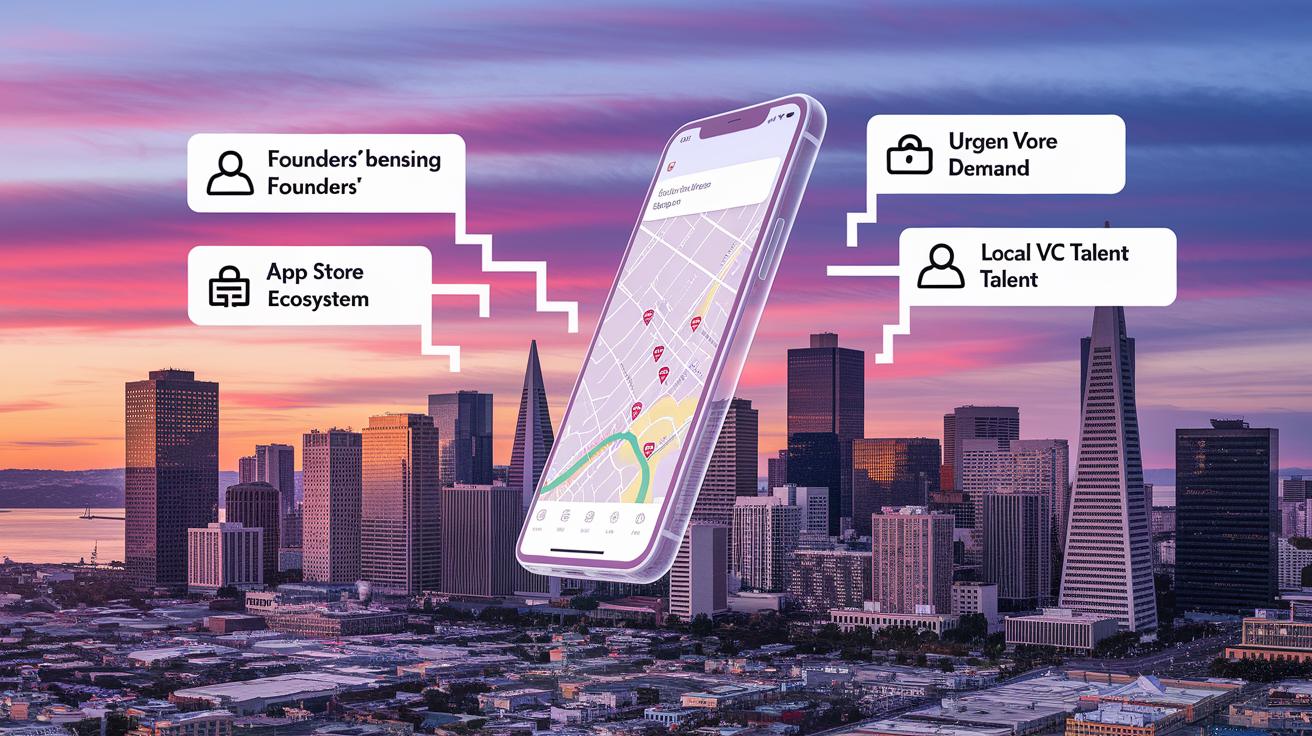
San Francisco’s taxi situation was bad by 2009. Drivers refused pickups in certain neighborhoods. Wait times stretched past 30 minutes during busy hours. Drivers demanded cash or skipped metered fares. Tech workers got hit especially hard by all this, which created a group of early adopters ready to try something new on their phones.
The iPhone App Store launched in July 2008, just months before Camp registered the UberCab domain. San Francisco had tons of iPhone users, app developers, and early-stage investors. Uber could test with a tech-savvy crowd while tapping local expertise to fix problems and improve the experience. Being close to venture capital firms on Sand Hill Road and engineering talent in Silicon Valley made every feedback loop faster.
Regulators came after them quickly. In October 2010, San Francisco city officials and California state regulators threatened penalties of $5,000 per ride and up to 90 days in jail per day of operation. They argued Uber was an unlicensed taxi service. Uber’s defense was that it connected riders and drivers but didn’t actually provide transportation itself. The company kept operating through the dispute, using legal arguments and public support to outlast the enforcement threats.
Four reasons San Francisco worked as the launch city:
- Founders lived and worked there, so they could manage operations directly
- Terrible taxi service created urgent demand and people willing to pay
- Close to iPhone developers and the App Store ecosystem for fast iteration
- Local venture capital and tech talent sped up product development and funding
Detailed Timeline of Uber’s First Launch Milestones in San Francisco
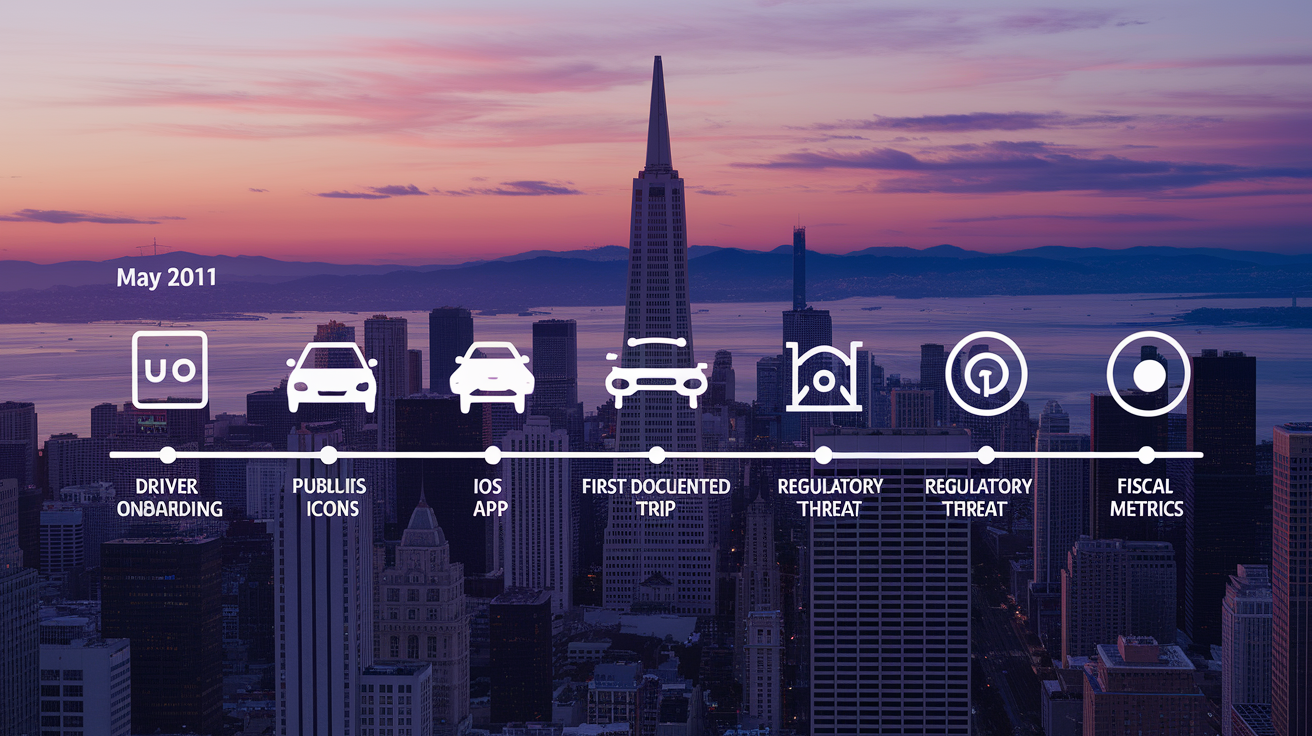
The early SMS and GPS prototype ran through mid-2009 into early 2010. Riders had to text a phone number, wait for confirmation, and hope GPS would get a driver to their location. The experience was clunky and full of errors. Sometimes you had to call just to confirm the pickup. Uber’s switch to a native iPhone app in June 2010 fixed all that. Users could see nearby cars on a map, tap a button, and get automated confirmation with driver details and an estimated arrival time.
Official announcements said operations started in May 2010, but the public iOS app came out in June 2010. The first documented San Francisco trip happened on July 5, 2010. This staggered timeline shows a phased rollout. The company started bringing on drivers in May, released the app to a small group in June, then opened it up to everyone by early July. By September 2011, Uber had processed $9 million in fares, kept $1.8 million in commissions, and served 9,000 customers. Roughly 80 percent of all that activity was in San Francisco.
| Date | Event | Relevance to First Launch |
|---|---|---|
| May 2010 | Driver recruitment and onboarding begins in San Francisco | Built initial supply side required to serve ride requests |
| June 2010 | Public iOS app released on the App Store | First time general users could request rides via smartphone |
| July 5, 2010 | First documented trip completed in San Francisco | Confirmed service was live and operational for paying customers |
| October 2010 | City and state threaten $5,000 fines per ride and jail time | Forced legal positioning as intermediary rather than taxi operator |
| September 2011 | $9M in fares processed, 9,000 customers, 80% in SF | Demonstrated sustainable unit economics in first market |
| December 2011 | International expansion referenced in reporting | SF success validated model for global rollout |
App Prototype to Public Release
Moving from SMS dispatch to the June 2010 iOS app changed everything for users. Early riders had to memorize a phone number, send a text with their location, and wait for a reply saying a driver was coming. The prototype tracked cars using GPS coordinates sent through SMS, but riders couldn’t see where cars were or get accurate pickup times. Bugs happened constantly. Messages failed. Drivers missed assignments because they didn’t check their phones fast enough.
The iOS app fixed these problems by showing real-time car positions on a map, calculating estimated arrival times using live traffic data, and sending push notifications when a driver accepted the request. Riders could see their driver’s name, car model, license plate, and photo before the car showed up. Payment happened automatically through a stored credit card. No cash, no tip negotiations. This combination of transparency, convenience, and speed became Uber’s core promise and separated it from every taxi service in San Francisco at the time.
How Uber Expanded After Launching Its First City

Uber’s first move beyond San Francisco came in early 2011 when they entered New York City. Manager Mike Kochman led the rollout. The playbook was straightforward: hire a local general manager, recruit drivers from Yelp reviews and airport taxi lots, and split the city into smaller areas like Wall Street and SoHo to concentrate supply and demand. During slow periods, drivers got repositioned manually to match expected request patterns. That was labor intensive, but it worked until they had enough data to automate it.
Seattle came next in July 2011. By early 2012, Uber was in roughly a dozen cities with around 50 employees. By Fall 2012, headcount passed 100 and the company was running at about a $100 million annual revenue rate. Funding helped speed up the geographic spread. A $1.4 billion Series D round in June 2014 valued the company at $18 billion. A $3.5 billion investment from Saudi Arabia in June 2016 pushed valuation to $68 billion. By the end of 2016, Uber operated in roughly 450 cities worldwide.
The competition at first was mainly traditional taxi services, which saw ridership drop sharply after Uber showed up. In San Francisco, taxi business fell 65 percent within two years of Uber’s launch. Lyft launched in 2012 as a direct peer-to-peer rival. International competitors like Didi Chuxing and Ola Cabs popped up in China and India. Public transit and local cab companies stuck around, but Uber’s combination of mobile hailing, upfront pricing, cashless payment, and mutual ratings created a service gap most incumbents couldn’t close.
Six key expansions and milestone years after San Francisco:
- Early 2011: New York City (first expansion beyond SF)
- July 2011: Seattle
- Early 2012: Approximately a dozen cities live with around 50 employees
- Fall 2012: More than 100 employees, roughly $100M revenue run rate
- 2014: Major funding ($1.4B Series D at $18B valuation)
- End of 2016: Operating in roughly 450 cities globally, $68B valuation following $3.5B Saudi investment
Final Words
San Francisco was Uber’s first public market, with the service rolling out to riders in 2010.
The company traces back to UberCab, with domain registration and LLC formation in 2008, and prototype work in 2009 that led to an app-ready service.
If you’re asking when did uber launch first city, the straightforward answer is San Francisco in 2010, a launch that set the stage for rapid growth and more transport options for riders and drivers.
FAQ
Q: What was the first city to have Uber?
A: The first city to have Uber was San Francisco, where the service began public operations in 2010 under the original name UberCab.
Q: Is Uber owner a billionaire?
A: Uber doesn’t have a single owner; some founders and early investors reached billionaire status thanks to equity stakes and later funding exits tied to the company.
Q: When was Uber nationwide, and did Uber exist in 2009?
A: Uber did exist in 2009 as a prototype and company entity, but public service launched in 2010 in San Francisco; U.S. national coverage expanded gradually through 2011–2012 and after.