
What happens during a fiber cut?
A single severed glass strand stops light and knocks services offline in milliseconds.
That means internet, phones, CCTV, and point-of-sale systems can fail instantly for customers and critical services.
In this post we explain what breaks physically, how operators detect and locate cuts, the hands-on recovery steps, and what you should do now to reduce downtime.
By the end you’ll know who’s at risk, how long outages often last, and the practical actions to take right away.
Immediate Network Impact When a Fiber Cut Occurs

Cut a fiber optic cable and signal transmission stops. Right now. The glass core breaks, light pulses scatter into the cladding and air instead of reaching the receiver. Every severed strand loses signal completely, dropping internet connections, phone services, and private data links in milliseconds.
The physical damage creates optical problems that go beyond simple disconnection. Severed fiber ends get contaminated with dust, dirt, whatever’s in the environment. These contaminants scatter and absorb what little light reaches the break. Signal loss jumps from the cable’s normal 0.2–0.4 dB per kilometer to effectively infinite at the cut point. Even if you could press the ends together temporarily, rough fracture surfaces and contamination would block nearly all light transmission.
Critical systems fail the instant it happens. CCTV feeds go dark, airport control systems lose data links, traffic signal networks drop offline, utility monitoring for electric grids stops receiving telemetry. Fiber cuts produce binary failure. The link either works or it doesn’t.
What happens in the real world:
- Internet service drops completely for all customers downstream
- VoIP phone systems lose dial tone, can’t complete or receive calls
- Point-of-sale terminals can’t process credit card transactions
- Remote workers lose VPN access to corporate networks and cloud apps
- Medical facilities may lose access to electronic health records and imaging archives
Causes of Fiber Cuts and How Physical Damage Typically Occurs
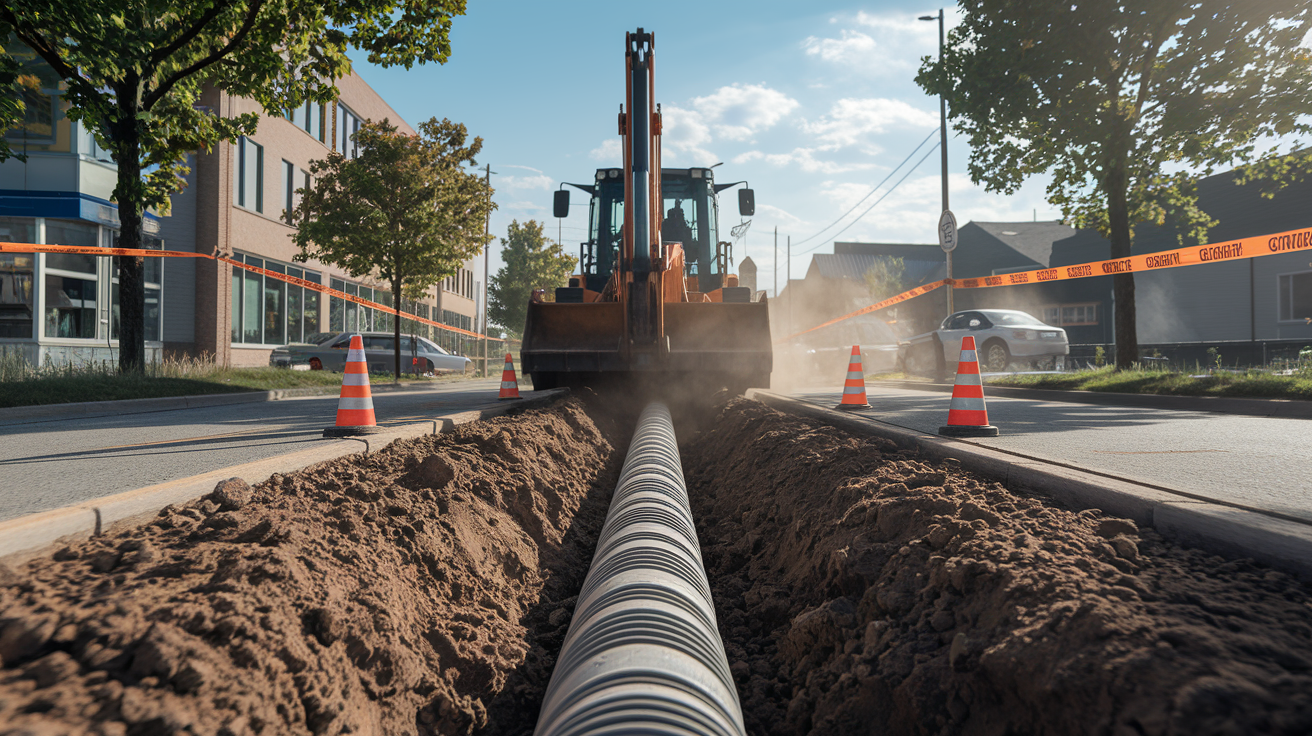
Construction activity is the leading cause. Excavation crews strike buried cables during trenching, directional boring equipment snags conduit runs underground, utility pole replacements sever aerial drops. The industry calls it “backhoe fade”—the sudden signal loss that follows an excavator blade slicing through a buried fiber route. Telecom facilities represented roughly 48 percent of all known underground infrastructure damage events in 2019. These incidents jumped approximately 30 percent from the previous year.
Environmental forces and accidents produce all kinds of physical failures. Flooding fills manholes and splice vaults with water that freezes during winter. Expanding ice cracks splice closures and crushes cable sheaths. Aerial cables face damage from gunfire (field techs call it “target practice”), squirrel and bird nesting, ice loading that snaps messenger wires, trees falling across spans during storms. Vehicle collisions with utility poles break attachment hardware and sever drop cables.
Human error inside buildings and data centers causes surprisingly frequent fiber failures. Technicians accidentally remove the wrong patchcord during maintenance, reversing polarity and preventing link establishment. Installers create tight bends or kinks when closing splice trays, micro-fracturing individual fibers that fail weeks later. Contractors demolishing walls cut through riser cables they assumed were abandoned. Cleaners moving equipment in server rooms snag and break connectors on active patch panels.
Major causes:
- Excavation and trenching operations that strike buried cables without proper locate markings
- Directional boring that punches through conduit or direct-bury cable runs
- Flooding and ice expansion in underground vaults, manholes, pedestal enclosures
- Aerial cable damage from vehicle strikes on poles, gunfire, animals, severe weather
- Accidental removal or cutting of cables during renovation, demolition, maintenance work
- Contaminated, cracked, or physically broken connectors and patchcords in premises installations
- Polarity errors and mismatched connector types that prevent optical alignment
- Kinked or over-bent fibers in splice closures and termination panels that fracture under stress
How Networks Detect a Fiber Cut and Locate the Fault

Service providers rely on continuous optical power monitoring and alarm systems to detect cuts within seconds. Optical transceivers measure received signal strength constantly, comparing live readings against baseline thresholds. When received power drops below the alarm threshold or disappears entirely, the monitoring system generates an immediate fault notification that identifies the affected circuit and endpoint equipment. For large operators managing thousands of fiber routes, centralized network management platforms aggregate these alarms and correlate them with topology maps to estimate the affected service area before field crews even begin troubleshooting.
Pinpointing the exact physical location requires test equipment and field investigation. Optical Time Domain Reflectometers measure the time delay of reflected light pulses to calculate distance to faults, but OTDR readings carry roughly ±2 percent location uncertainty and measure fiber length, which runs about 1 to 2 percent shorter than actual cable length due to helical lay and slack. OTDR testing doesn’t work on very short cables under 30 to 50 meters because the instrument’s dead zone obscures faults close to the launch point. For greatest accuracy on long routes, technicians shoot OTDR traces from both ends and average the results.
Locators who mark underground utilities before excavation report approximately 77 percent of telecom facility damage events. Most fiber cuts are discovered by third parties rather than the network operator’s own monitoring systems. This detection gap suggests many cuts go undetected initially, or monitoring alarms arrive after locators have already called in the strike.
Detection Tools and Their Capabilities
Visual Fault Locators use bright red laser light visible to the human eye over distances of several kilometers in fiber. At a break point, the scattered red light creates a visible glow that pinpoints the exact fault location when the cable is accessible. Especially useful for tracing patchcords in racks or finding breaks in aerial spans at night. An Optical Loss Test Set combines a calibrated light source and power meter to measure end-to-end insertion loss and verify transmitter output or receiver sensitivity, helping technicians separate cable plant faults from failed electronics. Connector inspection microscopes with 100 to 200 times magnification (preferably video microscopes with screens) reveal contamination, cracks, and polishing defects on fiber end faces that cause high loss or complete signal blockage. Power meters alone can confirm whether an optical transceiver is transmitting and whether the receiver is seeing any light at all. Often the fastest way to rule out dead electronics before dispatching a field crew. Each tool has distinct limits. OTDRs can’t resolve faults on patch-length cables, VFLs only work where the cable is visible or accessible, and microscopes require physical access to both connector ends. Complete fault isolation usually requires multiple instruments and systematic testing from both link endpoints.
Service Disruptions and Network Behavior During a Fiber Cut

Customers experience abrupt and total loss of connectivity the moment a cut occurs. Web pages stop loading mid-stream, video conferences freeze and disconnect, file uploads abort. Any application relying on the severed link returns timeout errors. For residential users on fiber-to-the-home circuits, internet access vanishes entirely along with digital voice service. No dial tone, no ability to call for support. Business customers lose access to cloud-hosted applications, remote desktop sessions drop, and point-of-sale terminals display “network unavailable” errors that halt transactions.
The scope of disruption scales with the position of the cut in the network hierarchy. A cut on a single drop cable affects one building or one customer. A trouble ticket but limited overall impact. A severed fiber feeding a neighborhood distribution hub can take hundreds or thousands of subscribers offline simultaneously. Damage to a backbone route linking cities or data centers disrupts traffic for entire regions, affecting not just end users but also the interconnected services and peering relationships that depend on that path. Cuts to dedicated circuits serving hospitals, emergency services, or financial institutions trigger high-priority restoration efforts because the consequences extend beyond inconvenience into safety and regulatory compliance.
Application behavior during the outage window varies by protocol and timeout settings. Real-time services like VoIP and video conferencing fail immediately and noticeably, dropping active calls within seconds. Bulk data transfers and large file downloads pause or abort depending on retry logic. Users see stalled progress bars or error messages. Interactive applications such as web browsing and database queries hang until TCP timeouts expire (often 20 to 120 seconds) before returning failure messages. The familiar experience of “waiting for a page that never loads.”
Typical symptoms:
- Complete loss of internet access with no ability to reach any external site or service
- VoIP phone systems show “no service” or “server unreachable” and can’t place or receive calls
- Video conference platforms disconnect all participants and can’t reconnect
- Cloud application sessions time out and display connection error or “offline mode” warnings
- Email clients can’t send or retrieve messages and show “disconnected” status
- Credit card terminals at retail counters return “communication failure” and can’t authorize transactions
Temporary Traffic Rerouting and Failover Options During a Fiber Cut
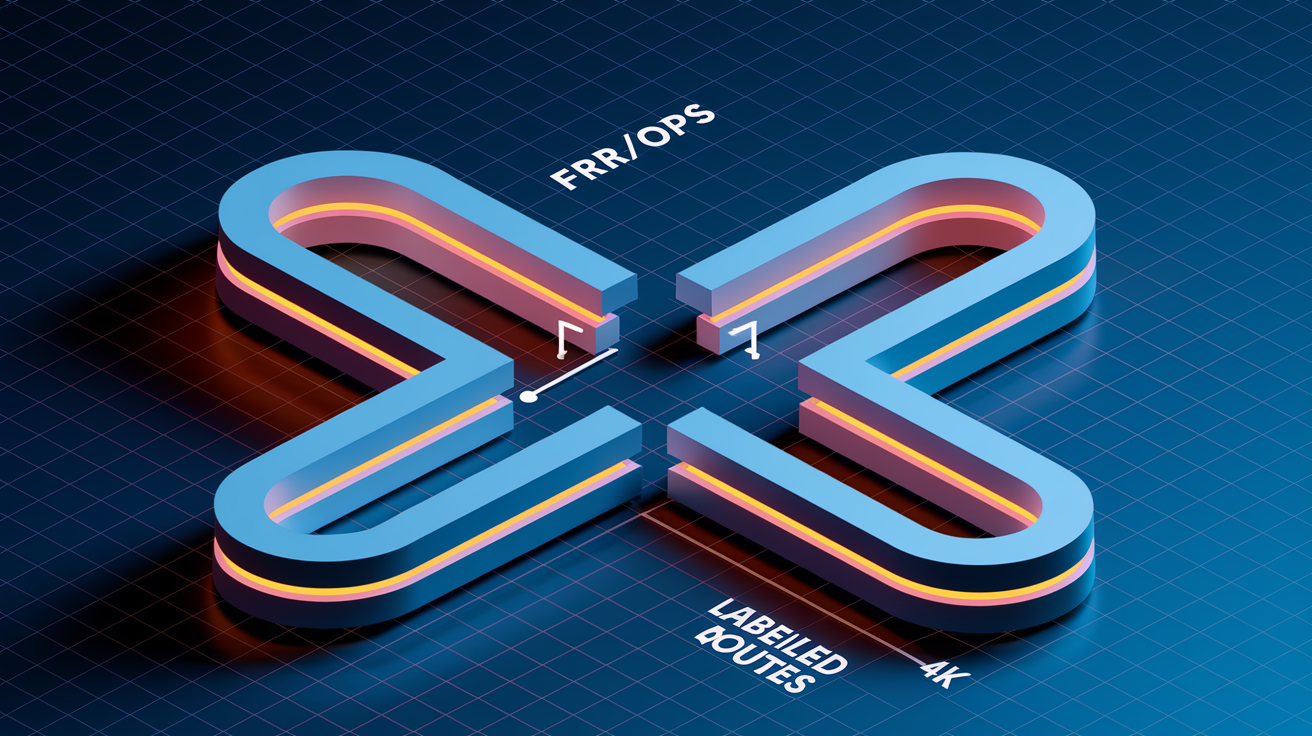
Ring topologies and dual-route diversity allow automatic failover that restores traffic in milliseconds when networks are designed with geographic path separation. Protection protocols such as MPLS Fast Reroute or optical layer Automatic Protection Switching detect the loss of signal and immediately redirect packets onto a pre-configured backup path that avoids the failed span. For carrier backbone networks with full route redundancy, customers may experience only a brief interruption, sometimes under 50 milliseconds. Short enough that a VoIP call continues without dropping and TCP sessions survive without timing out.
Most access and distribution networks lack the physical and economic justification for full geographic diversity. A fiber cut on the single cable feeding a neighborhood hub can’t reroute locally because no alternate physical path exists to those customers. Higher-layer routing protocols such as BGP can shift traffic to different upstream providers or peering points, but this helps only if the customer site or aggregation node has multiple diverse connections. When a cut severs the only fiber path, no amount of protocol sophistication restores service until physical repair or a temporary workaround is in place.
Networks with redundancy can still experience performance degradation during failover. Backup paths often carry less capacity than primary routes, so the sudden shift of traffic onto protection fibers introduces congestion, packet loss, increased latency. Routing convergence (the time required for all routers to learn the new best path) can take seconds to minutes depending on network size and protocol timers. During that window some traffic may loop or black-hole. Failover works best when the network was designed with enough spare capacity on alternate routes to absorb the shifted load without saturation.
| Protocol/Method | How It Responds During a Cut |
|---|---|
| MPLS Fast Reroute (FRR) | Pre-computed backup label-switched paths activate in under 50 ms, rerouting traffic around the failed link before upper-layer protocols notice. |
| Optical Protection Switching (OPS) | Physical-layer ring or linear protection detects loss of light and switches to standby fiber in 10–50 ms without any packet-layer involvement. |
| BGP Route Convergence | Routers withdraw unreachable prefixes and recalculate best paths; convergence can take 30–180 seconds depending on timers, during which some destinations remain unreachable. |
Repairing a Fiber Cut: Steps, Tools, and On‑Site Challenges

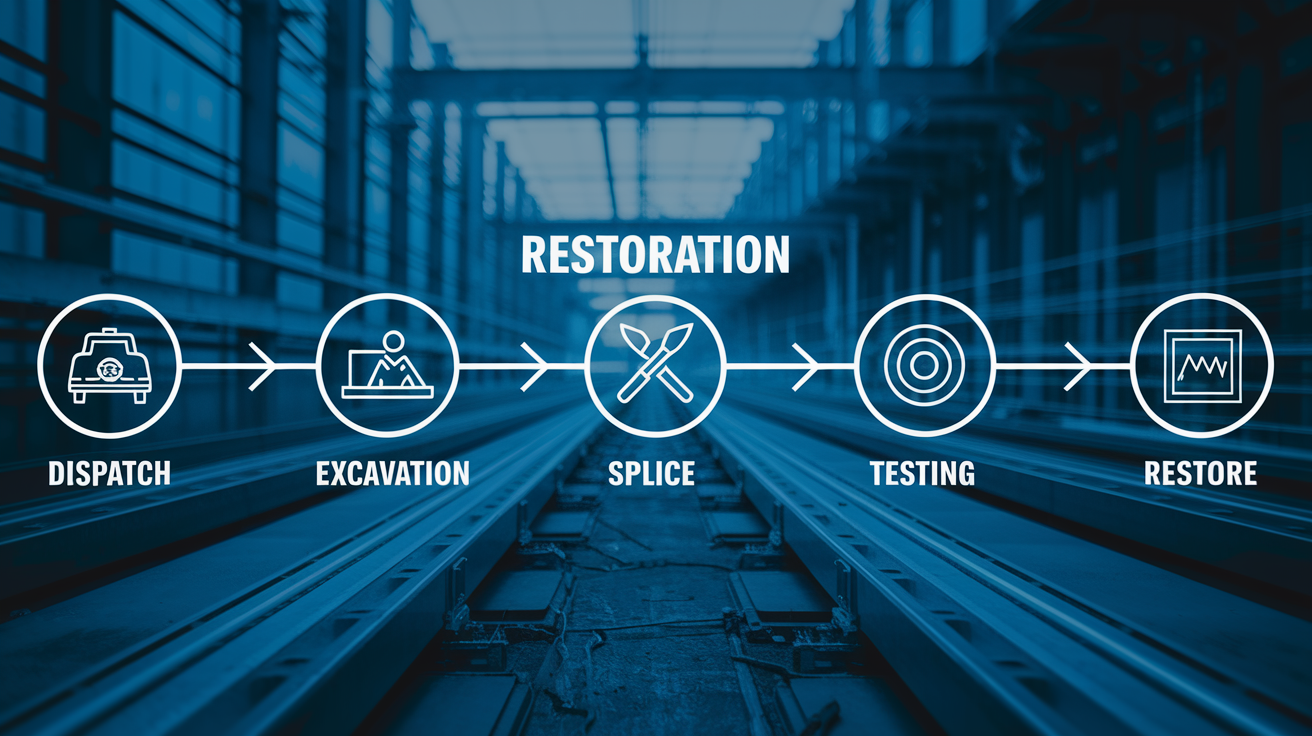
Repair begins with mobilizing a crew, locating the exact fault, and excavating or accessing the damaged cable section. For buried cables, crews must call 811 for utility locates, obtain any required permits, set up traffic control if the cut is under a road, and dig carefully to expose the damaged section without causing additional harm. Aerial repairs require bucket trucks and coordination with electric utilities if the fiber shares pole space with power lines. Inside buildings, technicians must navigate locked server rooms, cramped riser shafts, or ceiling spaces to reach the fault.
Once the cable is exposed, technicians assess whether a single fusion splice will suffice or if a new cable section must be inserted. Fusion splicing (the preferred permanent repair) requires roughly two meters of free cable at each end to strip jackets, clean fibers, cleave ends precisely, align cores in the fusion splicer, and protect the splice with heat-shrink tubing inside a weatherproof closure. If the cut destroyed too much cable or the ends are too short, the crew splices in a new segment. That doubles the work because it requires two splice points and two closures. For singlemode long-haul links, inserting 10 to 100 meters of new fiber avoids potential modal or chromatic dispersion mismatches between cable types.
Temporary mechanical splices can restore service in minutes without fusion equipment, using precision alignment sleeves and index-matching gel to couple the fibers. These field-installable connectors allow a quick fix to bring critical circuits back online, but they introduce higher loss (typically 0.5 to 1.0 dB compared to 0.1 dB or less for fusion) and remain vulnerable to moisture and temperature swings. Most operators replace mechanical splices with fusion splices and proper closures as soon as conditions and scheduling allow.
Repair costs and timelines vary widely depending on location and accessibility. Some incidents in 2019 reached repair costs up to $92,000 for a single event, driven by extensive excavation, traffic control, after-hours labor rates, or the need to pull hundreds of meters of new cable through conduit. Rural buried fiber averages about $75,000 per mile to install, so replacing a damaged span can match the cost of the original build.
Required tools:
- Fusion splicer with cleaver, stripping tools, and consumables (heat-shrink protectors, cleaning supplies)
- OTDR and OLTS to verify splice quality and measure end-to-end loss after repair
- Visual Fault Locator to confirm continuity and trace fibers during splicing
- Splice closures sized for fiber count, cable entries, and environmental sealing requirements
Realistic Outage Duration and Restoration Timelines After a Fiber Cut
Quick fixes (swapping a failed patchcord, replacing a transceiver, or installing a temporary mechanical splice on an accessible aerial cable) can restore service in minutes to a few hours if spares and access are immediately available. These best-case scenarios assume the fault is simple, the location is reachable without permits or excavation, and trained personnel with the right tools are on-site or nearby.
Field repairs requiring excavation or fusion splicing typically take several hours to a full day. Crews must mobilize equipment, obtain utility locates, dig to expose the cable, splice fibers, install closures, backfill and compact the trench, restore pavement or landscaping, and test the repaired link end-to-end. After-hours or weekend calls add mobilization delays. Remote or difficult-access locations (such as river crossings, railroad rights-of-way, or mountainous terrain) can extend repair timelines to multiple days, especially if specialized equipment like directional boring rigs or helicopter cable pulls are required.
Large-scale damage from natural disasters or widespread construction accidents can overwhelm available crews and supplies, stretching restoration timelines to weeks. The financial stakes are significant. Telecom operators incurred roughly $600 million in direct repair costs and approximately $18 billion in indirect costs during 2019 alone, driven by business closures, productivity losses, and customer compensation. Mean time to repair is a critical operational metric. Operators with trained on-call crews, pre-positioned restoration kits, and established contractor relationships consistently get faster recovery than those who must source everything ad hoc after the cut occurs.
Business, Customer, and Financial Impact of a Fiber Cut

Repeated outages erode customer trust and speed up churn. Costly outcome because acquiring a new customer costs between 5 and 25 times more than retaining an existing one. When service drops during business hours, customers voice frustration on social media, file complaints with regulators, and shop for alternative providers. Operators that experience frequent cuts develop reputations for unreliability. Harder to win new subscribers and easier for competitors to poach existing ones with promises of better uptime.
Service-level agreement breaches trigger contractual penalties and customer credits that pile up quickly across large subscriber bases. Even small per-customer credits (perhaps $5 to $20 depending on the contract) add up when thousands of customers are affected by a single backbone cut. Roughly 91 percent of customers accept company terms without reading them, but after an outage many will call support to demand compensation. Operators often issue credits proactively to reduce complaint volumes and demonstrate accountability. For dedicated enterprise circuits with strict SLAs, penalties can reach thousands of dollars per hour of downtime.
Business customers face direct financial losses during outages. Retailers can’t process credit card transactions, losing sales and frustrating customers who leave without purchasing. Remote workers miss deadlines. Project teams can’t collaborate when file servers and communication platforms go offline. Manufacturing and logistics operations that depend on real-time data feeds experience production stoppages or shipment delays. Medical facilities lose access to electronic health records and imaging systems, forcing staff to operate in degraded manual modes that slow patient care.
Financial consequences:
- Direct repair costs including labor, materials, equipment rental, permits, and emergency contractor premiums
- Customer credits and SLA penalties that scale with outage duration and number of affected subscribers
- Lost revenue from subscriber churn as frustrated customers switch to competitors after repeated outages
- Indirect costs such as lost business productivity, halted transactions, and reputational damage that persists beyond the outage window
Regulations, Safety Requirements, and Coordination in Fiber Cut Scenarios

Excavation-related fiber cuts trigger compliance obligations under state and federal damage-prevention laws. Before digging, contractors must submit locate requests (typically by calling 811) to notify underground utility owners, who then dispatch locators to mark buried infrastructure. Locators report approximately 77 percent of telecom facility damage events, highlighting their role as the primary detection mechanism for excavation-caused cuts. Failure to call for locates, digging outside marked areas, or ignoring marked cable routes can result in fines, liability for repair costs, and in some jurisdictions criminal penalties for willful or negligent damage to critical infrastructure.
Emergency fiber repairs often require expedited permits and close coordination with municipal authorities. If the damaged cable lies under a roadway, the repair crew must obtain a street opening permit, arrange traffic control with advance signage and lane closures, and sometimes schedule work during off-peak hours to minimize congestion. Aerial repairs near power lines require coordination with the electric utility to de-energize or establish safe working clearances. Repairs on railroad or pipeline rights-of-way involve additional approvals and safety protocols. Regulatory frameworks such as OSHA trench safety standards mandate sloping, shoring, or shielding for excavations deeper than a certain threshold to protect workers from cave-ins.
Outage reporting obligations vary by service type and jurisdiction. Carriers providing voice services may be required to notify public safety answering points and regulatory authorities if a cut affects 911 availability. Operators serving critical infrastructure customers (such as hospitals, airports, or emergency services) often have contractual notification and restoration-priority requirements that exceed general subscriber obligations. Post-incident documentation, including root-cause analysis and corrective-action plans, may be required by regulators or enterprise customers as part of formal review processes.
Preventing Fiber Cuts: Monitoring, Planning, and Long‑Term Resilience
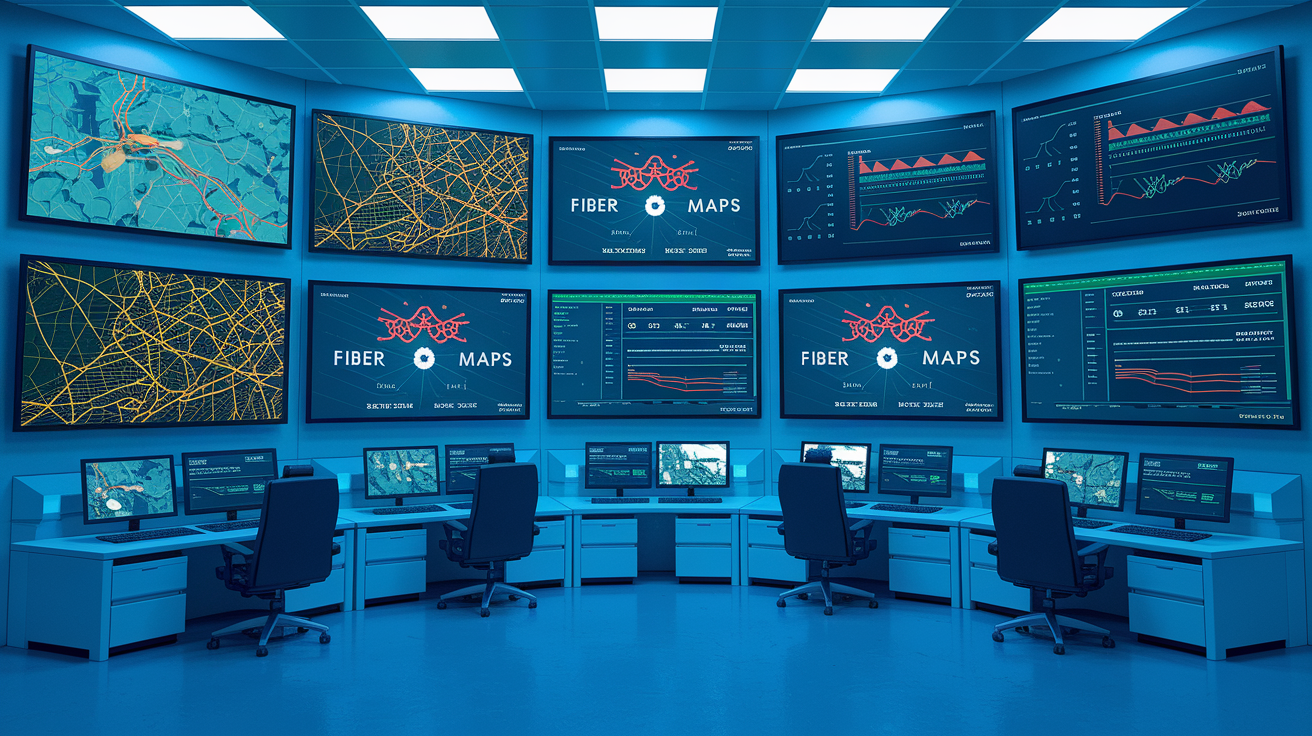
Predictive analytics platforms analyze historical damage data, excavation permits, construction activity forecasts, and geographic risk factors to identify high-probability cut zones before they occur. Operators use these risk scores to prioritize targeted interventions such as additional locate staff, enhanced marking, proactive outreach to excavation contractors, or temporary monitoring in active construction corridors. The financial case for prevention is strong given the scale of direct and indirect costs. Even modest reductions in annual cut rates deliver measurable return on investment.
Route diversity and ring topologies eliminate single points of failure by providing geographically separate paths between critical nodes. Properly designed rings automatically reroute traffic within milliseconds when a cut occurs, maintaining service continuity without manual intervention. For access networks where full diversity is uneconomical, operators provision spare fibers in every cable and deploy service loops at splice points and building entries, ensuring enough slack to make repairs without splicing in new cable sections. Burying cables roughly one meter (three feet) deep and using brightly colored innerduct with continuous warning tape reduces the chance of accidental excavation strikes.
Scheduled maintenance and proactive inspections (when done carefully) can catch deteriorating infrastructure before it fails. Aerial cables exposed to UV, ice loading, and wind fatigue benefit from periodic visual inspections to identify damaged messenger wires, cracked jackets, or sagging spans. Manholes and vaults should be checked for water intrusion, corrosion, and rodent activity. Operators must balance proactive care against the risk that intrusive testing contaminates otherwise healthy fiber. Opening splice closures and connector panels unnecessarily increases the chance of introducing dirt, moisture, or accidental damage that creates new outages.
Mapping, Documentation, and Inventory Discipline
Accurate GIS mapping with GPS coordinates for every splice point, pedestal, handhole, and building entry is the foundation of fast fault location and efficient restoration. Operators who maintain current route maps, splice diagrams, fiber identification labels, and as-built records can dispatch crews to the right location with the correct tools and spare cable on the first trip. Cuts hours from the repair timeline. Outdated or missing documentation forces field techs to visually trace routes and guess at splice locations, wasting time and increasing the risk of secondary damage.
Restoration kits and spare inventories must be sized to match the network architecture and maintained with discipline. Keeping spare cable on reels, pre-stocked splice closures, extra connectors, cleaning supplies, and backup electronics reduces mobilization delays when a cut occurs. Shelf-life items such as fusion splice protectors, epoxy adhesives, and gel-filled closures require tracked replacement dates to ensure crews don’t arrive on-site with expired consumables. Manufacturer datasheets, contact information for suppliers, and emergency contractor agreements should be documented and accessible 24/7 so that after-hours incidents don’t stall waiting for someone to find a phone number or part specification.
Final Words
A fiber cut instantly stops the optical signal, sharply increases attenuation, and collapses services — this piece walked through those physical effects, common causes, and how providers detect and locate faults.
We also covered user-visible outages, routing failovers, on-site repair steps, realistic restoration timelines, and the business and regulatory impacts operators face.
For a quick takeaway: know what happens during a fiber cut, keep route diversity and monitoring active, and maintain clear maps and response plans. With that prep, downtime is manageable and recovery is faster.
FAQ
Q: How does a fiber cut happen and what happens if you cut a fiber line?
A: A fiber cut happens when physical damage severs the optical core; cutting a fiber line immediately stops light transmission, sharply raises attenuation, and causes instant loss of internet, phone, and data services.
Q: How to fix a fiber cut and how long does fiber repair take?
A: Fixing a fiber cut involves cleaning, aligning, and fusion splicing cores or using temporary mechanical splices; simple restores take minutes to hours, while complex digs and full splices can take hours to days.