Could Netflix’s unstoppable rise finally be over?
In early 2022 Netflix lost 200,000 subscribers, warned 2 million more would go, and its stock plunged 35% in a single day.
That reversal exposed cracks in a business everyone thought was bulletproof.
This post breaks down the four linked causes: password sharing, tougher competition, pricing pressure, and content shifts, why each matters for viewers, creators, and investors, and what to do next.
Read on for a short, practical guide to what happened, who’s affected, and the steps to watch or take.
Key Reasons Behind Netflix’s Subscriber Losses in 2022

Netflix lost 200,000 subscribers globally in Q1 2022. Then they told investors to expect another 2 million gone by Q2. After years of consistent growth, that reversal hit hard. The stock cratered 35% in one day once Q1 numbers came out. Back in January, the company had forecast adding 2.5 million subscribers, so the actual decline wasn’t just a miss. It triggered immediate panic among investors and kicked off serious questions about whether streaming could sustain the growth everyone had taken for granted.
Netflix’s official explanation pointed to four connected problems. Over 100 million households were sharing passwords beyond the paying base, which meant viewing didn’t turn into revenue. Macro disruptions added pressure: Russia’s invasion of Ukraine forced Netflix to exit that country, and ongoing covid volatility kept things unpredictable. Post-pandemic viewing patterns normalized as people went back to work and other activities, cutting into the binge-watching surge that had fueled gains during lockdowns. And competition got fiercer. Legacy media companies and new entrants launched aggressively priced streaming services with high-profile original content.
TVision’s measurement data showed household reach dropping from 69.4% in the second half of 2021 to 64.3% in Q1 2022. That’s a 5.1 percentage-point fall. The average U.S. household tuned into 7.7 apps during the period, and 30% of households used ten or more apps. When people sample that many services, the odds of canceling Netflix go up.
Six surface reasons drove the subscriber decline:
Password sharing across over 100 million additional households limited official subscriber growth. Macro disruptions including the Russia exit and covid-related chaos reduced addressable markets. Post-pandemic viewing normalization pulled consumers back to pre-2020 routines. Household reach fell 5.1 percentage points in a single quarter. Multi-app viewing behavior meant households sampled 7.7 apps on average. And the competitive landscape intensified as dozens of new streaming services launched over three years.
Competitive Pressures Driving Netflix’s Subscriber Decline

Paramount+, HBO Max, and Peacock all showed steady increases in share of time spent over the six months leading into Q1 2022, according to TVision’s person-level, second-by-second measurement across hundreds of apps. Paramount+ gained traction with franchise content like “Star Trek” and the “Yellowstone” prequel “1883.” HBO Max pulled viewers with “And Just Like That,” the widely discussed “Sex and the City” revival. Peacock attracted attention with exclusive coverage of the 2022 Winter Olympics, a live-event draw Netflix couldn’t match.
Netflix still led overall viewing. It hosted the top five programs in March 2022. But the combination of household reach decline and multi-app sampling meant that high-profile releases on competing services could pull subscribers away even when Netflix remained the leader in total time spent. Disney briefly surpassed Netflix in total streaming subscribers across all its platforms in mid-2022. That was a symbolic shift that underscored how quickly things had changed. With 30% of households using ten or more apps, loyalty became fragile. Consumers subscribed for a specific show, binged it, then moved to the next platform.
| Service | Example Content | Impact on Netflix |
|---|---|---|
| Paramount+ | “Star Trek,” “1883” | Increased share of time spent, franchise appeal pulled sci-fi and Western audiences |
| HBO Max | “And Just Like That” | High-profile revival generated buzz and viewing sessions, diverted attention from Netflix originals |
| Peacock | 2022 Winter Olympics | Live-event exclusivity attracted sports fans, a content type Netflix lacked |
| Disney+ | Marvel, Star Wars franchises | Total Disney streaming subscribers briefly surpassed Netflix in mid-2022, signaling competitive reach |
| Apple TV+ | Best Picture Oscar win (first streamer) | Quality perception and prestige content challenged Netflix’s content leadership narrative |
Password Sharing’s Major Role in the Netflix Subscriber Drop
Netflix estimated that over 100 million households were sharing passwords beyond its paying base of roughly 221.6 million subscribers after Q1 2022. The percentage rate of sharing had stayed relatively stable, but the absolute scale made it harder to grow official subscriber counts. Each shared account represented viewing that didn’t convert into revenue or show up in subscriber metrics. The company told shareholders that password sharing was a significant factor limiting growth, even though Netflix had long tolerated the practice as a form of word-of-mouth marketing.
The scale of sharing meant Netflix’s actual audience was much larger than its paying subscriber base. But the business model depends on converting viewers into subscribers. As competition intensified and content costs remained high, leaving 100 million households unmonetized became unsustainable. The company faced a difficult choice: crack down and risk backlash, or continue losing potential revenue while competitors grew their own paying bases.
Netflix later rolled out paid sharing policies in more than 100 countries. They added “extra member” sub-accounts priced at $7.99 per additional household. The company introduced a profile-transfer feature to ease the transition for users who’d been sharing accounts and wanted to start their own subscriptions. Technical detection and limits on unauthorized sharing were implemented, and Netflix communicated the changes clearly to reduce immediate backlash and preserve trust.
Five ways password sharing contributed to the subscriber decline:
Over 100 million non-paying households used Netflix without converting to official subscribers. Stable sharing percentages masked growing absolute numbers as the paying base expanded. Shared accounts reduced the urgency to subscribe individually, especially as content libraries diversified across platforms. Competitors without widespread sharing grew their own paying bases more efficiently during the same period. Investors and analysts viewed unmonetized sharing as a structural weakness limiting growth potential and pricing power.
Pricing Dynamics and Consumer Pressure Behind the Netflix Losses
Netflix raised prices during a period of intensified competition, making the service relatively less attractive as newer platforms launched at lower entry points or bundled with existing subscriptions. Consumers facing rising costs for groceries, gas, and housing began cutting discretionary spending. Streaming subscriptions became an easy target for budget trimming. The combination of Netflix’s price increases and cheaper alternatives created a trade-off that many subscribers resolved by canceling Netflix and moving to lower-cost options.
The company later introduced a $6.99 ad-supported tier to capture price-sensitive users who’d canceled or were considering cancellation. The ad tier launched with a partnership with Microsoft for ad technology and sales, allowing Netflix to offer a significantly lower price point while generating revenue from advertising. This move acknowledged that a one-size pricing model no longer worked in a crowded, economically pressured market.
Four pricing pressures that drove subscriber losses:
Netflix’s price increases made the service more expensive just as Disney+, HBO Max, and others offered competitive content at lower prices. Economic pressures from inflation and rising costs elsewhere pushed consumers to prioritize spending and cut non-essential subscriptions. Price-sensitive households downgraded or canceled entirely rather than absorbing higher monthly fees during uncertain economic times. Lack of a lower-cost entry option (until the ad tier launched) left Netflix unable to retain subscribers who wanted to keep watching but needed a cheaper plan.
Content-Quality Concerns and Catalog Shifts Behind Subscriber Losses

Netflix faced growing concerns about uneven return on investment for high-cost productions and gaps in local content offerings, even as the company continued to spend billions on originals. Some widely promoted shows failed to generate sustained engagement. And the loss of notable licensed content left holes in the catalog. As studios pulled titles to supply their own streaming services, competitors launched high-profile originals that generated cultural buzz and viewing sessions, pulling attention away from Netflix releases.
Netflix still hosted the top five programs in March 2022 according to TVision data. But declining household reach suggested that content leadership alone wasn’t enough to prevent cancellations. The sheer volume of content became a challenge. Subscribers struggled to find shows that matched their interests, and recommendation algorithms didn’t always surface the right titles at the right time. As competitors invested in franchise-building content (Marvel, Star Wars, “Star Trek,” premium HBO dramas), Netflix’s mix of original films, series, and international content felt less cohesive.
The company later adjusted its content strategy to focus more on quality over volume. It increased investment in local-language content in growth markets, expanded its gaming catalog to over 50 mobile titles, and invested in live programming and sports documentaries. Improved recommendation algorithms aimed to boost engagement by surfacing relevant content more effectively. These shifts acknowledged that simply spending more wasn’t enough. Content had to drive sustained engagement and justify the subscription cost in a multi-app viewing environment.
Market Saturation, Broadband Limits, and Regional Subscriber Weakness

Netflix told shareholders that growth depends on factors it doesn’t directly control: broadband-home penetration, connected-TV adoption (since the majority of Netflix viewing occurs on TVs), on-demand viewing adoption, and data costs. In North America, the company had reached most broadband households willing to subscribe at current price points. That left little room for organic growth without either expanding broadband access or converting hesitant households. International markets offered more runway, but infrastructure and affordability challenges limited penetration in some regions.
The exit from Russia after the country’s invasion of Ukraine removed subscribers and closed off a market entirely, though Russia wasn’t a leading contributor to Netflix’s global base. The combination of saturated North American markets, uneven international growth, and geopolitical disruption created structural headwinds that pricing, content, or marketing alone couldn’t overcome. Netflix operates in over 190 countries, but reaching the next wave of subscribers required addressing infrastructure and economic barriers outside the company’s control.
External Disruptions and Macro Factors That Added to the Subscriber Loss

Netflix cited covid-related disruptions as a continuing factor, even as the pandemic’s direct impact on viewing habits began to fade. The pandemic had driven a surge in streaming subscriptions as people stayed home. But as societies reopened, overall TV viewing declined and consumers returned to pre-2020 routines: work, commuting, in-person entertainment, travel. This normalization reduced the hours available for streaming and made subscriptions easier to cut when households reassessed spending.
Russia’s invasion of Ukraine and Netflix’s subsequent exit removed a revenue stream and added operational complexity during a volatile period. TVision noted that consumers diversified their viewing across more apps as they explored the growing number of streaming options. This was a form of “streaming fatigue” where households cycled through services rather than maintaining multiple long-term subscriptions. Economic uncertainty and inflation further pressured discretionary spending, turning streaming into a flexible cost that households could add or remove month-to-month based on content releases and budgets.
Metrics That Show How Netflix’s Subscriber Loss Unfolded

| Metric | Period | Value |
|---|---|---|
| Net subscriber loss | Q1 2022 | 200,000 subscribers lost globally |
| Net subscriber loss | Q2 2022 (forecast) | Nearly 1,000,000 additional subscribers expected to be lost |
| Household reach | 2H 2021 to Q1 2022 | Declined from 69.4% to 64.3% (5.1 percentage-point drop) |
| Average apps per household | Q3 2021 | 7.7 apps; 30% of households used 10 or more apps |
| Stock drop | After Q1 2022 results | Approximately 35% decline in a single day |
The 5.1 percentage-point drop in household reach represented millions of households that stopped watching Netflix regularly, even if they hadn’t yet canceled their subscriptions. The decline signaled weakening engagement before churn fully showed up in subscriber counts. The fact that the average household used 7.7 apps, and nearly a third used ten or more, illustrated how fragmented viewing had become. Subscribers could shift time away from Netflix without completely abandoning streaming.
Netflix’s continued leadership in share of time spent meant the company still captured more total viewing hours than any competitor. But that dominance was eroding. The combination of declining reach, rising multi-app usage, and increased competition meant that Netflix could no longer rely on market leadership alone to drive subscriber growth. The metrics showed a business under pressure from multiple directions: engagement slipping, competition intensifying, and structural market limits becoming visible.
How Netflix Responded After the Subscriber Drop
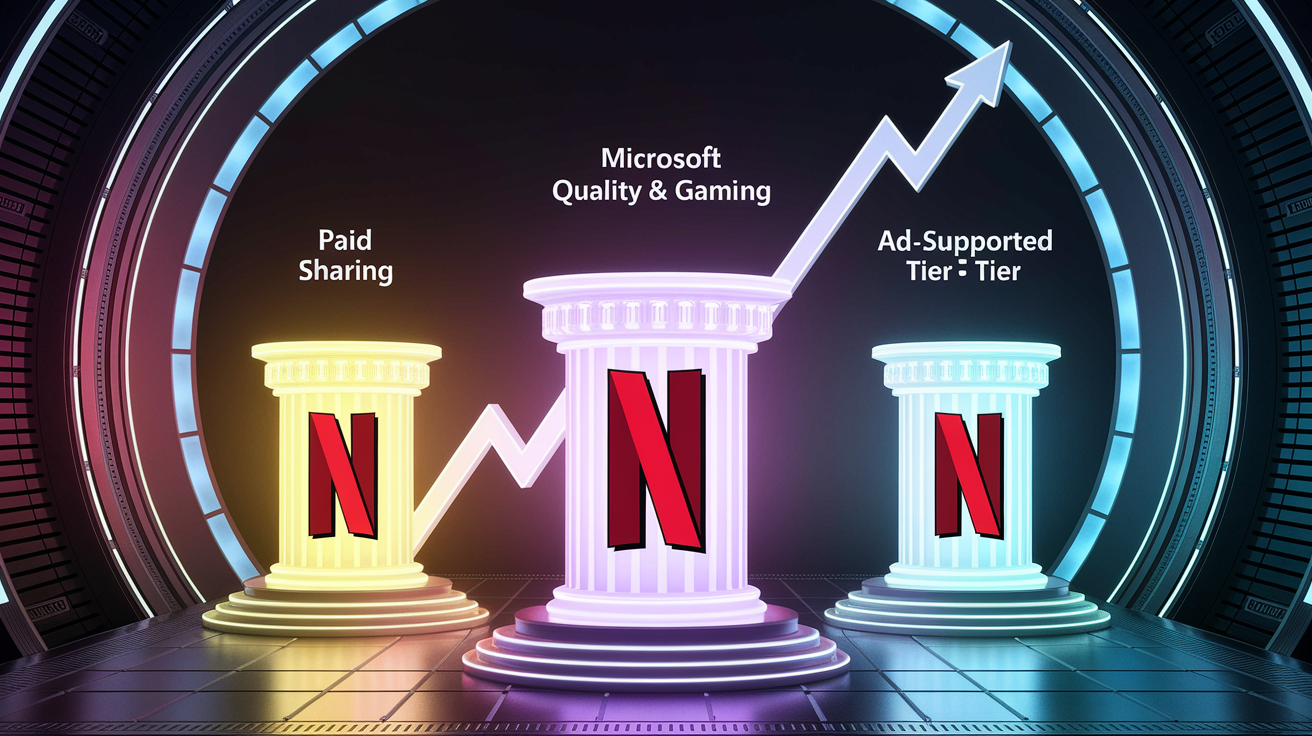
Netflix executed a three-pronged recovery strategy focused on monetizing password sharing, adjusting content investments, and introducing pricing innovation. The company rolled out paid sharing in more than 100 countries, adding “extra member” sub-accounts priced at $7.99 per additional household. It introduced profile-transfer tools to ease transitions for users moving from shared accounts to individual subscriptions. Technical detection and limits on unauthorized sharing were implemented gradually. Clear communication aimed to reduce backlash and preserve trust during the rollout.
The content strategy shifted from volume to quality and franchise-building, with increased investment in local-language content in growth markets and a push into gaming (expanding the catalog to over 50 mobile games). Netflix invested in live programming and sports documentaries, strengthened partnerships with established creators and studios, and improved recommendation algorithms to boost engagement. The goal was to increase viewing hours per subscriber and make the content spend more efficient.
Netflix launched a $6.99 ad-supported tier to capture price-sensitive customers while retaining premium ad-free options at higher price points. The company partnered with Microsoft for ad technology and sales, building sophisticated ad-targeting capabilities without having to develop the entire ad stack in-house. By Q3 2023, Netflix reported 254.04 million subscribers, a 14.4% year-over-year growth compared to Q3 2022’s 223.09 million. The company added 8.76 million new subscribers in Q3 2023, generated $8.54 billion in revenue (up roughly 7.5% year-over-year), improved operating margin to 22.4%, and increased average revenue per user by about 4%. The ad-supported tier reached 70 million global users as of November 2024. And the stock recovered 344% from its 2022 low.
Six tactical moves in Netflix’s recovery plan:
Rolled out paid sharing with $7.99 extra-member pricing and profile-transfer features to convert non-paying households. Shifted content strategy toward higher-quality, franchise-building content and increased local-language investment in growth markets. Launched a $6.99 ad-supported tier with Microsoft partnership to serve price-sensitive subscribers and open a new revenue stream. Expanded into gaming with over 50 mobile titles to increase engagement and product differentiation. Improved recommendation algorithms and content-discovery tools to boost viewing hours and content efficiency. Simplified plan structure and clarified value propositions to reduce confusion and support retention across price tiers.
Final Words
in the action, Netflix lost roughly 1.2 million subscribers in early 2022 (about 200k in Q1 and nearly 1M in Q2), and the stock fell sharply after the surprise results.
The company pointed to large-scale password sharing, the Russia exit, post‑pandemic viewing normalizing, economic pressure, price increases, and tougher competition as the short list of causes.
If you’re asking why did netflix lose subscribers, it was this mix — and Netflix’s paid‑sharing moves, ad tier, and local content push have since helped steady growth.
FAQ
Q: Why did Netflix lose 1 million subscribers and did Netflix lose subscribers overall?
A: The loss of nearly 1 million subscribers refers to Netflix’s Q2 2022 drop; the company also lost about 200,000 in Q1 2022. Netflix blamed password sharing, macro headwinds, Russia exit, normalization, pricing, and competition.
Q: Why has Netflix lost so many subscribers?
A: Netflix has lost subscribers because widespread password sharing (100M+ households), rising prices, stronger rivals, and post‑pandemic viewing normalization made growth and retention harder.
Q: Is Netflix losing popularity?
A: Netflix is showing reduced household reach and engagement, yet it still led total viewing; popularity dipped as users spread time across more apps and competitor originals gained traction.