Was Microsoft’s $26.2 billion move to buy LinkedIn a bold play or a predictable step?
Microsoft announced the deal on June 13, 2016, and it closed on December 8, 2016.
The acquisition, at $196 per share in cash, folded LinkedIn’s professional graph into Microsoft’s enterprise stack, reshaping recruiting, sales tools, and productivity features, and this post lays out the key dates, deal facts, who was affected, and practical checks users and IT teams should make after the takeover.
Key Dates and Deal Facts Behind the Microsoft Acquisition of LinkedIn
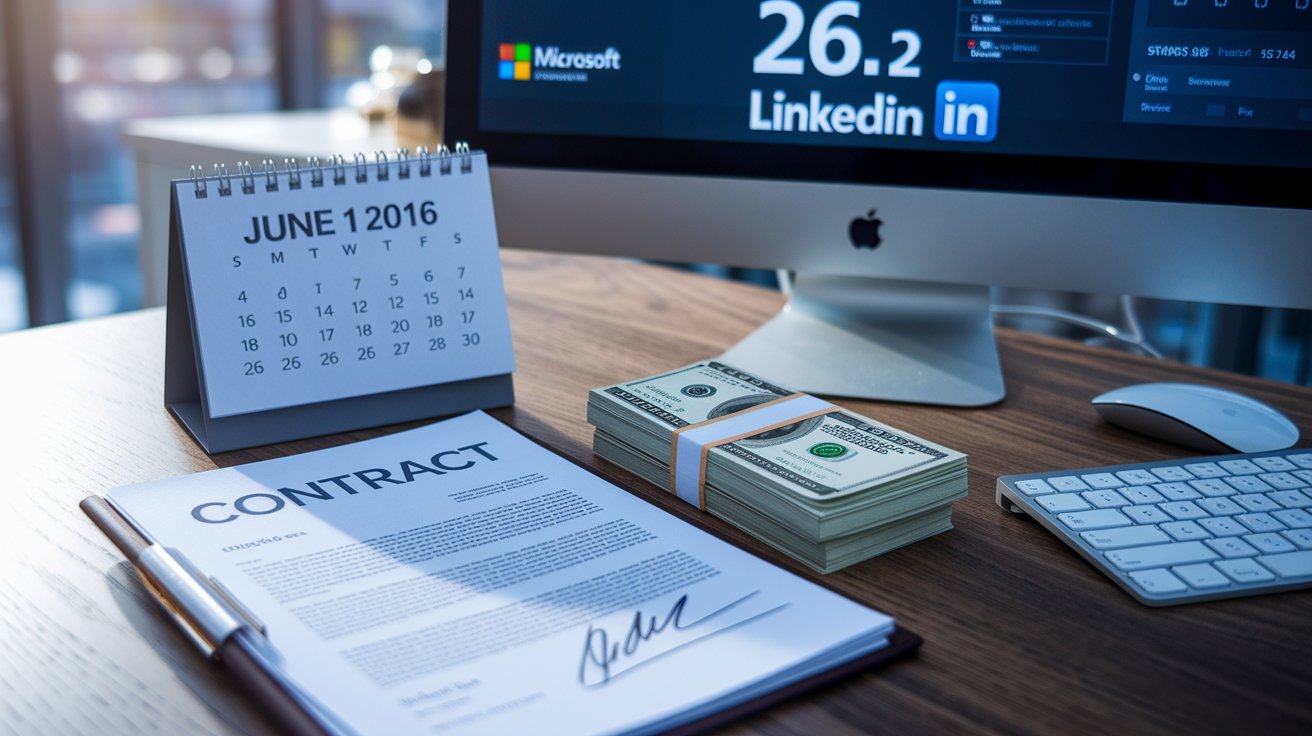
Microsoft announced it would acquire LinkedIn on June 13, 2016. The price tag? $26.2 billion. The deal closed six months later, on December 8, 2016, making it the biggest acquisition in Microsoft’s history up to that point.
LinkedIn shareholders got $196.00 per share, all cash. That’s nearly a 50% premium over where the stock traded before word got out. The deal dwarfed Microsoft’s 2011 Skype purchase ($8.5 billion) by more than three times and marked a serious expansion into professional networking.
Quick facts:
- Announcement date: June 13, 2016 (via Microsoft’s blog)
- Closing date: December 8, 2016
- Price per share: $196.00 cash
- Total value: $26.2 billion (including LinkedIn’s net cash)
- Deal structure: All cash, no stock
The six months between announcement and closing gave regulators time to review the deal, including the European Commission. This was one of Microsoft’s most significant acquisitions, positioning the company to merge its enterprise tools with the world’s largest professional network.
Background of LinkedIn and Microsoft Leading Up to the Acquisition

By 2016, LinkedIn had locked down professional networking. Over 433 million members worldwide. It was the go-to place for career development, recruiting, professional identity. Every industry, nearly every geography.
Microsoft was deep into a repositioning under Satya Nadella, who’d taken over as CEO in 2014. The focus? Cloud services, enterprise productivity, cross-platform collaboration. “Mobile-first, cloud-first” was the mantra. Office 365 and Azure were the growth engines.
But Microsoft had a gap. It dominated business productivity software and enterprise infrastructure. What it didn’t have was a foothold in professional social networking or talent markets. LinkedIn’s professional graph—all those connections, skills, endorsements, career histories—couldn’t be replicated easily. That made it a perfect fit for Microsoft’s enterprise and productivity lineup.
Why Microsoft Acquired LinkedIn: Strategic Drivers and Synergies

Microsoft saw a chance to build a vertically integrated ecosystem connecting professional identity, productivity tools, CRM, and cloud services. The combination promised to strengthen both companies and unlock new revenue across multiple segments.
Productivity and Cloud Synergies
Integrating LinkedIn with Office 365 and Outlook created immediate value. Users could see LinkedIn profiles right in Outlook when reading emails. Connection info showed up during calendar scheduling. Professional data became available in Microsoft Teams and SharePoint. Productivity tools got smarter, more contextual.
For enterprise customers, linking LinkedIn Sales Navigator with Dynamics 365 was huge. Sales teams could access prospect data, company insights, relationship intelligence—all inside their CRM. No more switching between systems. Moving LinkedIn’s infrastructure to Azure provided the technical foundation for deeper integration while cutting LinkedIn’s operating costs and boosting performance.
Data, AI, and Professional Graph Advantages
LinkedIn’s professional graph was a data goldmine. Member profiles, skills, endorsements, job histories, professional relationships. This data could train AI models, power recommendation engines, improve search. It understood professional context and career paths.
Combining LinkedIn’s identity data with Microsoft’s productivity tools created opportunities for cross-platform intelligence. Anonymized, aggregated data could inform talent analytics, skills gap analysis, workforce planning, market intelligence. Permission-based sharing enabled personalized experiences while respecting privacy.
Long term, owning a professional network with hundreds of millions of active members gave Microsoft a distribution channel for content, a talent marketplace that fit with its business tools, and a foundation for professional AI experiences competitors couldn’t easily match.
Acquisition Timeline From Announcement to Completion

Microsoft and LinkedIn moved fast. They announced the deal in June 2016, expecting to close before year-end. That depended on regulatory clearance and shareholder approval.
Regulators dominated the second half of 2016. The European Commission examined whether the deal would reduce competition in professional social networking, online advertising, or enterprise software. They also scrutinized data-sharing practices and whether Microsoft might gain unfair advantages by integrating LinkedIn data into other products.
| Event | Date | Description |
|---|---|---|
| Deal Announcement | June 13, 2016 | Microsoft and LinkedIn publicly announced acquisition agreement at $196 per share |
| Regulatory Review Period | June–November 2016 | U.S., EU, and other jurisdictions reviewed competitive and data privacy implications |
| European Commission Approval | December 6, 2016 | EC cleared the acquisition with conditions regarding data use and competitor access |
| Transaction Closing | December 8, 2016 | Acquisition completed, LinkedIn became a wholly owned Microsoft subsidiary |
Six months from announcement to close is pretty quick for a deal this size. The European Commission’s conditional approval came just two days before closing, letting the deal finish within the original calendar-year target and giving Microsoft the green light to start integration work.
Leadership Roles and Organizational Structure After the Acquisition

Jeff Weiner stayed on as LinkedIn’s CEO, reporting directly to Satya Nadella. That wasn’t an accident. Keeping Weiner preserved institutional knowledge and signaled Microsoft’s intent to let LinkedIn run with real autonomy.
LinkedIn became a distinct business unit within Microsoft, not folded into existing divisions. This let LinkedIn keep its own product roadmap, engineering priorities, go-to-market strategies. It had its own sales force, marketing teams, product development.
LinkedIn kept its brand, culture, operational independence. Same name, same headquarters, same values. Reid Hoffman, LinkedIn’s co-founder and chairman, endorsed the deal publicly. He called Microsoft the right long-term owner, citing aligned missions and respect for LinkedIn’s culture.
Post‑Acquisition Performance and Platform Growth

LinkedIn’s member base exploded after Microsoft took over. It grew from roughly 433 million members at the time of the deal to more than 645 million three years later. Nearly 50% growth. That expansion strengthened LinkedIn’s reach internationally and cemented its position as the definitive professional network.
Performance metrics showed the acquisition worked:
- User growth: member base jumped by about 212 million (433M to 645M+)
- Revenue expansion: LinkedIn generated $6.8 billion in the most recent reported fiscal year, 28% year-over-year growth
- Engagement improvements: time on site increased, boosting ad inventory and subscription conversions
- Recruiter product performance: strong labor markets drove talent solutions revenue
- Advertising growth: more engagement created more inventory for sponsored content and display ads
- Subscription strength: premium memberships and enterprise talent solutions showed consistent growth
Microsoft’s support was key. Access to Microsoft’s global sales force opened new enterprise customer relationships, especially for LinkedIn’s talent and sales solutions. Three years after the Microsoft acquisition, executives said results exceeded initial expectations. Integration work was still in early stages relative to long-term potential.
Product improvements, Microsoft ecosystem integrations, and favorable economic conditions (low U.S. unemployment, strong hiring) created a virtuous cycle. More members attracted more recruiters. That funded product investments that improved engagement. Microsoft’s technical resources enabled faster iteration and infrastructure improvements that would’ve required significant capital as a standalone company.
Product Integrations Between Microsoft and LinkedIn
Microsoft and LinkedIn pursued phased integration. They prioritized high-value touchpoints while letting LinkedIn keep its independent product development. Early efforts focused on surfacing LinkedIn data in existing Microsoft workflows and migrating LinkedIn’s infrastructure to Azure.
The integration roadmap balanced quick wins with longer-term architectural changes. Rather than forcing deep product mergers right away, the teams identified specific use cases where LinkedIn data could enhance Microsoft products and where Microsoft’s distribution could expand LinkedIn’s reach.
Key Integration Highlights
- Outlook integration: LinkedIn profile info appeared directly in Outlook email views. Users could see professional context, mutual connections, recent activity for email contacts without leaving their inbox.
- Sales Navigator and Dynamics 365 syncing: LinkedIn’s premium sales intelligence tool integrated with Microsoft’s CRM. Sales teams could access prospect insights, track relationship changes, manage outreach within unified workflows.
- Azure migration: LinkedIn’s services and infrastructure gradually moved to Microsoft Azure. This improved reliability, reduced operating costs, enabled better data integration across the ecosystem.
- Enterprise workflow enhancements: professional identity data from LinkedIn informed smart features in Microsoft Teams, SharePoint search results, organizational charts. Collaboration tools became more context-aware.
These integrations strengthened both platforms by creating network effects. Microsoft customers gained professional insights that made their existing tools more powerful. LinkedIn members found their professional identity more useful across a broader range of daily workflows. The technical foundation built through Azure migration enabled faster iteration on future integrations and positioned the combined company for AI-driven features requiring cross-platform data access.
How the Acquisition Reshaped Microsoft’s Market Position

The $26.2 billion LinkedIn acquisition blew past Microsoft’s previous record (the $8.5 billion Skype purchase) and fundamentally changed the company’s competitive positioning in professional software and services markets. Microsoft’s LinkedIn acquisition was the largest marketing technology deal in history. It positioned the company to compete more effectively against Google and Facebook in professional networking, talent markets, business-to-business marketing.
The acquisition addressed a critical gap in Microsoft’s portfolio. The company dominated productivity software and enterprise infrastructure, but it had no significant social platform or professional networking presence. LinkedIn filled that void immediately. Microsoft got access to professional identity data, business networking dynamics, talent marketplace activity that couldn’t be built organically in any reasonable timeframe.
The deal intensified vertical competition among tech giants by creating a more complete stack spanning client software (Windows, Office), enterprise services (Dynamics, Azure), and Internet platforms (LinkedIn). This vertical integration created competitive advantages through data synergies, cross-selling opportunities, bundled solutions addressing multiple stages of enterprise workflows. Competitors now faced a Microsoft ecosystem that could connect professional identity and networking with productivity tools, CRM platforms, cloud infrastructure. That raised the strategic stakes for companies competing in any single layer of that stack.
Final Words
We summarized the Microsoft-LinkedIn deal: announced June 13, 2016, closed December 8, 2016, for $26.2 billion at $196 per share, and why it mattered for productivity, data, and market position.
The piece covered background, timeline, leadership, integrations, and post-acquisition growth driven by Office, Azure, and LinkedIn product improvements.
If you want a quick answer to when did linkedin get acquired by microsoft: announced June 13, 2016; closed December 8, 2016.
The deal strengthened both platforms and set up steady growth, so it’s safe to call it a lasting strategic win.
FAQ
Q: Does Microsoft own 100% of LinkedIn?
A: Microsoft owns 100% of LinkedIn, which became a wholly owned Microsoft subsidiary after the $26.2 billion acquisition completed on December 8, 2016.
Q: Why are so many people leaving LinkedIn?
A: Many people are leaving LinkedIn because of increased spam and unsolicited outreach, algorithm-driven feed noise, privacy or trust concerns, and some users shifting to niche networks or direct recruiting platforms.
Q: Why did LinkedIn sell to Microsoft?
A: LinkedIn sold to Microsoft to combine its professional network with Microsoft’s Office 365, Dynamics, and cloud services, creating data and integration synergies to accelerate product and enterprise growth.
Q: Who is LinkedIn’s biggest competitor?
A: LinkedIn’s biggest competitor depends on the function: for job listings and recruiting it’s Indeed, while for professional networking and content, platforms like X and niche industry networks compete.