
What if a tiny bug or one slow service can knock your entire cloud offline?
Cascading failures are exactly that: a single component fails, then its dependents fail, and the problem snowballs into a region-wide outage.
This intro shows why developers, SREs, and platform teams must care fast.
Cloud architectures with tight coupling, shared control planes, and retries make small faults spread quickly.
Read on to learn how these cascades form, how they propagate, and practical steps (timeouts, circuit breakers, isolation) teams can use to stop a domino effect before it destroys availability.
Core Explanation of Cascading Failure Mechanisms in Cloud Services

A cascading failure in cloud services works like dominoes. One component breaks, then everything depending on it starts breaking too, turning a small hiccup into a full-blown disaster. Could be a server, database, control plane, whatever. When it goes down, the services relying on it fail next, each one dumping more load and chaos onto its neighbors until the whole dependency web collapses. The kicker? The initial problem might be nothing major. An overloaded cache. One slow query. A wonky load balancer config. But tight coupling between services lets that tiny issue spread like wildfire.
Propagation happens through dependency chains, shared resource pools, retry storms, queue overload. Service A needs Service B, which needs Service C. C slows down, B gets backed up with requests, A runs out of threads and connections. Clients see timeouts and start hammering retry buttons, flooding already struggling services with duplicate requests. Now you’ve got a retry storm accelerating resource exhaustion. Shared control planes like DNS resolvers, identity providers, API gateways, key vaults? They’re single points of failure. When they degrade, every service depending on them loses the ability to authenticate, resolve endpoints, grab configuration. Suddenly your otherwise healthy infrastructure is locked out.
Cloud architectures make this worse because microservices, autoscaling groups, multi-region deployments create these dense webs of interservice calls. A single HTTP request fans out to dozens of backend services, each with its own dependencies. Any link becomes a choke point. Stateful backends like databases and message queues? Especially vulnerable. Connection pool exhaustion or queue overflow blocks all downstream consumers at once.
Architectural Conditions That Enable Cascading Failures to Form

Cascading failures form when your design creates tight coupling, shared bottlenecks, and lousy isolation between failure domains. Dependency chains are the usual suspect. Service A synchronously calls Service B, which calls Service C. C hits a latency spike or timeout, that propagates backward, eating up threads and connections in B and A until all three are toast. Tight coupling makes it worse because services can’t operate independently. One fails, its callers wait, retry, or fail themselves.
Shared services become single points of failure when multiple regions or availability zones rely on the same instance. DNS, identity providers, centralized logging, secret vaults. If a shared Azure AD tenant or Okta identity layer gets slow, every federated service across both primary and failover clouds enters an authentication loop. Traffic halts despite healthy compute and storage.
Backlog growth and backpressure loops create instability before anything fully fails. Downstream service slows, request queues in upstream services start filling, memory and CPU usage climb, garbage collection pauses increase. Response times get worse. Resource pool saturation turns partial degradation into total unavailability. A database connection pool sized for 100 concurrent queries? It’ll be exhausted by 200 slow queries, blocking all new requests even if the database itself is fine. Shared infrastructure choke points like load balancers, API gateways, network interconnects concentrate traffic from many services. A sudden surge from one failing component overwhelms the shared resource and takes down unrelated workloads.
Architectural conditions that increase cascade risk:
Dependency chains without isolation. Synchronous calls through multiple hops, no circuit breakers or fallbacks.
Shared control planes. DNS, identity, key vaults, configuration services used by multiple failure domains.
Unbounded resource pools. Connection pools, thread pools, queues without hard limits or backpressure controls.
Tight coupling. Services can’t degrade gracefully or operate with reduced functionality when dependencies fail.
Single-region or single-zone deployments. No geographic or logical isolation to contain failures.
Cloud Failure Triggers That Commonly Start Cascades

Cascading failures don’t just happen. They start with specific triggers that expose weak spots in architecture, configuration, operational practices.
Common triggers:
Sudden load spikes or traffic surges. A failover event, viral content, coordinated bot activity overwhelming capacity buffers and autoscaling response times.
Misconfigurations or bad deployments. Incorrect timeout values, broken service mesh routing, dependency version mismatches introduced during rollout.
Software bugs. Memory leaks, infinite retry loops, race conditions, incorrect error handling that degrades performance under load.
Human operator error. Accidental deletion of capacity, incorrect credential rotation, manual traffic shifts without validation.
DDoS attacks. Volumetric floods or application-layer attacks exhausting connection pools, rate limiters, upstream bandwidth.
Resource pool exhaustion. Database connection limits hit during peak traffic, thread pools drained by slow backend calls, file descriptor limits reached.
These triggers show up constantly in post-incident reviews. The AWS S3 outage on Feb 28, 2017? Started when an operator debugging billing systems accidentally removed too much capacity from the S3 index subsystem. Request backlogs, retry storms, failures in dependent AWS services like EC2 instance launch, CloudFormation, health dashboards for nearly four hours. The Fastly CDN outage on June 8, 2021? Software configuration bug triggered by a single customer’s valid configuration change caused a global outage lasting roughly one hour as edge servers failed and overwhelmed control-plane services with status requests. Both show how small initial faults can cascade across tightly coupled systems when isolation and rate controls aren’t there.
How Failures Propagate Across Cloud Services After Formation

Once a failure begins, it spreads through predictable mechanisms that amplify the initial fault.
Retry storms create exponential load growth. A service starts returning errors or timeouts, clients automatically retry, often without backoff or jitter. If 1,000 clients each retry a failed request three times, the failing service now faces 4,000 requests instead of 1,000. Resource exhaustion accelerates, downtime extends. Without exponential backoff and randomized jitter, retries arrive in synchronized waves that overwhelm recovery attempts.
Queue overload and backpressure propagate upstream as request queues fill faster than services can process them. Service B’s queue reaches capacity, starts rejecting requests from Service A. Service A experiences timeout exceptions, fills its own queues, propagates the backpressure to its callers. Latency spikes become failure signals. Clients detecting slow responses reduce their own timeouts, causing requests to fail faster and retry sooner, further increasing load. Timeouts set too short trigger premature failures even when the backend eventually succeeds. Resources wasted, clients trained to retry aggressively.
Branching propagation happens when a single shared dependency serves multiple consumers. Centralized authentication service degrades, every service requiring token validation begins failing simultaneously. Those services propagate failures to their own dependents. Simple chain becomes a tree of failures radiating outward.
Feedback loops and circular dependencies create deadlock scenarios. Service A waits on Service B, which waits on Service A for health checks or configuration data. Both trapped in an unrecoverable state.
Propagation chain:
Client → [Service A] → [Service B] → [Service C: slow/failing]
            ↓              ↓              ↓
         retries      queue fills    resource exhausted
            ↓              ↓              ↓
         timeout    rejects requests   stops responding
            ↓              ↓              ↓
    retry storm ← backpressure ← propagates upstream
Propagation steps from initial fault to collapse:
Initial fault. A component (database, cache, API) slows or fails due to load, bug, misconfiguration.
Queue buildup and timeout growth. Upstream services accumulate waiting requests, threads block, connection pools exhaust.
Retry amplification. Clients detect failures and retry without sufficient backoff, multiplying request volume.
Systemic resource exhaustion. Shared resources (control planes, load balancers, networking) hit capacity limits and begin shedding traffic indiscriminately, taking down healthy services.
Real-World Examples of Cascading Failures in Major Cloud Platforms

The AWS S3 outage on Feb 28, 2017 is a textbook case of how human error and tight coupling create widespread cascades. An engineer debugging the S3 billing system ran a command meant to remove a small number of servers from one subsystem. Accidentally removed way more, including servers supporting the S3 index. Sudden capacity loss caused the index subsystem to fall behind on processing requests, creating backlogs and triggering retries from dependent services. S3’s own internal dependencies started failing. GET and PUT request routing, metadata lookups, status dashboards. Because many AWS services depend on S3 for storage, configuration, health data, failures propagated to EC2 instance launches, Elastic Beanstalk deployments, Lambda executions, CloudFormation stack operations. Even AWS’s own status dashboard relied on S3, preventing the company from updating customers on the outage. The cascade lasted approximately four hours and affected services across the us-east-1 region. Single subsystem failure paralyzed an entire cloud region.
The Fastly CDN outage on June 8, 2021 showed how a software bug and configuration interaction can trigger global failures within minutes. A valid configuration change submitted by a customer activated a previously undetected bug in Fastly’s edge server software. 85% of the global network started returning errors. As edge points of presence failed, traffic shifted to remaining healthy PoPs, overwhelming them and accelerating the cascade. High-traffic websites became unreachable globally. News organizations, government services, e-commerce platforms. Fastly’s control plane got flooded with health-check requests and status queries from failing edge nodes, creating additional load and delaying recovery. The outage lasted roughly one hour, but its visibility was amplified because Fastly serves as the CDN for a huge portion of the public internet. Single vendor’s failure became a globally visible event.
| Incident | Cause | Duration |
|---|---|---|
| AWS S3 outage (Feb 28, 2017) | Human error during debugging removed too much capacity from S3 index subsystem, triggering retry storms and dependency failures | ~4 hours |
| Fastly CDN outage (June 8, 2021) | Software bug triggered by customer configuration change caused global edge PoP failures and control-plane overload | ~1 hour |
Impacts of Cascading Failures on Availability and Reliability

Cascading failures compress multiple failure modes into a single incident, consuming availability budgets designed to absorb isolated faults over weeks or months. A four-hour outage caused by a cascade can blow through an entire quarter’s error budget for a service running at 99.95% availability. SLA math makes this visible. 99.95% availability allows approximately 21.6 minutes of downtime per month, 99.99% allows roughly 4.38 minutes per month, 99.9% permits about 43.2 minutes per month. A single cascading failure lasting even one hour obliterates the monthly budget for services with high SLA commitments and tanks composite uptime across dependent services. The false “eight nines” assumption? Believing that using two clouds each with 99.99% SLAs yields 99.9999% uptime. Ignores shared dependencies like identity providers, DNS, internet interconnects that create correlated failure modes.
Latency spikes during partial cascades degrade user experience before services become fully unavailable. Request timeouts, abandoned transactions, retry loops that amplify load. Data processing backlogs grow as queues fill and services fall behind real-time ingestion rates, requiring hours or days of catch-up processing after recovery. Operational teams lose observability when monitoring and logging systems depend on the same failing infrastructure, delaying root-cause identification and extending outage duration.
Key business impacts:
SLA breaches and financial penalties. Contractual credits owed to customers, revenue loss from service unavailability.
Reputational damage. Customer trust erosion, public visibility of failures, competitive disadvantage.
Operational disruption. Emergency response costs, engineering time diverted from roadmap work, incident retrospectives.
Downstream customer impact. SaaS platforms cascade failures to their own customers, multiplying harm and liability.
Architectural Strategies to Prevent Cascading Failures in Cloud Systems

Prevention starts with designing isolation and redundancy into the architecture before failures occur. Bulkheads partition resources so a failure in one area can’t exhaust shared pools. Dedicated thread pools per dependency, per-tenant database connection quotas, separate autoscaling groups for critical versus batch workloads prevent a single noisy neighbor from starving others. Fault domain isolation deploys services across at least three availability zones and two geographic regions. Single datacenter failure, power outage, network partition can’t take down the entire system. Critical stateful services like databases and control planes should maintain read-only replicas in secondary regions with automatic failover logic that doesn’t depend on the failing region’s infrastructure.
Circuit breakers stop cascades by failing fast when a dependency becomes unhealthy. Typical configuration opens the circuit after 5 consecutive failures within a 10-second window, immediately rejecting new requests without attempting calls to the failing service. After 30 seconds in the open state, the circuit enters a half-open state, allowing a small number of test requests through to check if the dependency has recovered. Prevents retry storms and gives the failing service time to recover without additional load.
Exponential backoff with jitter spaces retries over time. Start with a 100-millisecond delay, double after each failure, cap at 5 seconds, allow a maximum of 3 retry attempts. Adding randomized jitter (varying the delay by ±25%) prevents synchronized retry waves from overwhelming recovering services.
Graceful degradation lets services continue operating with reduced functionality when dependencies fail. Serve cached data, return partial results, disable non-critical features instead of failing completely. Feature toggles enable operators to disable expensive or failing features in real time without redeploying code. Capacity buffers (maintaining 20 to 30 percent spare capacity) and autoscaling that triggers before resource exhaustion provide headroom for traffic surges and allow systems to scale before queues fill.
Critical architectural controls:
Isolation via bulkheads. Dedicated resource pools per dependency, per-tenant quotas, separate failure domains.
Multi-region redundancy. Deploy across ≥3 availability zones and ≥2 geographic regions with independent control planes.
Circuit breakers with defined thresholds. Open after 5 failures in 10 seconds, half-open after 30 seconds.
Retry policies with backoff and jitter. Start at 100 ms, double per retry, cap at 5 s, max 3 attempts.
Graceful degradation and feature toggles. Serve reduced functionality instead of complete failure.
Operational Controls and Runtime Safeguards Against Cascading Failures

Runtime controls enforce limits and backpressure to prevent runaway failures even when architecture is sound. Rate limiting at ingress points caps request volume per client or tenant, preventing a single user or bot from overwhelming shared infrastructure. Throttling mechanisms shed load when services approach capacity, returning 429 (Too Many Requests) or 503 (Service Unavailable) responses to signal backpressure and allow clients to slow their request rate. Per-tenant quotas prevent noisy neighbors in multi-tenant systems from exhausting shared resources like database connections, API call limits, storage bandwidth.
Autoscaling policies must include headroom and pre-warming. Scale out before CPU or memory hits 100 percent and keep a baseline of warm instances to handle sudden surges without cold-start delays.
Deployment practices reduce the blast radius of bad code or configuration changes. Canary rollouts deploy new versions to 1 to 5 percent of traffic for 15 to 60 minutes, monitoring error rates, latency, resource usage before gradually increasing exposure. Automated rollback policies trigger when canary error rates exceed a defined threshold. For example, rolling back automatically if error rate rises above 1 percent or p99 latency increases by more than 50 percent. Blue-green deployments maintain two full production environments, allowing instant rollback by switching traffic back to the previous version if the new deployment causes issues.
| Control | Purpose | Example Threshold |
|---|---|---|
| Circuit breaker | Fail fast to stop calls to unhealthy dependencies | Open after 5 failures in 10 seconds; half-open after 30 seconds |
| Retry with backoff | Recover from transient failures without amplifying load | Start 100 ms, double per retry, cap 5 s, max 3 retries |
| Rate limiting | Cap request volume per client or tenant | 1,000 requests per minute per API key |
| Autoscaling headroom | Scale before exhaustion to handle surges | Trigger scale-out at 70% CPU or memory utilization |
| Canary rollout | Detect bad deployments before full exposure | 1–5% traffic for 15–60 minutes; auto-rollback if error rate > 1% |
Observability and Detection of Cascading Failures
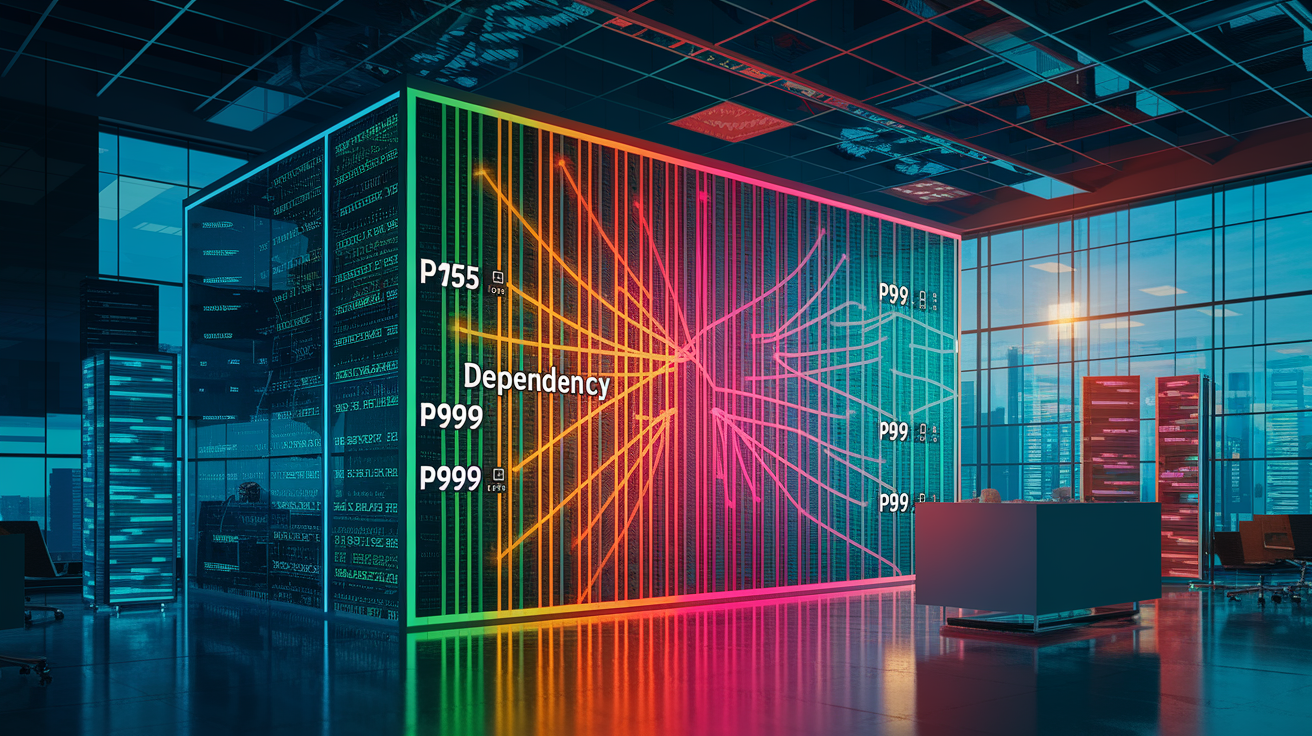
Early detection depends on monitoring the right signals and correlating metrics across services. Latency percentiles (p95, p99, p99.9) reveal slowdowns before error rates spike, giving operators time to intervene before queues overflow and services fail. Sudden increase in p99 latency from 50 milliseconds to 500 milliseconds? That indicates backlog growth or resource contention even if overall error rate remains low. Queue length and backlog metrics show request buildup in message brokers, job queues, internal service buffers. Early warning that a service is falling behind.
Error rate spikes, especially correlated spikes across multiple services, indicate propagation in progress.
Distributed tracing and dependency graph visualization map request flows across microservices, showing where latency is introduced and which services are blocking downstream callers. End-to-end traces reveal whether a slow request is waiting on database queries, external API calls, internal service hops. Focuses investigation on the root cause. Dependency graphs surface shared choke points. A single identity service called by 50 downstream services, a centralized cache layer with no failover. These represent cascade risk.
Automated alerting should trigger on combinations of signals. Rising queue length plus increasing retry count plus climbing p99 latency. Not single-metric thresholds that generate noise.
Top indicators for early cascade detection:
Latency spikes in high percentiles. p99 or p99.9 latency increasing before error rate rises.
Queue length and backlog growth. Message queues, request buffers, job backlogs growing faster than processing rate.
Retry bursts. Sudden increase in retry attempts across clients or services.
Correlated error rate increases. Multiple services showing rising error rates simultaneously, indicating shared dependency failure.
Testing, Chaos Engineering, and Failure Rehearsals to Prevent Cascades

Proactive testing exposes cascade vulnerabilities before production incidents occur. Chaos engineering injects deliberate failures. Kill instances, introduce latency, drop network packets, exhaust resource pools. Validates that circuit breakers, retries, fallbacks work as designed. Fault injection should target shared dependencies like databases, caches, identity providers, control planes. Simulate the exact choke points that cause real cascades.
Cold failover tests shut down an entire region or availability zone to verify that traffic shifts cleanly to secondary infrastructure without overwhelming it. DNS updates propagate correctly, no hidden dependencies on the primary region remain.
Game days and failure rehearsals walk engineering and operations teams through realistic outage scenarios. Test runbooks, communication protocols, decision-making under pressure. These exercises surface gaps in monitoring, unclear escalation paths, missing automation that would delay recovery during a real incident.
Dependency graph audits map all interservice calls, shared control planes, external dependencies. Identify single points of failure and tight coupling that increase cascade risk. Automated drift detection ensures that configuration, capacity, failover logic remain consistent across environments. Prevents divergence that can cause failover to fail when it’s needed.
Key rehearsal activities:
Chaos experiments. Inject failures into shared dependencies and validate circuit breakers, retries, degradation modes.
Cold failover drills. Shut down primary regions and measure time to recovery, traffic shift success, hidden dependency discovery.
Dependency audits. Map all service calls, shared infrastructure, control planes to identify choke points and single points of failure.
Final Words
We defined a cascading failure as a domino-effect where one component’s fault triggers dependent services, then walked through formation factors, common triggers, propagation behaviors like retry storms and queue overload, real outage examples, SLA impacts, and prevention and operational controls.
If you still ask what is a cascading failure in cloud services, think of one failure knocking over others. Audit dependencies, add bulkheads and rate limits, run chaos rehearsals, and your system will be more resilient.
FAQ
Q: What is cascading failure or the cascading effect in cloud computing?
A: A cascading failure in cloud computing is a domino‑effect where one component’s failure triggers dependent services to fail, often amplified by tight coupling, retry storms, queue overloads, control‑plane bottlenecks, or resource exhaustion.
Q: What is an example of cascading failures in Microservices?
A: An example in microservices is Service A timing out, clients repeatedly retrying, Service B’s thread pool and DB connections exhausting, queues backing up, and multiple downstream services becoming unavailable.
Q: How to handle cascading failures?
A: To handle cascading failures, isolate faults with circuit breakers and bulkheads, throttle traffic and rate limits, enforce exponential backoff with jitter, maintain autoscaling headroom, use canaries, tracing, and clear rollback runbooks.