
Is trying to run a market the same as already running it?
They sound similar, but the law treats them very differently.
Monopolization is about having market power now and using exclusionary tactics to keep it.
Attempted monopolization focuses on specific intent plus predatory acts and a dangerous probability you’ll become dominant even if you aren’t yet.
We’ll walk through the key tests—market definition, share thresholds, and exclusionary conduct—and explain what businesses and lawyers should watch for next.
Core Legal Distinctions Between Monopolization and Attempted Monopolization

Section 2 of the Sherman Act goes after two different things: “monopolize” and “attempt to monopolize.” They’re related, but not the same.
Monopolization means you’ve already got monopoly power in a market and you used shady tactics to get it or keep it. It’s about what you’re doing with the dominance you already have. Courts usually want to see market shares above 70 percent before they’ll call it monopoly power. Between 50 and 70 percent? That’s messier. Depends on how easy it is for new competitors to enter and what’s actually holding them back. And just being huge isn’t illegal. The Sherman Act cares about how you got there or what you’re doing to stay there, not the size itself.
Attempted monopolization got clarified by the Supreme Court in Spectrum Sports v. McQuillan back in 1993. Three things matter here: you specifically intended to build a monopoly, you did something predatory or anticompetitive to get there, and there’s a dangerous probability you’ll actually pull it off. Specific intent means you weren’t just competing hard. You were aiming for monopoly. Dangerous probability means the market setup and your position make it realistic, even if you’re not dominant yet. So a company with 30 percent share could face an attempt claim if it’s using exclusionary moves and the conditions let it grow into a monopoly. A straight monopolization claim wouldn’t work because it’s not there yet.
The real difference is timing and how much power you’ve got. Monopolization is for firms that already run the show and are abusing it. Attempted monopolization is for firms climbing toward dominance by shutting everyone else out. Both need exclusionary behavior, though. Stuff that damages the competitive process, not just beats rivals on price or quality. A firm controlling 75 percent of a market and using exclusive contracts to block new players? That’s monopolization. A firm at 40 percent doing the same thing might face an attempt claim if the market structure suggests it could realistically hit monopoly status.
Monopolization elements:
- Monopoly power in the relevant market (usually above 70 percent market share)
- Willful acquisition or maintenance of that power through exclusionary conduct
Attempted monopolization elements:
- Specific intent to achieve monopoly power
- Predatory or anticompetitive conduct aimed at that goal
- Dangerous probability of success (market conditions make monopolization plausible)
Relevant Market Framework in Monopolization and Attempted Monopolization

Defining the relevant market is where both monopolization and attempted monopolization claims start. Courts need plaintiffs to nail down a relevant product or service market and a relevant geographic market. The product market pulls in all the reasonable substitutes from a customer’s view. What would buyers actually switch to if you jacked up prices? Geographic market covers where the firm competes and where customers can realistically go for alternatives. Courts often use the SSNIP test (Small but Significant and Non-transitory Increase in Price). Would a hypothetical 5 percent price bump make enough customers bail to other products or suppliers that the increase wouldn’t work? If they’d switch, those alternatives are in the same market. Cross-elasticity of demand tracks how one product’s price change affects demand for another, helping courts figure out which products actually compete closely enough to matter.
Brown Shoe Co. v. United States (1962) gave courts a list of factors for spotting submarket boundaries: does the industry recognize the market as distinct, product characteristics and uses, unique production setups, distinct customer groups, distinct price levels, specialized vendors. Market definition directly shapes market share calculations and monopoly power assessments. Narrow the market and a firm’s share looks bigger. Broaden it and the share dilutes. In attempted monopolization cases, market definition also decides whether dangerous probability exists. A firm with 45 percent of a tight market might be closer to monopoly power than a firm with 60 percent of a broad one if entry barriers are different. Courts sometimes use the Herfindahl-Hirschman Index (HHI), which adds up squared market shares of all firms. Higher HHI means more concentration, which makes proving monopoly power or dangerous probability easier.
| Market Test | Core Purpose | Example Indicator |
|---|---|---|
| SSNIP (5% price increase test) | Identify whether customers would switch to alternatives if prices rose 5% | Survey data showing 30% of customers would buy a competing product if price increased |
| Cross-elasticity of demand | Measure how price changes in one product affect demand for another | A 10% price drop in Product A causes a 15% demand drop for Product B, showing they compete |
| Brown Shoe factors | Determine submarket boundaries within broader markets | Industry trade groups treat high-end and budget smartphones as distinct customer segments |
| HHI (market concentration index) | Quantify how concentrated a market is by summing squared market shares | HHI above 2,500 signals a highly concentrated market (e.g., three firms at 50%, 30%, 20% = 3,800 HHI) |
Exclusionary Conduct Central to Monopolization and Attempts

Exclusionary conduct is what both monopolization and attempted monopolization claims are built on. The Sherman Act doesn’t punish you for competing hard or growing because you’ve got better products, smarter business moves, or luck. It targets conduct that messes with the competitive process itself. Actions meant to block rivals, not outcompete them on merit. Courts split exclusionary behavior (which restricts rivals’ ability to compete) from just being aggressive (which hurts competitors but helps consumers through lower prices or better products). Conduct becomes exclusionary when there’s no real business reason for it beyond weakening competition. A monopolist bundling products to improve customer experience might be fine. The same monopolist bundling just to push customers away from a rival’s product? Way riskier.
Rule of reason analysis kicks in when conduct doesn’t fit established categories. Courts balance anticompetitive effects against any good reasons the firm offers. Did the conduct make things more efficient, improve product quality, or drive innovation? Or did it just raise rivals’ costs and shut them out? Some conduct might be fine alone but illegal when stacked together. Courts recognize “monopoly stew,” where a bunch of borderline acts combine to create an exclusionary effect. Predatory pricing (selling below cost to push out competitors) needs proof the monopolist could later make back its losses through higher prices once rivals are gone. Without realistic recoupment, below cost pricing might just be aggressive competition, not exclusionary conduct.
Exclusive dealing contracts can violate Section 2 when they lock up so much of the market that new entrants can’t reach efficient scale. Loyalty rebates and discounts tied to exclusivity get similar scrutiny if they shut rivals out from enough customers to compete. Refusals to deal get problematic when a monopolist controls something essential (a facility, platform, or technology) that competitors need and the refusal has no real business reason. Tying arrangements (requiring customers who buy Product A to also buy Product B) can exclude rivals in the tied market if the monopolist has power in the tying market and the arrangement touches a substantial volume of commerce. Most Favored Nation (MFN) clauses, which guarantee a buyer the seller’s lowest price, can kill price competition and lock in market positions when dominant firms use them.
Common exclusionary practices under Section 2 scrutiny:
- Tying that forces purchase of a second product to access a monopolized first product
- Exclusive dealing contracts blocking rivals from distribution channels or customer access
- Refusals to deal or supply essential inputs to competitors without real justification
- Loyalty rebates or discounts conditioned on buying exclusively or nearly exclusively from the monopolist
- Predatory pricing (below cost sales) where recoupment of losses is realistically probable
- MFN clauses preventing competitive price cutting and entrenching the dominant firm’s position
Proving Monopoly Power and the Dangerous Probability Standard

Plaintiffs can prove monopoly power directly or indirectly. Direct evidence shows the firm actually used market power. It raised prices by around 5 percent (or more) and kept selling without losing customers to rivals or new entrants. Courts treat this price control ability as strong proof of monopoly power because it shows the firm isn’t constrained by competition. Indirect evidence leans on market share thresholds and structural factors. Shares above 70 percent usually support monopoly power. Below 50 percent usually doesn’t cut it. The 50 to 70 percent zone is grey. Courts look at more stuff like entry barriers, how strong the remaining competitors are, and whether the firm’s conduct successfully shut out rivals. High entry barriers (patents, regulatory requirements, network effects, steep capital costs) make monopoly power easier to keep and prove.
In attempted monopolization cases, plaintiffs have to show a dangerous probability the defendant could hit monopoly power. This isn’t about certainty. It asks whether market structure and the firm’s trajectory make success plausible. A firm with 35 percent market share in a fragmented market with low entry barriers probably can’t show dangerous probability. A firm with 55 percent share in a concentrated market with high barriers and growing fast through exclusionary tactics? Stronger case. Courts look at whether the market could tip toward monopoly if the defendant’s conduct keeps going, checking growth trends, the strength of remaining competitors, and how the exclusionary behavior affects competitive dynamics. Dangerous probability needs more than a long shot, but less than a sure thing.
Categories of evidence used to prove monopoly power or dangerous probability:
- Direct evidence: ability to raise prices 5 percent or more without losing customers; sustained price increases above competitive levels; controlling output levels in the market
- Indirect/market share evidence: defendant’s percentage of sales in the relevant market; market share trends over time; concentration of the market (HHI scores and competitor fragmentation)
- Structural/barrier evidence: height of entry barriers (capital requirements, patents, regulatory approval, network effects); history of entry and exit; switching costs for customers; availability of substitute products
Case Law Illustrating Monopolization vs Attempted Monopolization
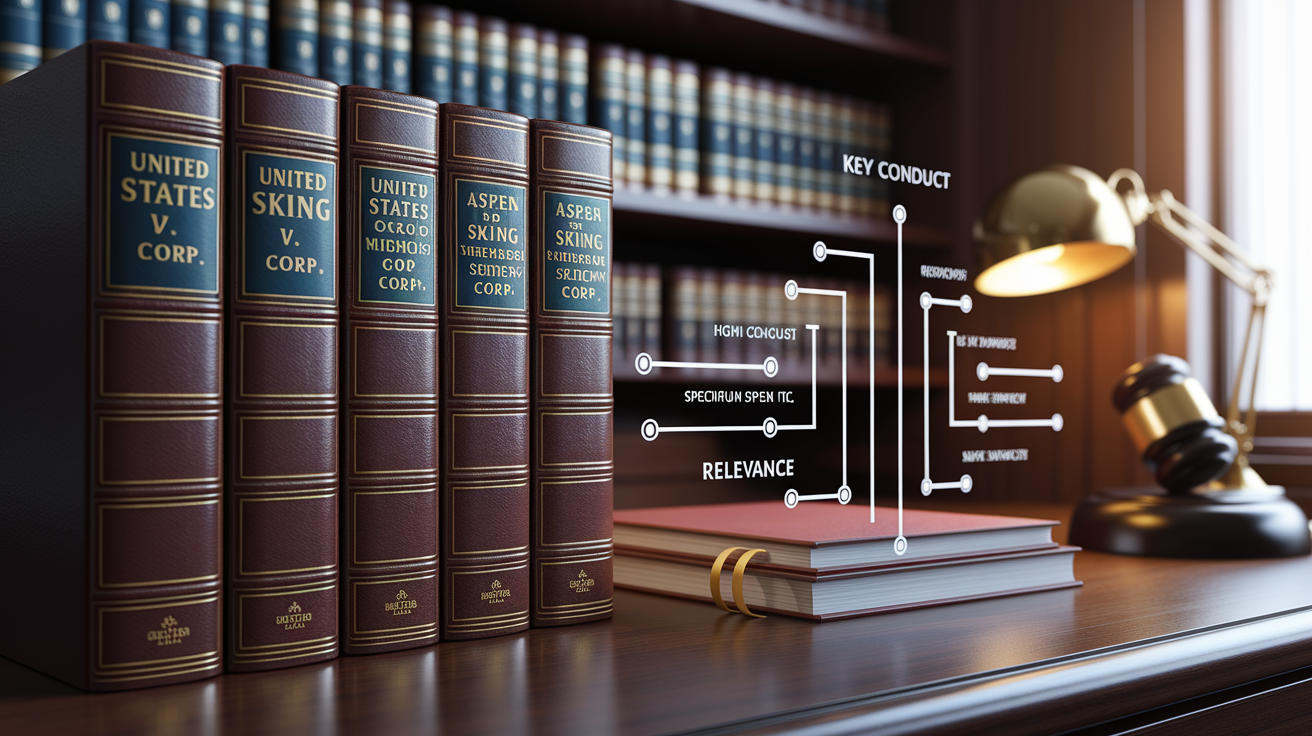
United States v. Grinnell Corp. (1966) set up the modern two part test for monopolization: monopoly power in the relevant market and willful acquisition or maintenance of that power through exclusionary conduct. Grinnell controlled central station protective services and used acquisitions, pricing strategies, and restrictive practices to stay dominant. The Supreme Court said monopoly power gained or kept through anything other than “superior product, business acumen, or historic accident” violates Section 2. The case made clear courts have to look at both the fact of monopoly power and the conduct used to get or keep it, separating lawful dominance from illegal monopolization.
United States v. Microsoft Corp. (2001) applied Grinnell’s framework to exclusionary conduct aimed at protecting a monopoly in operating systems. Microsoft held over 90 percent of the market for Intel compatible PC operating systems. When Netscape’s browser and Java technologies threatened to chip away at the “applications barrier to entry” protecting Windows, Microsoft bundled Internet Explorer with Windows, used exclusive contracts with PC makers, and restricted Java’s development to stop cross platform applications. The D.C. Circuit found Microsoft liable for monopolization because its conduct wasn’t about competing on browser quality. It was about killing the competitive threat Netscape and Java posed to the operating system monopoly. The case shows how exclusionary acts in one market (browsers) can be illegal maintenance of monopoly power in another (operating systems) when the markets are linked by potential competition.
Aspen Skiing Co. v. Aspen Highlands Skiing Corp. (1985) dealt with refusal to deal liability. Aspen Skiing ran three of four ski mountains in Aspen, Colorado, and had historically offered a joint ticket with Highlands (the fourth mountain). When Aspen Skiing killed the joint ticket and refused any cooperation, Highlands’ share dropped from 20 percent to 11 percent. The Supreme Court found monopolization because Aspen Skiing gave up short term revenue to exclude a rival, showing willful maintenance of monopoly power without a real business justification. Spectrum Sports, Inc. v. McQuillan (1993) clarified attempted monopolization, saying specific intent, anticompetitive conduct, and dangerous probability of success are all required. The case rejected a looser standard and stressed that attempted monopolization claims have to show the defendant had a realistic shot at achieving monopoly power, not just intent and bad acts.
| Case | Key Conduct | Relevance to Monopolization/Attempt |
|---|---|---|
| United States v. Grinnell Corp. (1966) | Acquisitions, pricing strategies, and restrictive practices to control central station alarm services | Established core monopolization test: monopoly power + willful acquisition/maintenance; ruled out “superior product” or “business acumen” defenses when conduct is exclusionary |
| United States v. Microsoft Corp. (2001) | Bundling Internet Explorer with Windows; exclusive contracts with OEMs; restricting Java to block cross platform competition | Monopolization via exclusionary conduct in adjacent market (browsers) to protect operating system monopoly; demonstrates how linked markets create Section 2 liability |
| Aspen Skiing Co. v. Aspen Highlands Skiing Corp. (1985) | Refusal to continue joint ski pass arrangement; elimination of rival’s access to integrated ticket product | Refusal to deal monopolization when firm sacrifices short term profit solely to exclude rival and maintain monopoly power |
| Spectrum Sports, Inc. v. McQuillan (1993) | Conduct by defendant alleged to show intent to monopolize sorbothane products distribution | Attempted monopolization requires specific intent, anticompetitive conduct, and dangerous probability of achieving monopoly power — clarified stricter standard than earlier circuit tests |
Business Conduct Red Flags for Monopolization or Attempt Claims
Dominance in one market combined with behavior affecting an adjacent or complementary market is a top red flag for Section 2 risk. When a firm holds serious power in Market A and starts messing with how competitors operate in Market B, especially if Market B could become a new source of competition in Market A, courts and enforcers look for exclusionary intent. Microsoft’s conduct is the classic example: dominance in operating systems led to browser market interference because browsers threatened the OS monopoly. Firms should ask whether conduct in a second market serves a real business purpose or mainly protects the monopoly in the first market.
Aggressive discounting or rebate programs tied to exclusivity or near exclusivity get scrutiny when the firm has major market share. Loyalty rebates that reward customers for buying all or most of their needs from the dominant firm can shut rivals out from enough volume to compete at efficient scale. The key split is whether the discount reflects cost savings or efficiencies (good) or whether it works as a penalty for customers who buy even a bit from rivals (exclusionary). Refusals to supply essential inputs, facilities, or access to platforms get dangerous when the monopolist controls something competitors need and no real business reason backs the refusal. Coupled product requirements (forcing customers to buy Product B to access Product A) can exclude competition in the market for Product B if the firm has monopoly power in Product A and the tying touches a substantial volume of commerce.
Business conduct red flags that increase Section 2 risk:
- Interference with adjacent or complementary markets that could threaten the firm’s primary monopoly (e.g., integrating products to block rivals’ cross market entry)
- Loyalty rebates or discounts conditioned on exclusive or near exclusive purchasing, especially when the firm’s share tops 50 percent
- Refusal to supply essential inputs, platforms, or facilities to competitors without documented business justification (cost, capacity, quality, safety)
- Coupled product restrictions or bundling requirements forcing customers to take a second product to access a monopolized first product
- Internal documents or communications expressing intent to “crush,” “destroy,” or “eliminate” competitors rather than outcompete them on price, quality, or innovation
Remedies, Penalties, and Enforcement in Section 2 Cases

Section 2 violations bring heavy penalties. Private plaintiffs who prove monopolization or attempted monopolization can recover treble damages (three times actual harm), plus attorneys’ fees and costs. Treble damages exist to deter antitrust violations and compensate victims for harm that’s often hard to pin down precisely. Courts can also issue injunctive relief to stop ongoing exclusionary conduct or block future violations. Injunctions can impose operational constraints, requiring a firm to license technology, grant rivals access to a platform, or unbundle products. That reshapes how the business runs. Sometimes injunctive relief hits business strategy harder than money damages, especially when it limits the firm’s ability to integrate products or control distribution channels.
Structural remedies, like divestitures or breakups, are less common but possible in monopolization cases. The government tried to break up Microsoft in the initial remedy phase of that case (the breakup order got overturned on appeal, and the parties settled on behavioral remedies instead). Structural relief is more typical in merger enforcement, but Section 2 cases can lead to court ordered sales of divisions, assets, or subsidiaries if the conduct and market structure make ongoing monitoring of behavioral remedies impractical. Behavioral remedies include ongoing compliance monitoring, reporting requirements, and restrictions on certain business practices (exclusive contracts, bundling, pricing strategies). These remedies often run for years and require firms to document business justifications and submit to audits, creating admin costs and limiting strategic flexibility.
Enforcement comes from multiple directions. The Department of Justice Antitrust Division and the Federal Trade Commission both investigate and prosecute monopolization claims, though DOJ handles criminal enforcement and has sole authority to bring Sherman Act cases in federal court. State attorneys general can also file Section 2 suits under federal law or parallel state antitrust statutes. The October 2020 lawsuit against Google included the federal government and 11 state AGs acting together. Private parties, including competitors, customers, and other businesses hurt by exclusionary conduct, frequently bring Section 2 cases seeking damages and injunctive relief. Antitrust litigation is expensive to defend, often running into tens of millions in legal fees and expert costs, even when firms win. The combo of treble damages, injunctive risk, and litigation costs makes Section 2 enforcement a powerful deterrent for firms with significant market shares.
Types of remedies in Section 2 cases:
- Treble damages (three times actual harm) awarded to private plaintiffs, plus attorneys’ fees and litigation costs
- Injunctive relief ordering firms to stop exclusionary practices or requiring access, licensing, or unbundling of products
- Structural remedies such as divestitures, asset sales, or business unit separations (less common but available in monopolization cases)
- Behavioral remedies imposing ongoing compliance obligations, reporting, monitoring, and restrictions on business practices (common in settlements and consent decrees)
Final Words
In the action, this article maps the legal line: monopolization requires monopoly power plus willful maintenance, while attempted monopolization needs specific intent, predatory conduct, and a dangerous probability of success.
It walks through how courts define markets (SSNIP, Brown Shoe), common exclusionary tactics, proof standards (price-raise tests and market-share thresholds), and key Section 2 cases that show these rules in practice.
Apply these tests to weigh risks in monopolization vs attempted monopolization. Stay proactive—clear analysis helps teams avoid enforcement headaches and keeps competition healthy.
FAQ
Q: What is attempted monopolization?
A: Attempted monopolization is a Section 2 offense where a firm acts with specific intent to monopolize, uses predatory or anticompetitive conduct, and creates a dangerous probability it will gain monopoly power.
Q: What are the two different types of monopolies?
A: The two common types of monopolies are natural monopolies—where one firm is most efficient due to high fixed costs—and legal (statutory) monopolies, where government grants exclusive rights to a single provider.
Q: What made it illegal to monopolize or attempt to monopolize?
A: It was made illegal by the Sherman Act—Section 2 (1890) prohibits a firm from monopolizing, or attempting to monopolize, trade or commerce in the United States.
Q: What is the difference between monopoly and monopolization?
A: The difference between monopoly and monopolization is that a monopoly describes market dominance, while monopolization is the unlawful, willful acquisition or maintenance of that dominance through exclusionary or anticompetitive conduct.