OpenAI didn’t release a model called “GPT-4o Turbo,” and the confusion shows how old naming conventions still trip people up months later. What actually launched in May 2024 is GPT-4o, a next generation model that costs 50% less than GPT-4 Turbo while running five times faster and handling text, images, audio, and video in one unified system. The “Turbo” label belonged to optimized versions of earlier models, but GPT-4o represents a completely new architecture that makes those naming patterns obsolete. Here’s what changed, what you’re actually paying for, and how to start using it today.
GPT-4o Release Details: Understanding the Model and Its Availability
GPT-4o Turbo doesn’t exist. There’s no such model. What OpenAI actually released in May 2024 is GPT-4o. The confusion comes from OpenAI’s old naming system, where “Turbo” meant optimized versions of earlier models like GPT-3.5 Turbo and GPT-4 Turbo. GPT-4o is a next generation model with better multimodal capabilities, not a “Turbo” variant of anything.
OpenAI launched GPT-4o in May 2024 with same-day availability across multiple platforms. You could use it the moment they announced it, which was OpenAI’s fastest rollout for a major model.
You can access GPT-4o right now through three channels. The ChatGPT interface at chat.openai.com lets you select GPT-4o from the model dropdown. Developers can use the OpenAI API with the model identifier “gpt-4o” in their API calls. Enterprise customers get access through Azure OpenAI Service, which bundles the model with Microsoft’s cloud infrastructure and compliance features.
Your access tier controls usage limits and priority. ChatGPT Plus subscribers ($20/month) get priority access with 80 messages every 3 hours on GPT-4o. Free tier users get limited access with caps that change based on platform demand, sometimes dropping to 10 messages per day during peak times. API developers can start using GPT-4o immediately through OpenAI’s API, with rate limits based on their usage tier. ChatGPT Enterprise customers get unlimited, high speed access without message caps, plus enterprise security features and dedicated support.
Technical Specifications and Core Capabilities of GPT-4o
GPT-4o works differently than what came before. The model combines language processing, speech recognition, and computer vision into one unified system that processes text, audio, images, and video at the same time. It’s not separate models handing off to each other anymore.
The model supports a 128,000 token context window. That’s roughly 300 pages of text in a single prompt. You can process full legal contracts, comprehensive reports, or lengthy conversation histories without cutting anything out or losing information.
GPT-4o delivers real improvements across key metrics:
Context capacity: 128,000 token context window for processing up to 300 pages of text at once
Generation speed: 109 tokens per second compared to GPT-4 Turbo’s 20 tokens per second, which is 5x faster
Rate limits: 5x higher throughput scaling up to 10 million tokens per minute for API users
Response latency: 50 to 80% faster time to first token across tested tasks
Audio processing: Real-time audio processing nearly as fast as human comprehension (around 320 milliseconds)
Vision capabilities: Native image and video understanding for photos, screenshots, charts, and video frames
Language support: About 50 languages with better non-English processing quality
Memory functions: Ability to remember objects and events across conversation turns
These specs translate to real world improvements. Faster token generation means chatbots respond in near real time instead of with visible typing delays. Higher rate limits let applications handle more simultaneous users without throttling. The unified multimodal architecture eliminates the lag that happened when previous models had to switch between separate vision and language systems. The expanded context window means developers can process entire customer support histories or product documentation sets without breaking them into smaller chunks.
Performance Improvements and Benchmark Results

OpenAI says GPT-4o achieves the company’s strongest reasoning performance while staying cost efficient. Independent testing by researchers and developers has validated many of these claims through standardized benchmarks that measure different cognitive capabilities.
Multiple benchmark suites provide specific performance metrics across reasoning, math, coding, and language understanding tasks.
| Benchmark Test | GPT-4o Score | GPT-4 Turbo Score | Improvement |
|---|---|---|---|
| MMLU (reasoning) | 88.7% | 86.5% | +2.2% |
| GPQA (science) | 53.6% | 49.3% | +4.3% |
| MATH (problem solving) | 76.6% | 72.2% | +4.4% |
| HumanEval (coding) | 90.2% | 87.6% | +2.6% |
| Verbal Reasoning (16 questions) | 69% | 50% | +19% |
These improvements matter for specific use cases. The GPQA gains in biology, physics, and chemistry make GPT-4o better for scientific research assistance and technical documentation. The MATH benchmark improvement means more reliable quantitative analysis and financial modeling. HumanEval gains mean better code completion and debugging assistance for software developers. The model also hit a 1310 ELO ranking on the LMSYS Chatbot Arena leaderboard, making it the top performing model when it first appeared as “im-also-a-good-gpt2-chatbot” before the official release.
Performance varies by context length and task type. At 2,000 token context lengths, both GPT-4o and GPT-4 Turbo performed identically in testing. GPT-4o showed better performance at higher context lengths up to 31,500 tokens, making it better for processing lengthy documents. But GPT-4 Turbo still beats GPT-4o on the DROP dataset, which requires complex reasoning combined with arithmetic operations over multiple steps. In classification tasks, GPT-4o demonstrated the highest precision at 88.00%, making it the best choice for applications where avoiding false positives matters more than catching every possible match.
Complete Pricing Structure and Cost Efficiency Comparison

GPT-4o costs 50% less than GPT-4 Turbo at $5 per million input tokens and $15 per million output tokens, compared to GPT-4 Turbo’s $10 per million input tokens and $30 per million output tokens.
Four pricing tiers provide access based on usage needs and budget:
API token pricing: $5 per million input tokens and $15 per million output tokens with pay as you go billing and rate limits scaling from 500 tokens per minute on free tier up to 10 million tokens per minute on highest paid tiers
ChatGPT Plus: $20 per month subscription with 80 messages every 3 hours on GPT-4o and 40 messages every 3 hours on GPT-4, plus priority access during high demand periods
ChatGPT Free tier: Limited access to GPT-4o with usage caps between 10 and 50 messages per day depending on current platform demand, plus basic access to data analysis, file uploads, and GPTs
ChatGPT Enterprise: Custom pricing with unlimited high speed access to both GPT-4o and GPT-4, enterprise security, dedicated support, and administrative controls
Real world cost scenarios show serious savings. A customer service application processing 10 million input tokens and generating 2 million output tokens per month would pay $80 with GPT-4o ($50 input + $30 output) versus $160 with GPT-4 Turbo ($100 input + $60 output). For a content generation tool processing 5 million input tokens and generating 15 million output tokens monthly, GPT-4o costs $250 ($25 input + $225 output) compared to $500 with GPT-4 Turbo ($50 input + $450 output). Development and testing environments with 1 million input tokens and 500,000 output tokens cost just $12.50 with GPT-4o versus $25 with GPT-4 Turbo.
The message limit system runs on a rolling 3 hour window. Plus users get 80 messages every 3 hours for GPT-4o, which resets continuously rather than at fixed times. If you send 40 messages at 2:00 PM, those message slots become available again at 5:00 PM, not at a fixed reset time like midnight. Unused messages don’t accumulate or carry over across windows. If you send only 20 messages in a 3 hour period, you don’t get 140 messages in the next window. You still get the standard 80 message allocation.
Accessing GPT-4o: API Integration and Migration Guide

Three primary access methods serve different use cases and technical requirements. The OpenAI API at platform.openai.com provides programmatic access for developers building applications. The ChatGPT web interface at chat.openai.com offers browser based access for individual users and teams. Azure OpenAI Service integrates GPT-4o into Microsoft’s cloud infrastructure for organizations with existing Azure deployments and compliance requirements.
GPT-4o’s multimodal capabilities are available now for text and images through all channels. Audio processing capabilities for real time voice interactions are under active development with API integration expected in a future release, though ChatGPT interface users can already test voice features in the web and mobile applications.
Getting started with the GPT-4o API takes six steps:
Create an OpenAI account at platform.openai.com and add payment information to access paid tier rate limits beyond the free tier’s 500 tokens per minute
Generate an API key from your dashboard under the API Keys section, storing it securely since it won’t be shown again after creation
Select the model identifier “gpt-4o” in your API calls rather than “gpt-4-turbo-2024-04-09” or earlier model versions
Make your first API call using code like: response = openai.ChatCompletion.create(model="gpt-4o", messages=[{"role": "user", "content": "Explain quantum computing"}])
Test multimodal capabilities by including image URLs or base64 encoded images in message content with {"type": "image_url", "image_url": {"url": "https://example.com/image.jpg"}} format
Configure production deployment including error handling, rate limit management, retry logic, and monitoring for token usage and response times
Migrating existing applications from GPT-4 Turbo to GPT-4o requires minimal code changes. The model identifier changes from “gpt-4-turbo-2024-04-09” to “gpt-4o” in API calls, but all other parameters stay compatible. Prompts designed for GPT-4 Turbo work without modification, though you may want to adjust system prompts to use GPT-4o’s stronger multimodal capabilities. If your application already handles images with GPT-4 Turbo’s vision features, those same image inputs work with GPT-4o without reformatting. Test thoroughly before production deployment, especially for applications that depend on specific output formats, since the improved reasoning may generate slightly different response structures even when answers are semantically equivalent.
Real World Use Cases and Business Applications

GPT-4o’s combination of speed, multimodal processing, and cost efficiency opens specific application categories where previous models faced limitations.
Customer Service and Support Automation
Chatbot applications benefit immediately from GPT-4o’s fast response times and natural conversational abilities. The 109 tokens per second generation speed eliminates the visible typing delay that made earlier models feel robotic, creating interactions that match human conversation pace. Customer support ticket classification improved 7% over GPT-4 Turbo in testing on 100 real support cases, with GPT-4o achieving 88% precision. That makes it better at avoiding false positives when routing tickets to specialized teams. The model’s support for about 50 languages with improved non-English processing quality enables global customer service operations without maintaining separate models for each language region. Companies can deploy a single GPT-4o powered chatbot that handles inquiries in Spanish, French, German, Japanese, and dozens of other languages with consistent quality.
Content Creation and Code Generation
Text generation tasks show measurable improvement in output cohesiveness and structure. Internal testing showed that GPT-4o produces more structured summaries compared to GPT-4 Turbo, with better organization and clearer section breaks. Programming assistance benefits from faster code completion that keeps pace with developer typing speed rather than lagging behind. The vision capabilities enable a workflow previous models couldn’t handle. “Read the code in this screenshot and explain what it does.” Developers can point GPT-4o at error messages, stack traces, or code snippets in images and get debugging assistance without manually transcribing text from screenshots or photos of whiteboards.
Data Analysis and Document Processing
Document summarization produces better structured outputs with improved cohesiveness compared to GPT-4 Turbo. The model’s vision capabilities enable chart and data interpretation directly from images, processing graphs, tables, and visualizations without requiring data extraction into text format first. The 128,000 token context window enables processing entire reports, legal contracts, or technical documentation in single prompts without chunking. A 50 page Master Services Agreement can be uploaded as a complete document, and GPT-4o can answer questions about specific clauses, extract key terms, or compare provisions across the entire contract while maintaining full context. Vision enhanced data extraction can read tables from images and include numerical values like percentages and p-values that earlier models missed when they only processed text.
GPT-4o Limitations and Areas for Improvement

Despite performance gains on standard benchmarks, GPT-4o has specific weaknesses that affect production applications. These limitations appear consistently across independent testing and should inform implementation decisions.
Data extraction accuracy stays below production grade requirements for mission critical applications. Both GPT-4o and GPT-4 Turbo only identified 60 to 80% of data correctly in most contract extraction fields during testing on Master Services Agreements ranging from 5 to over 50 pages. In a test extracting 12 specific fields from 10 contracts, GPT-4o outperformed GPT-4 Turbo on 6 fields, matched performance on 5 fields, and showed worse performance on 1 field. This 60 to 80% accuracy ceiling makes the model insufficient for applications like legal document processing, financial data extraction, or medical record analysis where errors have serious consequences.
Complex reasoning with arithmetic operations shows unexpected gaps. GPT-4 Turbo outperforms GPT-4o on the DROP dataset, which requires multi step reasoning combined with arithmetic calculations. This suggests GPT-4o may struggle with tasks that require tracking multiple numbers through a chain of logical operations, despite showing improvements on pure math benchmarks.
Five categories of tasks continue to challenge the model:
Word manipulation: Counting letters in words, generating spelling variations, or reversing text produces inconsistent results
Spatial reasoning: Understanding physical relationships like “the book on top of the box next to the lamp” or determining which object is closest in a described scene
Pattern recognition: Identifying complex sequences or rules in number series, particularly with multi step patterns
Analogy reasoning: “A is to B as C is to D” style problems show lower accuracy than simpler comparison tasks
Complex categorization: The model can understand multi level categorization requests with subgroups, but often categorizes items incorrectly despite following the structural format requested
Best Practices for GPT-4o Implementation
Proper implementation strategy determines whether you see the full performance and cost benefits GPT-4o offers, or run into avoidable problems in production.
Prompt engineering for GPT-4o requires different approaches than earlier models. System prompts should explicitly reference multimodal capabilities when relevant, stating “You can process both text and images in user messages” rather than assuming the model will automatically use all available capabilities. The improved reasoning also means you can often use shorter, more direct prompts instead of the elaborate examples and step by step instructions that were necessary with earlier models.
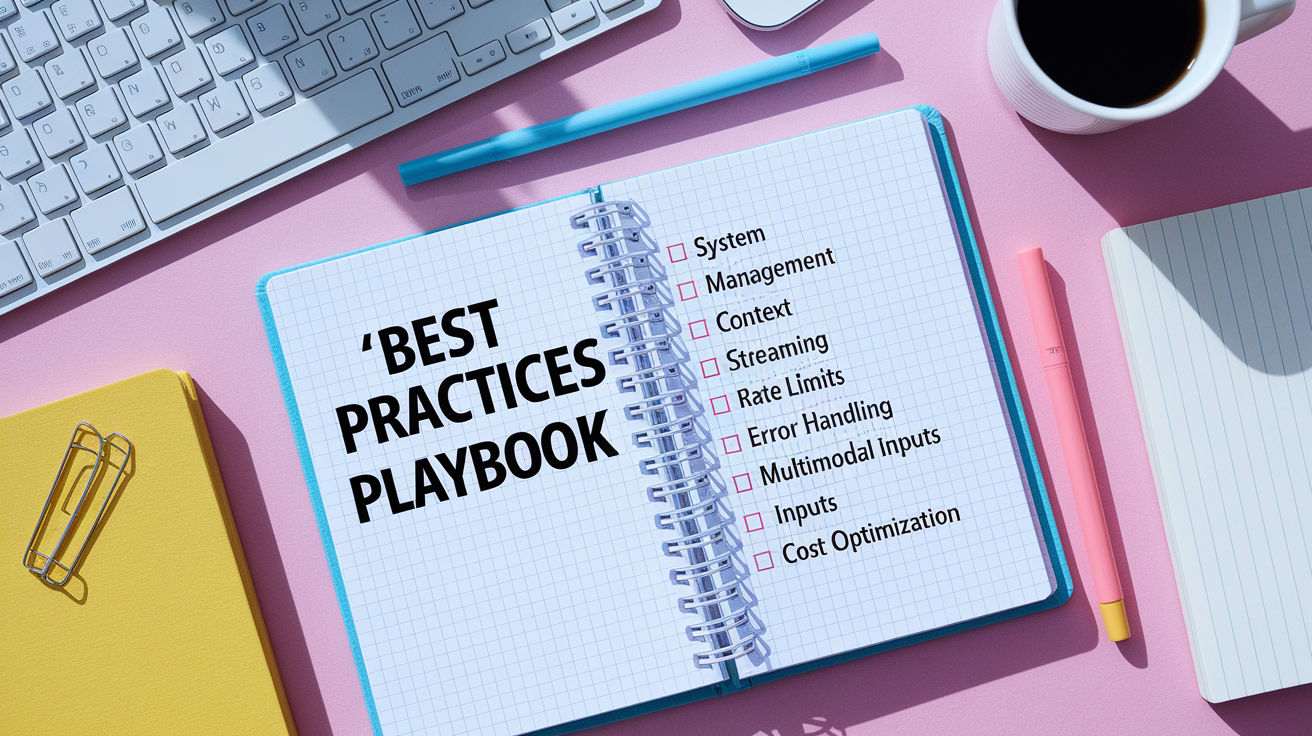
Seven implementation practices maximize performance and reliability:
System prompt optimization: Design prompts that explicitly reference multimodal inputs when your application will send images or structured data, using examples that show the expected format like “When shown a chart image, extract the title, axis labels, and key data points”
Context window management: Structure inputs to use the full 128,000 token context when processing long documents, but monitor token usage since costs scale with context length (processing a 100,000 token document costs $0.50 in input tokens per request)
Streaming response implementation: Enable streaming with stream=True parameter so your application displays tokens as they generate rather than waiting for complete responses, which creates the perception of even faster performance
Rate limit handling: Implement exponential backoff retry logic for rate limit errors and monitor your usage against the 10 million tokens per minute ceiling to scale your tier before hitting limits during traffic spikes
Error handling strategies: Build fallback logic for API failures since even with 99.9% uptime, you’ll encounter occasional errors in production (retry transient failures, cache responses when possible, and have a degraded experience mode)
Multimodal input formatting: Encode images as base64 or use publicly accessible URLs, and compress images to reasonable sizes since a 4K screenshot might consume thousands of tokens worth of processing
Cost optimization techniques: Use the 50% price reduction strategically by migrating high volume, low complexity tasks from GPT-4 Turbo first, monitoring per request costs, and implementing prompt caching when the API feature becomes available
Testing and validation matter more for GPT-4o despite its improvements, especially for applications where the 60 to 80% accuracy ceiling in data extraction creates risk. Implement human review workflows for high stakes outputs like contract analysis or financial data extraction. Add confidence scoring by asking the model to rate its certainty and flagging low confidence responses for manual review. Build automated testing that runs representative inputs through the model and compares outputs against known correct answers, tracking accuracy over time to catch model degradation (a December evaluation of GPT-4 Turbo showed 65% classification accuracy compared to lower current results, suggesting models can degrade between versions). For categorization tasks where GPT-4o often categorizes incorrectly despite understanding the request structure, validate outputs programmatically by checking category assignments against your expected taxonomy before using results in downstream systems.
Final Words
GPT-4o turbo released marks a significant step in AI accessibility and performance. The model delivers twice the speed of its predecessor at half the cost, making advanced AI capabilities more practical for developers and businesses.
The 128,000 token context window, improved multimodal processing, and 5x higher rate limits open new possibilities for real-time applications and complex document analysis.
Start with the free tier to test capabilities, then scale to Plus or API access based on your specific needs. Remember the 60-80% accuracy threshold for complex data extraction and plan validation workflows accordingly.
The combination of speed improvements, cost reduction, and expanded multimodal features makes GPT-4o a solid choice for most production applications today.
FAQ
When did GPT-4o come out?
GPT-4o came out in May 2024 as OpenAI’s newest model with expanded multimodal capabilities. The model launched with immediate availability through ChatGPT, the OpenAI API, and Azure OpenAI Service for both free and paid users.
Is GPT-4o Turbo available?
GPT-4o Turbo does not exist as a distinct model. OpenAI released GPT-4o in May 2024 without using the “Turbo” naming convention, which previously applied to GPT-3.5 and GPT-4 variants. The confusion comes from earlier naming patterns.
Is GPT-4o or GPT-4 Turbo better?
GPT-4o is better than GPT-4 Turbo for most tasks, delivering 2x faster speeds, 5x higher rate limits, and 88.7% accuracy on MMLU benchmarks compared to GPT-4 Turbo’s 86.5%. GPT-4 Turbo still outperforms GPT-4o on complex arithmetic tasks like the DROP dataset.
Is GPT-4o being discontinued?
GPT-4o is not being discontinued. OpenAI actively supports GPT-4o as its current flagship model alongside GPT-4 Turbo, which remains available. ChatGPT Plus users can access both models with 80 messages every 3 hours for GPT-4o and 40 for GPT-4.
How much does GPT-4o cost through the API?
GPT-4o costs $5 per million input tokens and $15 per million output tokens through the API, making it 50% cheaper than GPT-4 Turbo. ChatGPT Plus subscribers pay $20 monthly for enhanced GPT-4o access with 80 messages every 3 hours.
What is the context window size for GPT-4o?
The GPT-4o context window is 128,000 tokens, equivalent to approximately 300 pages of text in a single prompt. This matches GPT-4 Turbo’s context window and enables processing of extensive documents, long conversations, and complex analyses in one request.
Can free users access GPT-4o?
Free users can access GPT-4o with limited usage caps that vary based on current demand. ChatGPT Plus subscribers ($20/month) receive priority access with 80 messages every 3 hours, while free tier users face stricter limits that adjust dynamically.
What multimodal capabilities does GPT-4o support?
GPT-4o supports text, audio, image, and video processing simultaneously in approximately 50 languages. The model includes real-time voice communication, vision capabilities for photos and videos, and memory functions for objects and events across conversations.
How fast is GPT-4o compared to GPT-4 Turbo?
GPT-4o generates 109 tokens per second compared to GPT-4 Turbo’s 20 tokens per second, making it roughly 5x faster. Time to first token improved 50-80% across tested tasks, with audio processing nearly as fast as human brain response times.
Where does GPT-4o struggle compared to GPT-4 Turbo?
GPT-4o struggles with word manipulation, spatial reasoning, pattern recognition, and complex arithmetic tasks where GPT-4 Turbo performs better. Both models achieve only 60-80% accuracy in complex contract data extraction, insufficient for mission-critical applications requiring higher precision.
How do I migrate from GPT-4 Turbo to GPT-4o?
To migrate from GPT-4 Turbo to GPT-4o, change the model identifier to “gpt-4o” in your API calls while maintaining backward compatibility. Adjust prompt engineering to leverage multimodal capabilities and test thoroughly, especially for data extraction tasks where accuracy requirements differ.
What are the rate limits for GPT-4o?
GPT-4o offers rate limits up to 10 million tokens per minute, which is 5x higher than GPT-4 Turbo. ChatGPT Plus users can send 80 messages every 3 hours on a rolling window basis, with unused messages not accumulating across periods.