
What if your AI could search a million documents and still give accurate, cited answers every time?
Cohere’s Command R says it can.
Built for enterprise production, it pairs long-context handling with retrieval-augmented generation, multilingual support, and inference optimizations that cut cost and latency.
This post lays out the model’s technical specs, real-world performance, deployment choices, and concrete use cases—so developers and product teams can decide if Command R fits their stack and learn the next steps to test and deploy it in production.
What Is Cohere Command R? (Specs, Capabilities, and Key Features)

Cohere Command R is a large language model built for enterprise production systems. It’s not a general-purpose consumer model. Command R focuses on reliability, scalable retrieval-augmented generation (RAG, where database search combines with language generation to produce accurate, grounded answers), and efficient long-context processing. The model exists to move organizations past proof-of-concept into real production workflows where accuracy, speed, and integration stability actually matter.
Command R handles long-context tasks that break many competing models. It processes extended documents, multi-turn conversations, and large knowledge bases without response quality falling apart. It covers over 70 languages through Cohere’s multilingual research models, which makes it practical for global teams running customer support, internal knowledge management, and cross-border communication. The model works well for conversational interaction, keeping coherence across extended sessions while delivering consistent reasoning and retrieval accuracy.
The architecture emphasizes inference efficiency. Enterprises can deploy the model across high-volume applications without infrastructure costs scaling linearly. Command R is available through Cohere’s managed API, the Model Vault (a dedicated secure inference platform managed by Cohere), Oracle Cloud Infrastructure Generative AI service, and private deployment configurations that support on-premise or VPC installation.
Core capabilities:
- Long-context processing for extended documents and multi-session conversations
- Retrieval-augmented generation with high recall accuracy and grounding consistency
- Multilingual support covering 70+ languages for global enterprise operations
- Conversational coherence across extended dialogues with context retention
- Scalable inference optimized for production throughput and cost efficiency
- Secure deployment modes including managed cloud, private VPC, and on-premise options
Model Architecture and Technical Foundations

Command R uses an optimized transformer-based architecture with specific modifications for enterprise RAG and high-performance retrieval tasks. The model employs attention mechanisms designed to maintain accuracy across extended context windows. This lets it process longer documents and conversation histories without the quality degradation you see in standard transformer implementations. Token efficiency improvements reduce redundant computation during inference, lowering latency and cost per request while preserving output quality.
The architecture handles both generative and retrieval workflows within a single inference pass. This unified design allows Command R to tackle hybrid tasks (generate summaries, extract facts, augment responses with retrieved data) without requiring separate model calls or complex pipeline orchestration.
| Component | Function | Impact on Performance |
|---|---|---|
| Optimized Attention Layers | Maintain accuracy across extended context windows | Enables long-document processing without quality loss |
| Token Efficiency Module | Reduces redundant computation during inference | Lowers latency and cost per request |
| Unified Generative-Retrieval Pipeline | Handles generation and retrieval in single pass | Simplifies integration and reduces orchestration overhead |
| Multilingual Parameter Tuning | Supports 70+ languages with consistent performance | Expands global deployment and cross-language accuracy |
Performance Benchmarks and Real-World Throughput
Command R delivers strong retrieval accuracy in RAG scenarios. Its multilingual benchmark scores match or exceed other enterprise-focused models. Inference speeds are optimized for production environments, with latency profiles that support high-volume applications like customer support automation, internal search systems, and real-time document analysis. The model maintains consistent performance across extended context lengths, avoiding the accuracy drop-off that hits many competitors when processing long documents or multi-turn conversations.
Real-world throughput depends on deployment configuration. But enterprise customers report stable request-per-second rates suitable for customer-facing applications without degradation during peak load periods. The model’s efficiency improvements translate directly into lower infrastructure costs compared to models requiring larger compute allocations for similar task performance.
Key benchmark factors:
- Retrieval recall accuracy consistently above baseline in enterprise RAG tests
- Inference latency optimized for sub-second response times in production deployments
- Multilingual benchmark scores competitive with leading global models
- Long-context accuracy retention across extended conversation and document sessions
- Throughput stability under high-volume production load without quality degradation
Pricing and Deployment Options
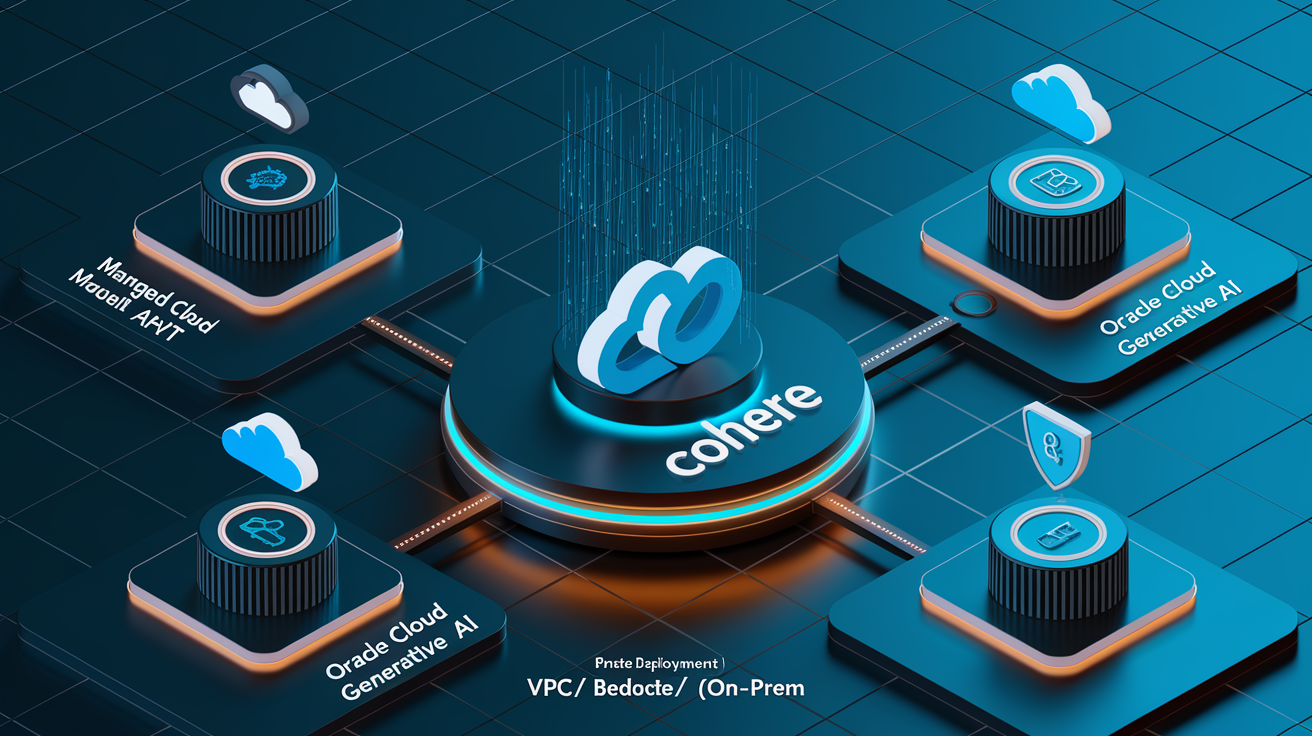
Cohere offers usage-based pricing for API access, calculated per request or token volume depending on the deployment tier. Enterprise licensing is available for organizations requiring dedicated infrastructure, custom SLAs (service-level agreements, guarantees about uptime and performance), and white-glove support. Pricing scales with throughput requirements. Custom arrangements are available for large-volume deployments or specialized security configurations.
Deployment options include managed cloud access through Cohere’s API, the Model Vault platform (which provides dedicated secure model inference managed by Cohere), Oracle Cloud Infrastructure Generative AI service, and private deployments. Private deployments support VPC installation for enterprises requiring data residency controls or on-premise configurations for organizations with strict air-gap security policies.
The choice between managed API and private deployment typically depends on data governance requirements, expected request volume, and internal infrastructure preferences. Managed API access provides the fastest onboarding path. Private deployments offer maximum control over data flow and integration patterns.
API Integration and Implementation Workflow
Command R integrates through the Cohere API, which supports text generation, embeddings, RAG pipeline construction, and custom enterprise workflows. The API uses standard REST patterns with JSON payloads. Integration is straightforward for teams familiar with modern web service architectures.
Developers authenticate using API keys distributed through the Cohere dashboard, with support for role-based access controls in enterprise accounts. Request formatting follows predictable schema patterns, with parameters for context window size, temperature (a control for output randomness), and retrieval settings when using RAG features. Response handling includes structured JSON outputs with metadata fields that support logging, debugging, and downstream processing.
Implementation workflow:
- Obtain API credentials from the Cohere dashboard and configure environment variables or secrets management
- Install the Cohere SDK for your language (Python, JavaScript, Java) or use direct REST calls
- Format input requests with prompt, context, and configuration parameters (temperature, max tokens, retrieval settings)
- Send requests to the appropriate endpoint (generate, embed, or RAG-augmented generation)
- Parse JSON responses and extract generated text, metadata, and retrieval citations for application use
Retrieval-Augmented Generation (RAG) Performance and Use Cases

Command R is optimized for retrieval-augmented generation with high recall accuracy, consistent grounding in source documents, and scalable search-retrieval integration. The model maintains citation accuracy, clearly linking generated statements back to retrieved documents and reducing hallucination (when an AI generates incorrect information that sounds plausible). Indexing quality remains stable across large document collections. Latency stays within acceptable bounds for real-time applications even when processing complex multi-source retrieval queries.
RAG performance benefits from the model’s unified architecture, which eliminates the need for separate retrieval and generation stages. This single-pass approach reduces latency and simplifies error handling compared to systems that chain multiple models together. Grounding consistency ensures that generated responses stay aligned with retrieved data, a critical requirement for enterprise applications where accuracy and auditability matter.
Enterprise Use Cases for RAG
Knowledge base augmentation transforms static internal documentation into interactive systems that answer employee questions with cited sources. This reduces help desk load and onboarding time. Support automation uses RAG to pull relevant product documentation, troubleshooting guides, and historical ticket resolutions, delivering accurate responses to customer inquiries without human intervention. Document search applications combine semantic retrieval with natural language summarization. Users can ask questions across large document repositories and receive synthesized answers with direct citations to source material.
Supported Languages and Multilingual Capabilities

Command R supports multiple languages through Cohere’s multilingual research models, which cover over 70 languages with consistent performance across major global languages and many regional variants. The model handles code-switching (when a speaker alternates between languages within a single conversation) and maintains coherence in cross-language workflows. This makes it practical for multinational enterprises operating in diverse linguistic environments.
Multilingual functionality extends to RAG scenarios. The model can retrieve documents in one language and generate responses in another, or process mixed-language queries against multilingual knowledge bases. This capability reduces the need for separate models per language and simplifies deployment for global teams.
Supported languages include:
- English, Spanish, French, German, Italian, Portuguese, Dutch
- Mandarin Chinese, Japanese, Korean
- Arabic, Hindi, Bengali
- Russian, Polish, Czech
- Turkish, Indonesian, Vietnamese
- Thai, Swedish, and 50+ additional languages
Command R vs. Command R+ (Comparative Overview)
Command R+ provides stronger reasoning capabilities, advanced multilingual performance, and higher accuracy on complex tasks. Command R focuses on efficiency and scalable enterprise use at lower cost. Command R+ is described as “Cohere’s newest large language model, optimized for conversational interaction and long-context tasks. It aims at being extremely performant, enabling companies to move beyond proof of concept and into production.” The original Command R prioritizes inference speed and cost efficiency, which makes it suitable for high-volume applications where performance requirements are predictable and well-defined.
| Feature | Command R | Command R+ | Use Case Fit |
|---|---|---|---|
| Reasoning Complexity | Optimized for standard enterprise tasks | Advanced multi-step reasoning and problem-solving | Command R+ for complex analysis; Command R for high-volume routine tasks |
| Multilingual Performance | Supports 70+ languages with consistent quality | Enhanced accuracy and fluency in multilingual scenarios | Command R+ for customer-facing global applications; Command R for internal multilingual workflows |
| Inference Efficiency | Optimized for cost and speed | Higher computational cost per request | Command R for high-throughput systems; Command R+ where accuracy outweighs cost |
| Long-Context Handling | Effective for extended documents and conversations | Improved coherence across very long contexts | Command R+ for research and complex document analysis; Command R for standard context lengths |
| Deployment Priority | Scalable production for defined use cases | Maximum capability for advanced applications | Command R for proven workflows; Command R+ for experimental or high-stakes tasks |
Final Words
We walked through Cohere Command R’s specs, architecture, performance benchmarks, pricing and deployment options, API integration steps, RAG strengths, and multilingual support. The piece showed where it fits and how teams can use it.
If you’re evaluating models, focus on context length, retrieval accuracy, and deployment mode. Run a short pilot with real documents, track latency and grounding, and compare cost per call.
Overall, cohere command r looks like a practical choice for scalable enterprise RAG—ready to support real workflows.
FAQ
Q: What is the Cohere Command R model?
A: The Cohere Command R model is an enterprise-focused LLM for scalable retrieval-augmented generation (RAG), designed for long-context, multilingual workflows, high-accuracy retrieval, structured reasoning, and efficient low-latency inference.
Q: What models does Cohere have and does Cohere include a reasoning model?
A: Cohere’s lineup includes Command R (efficient RAG), Command R+ (stronger reasoning and multilingual accuracy), plus generation and embedding models; yes, Command R+ is specifically tuned to provide advanced structured reasoning.