
What if a judge could rewrite parts of your business for years?
An antitrust consent decree does exactly that: a court-approved settlement becomes a binding federal order that forces new rules, monitoring, and penalties.
It can change contracts, product features, hiring and reporting, and can last years.
This post explains what a decree is, who’s likely to face one, common requirements you’ll see, and quick steps your company should take now to limit risk and stay compliant.
Clear Overview of What an Antitrust Consent Decree Is

An antitrust consent decree is a court-approved settlement between a company and a federal agency (usually the DOJ or FTC) that ends an antitrust investigation without going to trial. Think of it as a legally binding performance plan that can reshape how a company does business for years, sometimes decades.
Unlike a regular settlement, this one comes with teeth. It’s a federal court order. The company agrees to follow specific rules, file regular reports, and submit to monitoring. And the court keeps watch the whole time. Break the rules? The judge can slap you with contempt charges, daily fines, or even install a court-appointed receiver who takes over parts of your business.
Here’s what you’ll find in most consent decrees:
Court approval and oversight: a federal judge reviews the deal, greenlights it, and keeps authority to enforce it
Injunctive relief: binding orders that ban certain behaviors or force specific actions (like selling off assets or changing policies)
Compliance monitoring: agencies or court-appointed monitors track your performance using benchmarks, data reports, audits, and surprise visits
Long duration: most modern decrees run 10 years. Some older ones lasted indefinitely.
Enforcement mechanisms: courts can hold you in contempt, charge daily penalties, demand additional fixes, or hand control to a receiver
Regulators use consent decrees when they’ve spotted serious competition problems but want to skip the time, expense, and risk of a trial. The company settles without admitting guilt. The agency gets enforceable remedies that change market behavior going forward. Courts make the final call, ensuring the deal actually protects competition and the public interest. What you get is a hybrid instrument: part settlement, part court order, part regulatory babysitter. It can reshape entire industries and outlast the executives who signed it.
Core Components and Legal Structure of an Antitrust Consent Decree

Every antitrust consent decree starts with the same foundation: a federal lawsuit (filed or about to be) that the parties settle before trial, subject to court approval. The court enters a final judgment that locks in the settlement terms, and that judgment becomes a binding order with the same force as any other ruling. The agency and the company submit the proposed decree. The judge reviews it to make sure it serves the public interest and protects competition. Once approved, the decree replaces the lawsuit and governs the company’s conduct for the full term.
The decree imposes injunctive obligations, commands the company must follow. These can include prohibitions (like bans on buying competitors or engaging in certain business practices) and affirmative duties (such as selling assets, implementing compliance programs, or filing reports to the agency). The company also commits to transparency and cooperation: it keeps records, allows agency inspections, makes personnel available for interviews, and delivers regular compliance reports signed by senior officers. These requirements ensure the agency and the court can monitor whether the company’s actually meeting its obligations.
Policy and operational reforms often tag along with the injunctive relief. The company might be required to:
- Adopt and publish competition compliance policies, train employees, and build internal controls
- Notify the agency before making acquisitions or entering contracts in relevant markets, even if the deals fall below normal reporting thresholds
- Provide transitional support to buyers of divested assets, including personnel, technical help, and access to intellectual property
- Submit to audits, data collection, and interviews conducted by independent monitors or agency staff
The court retains enforcement authority throughout the life of the decree. If the company fails to comply, the agency can return to court and ask the judge to impose sanctions, modify the decree, or appoint additional oversight. The decree is a living document, supervised by the court. The company stays under judicial supervision until the decree expires or the court terminates it.
How Antitrust Consent Decrees Are Created: Investigation to Court Approval
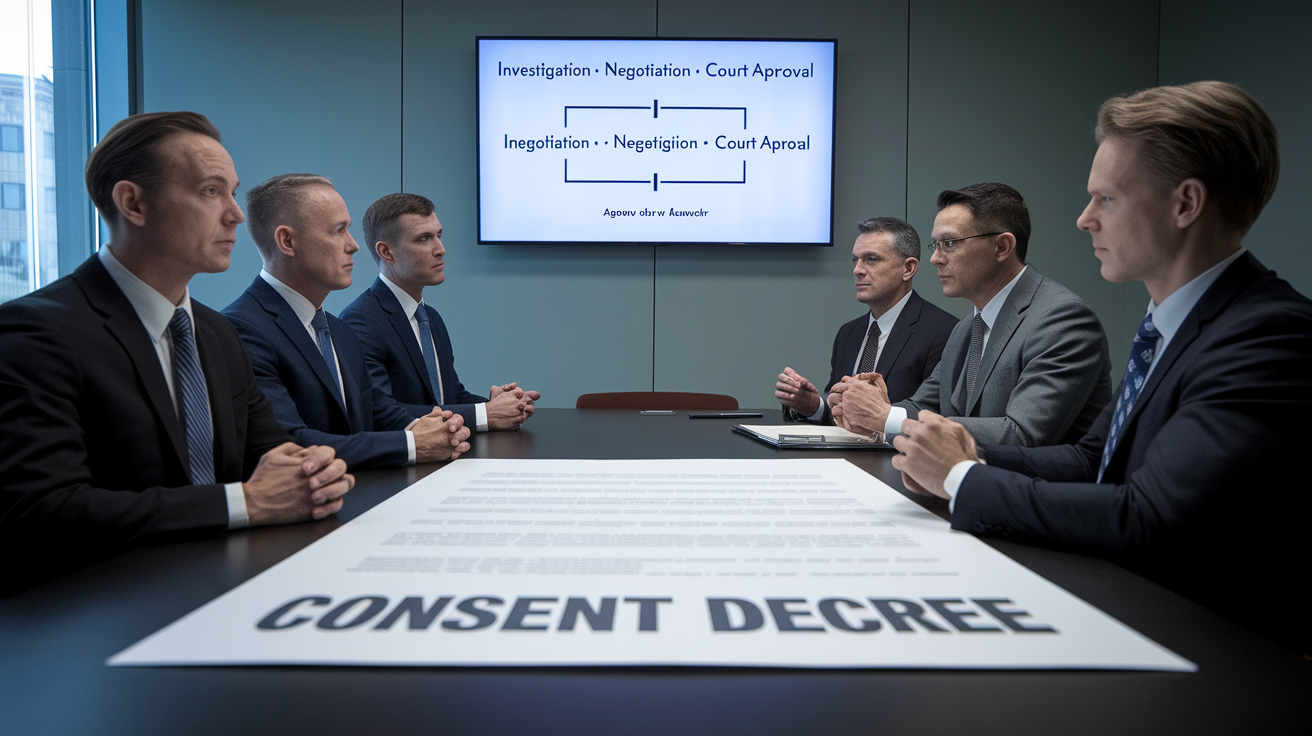
A consent decree usually begins when a federal agency opens an investigation into potential anticompetitive conduct. The trigger can be a merger filing under Hart-Scott-Rodino, a complaint from a competitor or customer, market monitoring by agency staff, or a pattern of conduct spotted through public information. Once the agency determines there’s a plausible competition concern, staff attorneys and economists launch a formal review, collecting documents, interviewing market participants, and analyzing competitive effects.
If the agency concludes the conduct or transaction violates antitrust law, it enters settlement negotiations with the company. The parties work to design remedies that address the competitive harm without requiring a trial. This phase often involves economic modeling, market testing of proposed divestitures, and back-and-forth discussions about monitoring and compliance mechanisms. Once both sides reach agreement on the terms, the agency and the company prepare a proposed consent decree and supporting documents.
The typical process from agreement to final order includes:
Agency files or proposes a lawsuit: DOJ files a civil complaint in federal district court. FTC issues an administrative complaint and simultaneously proposes a consent order.
Public comment period: the proposed decree is published, and the public has 30 days (sometimes longer for complex cases) to submit comments. Agencies review comments and may revise the decree.
Court review and approval: for DOJ cases, a federal judge holds a fairness hearing and approves the decree under the Tunney Act, which requires the court to determine the settlement is “in the public interest.” For FTC cases, the Commission votes to accept the consent order after considering public comments.
Entry of final judgment: the court enters the decree as a final order. At that moment, the company becomes subject to its terms, and the monitoring and compliance period begins.
Courts play a gatekeeping role. Judges don’t rubber-stamp settlements. They review the factual basis for the complaint, the scope of the remedies, the adequacy of enforcement mechanisms, and any public objections. In some cases, courts have required agencies to strengthen remedies or provide additional justification. Once the decree is entered, the court retains jurisdiction for the full term, and the company is bound by every provision.
Real-World Antitrust Consent Decree Examples and What They Show

Consent decrees have shaped competitive landscapes across industries, from technology and telecommunications to media and manufacturing. They demonstrate how agencies use court-enforced settlements to impose structural and behavioral changes on dominant firms, often for years or decades. The choice of remedy, monitoring approach, and duration varies with the conduct and market at issue, but the common thread is long-term oversight enforced by a federal court.
| Case | Industry | Key Remedy | Duration |
|---|---|---|---|
| United States v. Microsoft (2001) | Software / Operating Systems | Prohibited exclusive dealing and tying; required disclosure of APIs; imposed compliance committee and technical oversight | Initial term through 2007; extended to 2011 |
| United States v. AT&T (consent decree phase, pre-breakup) | Telecommunications | Restrictions on entry into unregulated markets; licensing obligations; later replaced by full divestiture | Decades; modified multiple times before 1982 breakup |
| FTC / Google (DoubleClick acquisition, 2007) | Online Advertising | Privacy and data-use restrictions; monitoring and reporting | Typically 10–20 years for related orders |
| DOJ / HPE-Juniper (2025) | Enterprise Networking | Divestiture of campus networking business; licensing of AI source code; transitional support; 10-year term | 10 years with five-year review reopening right |
The Microsoft decree stands as one of the most detailed behavioral consent orders in modern antitrust history. It prohibited Microsoft from retaliating against PC manufacturers or software developers, required the company to disclose technical information to competitors, and established a three-member technical committee with broad access to source code, business records, and personnel. The committee filed regular reports with the court, and the decree was extended twice as compliance issues emerged. The case shows how behavioral remedies demand intensive, sustained oversight and how courts retain flexibility to extend decrees when compliance is incomplete.
Earlier telecommunications and media cases show how decrees can serve as holding patterns before structural change. The AT&T consent decree of 1956 and subsequent modifications attempted to regulate the company’s conduct for decades, but the remedies proved difficult to enforce and ultimately gave way to the 1982 breakup. Modern merger decrees tend to favor immediate divestitures paired with shorter-term behavioral restrictions, reflecting lessons learned about the limits of long-term court supervision.
Recent cases demonstrate a return to standardized decree structures. The HPE-Juniper order (filed June 2025) required divestiture within 180 days, licensing of critical software, transitional support for the buyer, and a 10-year term with a five-year review window. Features now common across DOJ and FTC merger settlements. The Omnicom-IPG decree (June 2025) imposed narrow behavioral restrictions on advertising exclusion lists, coupled with five-year detailed reporting and a 10-year term. These cases show agencies refining a toolkit that balances structural remedies, targeted behavioral limits, and flexible enforcement mechanisms.
Types of Remedies: Structural, Behavioral, and Divestiture Requirements

Antitrust consent decrees deploy three broad categories of remedies, each addressing different kinds of competitive harm. Structural remedies physically separate assets or businesses to restore competition in a market. Behavioral remedies impose ongoing restrictions on conduct without changing ownership. Divestiture requirements are the most common structural tool, requiring a company to sell assets, intellectual property, or entire business units to an approved buyer who can compete effectively.
Agencies strongly prefer structural remedies because they solve the competitive problem permanently and require less long-term monitoring. A divestiture decree typically orders the company to sell specified assets (factories, brands, customer contracts, patents, or business divisions) to a buyer pre-approved by the agency within a tight timeline, often 10 to 180 days after the decree is entered. The buyer must have the operational capability, financial resources, and incentive to compete vigorously. To ensure the buyer can stand up the business, decrees often require the seller to provide transitional services (like IT support, supply agreements, or technical assistance), facilitate hiring of key personnel, and transfer enough intangible assets (know-how, customer relationships, regulatory approvals) to make the divested unit viable. Recent cases illustrate this approach: HPE was required to divest its Instant On networking business with full transitional support. Synopsys divested optical software tools to Keysight with a mandate to provide additional assets within 12 months if needed. And Safran transferred all THSA-related assets to Woodward with workforce protections and firewall training to prevent information leakage.
Behavioral remedies impose restrictions on how the company operates. These are used when divestiture is impractical or when the competitive concern involves exclusionary conduct rather than concentration. Common behavioral provisions include:
Non-discrimination obligations: requiring a company to offer products, services, or platform access on equal terms to all customers or competitors
Prohibitions on exclusive dealing or bundling: preventing a dominant firm from tying products together or locking customers into exclusive contracts
Reporting and prior-notice requirements: mandating that the company notify the agency before making acquisitions, entering joint ventures, or changing business practices in relevant markets, even if the transactions fall below statutory thresholds
Behavioral remedies demand intensive, long-term oversight. The Omnicom-IPG decree shows this: it prohibited coordination with competitors to exclude publishers based on political viewpoint, banned creation of ideological exclusion lists unless directed by advertisers, and required five years of detailed annual compliance reports. The Microsoft decree required disclosure of APIs and prohibited retaliation against partners. Obligations that needed a technical committee and years of monitoring to enforce. Because behavioral decrees depend on continuous compliance, they typically include sunset provisions (commonly 10 years) and reserve agency or court authority to reopen or extend the decree if competitive conditions change.
Modern decrees also feature protective mechanisms to ensure remedies work. Most include 10-year prohibitions on reacquiring divested assets, preventing the merging parties from undoing the remedy. Agencies may appoint divestiture trustees (independent agents with authority to complete the sale if the company fails to do so within the prescribed window). Orders often waive or limit enforcement of non-compete agreements and non-disclosure agreements on employees transferring to buyers, ensuring talent and knowledge move with the assets. And agencies reserve rights to demand additional divestitures within 12 months if the initial remedy proves insufficient, as seen in the Synopsys-Ansys decree. These tools reflect decades of experience with remedy failures and an evolving commitment to front-load enforcement rather than rely solely on post-close corrections.
Monitoring, Compliance, and Independent Oversight Under Antitrust Decrees

Monitoring turns a consent decree from paper into practice. Federal courts routinely authorize or require the appointment of an independent monitor (a neutral expert who oversees compliance, investigates potential violations, and reports findings to the court and the agency). The monitor is typically a single individual (often a former government official, economist, or industry expert) who hires a team of lawyers, analysts, and technical specialists. The monitor has broad authority to access company records, interview employees, observe operations, audit data systems, and inspect facilities without advance notice.
Monitoring relies on both quantitative and qualitative data. The company must submit regular compliance reports (often annually for five years, but sometimes quarterly or on-demand) verified and signed by a senior corporate officer. These reports include narrative descriptions of compliance activities, data tables showing performance against benchmarks, copies of relevant policies and training materials, and certifications that the company has met all obligations. Agencies and monitors use objective metrics wherever possible: in merger cases, this might include market share data, pricing trends, customer wins and losses, and counts of customer complaints. In conduct cases, it might include counts of API disclosures, contract terms offered to different customer classes, or records of meetings with competitors.
Qualitative inputs supplement the numbers. Monitors and agency staff conduct interviews with company personnel, customers, and competitors. They review internal communications, board minutes, and strategy documents to assess intent and understand how decisions are made. They test whether policies are being followed in practice by sampling transactions, auditing contract negotiations, or observing how employees respond to hypothetical compliance scenarios. In divestiture cases, monitors confirm that buyers receive all promised assets, that transitional services are delivered as agreed, and that firewalls prevent the sharing of competitively sensitive information between the merged entity and the divested business.
Companies operating under a decree face detailed recordkeeping obligations. Most orders require retention of all compliance-related documents for at least one year, and often three to five years. This includes communications with the buyer, records of employee transfers, copies of all reports submitted to the agency, and documentation of any third-party consents or regulatory approvals obtained during divestiture. Agencies reserve inspection and audit rights: staff can demand documents, schedule site visits, and require employees to appear for interviews, all without prior court approval. The goal is transparency and deterrence. The company knows that any deviation will likely be discovered, documented, and reported to the court.
Enforcement: Penalties, Contempt, and What Happens When Companies Don’t Comply

When a company violates a consent decree, enforcement moves quickly and carries serious consequences. Because the decree is a court order, noncompliance is treated as contempt of court. The agency files a motion asking the judge to find the company in contempt and impose sanctions. Courts have wide discretion: they can order the company to comply immediately, levy substantial financial penalties, require additional remedies, or escalate oversight by appointing a receiver who takes operational control of the relevant business.
Financial penalties are often calculated on a per-day basis for ongoing violations. Courts may impose fixed daily fines (sometimes tens or hundreds of thousands of dollars per day) until the company cures the breach. In some cases, decrees specify liquidated damages or stipulated penalties that apply automatically when deadlines are missed. For example, if a divestiture deadline passes without a completed sale, the decree may authorize the agency to petition for appointment of a trustee and assess penalties for each day of delay. Courts may also award compensatory damages to harmed parties or order the company to fund additional monitoring or compliance programs at its own expense.
Some decrees lower the evidentiary bar for enforcement. The Keysight-Spirent and Safran-Collins orders included provisions under which the defendants waived the higher “clear and convincing evidence” standard and agreed that the DOJ need only prove violations by a preponderance of the evidence (the same standard used in ordinary civil cases). This makes it easier for the government to establish a breach and obtain sanctions, reducing the company’s ability to litigate compliance disputes. Agencies also reserve the right to reopen decrees and seek additional relief. Many modern orders include 12-month follow-up windows or five-year review periods during which the agency can return to court and demand supplemental divestitures, expanded monitoring, or new restrictions if the original remedy is failing or if competitive conditions have changed unexpectedly. The court retains ultimate authority to grant or deny these requests, but the agency’s reserved reopening rights create ongoing leverage and risk for the company.
Duration, Modification, and Termination of Antitrust Consent Decrees

Most modern antitrust consent decrees include a sunset provision that terminates the order after a fixed period, typically 10 years. The 10-year term has become standard in DOJ and FTC merger and conduct settlements since the late 1970s, reflecting a policy judgment that court oversight shouldn’t be indefinite. At the end of the term, the decree expires automatically unless the court or the agency successfully moves to extend it. Extensions are possible if compliance has been incomplete or if competitive conditions still require oversight, but they’re not routine.
Older decrees often lacked expiration dates and remained on court dockets for decades. The Department of Justice announced an initiative in April 2018 to review and terminate over 1,000 legacy antitrust judgments, some dating back nearly a century. The oldest identified case, United States v. The Noland Company, involved a final decree entered in 1926 that imposed a perpetual restraining order on alleged price fixing in plumbing supplies. Under the termination process, DOJ assigns each legacy case to an attorney who reviews court files and publicly available information to determine whether continued judicial supervision is still necessary. If termination is appropriate, DOJ posts the case name and judgment on its public website and opens a 30-day public comment period. After evaluating comments, DOJ files a motion with the court to vacate the judgment. The court makes the final decision.
| Stage | Action Required |
|---|---|
| Internal review | Assigned DOJ attorney reviews case files, court dockets, and market information to assess whether oversight remains necessary |
| Public posting and comment | DOJ posts case name and judgment link on public website; 30-day comment period opens; public, competitors, and affected parties may submit views |
| Motion to terminate | After reviewing comments, DOJ files motion with the court requesting termination; court holds hearing if needed and issues ruling |
Decrees can also be modified before expiration if both parties agree and the court approves. Modifications are rare and typically involve technical corrections, clarifications of ambiguous terms, or adjustments to reflect changed market conditions. Courts scrutinize modification requests carefully to ensure they don’t weaken competitive protections. If a company seeks early termination, it must demonstrate full compliance and show that the competitive concerns justifying the decree have been resolved. Agencies and courts are cautious about early exits, and most decrees run their full term. The result is a system in which oversight is long but not infinite, and the end date is usually clear from the start.
Practical Implications for Businesses Operating Under an Antitrust Consent Decree

A consent decree imposes immediate and sustained operational burdens. From the moment the court enters the order, the company must dedicate resources to compliance: staff time, legal and consulting fees, IT systems to track and report data, and training programs for employees who handle relevant business decisions. Senior executives bear personal responsibility, often required to certify compliance in writing each year. Noncompliance can result in contempt sanctions against the company and, in some cases, individual liability for officers who knowingly participate in violations.
Divestiture obligations demand fast execution and careful planning. The company must identify, separate, and transfer all assets specified in the decree within the prescribed window (sometimes as short as 10 days, more commonly 90 to 180 days). This requires assembling transaction teams, obtaining third-party consents (like landlord approvals for facility leases or supplier agreements), carving out IT systems, transferring intellectual property, and training the buyer’s personnel. The decree often mandates “best efforts” to obtain consents and complete the sale, and failure to meet deadlines can trigger appointment of a divestiture trustee who takes control of the process. Companies must also facilitate employee transfers: decrees commonly require that the seller grant full access to recruitment, waive non-compete and confidentiality agreements for employees who accept offers from the buyer, and vest compensation and benefits to make the transition seamless. In the Safran-Collins case, candidates accepting offers within 180 days had to have their non-competes waived and certain benefits vested, reflecting a policy priority to move talent with assets.
Training, policy, and reporting obligations continue throughout the decree term. The company must:
Develop and implement antitrust compliance policies, distribute them to relevant employees, and conduct regular training sessions (often annual or biannual)
Maintain firewalls between business units to prevent sharing of competitively sensitive information, especially between retained and divested operations
Submit detailed compliance reports at intervals specified in the decree, including narrative updates, data tables, and copies of relevant documents
Retain records related to all compliance activities for one to five years, making them available for inspection by agency staff or monitors on short notice
Provide prior notice to the agency before acquiring assets or businesses in relevant markets, even for transactions that fall below statutory filing thresholds, ensuring the agency can review follow-on deals that might undermine the original remedy
Transitional support obligations are common in divestiture decrees and can last months. The seller must supply the buyer with services like IT hosting, logistics support, supply chain management, and technical assistance while the buyer stands up independent operations. These arrangements are spelled out in ancillary agreements (such as transition services agreements and supply agreements) that the agency reviews and approves. The seller must perform these obligations in good faith and on terms that don’t disadvantage the buyer, and monitors track delivery to ensure compliance.
Prior-notice provisions extend the agency’s oversight beyond the decree’s primary remedies. Even after a divestiture closes, the company must alert the agency if it plans to buy back divested assets, acquire a competitor in the relevant market, or enter a joint venture that could reduce competition. These notifications give the agency an opportunity to investigate and, if necessary, challenge the new transaction. The practical effect is that companies under decrees face stricter scrutiny and longer timelines for future deals, and they must budget for the legal and business costs of navigating ongoing agency review.
Final Words
We defined an antitrust consent decree as a court‑approved, binding settlement that sets obligations, reporting, and monitoring to address competition issues. The post covered core components, how decrees form, typical remedies, monitoring and enforcement tools, and how long orders can last.
For businesses, the practical takeaway is simple: adopt clear policies, invest in training and reporting, cooperate with monitors, and plan for long‑term oversight. Keep this antitrust consent decree explained summary handy, and you’ll be better prepared to manage risk and move forward confidently.
FAQ
Q: What is a consent decree in antitrust and how are they used?
A: A consent decree in antitrust is a court-approved, legally binding settlement that sets compliance, reporting, and performance obligations after an agency probe; courts enforce it, often with monitors and long-term oversight.
Q: Is a consent decree a guilty plea?
A: A consent decree is not a guilty plea: it’s a settlement where the defendant typically does not admit guilt but agrees to court-ordered remedies and oversight to resolve antitrust claims.
Q: What’s the difference between a consent decree and a settlement?
A: The difference between a consent decree and a settlement is that a consent decree becomes a court-enforceable order with monitoring and penalties, while ordinary settlements can remain private and lack judicial enforcement.