
Most security tools are blind to the attacks that matter most.
Zero‑day threats are undisclosed flaws attackers exploit before vendors can patch them.
They slip past signature‑based defenses and can be used by nation‑states, cybercrime groups, or insiders to steal data, install malware, or disrupt services.
This post shows how zero‑day attacks work—from reconnaissance to exploit—and gives clear protection steps: behavior‑based detection, continuous monitoring, rapid patching, and incident playbooks you can use now.
Read on to learn what to watch for and how to reduce your risk.
Core Understanding of Zero‑Day Security Threats and Their Impact

A zero‑day security threat is a previously undisclosed flaw in software, hardware, or system configuration that attackers can exploit before the vendor issues a patch. The “zero‑day” label came out of 1990s software piracy circles and later moved into security, describing the window where developers have literally zero days to fix a vulnerability before it’s weaponized. These threats don’t show up in public databases or patch notes. Attackers find them and use them while vendors and defenders are still in the dark.
Zero‑day security threats matter because they slip right past signature‑based defenses, which can only catch known attack patterns. The 1988 Morris Worm hit previously unknown Unix vulnerabilities and infected about 10% of all internet‑connected computers at the time. Fast forward to June 2010, and the Stuxnet worm used four zero‑day vulnerabilities to infiltrate more than 14 industrial sites in Iran, marking a serious turning point in state‑sponsored cyber operations. Every year, researchers and vendors identify at least a dozen zero‑day vulnerabilities. Major incidents like the early 2022 Google Chrome zero‑day exploited by North Korean actors show the threat isn’t going anywhere.
Here’s what makes zero‑day security threats different from routine security issues:
Unknown to vendors and security communities until someone finds exploitation happening in the wild. No existing signature or detection rule means traditional antivirus and IPS tools won’t catch them. They’re sold or traded in underground exploit markets for prices that can hit six figures. Sophisticated actors use them: nation‑states, corporate espionage groups, advanced criminal organizations. They enable data theft, malware installation, privilege escalation, and large‑scale breaches. Incidents can expose organizations to regulatory penalties under GDPR, CCPA, and DORA.
Detection is the central challenge. Signature‑based security won’t detect zero‑day exploits because signatures and patches don’t exist yet. Defenders rely on behavioral analytics, anomaly detection, and continuous monitoring across files, Active Directory, DNS logs, VPN sessions, and web proxy traffic. Historical examples drive home the urgency. Stuxnet stayed undetected for months, and even after disclosure, many organizations didn’t apply patches quickly, turning zero‑day vulnerabilities into persistent threats.
Lifecycle and Progression of Zero‑Day Vulnerabilities
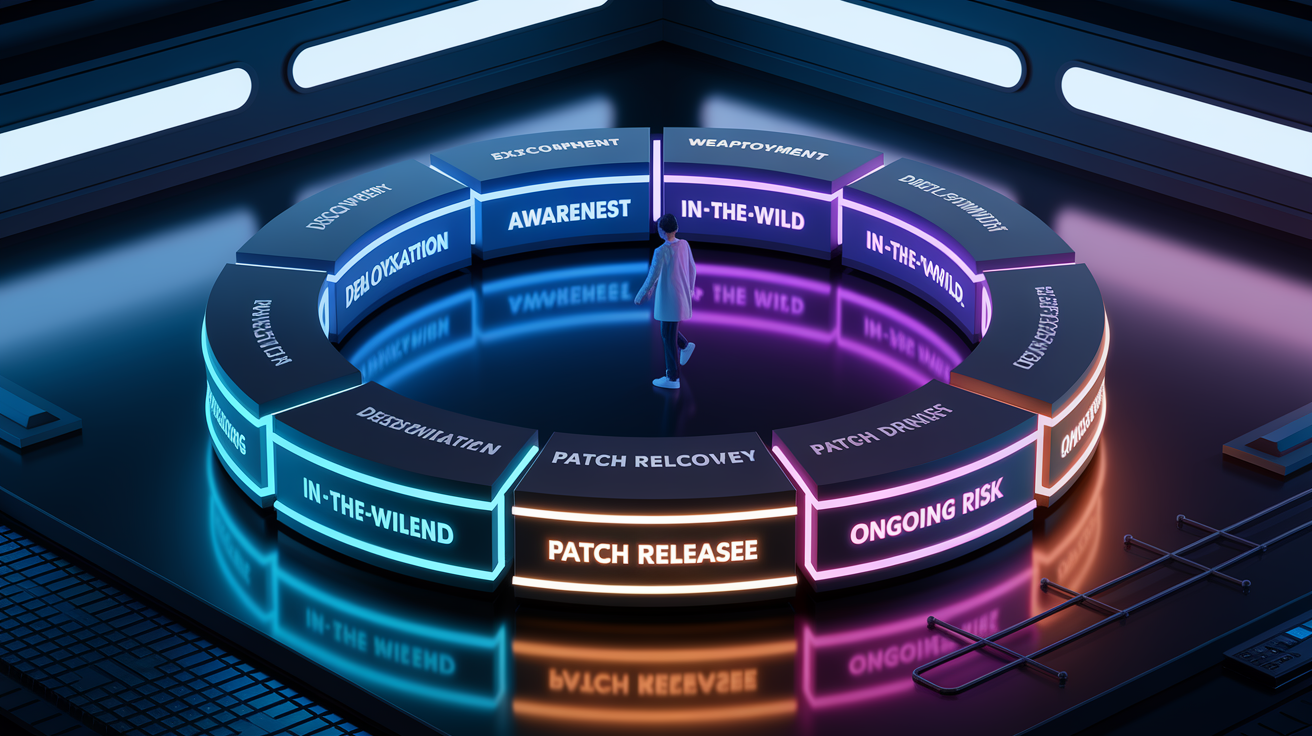
Zero‑day vulnerabilities move through a predictable lifecycle, starting with discovery and ending with ongoing risk management even after patches are available. Understanding this progression helps security teams anticipate where threats may surface and when defensive actions become most urgent. The lifecycle spans both the attacker’s timeline and the vendor’s timeline, creating windows of opportunity and responsibility that shape the entire threat landscape.
A commercial vulnerability marketplace showed up in the early 2000s, formalizing the flow of zero‑day intelligence between researchers, brokers, and buyers. Today, bug bounties from vendors like Microsoft and Google offer rewards above $100,000 for responsibly disclosed vulnerabilities. Underground markets pay similar or higher amounts for exclusive exploit code. This economic incentive accelerates discovery but also creates competing pressures: public disclosure versus private sale, coordinated vulnerability disclosure versus immediate weaponization.
Mapping the Full Zero‑Day Lifecycle
Vulnerability discovery happens when a researcher, attacker, or automated tool identifies a previously unknown flaw in code, configuration, or design. Exploit development and weaponization follow, turning proof‑of‑concept code into a reliable exploit that attackers may sell or use privately. Zero‑day attack in the wild is when the exploit gets deployed to steal data, install malware, escalate privileges, or disrupt services. Vendor awareness and patch development begin when the vendor learns of the flaw through detection, disclosure, or incident response and starts developing a fix. Patch release and deployment come next, and organizations must apply the update to close the vulnerability. Continued risk and monitoring follow because attackers may reverse‑engineer the patch to target unpatched systems.
Lifecycle awareness improves detection timing by highlighting the narrow window between active exploitation and patch availability. Security teams that monitor for behavioral anomalies during the “attack in the wild” phase can contain incidents before widespread damage. Rapid patch deployment during the “release and deployment” phase minimizes the window of continued risk.
Attack Mechanics Behind Zero‑Day Exploits

Zero‑day exploits operate through a structured sequence of attacker actions designed to maximize impact while minimizing detection. Security researchers have mapped this process into a seven‑step kill chain that applies to most advanced intrusions, from phishing‑based entry to data exfiltration. Each step leaves digital footprints across network logs, endpoint telemetry, and cloud infrastructure. Behavior‑based detection tools can identify these signals even without a known signature.
The kill chain begins with reconnaissance, where attackers gather information about target systems, users, and network topology. Weaponization follows as attackers embed a zero‑day exploit into a delivery vehicle like a malicious email attachment, compromised website, or supply chain component. Once delivered and executed, the exploit triggers actions such as remote code execution (RCE), memory corruption, or sandbox escape techniques that grant the attacker control over the targeted system.
After initial compromise, attackers install persistent malware, establish command‑and‑control (C2) channels, and pursue their ultimate objectives: data theft, privilege escalation, lateral movement, or service disruption. Common behaviors include unusual searches for sensitive files (credit card numbers, password lists), attempts to escalate privileges (targeting Domain Admin accounts), and anomalous access patterns across VPN logs, DNS queries, and web proxy traffic. These actions generate observable indicators across files, folders, emails, Active Directory, and network infrastructure.
Reconnaissance gathers target information, maps network topology, identifies high‑value assets. Weaponization integrates the zero‑day exploit into a delivery mechanism (attachment, link, infected update). Delivery transmits the weaponized payload via phishing, drive‑by download, or supply chain compromise. Exploitation triggers the zero‑day vulnerability to achieve remote code execution, privilege escalation, or sandbox escape. Installation deploys malware, backdoors, or persistence mechanisms on compromised systems. Command and Control establishes encrypted or obfuscated communication channels to direct attacker operations. Actions on Objectives execute the final mission: exfiltrate data, deploy ransomware, pivot to additional systems, or disrupt operations.
Memory corruption exploits and RCE incidents are among the most dangerous zero‑day attack types because they grant attackers immediate, deep access to system resources. Privilege escalation methods allow attackers to move from a low‑privileged user account to administrative control. Sandbox escape techniques break out of isolated execution environments—common in browsers and virtualized infrastructure—to reach the underlying operating system or host.
Real‑World Examples of Zero‑Day Security Threats

Historical zero‑day incidents show the scale and sophistication of modern threats, from nation‑state operations targeting critical infrastructure to criminal campaigns exploiting consumer software. These cases provide measurable evidence of impact: infection counts, financial losses, regulatory consequences. They also highlight the patterns that inform current detection and mitigation strategies.
The 1988 Morris Worm marked one of the earliest large‑scale zero‑day events, exploiting previously unknown vulnerabilities in Unix systems to spread across the early internet. Stuxnet, discovered in June 2010, remains the most studied example of a multi‑zero‑day campaign. A 500‑kilobyte worm that used four separate zero‑day vulnerabilities to infiltrate industrial control systems at more than 14 sites in Iran, including a uranium‑enrichment plant. The precision and complexity of Stuxnet signaled a new era of state‑sponsored cyber operations, where zero‑days became strategic tools for geopolitical objectives.
| Incident | Year | Core Zero-Day Details | Impact |
|---|---|---|---|
| Morris Worm | 1988 | Exploited unknown Unix vulnerabilities; self‑replicating | Infected ~10% of all internet‑connected computers; first major internet security event |
| Stuxnet | 2010 | Four zero‑day vulnerabilities in Windows and Siemens software; 500 KB worm | Compromised ≥14 industrial sites in Iran; disrupted uranium enrichment; shifted perception of cyber warfare |
| Google Chrome Zero‑Day | 2022 | Exploited by North Korean actors via phishing; delivered spyware/malware | Google quickly detected and patched; limited public data on stolen content; demonstrated speed of modern exploit cycles |
The 2022 Chrome zero‑day shows the accelerated tempo of modern threats. North Korean threat actors used phishing to deliver the exploit, which installed spyware and malware on targeted systems. Google detected the activity and released a patch rapidly, but the incident showed the importance of swift vendor response and immediate patch deployment by users. In contrast, a 2017 case saw a patch for the Strutshock vulnerability released in March 2017, yet one organization failed to apply the update. That turned a disclosed vulnerability into a major data breach.
Detection Strategies for Zero‑Day Exploits

Detecting zero‑day exploits requires a shift from signature‑based defenses to behavior‑based detection, continuous monitoring, and real‑time analysis of network and endpoint activity. Because no prior knowledge of the exploit exists, security teams establish baselines of normal behavior and alert on deviations: unusual privilege attempts, anomalous data flows, unexpected process execution, irregular network patterns.
Every cyberattack leaves digital footprints across data stores and network signals, even when the exploit itself is unknown. Packet‑level capture and storage, SSL/TLS decryption, and AI/ML analytics improve detection by revealing hidden threats and correlating events across distributed systems. Behavioral analytics platforms, endpoint detection and response (EDR) tools, and security information and event management (SIEM) systems enable defenders to flag activities like lateral movement, credential abuse, and data exfiltration. These actions often follow zero‑day exploitation.
Key detection signals for zero‑day exploits:
Unusual searches for sensitive data: credit card numbers, password lists, intellectual property, or customer records accessed by unexpected accounts or at unusual times. Privilege escalation attempts targeting Domain Admin, root accounts, or cloud IAM roles without documented authorization. Lateral movement where authenticated sessions spread across network segments or cloud environments in patterns inconsistent with normal workflows. Anomalous DNS queries requesting newly registered domains, algorithmically generated hostnames, or domains with suspicious geolocation or reputation. Unexpected process creation like binaries or scripts executing from unusual directories, unsigned executables, or processes spawned by applications not typically associated with code execution. VPN and remote access anomalies including logins from unfamiliar IP addresses, concurrent sessions from distant locations, or access during off‑hours. Active Directory changes such as new user creation, group membership modifications, or service account alterations outside change control windows. Web proxy and email irregularities like large file uploads to cloud storage, emails with embedded macros or obfuscated links, or HTTP/HTTPS traffic to command‑and‑control infrastructure.
Behavior‑based detection and endpoint detection and response (EDR) platforms provide the visibility and context needed to identify these signals in real time. By correlating indicators across files, folders, emails, Active Directory, VPN logs, DNS, and web proxy logs, security teams can detect zero‑day activity even when traditional antivirus and intrusion prevention systems remain silent.
Preventing and Reducing Exposure to Zero‑Day Security Threats

Preventing zero‑day security threats focuses on reducing the attack surface, limiting the blast radius of successful exploits, and maintaining the operational readiness to respond quickly when an incident occurs. Because zero‑day attacks can’t be stopped by prior knowledge of the vulnerability, organizations prioritize proactive architecture, strict access controls, rapid patching, and practiced incident response.
Least‑privilege access controls minimize the lateral movement and data exfiltration an attacker can achieve after exploiting a single system. Multi‑factor authentication (MFA) adds an additional verification step that slows credential‑based attacks. Network segmentation and micro‑segmentation contain breaches within isolated zones. Regular vulnerability scanning and patch management reduce the number of known vulnerabilities attackers can chain with zero‑day exploits to expand their foothold.
User training remains critical defense against phishing‑based delivery vectors, which are common entry points for zero‑day attacks. Empowering employees to report anomalous system behavior (unexpected pop‑ups, slow performance, unusual network activity) creates a human layer of detection when automated tools miss early indicators. Offline and regular backups of critical systems, combined with defined recovery and incident response plans, ensure that organizations can restore operations even after a zero‑day compromise.
Enforce least‑privilege access and remove excess permissions from user accounts, service accounts, and cloud IAM roles to limit lateral movement and data access. Apply software and security updates as soon as patches are available, including endpoint security tools, intrusion prevention systems, and network infrastructure firmware. Implement zero‑trust architecture with continuous verification, network segmentation, and micro‑segmentation to contain breaches and restrict attacker movement. Maintain offline and regular backups of critical systems, test recovery procedures, and document incident response playbooks with clear roles and communication protocols. Conduct regular vulnerability scanning, security audits, and penetration testing to identify and remediate configuration weaknesses and known flaws that attackers may chain with zero‑days. Deliver ongoing user training focused on phishing, social engineering, and recognizing suspicious links or attachments, and establish clear reporting channels for security concerns.
A 2017 case study shows the risk of delayed patching. A patch for the Strutshock vulnerability was released in March 2017, but one organization failed to apply the update. Attackers used the unpatched flaw to execute a major data breach, demonstrating that vendor‑issued patches are ineffective unless organizations deploy them promptly. Strong patch management and automated vulnerability workflows reduce exploitation via chained known vulnerabilities and shrink the window of opportunity for zero‑day attackers.
AI’s Expanding Role in Zero‑Day Security Threat Detection and Exploitation

Artificial intelligence is reshaping the zero‑day threat landscape by accelerating both vulnerability discovery and exploit development on the attacker side, while simultaneously enabling faster detection, real‑time response, and predictive analytics on the defender side. AI can compress vulnerability discovery from weeks to hours by scanning codebases, binaries, and system configurations at scale, identifying patterns and edge cases that manual review might miss.
On the offensive side, AI‑powered tools can automate exploit development, adapt payloads to different environments using reinforcement learning, and scale attacks across thousands of targets with minimal human intervention. This scalability increases the speed and success rate of zero‑day campaigns, particularly when combined with phishing automation and social engineering driven by large language models. Nation‑state actors and advanced persistent threat (APT) groups are investing in AI‑driven offensive capabilities to shorten the time between vulnerability discovery and active exploitation.
Defenders use AI for anomaly detection, behavior‑based analytics, and autonomous defense. Systems that can identify deviations from baseline activity, correlate threat intelligence across global events, and execute containment actions without waiting for human approval. Machine learning models trained on network traffic, endpoint telemetry, and cloud logs can flag zero‑day indicators such as unexpected privilege escalation, unusual data flows, unrecognized processes, and command‑and‑control communication patterns. AI narrows the gap between known and unknown threats by focusing on behavior rather than signatures.
AI‑driven changes to threat dynamics:
Faster vulnerability discovery where automated scanning and fuzzing tools reduce discovery time from weeks or months to hours or days. Scalable exploit automation as reinforcement learning and adaptive payloads enable attackers to deploy exploits across diverse environments with minimal manual tuning. Predictive detection through machine learning models that identify anomalous behavior and early‑stage compromise before full exploitation occurs. Autonomous defense where AI‑powered systems can isolate compromised endpoints, block malicious traffic, and trigger incident response workflows in real time without human intervention.
The net effect is a compressed timeline for both attack and defense. Organizations that combine AI‑powered analytics with zero‑trust architecture, rapid patch deployment, and practiced incident response can detect and contain zero‑day threats faster than those relying solely on signature‑based tools and manual triage.
Response Actions for Organizations Facing Zero‑Day Security Threats

When a zero‑day exploit is detected, rapid containment and investigation are required because no immediate patch may exist. Incident response (IR) plans must include clear roles, communication protocols, and containment workflows that can be executed under pressure. Forensic analysis of binaries, logs, memory dumps, and network traffic provides the evidence needed to understand attacker actions, identify persistence mechanisms, and assess the scope of the breach.
Root cause vulnerability analysis helps determine whether the exploited flaw is unique to the targeted system or represents a broader risk across the organization’s infrastructure. Attackers may reverse‑engineer vendor patches to identify the underlying vulnerability and target unpatched systems, so continuous monitoring post‑patch is essential. Digital forensics for exploits involves examining executable files, registry changes, scheduled tasks, and authentication logs to reconstruct the attack timeline and identify indicators of compromise (IOCs) that can inform detection rules and threat intelligence feeds.
Core Phases of Zero‑Day Incident Response
Containment limits the spread of the exploit by isolating compromised systems, disabling affected accounts, and blocking command‑and‑control communication. Analysis involves forensic investigation of binaries, memory, and logs to understand attacker techniques and identify additional compromised assets. Eradication removes malware, backdoors, and persistence mechanisms. Recovery restores systems from clean backups and validates that the environment is free of attacker presence. Monitoring continues post‑incident to detect re‑infection attempts, patch reverse‑engineering activity, and related campaigns.
| Phase | Primary Actions | Key Data Sources | Objective |
|---|---|---|---|
| Containment | Isolate affected systems, disable compromised accounts, block C2 domains, restrict network access | Firewall logs, EDR alerts, DNS queries, network packet captures | Stop lateral movement and prevent data exfiltration |
| Analysis | Conduct forensic investigation of binaries, memory dumps, registry, scheduled tasks, authentication logs | Disk images, memory dumps, Windows Event Logs, syslog, cloud access logs | Understand attacker techniques, identify IOCs, determine scope of compromise |
| Eradication | Remove malware, delete backdoors, revoke compromised credentials, apply temporary mitigations | Endpoint file systems, Active Directory, IAM roles, configuration files | Eliminate attacker presence and persistence mechanisms |
| Recovery | Restore from clean backups, rebuild compromised systems, re‑enable services, validate security posture | Backup archives, configuration baselines, integrity check tools | Return to normal operations with confidence that environment is secure |
| Monitoring | Watch for re‑infection attempts, track patch reverse‑engineering, update detection rules, share IOCs | SIEM correlation, threat intelligence feeds, EDR behavioral rules, network traffic analysis | Detect recurrence, improve defenses, and contribute to broader threat intelligence |
Post‑incident remediation steps include conducting a thorough root cause vulnerability analysis, updating incident response playbooks based on lessons learned, and sharing indicators of compromise with industry peers and threat intelligence platforms. Organizations should also review access controls, patch deployment processes, and detection coverage to close gaps exposed during the incident.
Organizational Risk, Policy Requirements, and Zero‑Day Governance

Zero‑day incidents may trigger legal and regulatory reporting obligations under frameworks such as GDPR, CCPA, and the Digital Operational Resilience Act (DORA). Data breach notification obligations require organizations to disclose incidents within specified timeframes, often 72 hours under GDPR. Failure to comply can result in fines, penalties, and reputational damage. Vulnerability disclosure timelines impact organizational risk because delayed or incomplete disclosure leaves customers, partners, and regulators without critical information needed to assess their own exposure.
Third‑party risk management becomes especially important in zero‑day scenarios, as supply chain vulnerabilities can lead to widespread breaches across multiple organizations. The economic incentives that drive exploit markets (bug bounties, underground sales, and state‑sponsored acquisition programs) influence disclosure timing and the availability of patches. Organizations must balance the need for rapid internal action with external reporting requirements, coordinated vulnerability disclosure practices, and communication with affected stakeholders.
Final Words
in the action, this article defined zero-day security threats, mapped the lifecycle from discovery to patch, and showed how exploits work in the wild. It covered detection gaps with signature tools, behavioral and EDR strategies, AI’s growing role, prevention priorities, and response phases with real examples like Stuxnet and the Morris Worm.
Takeaway: prioritize least-privilege, fast patching, behavioral monitoring, and a tested IR plan. Keep an eye on zero day security threats, apply layered defenses, and you’ll be better prepared to spot and stop attacks—reason to be cautiously optimistic.
FAQ
Q: What are zero-day threats?
A: Zero-day threats are attacks that exploit software vulnerabilities the vendor doesn’t yet know about, so no official patch exists; attackers can run code, escalate privileges, or steal data before fixes arrive.
Q: What are some famous 0-day attacks?
A: Some famous zero-day attacks include Stuxnet (four zero-days against industrial systems), the 1988 Morris Worm, and the 2022 Chrome zero-day used in targeted campaigns that prompted rapid patches.
Q: Who is most at risk from zero-day attacks?
A: Those most at risk from zero-day attacks are organizations with exposed internet-facing systems, critical infrastructure, high-value targets (government, finance, energy), and users or admins who delay patching.
Q: What are the 4 types of threats?
A: The four types of threats are external attackers (criminals or nation-states), insider threats (malicious or careless employees), third‑party/supply‑chain risks, and environmental or physical threats to systems.