Most organizations are only one missed patch away from a major breach.
A security vulnerability is the flaw: a software bug, misconfiguration, or hardware weakness that lets attackers steal data, run code, or knock services offline, like an unlocked door where the flaw is the door, the exploit is the burglar, and the threat is the person outside.
This post explains what vulnerabilities are, how they differ from exploits and threats, where they show up (software, hardware, network, people), why they cause real harm, and what to do next: patch, fix configs, and prioritize risks.
Core Explanation of Security Vulnerabilities for Beginners

A security vulnerability is a flaw in software, hardware, or system configuration that attackers can use to steal data, run malicious code, or knock services offline. Picture an unlocked door in a building. The vulnerability is that unlocked door. The exploit is the burglar who walks through it. And the threat? That’s the burglar’s intent to cause harm.
Vulnerabilities mess with one or more of three things: confidentiality (keeping data private), integrity (making sure data isn’t tampered with), or availability (ensuring systems stay accessible to the right people).
You’ve got to understand the difference between related terms. A vulnerability is just the weakness itself. Maybe it’s unpatched software or a server that’s been configured wrong. An exploit is the tool or technique that takes advantage of that weakness to carry out an attack. A threat is the actor (a hacker, a ransomware crew, someone on the inside) or tool (like malware) that uses the exploit to do damage. Malware is a threat, not a vulnerability. Simple version: the vulnerability is the unlocked window, the exploit is climbing through it, and the threat is the person doing the climbing.
Common examples you’ll run into:
- SQL injection – slipping malicious database commands through user input fields to steal or change data.
- Cross-site scripting (XSS) – injecting scripts into web pages so other users’ browsers run them, stealing session cookies or login credentials.
- Buffer overflow – sending more data than a program can handle, which lets attackers run whatever code they want.
- Remote code execution (RCE) – running unauthorized commands on a remote system through a service that’s accessible over the network.
- Misconfigurations – leaving default passwords enabled, unnecessary ports open, or encryption turned off.
Types of Vulnerabilities in Software, Hardware, and Systems

Security vulnerabilities show up in four major categories: software, hardware, network, and organizational. Each one brings different risks and needs different fixes. Software vulnerabilities are the most widely reported. They’re mistakes in code or application logic. Hardware vulnerabilities are physical or design flaws in chips, firmware, or devices. Network vulnerabilities come from insecure protocols, open services, or networks that aren’t properly segmented. Organizational vulnerabilities? Those come from human behavior, weak policies, or not enough security training. All four can expose systems to unauthorized access, data theft, service disruption, or privilege escalation.
| Vulnerability Category | Description | Real-World Example |
|---|---|---|
| Software | Flaws in application code, libraries, or operating systems | Heartbleed (OpenSSL), Log4Shell (Log4j) |
| Hardware | Design flaws in processors, memory, or firmware | Spectre and Meltdown (CPU side-channel attacks), rowhammer (DRAM) |
| Network | Insecure protocols, open ports, or weak encryption | Unencrypted wireless (WEP), exposed admin interfaces |
| Organizational | Human error, low security awareness, weak policies | Phishing attacks, malicious USB drives, poor password hygiene |
Software vulnerabilities are the most common type. They include unvalidated input, injection flaws, broken authentication, and insecure dependencies. Take the Heartbleed vulnerability in OpenSSL from 2014. It let attackers read sensitive memory from servers, exposing passwords, session tokens, and private encryption keys. More recently, Log4Shell in 2021 hit the widely used Log4j logging library. It enabled remote code execution just by inserting a specially crafted string into a log entry. Both spread quickly because the affected libraries were embedded in thousands of commercial and open-source applications.
Hardware and network vulnerabilities don’t get as much public attention, but they can be just as bad. Rowhammer attacks exploit physical characteristics of high-density DRAM (DDR3 and DDR4) to flip bits in adjacent memory rows, potentially allowing privilege escalation or data corruption. Network vulnerabilities like insecure wireless encryption (WEP) expose all network traffic to eavesdropping. Misconfigurations like leaving SSH or RDP ports open to the internet create easy entry points for brute-force attacks.
Software Vulnerabilities
SQL injection happens when an application accepts user input and inserts it directly into a database query without validation. An attacker can modify the query to retrieve, delete, or alter data they shouldn’t touch. For example, entering ' OR '1'='1 into a login field can bypass authentication if the application doesn’t properly escape special characters. A 2019 study found that SQL injection remained among the top three attack vectors for web applications, despite being well understood for over two decades.
Cross-site scripting (XSS) lets attackers inject malicious scripts into web pages viewed by other users. When a victim’s browser executes the injected script, it can steal cookies, session tokens, or keystrokes. Or it redirects users to phishing sites. Stored XSS persists in a database (like a comment field), affecting every user who views the page. Reflected XSS executes immediately from a crafted URL. Both types remain widespread because developers often trust user input or fail to properly encode output. Security researchers regularly find XSS flaws in everything from small blogs to major e-commerce platforms.
How Security Vulnerabilities Occur and Why They Matter

Vulnerabilities arise from a mix of human error, outdated technology, and complexity. Coding mistakes like failing to validate user input or mishandling memory allocation create software flaws. Misconfigurations happen when administrators use default credentials, leave unnecessary services enabled, or skip encryption settings. Weak or missing authentication lets unauthorized users gain access with minimal effort. Outdated systems and unpatched software remain exposed to publicly known exploits long after fixes are available. Third-party libraries and open-source dependencies introduce vulnerabilities that developers may not even know exist until a scanner flags them.
The consequences of unaddressed vulnerabilities can be severe. Real-world attacks like WannaCry in 2017 exploited a Windows vulnerability to encrypt files across hundreds of thousands of computers worldwide, demanding ransom payments and disrupting hospitals, factories, and government agencies. The Equifax breach in 2017 resulted from an unpatched Apache Struts vulnerability, exposing personal data of 147 million people and leading to regulatory fines and legal settlements exceeding $700 million. CVE-2017-0199, a remote code execution flaw in Microsoft Office, was exploited by ransomware families including Ryuk, Emotet, and Dridex to deliver malware through malicious documents. Supply-chain attacks on SolarWinds and Kaseya showed that a single vendor vulnerability can cascade to thousands of downstream customers.
Real-world impacts include:
- Data breaches – unauthorized access to customer records, financial data, intellectual property, or health information.
- Ransomware outbreaks – encryption of critical files and systems with demands for payment, often crippling operations for days or weeks.
- Service disruption – denial-of-service attacks, system crashes, or loss of availability for critical applications.
- Legal and regulatory penalties – fines, lawsuits, and compliance failures when organizations fail to patch known vulnerabilities or protect sensitive data (Target was found liable in 2018 for failing to patch a payment-system vulnerability).
Vulnerability vs. Exploit vs. Threat: Key Security Distinctions
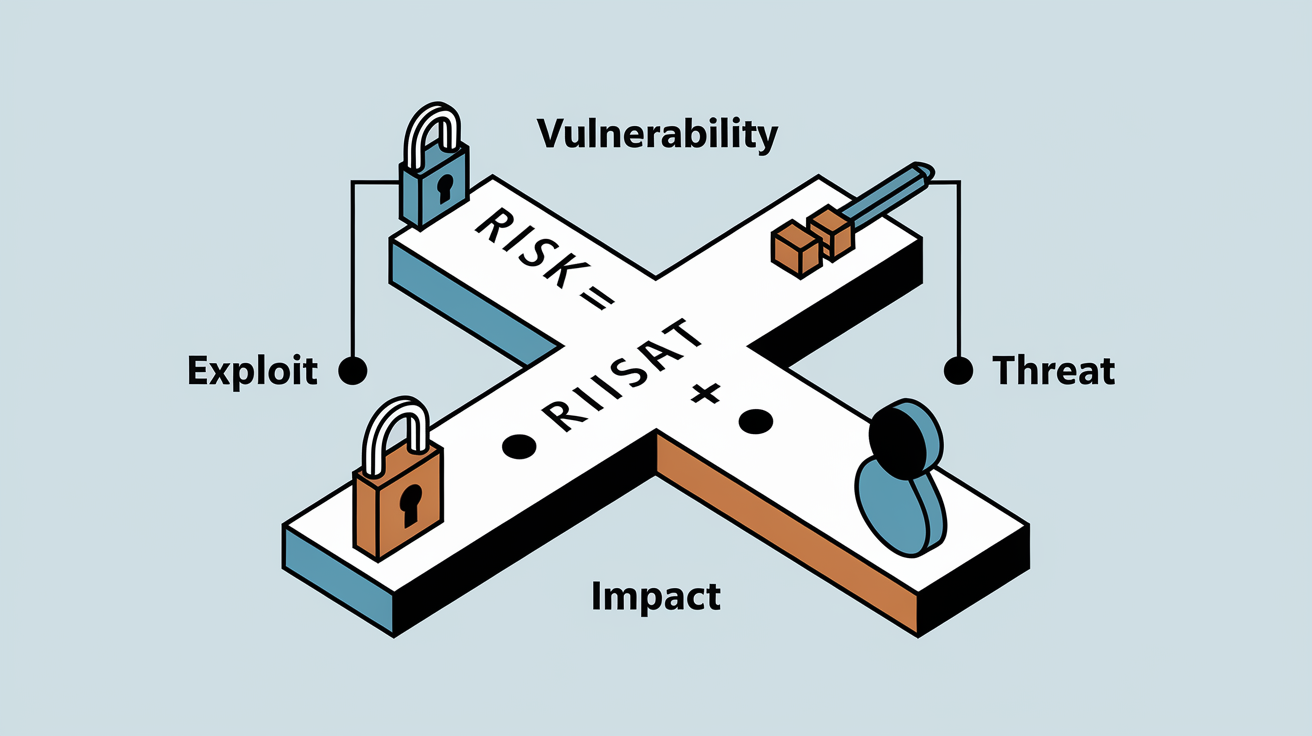
Understanding the relationship between vulnerability, exploit, and threat helps clarify how attacks actually work and where defenses should focus. A vulnerability is the underlying weakness. An exploit is the specific method, tool, or piece of code that takes advantage of that weakness. A threat is the actor, event, or malicious software that uses the exploit to cause harm. The risk formula captures this relationship: Risk = Vulnerability × Threat × Impact. A critical vulnerability with no active threats may pose lower immediate risk than a moderate vulnerability being actively exploited by ransomware groups.
Exploitability matters when you’re assessing real-world danger. Some vulnerabilities remain theoretical because no one has published working exploit code or demonstrated a practical attack. Others have publicly available proof-of-concept (PoC) exploits that anyone can download and run. When exploit code is integrated into automated toolkits like Metasploit or used in active malware campaigns, the window for safe remediation shrinks fast. Organizations must prioritize vulnerabilities based on whether exploits exist in the wild, not just on severity scores alone.
- Vulnerability – the flaw itself, like an unpatched library, a missing input check, or a misconfigured firewall rule.
- Exploit – the technique or code that weaponizes the flaw, like a crafted HTTP request, a malicious file, or a shellcode payload.
- Threat – the attacker, malware, or malicious event that delivers the exploit to compromise systems, steal data, or cause disruption.
How Vulnerabilities Are Found: Scanners, Research, and Testing

Vulnerabilities are discovered through a combination of automated tools, manual testing, academic research, bug bounty programs, and real-world exploitation. Static Application Security Testing (SAST) analyzes source code or compiled binaries without running the software, looking for patterns that indicate flaws like hardcoded credentials, SQL injection, or insecure cryptography. Dynamic Application Security Testing (DAST) runs the application and sends crafted inputs to identify runtime issues like XSS, authentication bypass, or error-handling weaknesses. Both SAST and DAST are commonly integrated into development pipelines to catch issues before code reaches production. A practice known as “shifting left.”
Penetration testing (pentesting) involves security experts simulating real-world attacks to discover vulnerabilities that automated tools might miss. Pentesters use a mix of reconnaissance, scanning, exploitation, and privilege escalation to map out an organization’s security posture. Bug bounty programs incentivize independent researchers to responsibly disclose vulnerabilities in exchange for financial rewards, which can range from a few hundred to tens of thousands of dollars per issue. Companies like Google, Microsoft, and many others run ongoing bounty programs to crowdsource vulnerability discovery. Software Composition Analysis (SCA) tools scan third-party and open-source dependencies, often revealing tens or hundreds of known vulnerabilities in transitive libraries that developers didn’t directly choose.
Academic researchers and security firms regularly publish detailed analyses of new vulnerability classes, proof-of-concept exploits, and hardware flaws. In some cases, vulnerabilities are discovered through in-the-wild exploitation. Attackers find and use a zero-day before vendors or researchers become aware of it. The volume of new discoveries is substantial: over 24,000 CVEs were submitted in 2020 alone, reflecting the growing attack surface as more devices connect to networks and more data moves online.
Six primary discovery methods:
- Automated vulnerability scanners (network-based signature matching)
- Static and dynamic code analysis during development
- Penetration testing by external security experts
- Bug bounty programs offering financial rewards
- Software Composition Analysis for third-party libraries
- Academic research and published proof-of-concept exploits
Vulnerability Scoring and Prioritization (CVSS, CVE, Context)

The Common Vulnerability Scoring System (CVSS) provides a standardized way to rate the severity of vulnerabilities on a scale from 0 to 10. Scores near 0.1 indicate very low severity. Scores from 9.0 to 10.0 are considered critical. CVSS combines metrics for exploitability (how easy it is to attack), impact (what happens if the attack succeeds), and environmental factors (whether the vulnerability affects your specific environment). A high CVSS score signals that a vulnerability is both easy to exploit and highly damaging, but context matters just as much as the raw number. A CVSS 6.5 vulnerability in a widely used library may be more urgent than a CVSS 9.0 flaw in a niche application if the 6.5 issue is actively exploited by ransomware groups or has public exploit code available.
Common Vulnerabilities and Exposures (CVE) identifiers provide unique labels for publicly disclosed vulnerabilities, making it easier for security teams, vendors, and researchers to communicate about the same issue. A CVE entry includes a description, affected software versions, references to patches or advisories, and often a CVSS score. The National Vulnerability Database (NVD) enriches CVE data with additional analysis, configuration guidance, and links to exploit databases. When a vendor publishes a security update, they typically reference the CVE ID so organizations can cross-check their systems and prioritize remediation.
| Vulnerability Name | CVE Identifier | CVSS Score |
|---|---|---|
| Heartbleed (OpenSSL memory leak) | CVE-2014-0160 | 10.0 (Critical) |
| BlueKeep (Windows Remote Desktop) | CVE-2019-0708 | 9.8 (Critical) |
| Shellshock (Bash command injection) | CVE-2014-6271 | 10.0 (Critical) |
Zero-Day Vulnerabilities and High-Risk Security Gaps

A zero-day vulnerability is a flaw that’s unknown to the software vendor or the public and is being actively exploited by attackers before a patch exists. The term “zero-day” refers to the fact that defenders have had zero days to prepare or apply a fix. These vulnerabilities are particularly dangerous because no official remediation is available. Organizations must rely on compensating controls like disabling affected features, blocking network access, or deploying intrusion detection signatures based on observed attack behavior. Zero-days are discovered through in-the-wild attacks (incident responders notice unusual behavior and reverse-engineer the attack), private security research, or intelligence sharing among government agencies and vendors.
Log4Shell (CVE-2021-44228) is a recent example of a vulnerability that was exploited in the wild before many organizations even knew it existed. Attackers used the flaw in the Log4j logging library to download and execute arbitrary code by embedding malicious strings in application logs. Because Log4j is embedded in thousands of commercial and open-source products, the exposure was widespread and remediation took weeks for many enterprises. The vulnerability was assigned a CVSS score of 10.0 and triggered emergency patching efforts across industries worldwide.
Zero-day characteristics:
- No public patch or vendor fix available at the time of exploitation.
- Often discovered through active attacks, incident investigations, or private security research.
- High value to attackers because defenses are unprepared.
- Require temporary mitigations like blocking network access, disabling features, or deploying behavioral detection rules until a patch is released.
Prevention, Patch Management, and Basic Mitigation Practices

Timely patching is the most effective way to close known vulnerabilities and reduce the window of exposure. Industry standards like PCI DSS (Payment Card Industry Data Security Standard) require organizations to apply security patches within 30 days of release to minimize the risk of breaches involving payment systems. Remediation can take several forms: applying a vendor-supplied patch, changing configurations to eliminate the weakness, or implementing compensating controls when patching isn’t immediately feasible (for example, restricting network access to a vulnerable service until a patch can be tested and deployed). Organizations should maintain a documented patch management process that includes asset inventory, vulnerability scanning, prioritization based on exploitability and business impact, testing in a staging environment, and validation after deployment.
Prevention begins with secure development and configuration practices. Use strong authentication like multi-factor authentication (MFA, an extra login check beyond passwords) to reduce the risk of credential theft. Encrypt sensitive data in transit and at rest to protect confidentiality even if an attacker gains network access. Follow secure coding standards that emphasize input validation, output encoding, and safe memory handling to prevent injection flaws and buffer overflows. Limit unnecessary services and apply the principle of least privilege. Users and applications should have only the permissions they need to perform their tasks, nothing more. Regularly review firewall rules, disable unused protocols, and segment networks to contain breaches if they occur.
Software Composition Analysis (SCA) tools help detect known vulnerabilities in third-party and open-source libraries. Modern applications often depend on dozens or hundreds of external packages, and each dependency can introduce vulnerabilities. SCA tools compare your dependencies against CVE databases and can automatically generate pull requests or alerts when vulnerable versions are detected. Maintaining a Software Bill of Materials (SBOM), an inventory of all components used in your software, makes it easier to respond quickly when a new vulnerability is disclosed in a widely used library.
Fundamental prevention steps:
- Keep all software, operating systems, and firmware updated with the latest security patches.
- Enable automatic updates for end-user devices and critical infrastructure where feasible.
- Use strong, unique passwords and enforce multi-factor authentication.
- Conduct regular penetration tests and code reviews to identify issues before attackers do.
- Scan dependencies with SCA tools and maintain an up-to-date SBOM.
How Organizations Track and Measure Vulnerability Risk

Effective vulnerability management relies on metrics that track both the scale of exposure and the speed of remediation. Mean time to patch (MTTP) measures the average time from when a vulnerability is discovered (or a patch is released) to when it’s deployed across affected systems. Shorter MTTP reduces the window during which attackers can exploit known flaws. Patch coverage tracks the percentage of systems and applications that have been successfully updated. High coverage indicates that the organization is consistently applying fixes across its environment, while gaps in coverage signal areas of elevated risk.
Organizations also monitor the number of outstanding high-severity vulnerabilities, those with CVSS scores above 7.0 or classified as critical by vendor advisories. Tracking the rate of recurring vulnerabilities (the same issues appearing repeatedly in scans) helps identify systemic problems like insecure coding practices, inadequate testing, or configuration drift. Monitoring exploit trends in threat intelligence feeds allows security teams to prioritize remediation based on real-world attack activity rather than severity scores alone. If a vulnerability is being actively exploited by ransomware groups or nation-state actors, it moves to the top of the remediation queue regardless of its theoretical CVSS rating.
| Metric | Definition |
|---|---|
| Mean Time to Patch (MTTP) | Average time from vulnerability discovery or patch release to deployment across systems |
| Patch Coverage | Percentage of systems and applications successfully updated with available patches |
| Outstanding High-Severity Fixes | Count of unresolved vulnerabilities with CVSS scores above 7.0 or vendor-classified critical issues |
| Recurring Vulnerabilities | Rate at which the same issues reappear in scans, indicating systemic configuration or coding weaknesses |
Maintaining an accurate and complete asset inventory is essential for understanding exposure. Organizations must know what systems, applications, and devices exist across on-premises data centers, cloud environments, operational technology (OT) networks, and shadow IT (unauthorized or unmanaged systems). Without visibility, vulnerabilities can persist undetected in forgotten servers, legacy applications, or third-party services. Regular inventory audits, automated discovery tools, and integration between asset management and vulnerability scanning platforms help ensure that every system is accounted for and monitored.
Final Words
We defined what is a security vulnerability, walked through software, hardware, network, and organizational types, and explained how vulnerabilities are found and scored.
You learned practical steps: run scans, prioritize with CVSS and context, keep an asset inventory, and patch promptly to cut risk.
If you still wonder what is a security vulnerability, it’s a flaw attackers can use to harm systems — but regular testing, timely patches, and simple controls make your environment much safer. Stay proactive.
FAQ
Q: What is the meaning of security vulnerability?
A: Security vulnerability means a flaw or weakness in software, hardware, or processes that attackers can exploit to bypass protections, risking the confidentiality, integrity, or availability of systems and data.
Q: What are examples of security vulnerabilities?
A: Examples of security vulnerabilities are SQL injection, cross-site scripting (XSS), buffer overflows, insecure configurations, and weak authentication like default or stolen credentials.
Q: What are the five types of vulnerability? / What are the four main types of security vulnerability?
A: The main types of security vulnerabilities are software (bugs, input-validation flaws), hardware (firmware or design weaknesses), network (open ports, unencrypted traffic), and organizational/human (phishing, poor processes); some lists add physical as a fifth.