
Patches are often too slow, and attackers can exploit zero days within hours.
In 2025 alone, over 1,000 zero-day bugs were disclosed, and many were abused before fixes landed.
When exploitation starts before a patch arrives, compensating controls become your only defense.
This matters for developers, IT teams, and security ops who must keep systems online and data safe.
Read on for a practical checklist: identify exposed assets, isolate at-risk hosts, apply virtual patches, enable EDR and behavior analytics, and harden systems.
Immediate Zero‑Day Mitigation Actions for Active Defense

Over 1,000 zero-day vulnerabilities were disclosed in 2025. Attackers didn’t wait around.
Windows got hit with CVE‑2025‑62221 and CVE‑2025‑54100, two privilege escalation and remote code execution flaws patched in December 2025. Hyper‑V took three more: CVE‑2025‑21333, CVE‑2025‑21334, and CVE‑2025‑21335, all fixed in January. Chrome and Android faced V8 type confusion bugs CVE‑2025‑10585 and CVE‑2025‑6554, with active exploitation spotted in Saudi Arabia come June. SAP NetWeaver’s CVE‑2025‑31324 was exploited in March, dropping webshells across enterprise networks. SharePoint’s CVE‑2025‑53770, nicknamed “ToolShell,” compromised more than 75 servers in July.
When exploitation happens within hours of disclosure, compensating controls become your only defense before patches arrive.
Immediate containment starts with network segmentation. Cut off affected systems at layer 3 before the exploit spreads laterally. Use EDR platforms to isolate compromised endpoints, blocking network access while you preserve forensic evidence. Deploy IPS signatures and WAF rules to filter known exploit patterns. Vendors often publish virtual patches or detection rules before full software updates ship. Disable vulnerable services entirely if they’re not business critical. For SharePoint CVE‑2025‑53770, that meant taking exposed SharePoint servers offline until patches landed.
Temporary hardening buys you time. Switch high risk endpoints to application allow listing mode, so only approved binaries execute. Turn on enhanced logging across identity systems, file shares, and network perimeters to capture indicators of compromise. Deploy sandbox detonation for suspicious files and URLs. Feed threat intelligence into your SIEM, including CISA’s Known Exploited Vulnerabilities catalog, to spot active campaigns.
Immediate zero day response checklist:
- Identify exposed assets using continuous scanning and asset tags for criticality and Internet exposure.
- Isolate compromised or at risk hosts at the network layer and through EDR quarantine features.
- Apply virtual patches via IPS, WAF, or host based firewall rules to block known exploit vectors.
- Block IOCs such as malicious domains, IPs, file hashes, and process signatures in endpoint and perimeter tools.
- Enable behavior analytics across EDR and SIEM to detect abnormal process launches, privilege escalations, and lateral movement attempts.
- Validate segmentation by testing firewall rules, ACLs, and microsegmentation policies to confirm east west traffic is restricted.
Asset Visibility and Attack Surface Reduction for Zero‑Day Defense

Accurate asset inventory is the foundation of zero day defense. You can’t protect what you can’t see.
Continuous discovery tools must cover on premises servers, cloud workloads, containers, SaaS applications, and shadow IT. Tag each asset by criticality. Production revenue systems get higher priority than lab machines. Tag by Internet exposure too. Systems facing the public web carry more risk because attackers find them first. Configuration drift monitoring ensures secure baselines stay in place. When CVE‑2025‑31324 hit SAP NetWeaver, organizations with up to date inventories knew which instances were exposed within minutes. Those without inventory spent days hunting.
Attack surface reduction means removing unnecessary services and closing exposed ports. Legacy systems that can’t be patched quickly should be isolated on separate VLANs with strict firewall rules. Retire or replace infrequently maintained software. Old modem drivers like the one exploited in CVE‑2025‑24990, a third party Agere driver, show how forgotten components become attack vectors. Run automated configuration scans to catch deviations from hardening guides. Enforce least privilege across service accounts and administrative roles. Reducing the number of exploitable entry points limits the blast radius when a zero day surfaces.
| Asset Type | Typical Zero‑Day Risk | Recommended Mitigation |
|---|---|---|
| Internet-facing servers | High, attackers scan continuously for new CVEs | WAF rules, IPS signatures, minimal exposed services, fast patch cycles |
| Endpoints (workstations) | Medium, targeted via phishing or drive-by downloads | EDR, application allow listing, disable unnecessary plugins (JavaScript, ActiveX) |
| Cloud workloads | Medium, public cloud APIs and misconfigurations expand attack surface | Cloud security posture management, segmentation, IAM least privilege |
| Network devices (routers, firewalls, IoT) | High, often unpatched, firmware lags behind threats | Vendor monitoring, out of band management, replace end of life hardware |
Network Architecture and Segmentation Strategies for Limiting Zero‑Day Blast Radius
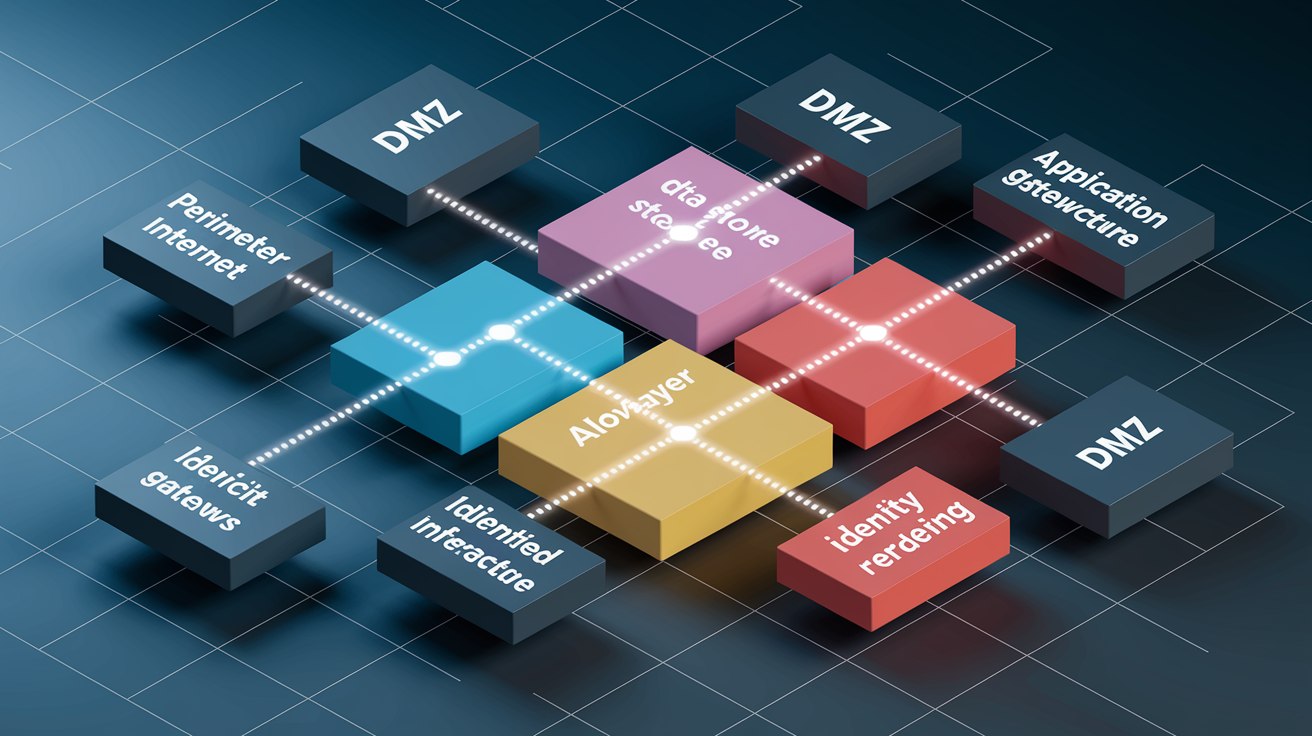
Network segmentation limits how far an unknown exploit can spread. When attackers land initial access through a zero day, they try to move laterally across the network to find high value targets. Domain controllers, file servers, databases. VLAN segmentation and firewall policies create boundaries. Internet facing web servers sit in one zone, internal application servers in another, and identity infrastructure in a third. An exploit on the web tier can’t reach Active Directory if firewall rules block that path.
Storm‑2460 ransomware operators used CVE‑2025‑29824 in Windows Common Log File System for privilege escalation. Organizations with segmented networks contained the outbreak to a handful of hosts instead of losing entire departments.
Practical segmentation starts with grouping systems by trust level and function. Place dev and test environments on separate subnets from production. Isolate payment processing and sensitive data stores behind additional firewall hops. Use jump hosts or bastion servers for administrative access instead of allowing RDP or SSH from anywhere. Each segment should have explicit allow rules. Default deny for everything else. Log all inter segment traffic so anomaly detection can flag unusual connections, like a web server initiating SMB sessions to internal file shares.
Microsegmentation takes this further in hybrid and cloud environments. Instead of perimeter only controls, microsegmentation applies policies at the workload or container level. Each application component gets its own policy: the front end web tier can talk to the API tier, but not directly to the database. The API tier connects to the database, but nowhere else.
Zero trust network architecture enforces continuous verification. No implicit trust based on network location. When a zero day hits a single microservice, microsegmentation prevents it from pivoting across the entire stack.
Hardening, Exploit Mitigation, and Memory Protection Controls Against Zero‑Days

Memory corruption vulnerabilities power many zero day exploits, especially in browsers and operating systems. V8 type confusion flaws CVE‑2025‑10585 and CVE‑2025‑6554 in Chrome and Android let attackers execute arbitrary code by manipulating JavaScript objects. System level defenses reduce the impact even when a vulnerability exists.
Address Space Layout Randomization (ASLR) makes it harder for exploits to predict where code and data live in memory. Data Execution Prevention (DEP) blocks code execution from memory regions marked as data only. Control Flow Integrity (CFI) ensures programs follow their intended execution paths, stopping exploits that hijack function pointers or return addresses.
Hardware backed protections add another layer. Trusted Platform Module (TPM) chips enable secure boot, verifying that only signed firmware and operating system components load at startup. This stops rootkits and bootkits that try to persist before the OS launches. Kernel hardening features, like Windows Kernel Control Flow Guard or Linux’s Kernel Address Sanitizer, catch exploit attempts at the OS level. Sandboxing isolates risky processes. Browsers run tabs in separate sandboxes so a compromised page can’t touch the file system or other tabs. Emulation environments let security teams detonate suspicious files safely, watching for exploitation techniques without risking production systems.
Key exploit mitigation defenses to enable:
- ASLR randomizes memory layout, forcing attackers to guess addresses and increasing exploit failure rates.
- DEP (also called NX or W^X) marks memory pages as non executable, blocking shellcode injection.
- CFI validates control transfers, stopping return oriented programming and jump oriented attacks.
- TPM backed secure boot ensures only trusted code runs during system initialization, preventing persistent malware.
- Sandboxing and emulation isolate high risk processes and files, limiting damage when zero days are triggered.
Application Security and Zero‑Day Prevention in the SDLC

Organizations can reduce zero day creation in their own software by integrating security into the development lifecycle. Fuzzing tools automatically generate malformed inputs to discover crashes and memory errors before release. Static Application Security Testing (SAST) analyzes source code for unsafe patterns. Buffer overflows, SQL injection points, authentication bypasses. Dynamic Application Security Testing (DAST) runs against live applications, testing how they respond to attack payloads. Combining SAST and DAST catches vulnerabilities that single methods miss. Code reviews by security focused developers spot logic flaws that automated tools overlook.
Third party dependencies introduce supply chain risk. Public proof of concept exploit code raises the danger. When researchers publish working exploits, attackers adapt them fast. Software Bill of Materials (SBOM) tracking lists every library, framework, and component in an application. When a zero day hits a popular open source library, teams with SBOMs know within minutes which applications are affected. Dependency monitoring tools flag outdated or vulnerable packages and suggest safer alternatives. Runtime Application Self Protection (RASP) instruments applications to detect and block attacks in real time, even when the vulnerability hasn’t been patched yet.
Bug bounty programs turn external researchers into allies. Instead of selling zero days on underground markets, skilled hackers report findings for rewards. Public bug bounties and private vulnerability disclosure programs both work. The key is fast response. Acknowledge reports quickly, validate findings, and issue patches before exploits spread. Organizations that treat researchers well build reputations that attract high quality submissions, discovering zero days before attackers do.
Monitoring, Detection Engineering, and Behavior Analytics for Zero‑Day Threats

Traditional signature based antivirus fails against zero days by design. There’s no signature for an unknown exploit.
Behavioral analytics and anomaly detection fill the gap. Machine learning models baseline normal activity for users, endpoints, and network flows. Deviations trigger alerts: a web server suddenly launching PowerShell, a user account accessing file shares it never touched before, or outbound DNS queries to newly registered domains. Security Information and Event Management (SIEM) platforms correlate logs from firewalls, endpoints, identity systems, and cloud services, surfacing patterns that individual tools miss.
EDR platforms collect deep telemetry. Process launches, registry changes, file modifications, network connections, memory injections. Detection engineers write rules that flag known attack techniques, like credential dumping or lateral movement via PsExec. Sandbox detonation chambers execute suspicious files in isolated environments, watching for malicious behavior. Threat intelligence feeds supply fresh IOCs: malicious IPs, domains, file hashes, and YARA rules. Integrating CISA’s Known Exploited Vulnerabilities catalog into your SIEM means you get alerts when logs match active campaigns. Honeypots simulate vulnerable systems to attract attackers, capturing their tools and techniques for analysis.
Five types of telemetry that detect zero day activity:
- Process telemetry tracks executable launches, parent child relationships, command line arguments, and unusual process injections.
- Network telemetry logs connections, DNS queries, data volumes, protocol anomalies, and traffic to rare or newly seen destinations.
- Identity telemetry monitors authentication events, privilege escalations, new account creation, and access to sensitive resources.
- File telemetry records file creation, modification, deletion, and hashes to spot ransomware encryption or malware staging.
- Memory telemetry detects code injection, reflective loading, memory only malware, and exploitation techniques that avoid disk writes.
Incident Response and Zero‑Day Containment Procedures

Zero day incident response demands speed and preparation. Log4j exploitation attempts were detected 9 minutes after public disclosure in early December 2021. Proof that attackers script automation against fresh CVEs.
IR playbooks specific to zero day scenarios should exist before the crisis hits. Steps include isolating affected hosts, preserving forensic artifacts (logs, memory dumps, disk images), deploying emergency access control lists on firewalls, and activating WAF or IPS rules to block exploit traffic. Patch deployment windows shrink when exploits are public, so test patches in non production environments and roll them out in waves, starting with Internet facing assets.
Forensic analysis determines scope. Which systems were compromised? What data was accessed or exfiltrated? How did the attacker move laterally? Preserve evidence before rebuilding or reimaging machines. Engage trusted external incident responders if internal teams lack capacity or specialized skills. Communicate scope to stakeholders: executives, legal, customers. But don’t expose technical IOCs prematurely. Attackers monitor public statements to refine their tools. Coordinate with vendors and CERTs to share anonymized indicators and help the broader community defend.
Tabletop exercises and red team drills test playbooks under pressure. Simulate a zero day scenario: a vulnerability is disclosed, exploits appear online, and you have 24 hours to contain it. Run through identification, isolation, mitigation, monitoring, and patching steps. Identify gaps in tooling, authority, or communication. Update runbooks based on lessons learned. Repeat quarterly to keep skills sharp and playbooks current.
Zero day containment workflow:
- Identify affected assets using rapid scans, asset inventory tags, and threat intelligence correlation.
- Isolate compromised or at risk systems at the network layer and through endpoint quarantine.
- Mitigate with virtual patches (WAF/IPS rules), disable vulnerable services, and apply compensating controls (segmentation, MFA, allow listing).
- Monitor enhanced logging, EDR alerts, SIEM dashboards, and threat feeds for IOCs and lateral movement.
- Patch as soon as vendor updates are available; automate deployment where possible, prioritize by exposure and criticality.
Final Words
in the action, we laid out a clear, runnable path: immediate containment, asset visibility, network segmentation, system hardening, app security, and tuned detection and response.
After 1,000+ zero‑days were disclosed in 2025 — including high‑profile Windows and Chrome flaws — speed and compensating controls mattered more than ever.
Start with inventory and isolation, add virtual patches and behavior analytics, then harden and monitor continuously. These zero day vulnerability mitigation strategies cut risk now and make future incidents easier to handle. Stay proactive and keep improving.
FAQ
Q: What is zero-day vulnerability mitigation?
A: Zero-day vulnerability mitigation is the set of controls and temporary fixes you use to reduce risk from unpatched, unknown flaws until a vendor patch is available and fully deployed.
Q: Which methods can be used to handle zero-day vulnerabilities? How can zero day exploits be prevented?
A: Methods to handle and prevent zero-day vulnerabilities include EDR and behavior analytics, network segmentation, virtual patching, IPS/WAF rules, allow-listing, rapid isolation, monitoring threat feeds, and applying vendor patches promptly.
Q: What is a common method to exploit a zero-day vulnerability?
A: A common method to exploit a zero-day vulnerability is using an unpatched flaw in widely used software (browser, OS, plugin) to execute remote code or escalate privileges via crafted inputs.