
What if one unknown bug could shut down factories, seize corporate networks, or spread ransomware to thousands overnight?
That’s not theory — Stuxnet, Zerologon, Kaseya, and PrintNightmare all exploited zero-day flaws attackers used before vendors had fixes.
These cases forced a rethink: zero-days can cause physical damage, break identity systems, and turn trusted software into a delivery vehicle for attacks.
Read on to see how each attack worked, why the vulnerability window decides the blast radius, and the concrete steps defenders should take now: patch fast, map dependencies, and watch for unusual activity.
Direct Real‑World Zero Day Vulnerability Attack Examples

- Stuxnet (2010) exploited four zero-day vulnerabilities in Microsoft Windows to gain code execution and manipulate programmable logic controllers, physically destroying Iranian nuclear centrifuges.
- NTLM vulnerability (2019) bypassed NT LAN Manager message integrity checks, letting attackers modify authentication messages across Windows networks before a vendor patch existed.
- Zerologon (2020) allowed unauthenticated network attackers with access to a domain controller to completely compromise Active Directory identity services.
- Kaseya VSA (July 2021) was a zero-day in remote management software that distributed ransomware through managed service provider supply chains, affecting more than 1,000 companies worldwide.
- PrintNightmare (June 2021) was a Windows Print Spooler remote code execution flaw that granted SYSTEM-level privileges, enabling full system takeover on affected machines.
These incidents represent different threat categories but share one thing: attackers exploited unknown flaws before vendors could release fixes. Stuxnet showed that zero-day attacks could cause physical damage beyond data theft. Zerologon and NTLM proved that authentication protocols become single points of catastrophic failure when compromised at the zero-day stage.
The exploitation window determined impact scale. Kaseya’s supply-chain position meant a single zero-day multiplied into thousands of downstream infections within hours. PrintNightmare persisted as a risk even after patches shipped because many administrators delayed deployment, extending the vulnerability window across enterprise networks.
What made each a true zero-day was simple timing. Stuxnet’s four Windows flaws were unknown when attackers deployed the worm in 2010. NTLM’s integrity bypass was exploited in production networks throughout 2019 before Microsoft issued a fix. Zerologon gave attackers a direct path to domain-wide control while administrators had zero advance notice. Kaseya and PrintNightmare both reached active exploitation before or during the earliest patching efforts, catching defenders without signature-based defenses or compensating controls.
Technical Breakdown of Zero Day Vulnerabilities Used in Major Attacks

Zero-day vulnerabilities originate during software development when coding errors, design oversights, or incomplete input validation create exploitable paths. Attackers or security researchers discover these flaws through reverse engineering, fuzzing, or source-code analysis. The “vulnerability window” starts when an attacker first exploits the flaw and ends when the vendor ships a patch and organizations deploy it.
Signature-based defenses fail during this window because no known pattern exists. Attackers refine proof-of-concept code into weaponized exploits that bypass antivirus engines, sandbox detection, and intrusion prevention systems. The technical nature of these flaws determines exploitation difficulty and blast radius.
Common zero-day flaw categories include:
- Memory corruption like buffer overflows and use-after-free bugs that allow attackers to overwrite program memory and redirect execution flow.
- Remote code execution (RCE) flaws that let attackers run arbitrary commands on target systems without prior authentication, often via network protocols or file parsers.
- Authentication bypass where design or implementation errors in credential checks allow unauthenticated access to privileged functions.
- Protocol design issues involving weaknesses in cryptographic handshakes, message-integrity checks, or state machines that enable man-in-the-middle attacks or session hijacking.
Stuxnet combined multiple memory-corruption flaws to get privileged code execution on air-gapped industrial controllers. NTLM’s authentication bypass stemmed from a protocol design flaw in message-integrity validation. Zerologon exploited a cryptographic weakness in the Netlogon protocol’s implementation. PrintNightmare and Kaseya both involved remote code execution paths that granted attackers elevated privileges immediately upon successful exploitation.
Zero Day Exploit Lifecycle Illustrated Through Attack Examples

Every zero-day passes through four lifecycle stages: introduction (when the coding flaw enters production software), discovery (when an attacker or researcher identifies the vulnerability), exploitation (when attackers weaponize and deploy the flaw), and mitigation (when the vendor releases a patch and defenders apply it). The interval between discovery and mitigation defines the vulnerability window.
Zero-day attacks bypass signature-based defenses because no prior samples exist in threat databases. Detection during active exploitation relies on behavioral anomaly techniques, monitoring for unusual process behavior, abnormal memory access patterns, or unexpected network traffic flows. Defenders face a race. Attackers refine exploits quickly, while patching cycles require testing and staged rollouts across production environments.
| Attack | Stage Triggered | Why It Matters | Patch Timing |
|---|---|---|---|
| Stuxnet | Exploitation before discovery | Four Windows zero-days enabled air-gap bypass and PLC control | Patches released months after worm was active in the wild |
| Zerologon | Discovery and exploitation overlapped | Unauthenticated domain-controller compromise possible within minutes | Patch available September 2020; enforcement delayed to February 2021 |
| Kaseya VSA | Exploitation during vulnerability-disclosure discussions | Supply-chain position amplified ransomware distribution to >1,000 companies | Patch released days after mass exploitation began |
| PrintNightmare | Public PoC released before vendor readiness | SYSTEM-level RCE on domain-joined systems triggered emergency patching | Multiple patch iterations over weeks as bypasses emerged |
Timeline compression increases severity. Stuxnet operated undetected for months because the vulnerability window opened before security teams knew the flaws existed. Zerologon’s short window between public disclosure and exploit maturity left minimal time for testing patches in complex Active Directory environments. Kaseya’s attackers exploited the flaw during vulnerability-disclosure coordination, catching managed service providers mid-response. PrintNightmare’s premature proof-of-concept release triggered a global scramble to patch before mass exploitation, showing how disclosure timing directly shapes defender success rates.
High‑Impact Supply Chain Zero Day Attack Examples

Supply-chain attacks exploit zero-day vulnerabilities in software that thousands of organizations rely on, turning a single flaw into a force multiplier. When attackers compromise centralized management tools or widely deployed libraries, every downstream customer inherits the risk without individual culpability.
Kaseya VSA’s July 2021 breach weaponized a zero-day in remote monitoring and management software used by managed service providers. Attackers injected ransomware through Kaseya’s update mechanism, encrypting endpoints across more than 1,000 companies within hours. The VSA platform’s role as a trusted administrative channel bypassed endpoint defenses because clients assumed updates from their MSP were legitimate.
Log4Shell, discovered in late 2021, exposed a remote code execution flaw in Apache Log4j, a logging library embedded in millions of Java applications. Organizations faced cascading remediation because the vulnerable component lived deep inside application dependencies, invisible to asset inventories and difficult to patch without vendor cooperation.
Supply-chain zero-days spread rapidly for three reasons:
- Centralized trust. Management platforms and shared libraries operate with elevated privileges, so a single exploit grants broad access across client environments.
- Hidden dependencies. Embedded open-source components like Log4j remain untracked in many software bills of materials, delaying discovery of exposure.
- Delayed visibility. Organizations learn they’re affected only after vendors disclose the flaw, compressing the time available for testing and deploying fixes before exploitation peaks.
Zero Day Vulnerabilities Targeting Authentication & Identity Systems
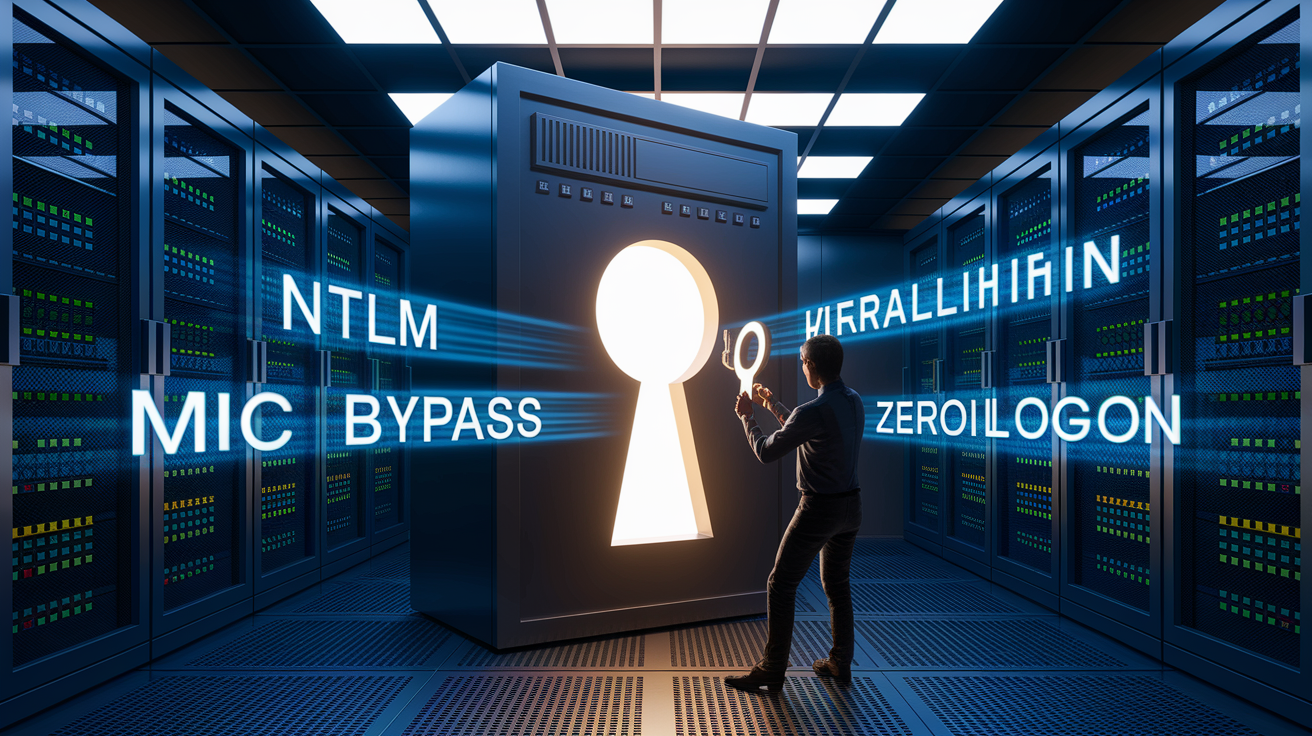
Authentication and identity systems control access to everything else in a network, making them high-value zero-day targets. A single flaw in domain controllers, authentication protocols, or credential stores can grant attackers domain-wide control, bypass multi-factor authentication, and enable persistent access across thousands of endpoints.
NTLM’s 2019 message-integrity bypass allowed attackers to modify authentication handshakes in transit, downgrading security or injecting malicious payloads during legitimate login sessions. Because NTLM remains enabled by default in many Windows environments for backward compatibility, the vulnerability affected millions of systems.
Zerologon’s 2020 flaw in the Netlogon Remote Protocol let unauthenticated attackers reset domain-controller computer account passwords and take over Active Directory identity services. An attacker with network access to a domain controller could get full enterprise compromise in under a minute.
| Vulnerability | Impact | Risk to Identity Systems |
|---|---|---|
| NTLM MIC bypass (2019) | Modification of authentication messages; credential relay attacks | Allowed lateral movement and privilege escalation across Windows domains |
| Zerologon (2020) | Unauthenticated domain-controller takeover | Complete compromise of Active Directory; attacker could create admin accounts and disable security controls |
Identity compromise unlocks lateral movement because attackers inherit the trust relationships embedded in authentication systems. Once domain-admin credentials are obtained through Zerologon, every server, workstation, and service account becomes accessible. NTLM relay attacks chain across multiple systems, using one compromised host to authenticate against another without needing plaintext passwords. This cascading access means a zero-day in identity infrastructure delivers persistent, network-wide control, far beyond the initial entry point.
Lessons Learned From Historical Zero Day Attack Examples

Historical zero-day incidents expose recurring defensive gaps and offer lessons that apply across threat scenarios.
Prioritize patching for identity and management systems. Domain controllers, authentication services, and centralized management tools are force multipliers when compromised. Test and deploy patches for these components first.
Implement network segmentation and least privilege. Isolate critical infrastructure and limit service-account permissions to reduce blast radius when a zero-day is exploited.
Deploy anomaly-based detection alongside signature tools. Behavioral monitoring can flag unusual authentication patterns, abnormal process execution, or unexpected network flows during the vulnerability window.
Adopt Zero Trust architecture. Authenticate and authorize every access request. Assume breach and enforce continuous verification to limit lateral movement.
Integrate automated Dynamic Application Security Testing (DAST) into CI/CD. Continuous runtime scanning shortens the window for application-level zero-days by detecting flaws before production deployment.
Prepare rapid incident-response workflows. Rehearse emergency patching, rollback procedures, and forensic timelines so teams can act decisively when a zero-day disclosure occurs.
These lessons apply universally because zero-day attacks exploit the same structural weaknesses: unpatched systems, excessive trust, delayed detection, and slow response cycles. Stuxnet showed that even air-gapped networks fall when multiple zero-days are chained together. Zerologon and NTLM proved that identity systems require hardening beyond default configurations. Kaseya and Log4Shell demonstrated that supply-chain dependencies extend the attack surface beyond direct control. Across every incident, the organizations that limited damage were those that had already implemented layered defenses, segmentation, rapid patching pathways, and behavioral monitoring, reducing the vulnerability window even when signature-based tools offered no protection.
Final Words
In the action, we laid out five major zero‑day incidents, then unpacked the technical flaws, exploit lifecycle, supply‑chain risk, identity targets, and practical lessons.
These sections showed why unpatched windows matter, how attackers weaponize flaws, and why defenses like segmentation, anomaly detection, and fast patching reduce risk.
If you want a quick takeaway: treat these zero day vulnerability attack examples as a prompt to prioritize high‑value assets, automate detection and patching, and keep incident playbooks ready. Stay proactive.
FAQ
Q: What is an example of a zero-day vulnerability?
A: An example of a zero-day vulnerability is Stuxnet (2010 — four Windows zero-days used to sabotage Iranian PLCs), plus Zerologon (2020 AD takeover) and Log4Shell (2021 Java RCE affecting many apps).
Q: What is an example of a zero attack?
A: An example of a zero attack is the Kaseya VSA supply-chain incident in July 2021, where a vendor zero-day enabled ransomware that impacted over 1,000 downstream companies before a patch was available.
Q: What is the most famous zero-day attack?
A: The most famous zero-day attack is Stuxnet, a 2010 worm that used four undisclosed Windows flaws to physically damage Iranian centrifuge controllers, illustrating nation-state use of zero-days.
Q: How are zero-day vulnerabilities found?
A: Zero-day vulnerabilities are found by researchers or attackers during coding, fuzzing, or review, and discovered in the wild via threat intel or incidents — exploited before vendors know and while a patch is pending.