
A zero-day can be fixed in 24 hours—or stay exploitable for years.
Which outcome you get depends on severity, vendor practices, and whether attackers are already using the flaw.
This post maps the patch timeline from discovery to deployment, outlines typical windows (emergency fixes in days, scheduled patches in weeks, complex cases stretching months), and compares how major vendors respond.
You’ll also get simple, actionable steps to cut your exposure: what to check, when to force updates, and what to prioritize while vendors work.
Overview of Zero‑Day Patch Timeframes
Zero-day patch timelines usually land somewhere between 24 hours and 90 days. What determines the speed? Severity of the flaw, how the vendor’s internal team works, and whether attackers are already using it in the wild.
For critical bugs hitting widely used systems, most major vendors can ship emergency patches in 3 to 7 days. Standard-severity issues? Those often get bundled into monthly patch cycles, pushing the window out to 30 or 60 days. When you’re dealing with something structurally messy or legacy code scattered across multiple product versions, expect timelines that stretch past three months.
The data tells a clear story. Critical zero-days with a CVSS score of 9.0 or higher and confirmed real-world exploitation typically get vendor fixes within 7 to 14 days. Google’s Project Zero? They enforce a 90-day disclosure deadline for everything they report, with a 7-day grace period if the patch is almost ready. Microsoft often speeds things up for actively exploited zero-days outside their regular Patch Tuesday schedule, dropping out-of-band updates in 48 to 72 hours when needed.
Open-source projects are a different story. Limited maintainer capacity can mean weeks or months before you see a stable patch, especially if the flaw sits in a library nobody’s touched in years.
Outliers exist everywhere. Some browser vendors have shipped emergency patches within 24 hours of public disclosure. A Firefox XSS flaw from 2009 logged 1,140 days of exposure. A PHP vulnerability list published in 2005 had zero maintainer response by July 2010, racking up a DoE of 12,873. The average eradication timeframe across all vulnerability classes has historically hung around 10 months until a specific flaw is fully gone from production environments.
Emergency patches get released within 1 to 7 days for critical, actively exploited zero-days. Standard-cycle patches arrive within 30 to 60 days, aligned with scheduled update windows. Extended-cycle patches show up after 60 to 90 days for complex or lower-priority vulnerabilities. And then there are the outliers, ranging from same-day fixes to multi-year exposure in unmaintained or low-priority projects.
Factors That Influence Patch Speed

Patch development timelines get shaped by several interconnected variables. Exploit maturity and active in-the-wild usage drive prioritization. Vendors typically fast-track fixes when attackers are already leveraging the flaw. A zero-day confirmed in targeted campaigns will often jump to the front of the engineering queue, compressing timelines to days instead of weeks. A theoretical vulnerability discovered through research without evidence of weaponization? That might follow a slower, more deliberate patching cycle that allows for broader code review and regression testing.
Codebase complexity and product architecture introduce serious delays. Vulnerabilities in widely embedded libraries like Java or Apache Commons require coordination across multiple releases and platform variants. A flaw in a single shared component might need patches for desktop, mobile, server, and embedded editions, each with its own QA requirements. Vendors also have to evaluate backward compatibility, making sure the fix doesn’t break existing integrations or introduce new regressions.
This is why HD Moore observed that “It could take two years for Oracle to fix all the security flaws in the version of Java used to surf the web.” The sheer ubiquity and cross-platform sprawl of Java extend the remediation timeline far beyond initial discovery.
Severity and active exploitation matter. Confirmed in-the-wild use and high CVSS scores accelerate patch priority and reduce review cycles. Engineering complexity slows things down. Deep architectural dependencies, cross-platform requirements, and intricate code paths all drag out testing and validation. Vendor QA requirements add more time. Rigorous compatibility testing, multi-stage internal reviews, and staged rollouts extend time-to-release. And then there’s dependency and architecture constraints. Shared libraries, third-party integrations, and legacy support obligations multiply the number of affected releases and increase coordination overhead.
Vendor Response Comparison

Major vendors follow distinct disclosure and patch-release workflows shaped by their engineering culture, product architecture, and user base.
Microsoft typically aligns security updates with its monthly Patch Tuesday cycle, releasing fixes on the second Tuesday of each month. When a zero-day is actively exploited, they issue out-of-band updates within 48 to 96 hours, bypassing the regular schedule. For MS10-002, labeled a critical update for Internet Explorer and linked to the Google breach, Microsoft acknowledged the bug following a report from a security firm and released an emergency patch outside the standard cycle.
Google enforces a strict 90-day disclosure deadline through Project Zero, regardless of whether the vendor has issued a fix. If a patch is imminent, a 7-day grace extension might be granted, but public disclosure happens at the deadline to maintain transparency and pressure vendors. Google’s internal products, especially Chrome, often get same-day or next-day patches for critical zero-days. CVE-2023-4863, a critical WebP exploit in Chrome, was patched within hours of confirmation.
Apple’s response model varies. The company sometimes issues rapid unscheduled patches for critical flaws affecting iOS or macOS, particularly when exploitation is confirmed. Other times, Apple batches security fixes into scheduled OS updates, which can stretch timelines to several weeks.
Open-source ecosystems present the widest variance. Maintainer availability, project funding, and community engagement all influence response speed. The SQLite example from Google’s Big Sleep AI agent demonstrated rapid turnaround, with maintainers fixing the reported vulnerability the same day. The OSVDB PHP case from 2005? No responsible-party responses by July 2010, accumulating 12,873 Days of Exposure. Small or under-resourced projects might lack the capacity for urgent fixes, while well-funded initiatives like the Linux Kernel or cURL project can deliver patches within days.
| Vendor | Typical Patch Window | Notes |
|---|---|---|
| Microsoft | 2–14 days (emergency) / 30 days (Patch Tuesday) | Out-of-band for active exploits; aligns critical fixes with monthly cycle otherwise |
| 1–7 days (Chrome) / 90-day disclosure deadline (Project Zero) | Enforces public disclosure at 90 days; rapid internal patching for Chrome/Android | |
| Apple | 3–21 days (critical) / 30–60 days (standard) | Rapid unscheduled patches for high-risk iOS/macOS flaws; otherwise batched into OS updates |
| Open-source ecosystems | 1 day to several years | Depends on maintainer capacity, funding, and community engagement; varies widely by project |
Case Studies of Past Zero‑Day Patch Timelines

Log4Shell (CVE-2021-44228) serves as a benchmark for rapid, coordinated response under extreme pressure. Discovered in late 2021, the critical remote code execution flaw in the ubiquitous Log4j library got a CVSS 10 severity rating. Apache released an initial patch within 72 hours of public disclosure, though subsequent updates were required to address bypass techniques and edge cases. The speed came from the library’s presence in millions of enterprise applications and the immediate threat of mass exploitation.
Despite the fast vendor response, customer deployment timelines stretched into months and years. Why? Inventory discovery challenges and the need to patch indirect dependencies across containerized environments.
Heartbleed (CVE-2014-0160), disclosed in April 2014, exposed a critical memory handling bug in OpenSSL that leaked cryptographic keys and sensitive data. The OpenSSL project released a fix within hours of coordinated disclosure, but the patch rollout highlighted the gap between vendor release and global deployment. Many organizations took weeks to identify affected systems, regenerate certificates, and apply updates. The incident showed that even rapid vendor fixes don’t eliminate risk when deployment complexity and asset visibility are low. Heartbleed remained exploitable on unpatched systems for years, demonstrating the long tail of zero-day risk.
Stuxnet, discovered around 2010, used multiple zero-days to target industrial control systems. The sophisticated attack used four previously unknown Windows vulnerabilities, and Microsoft released patches over several months as each component was reverse-engineered and understood. The staggered timeline reflected both the complexity of the exploit chain and the time required to coordinate disclosure and testing across critical infrastructure environments. Unlike consumer-facing zero-days, Stuxnet’s patches required validation in air-gapped networks and specialized SCADA environments, extending deployment timelines well beyond typical enterprise workflows.
Log4Shell (2021) was a critical CVSS 10 RCE in Log4j. Apache patched within 72 hours, but enterprise deployment took months to years because of dependency sprawl. Heartblood (2014) was a critical OpenSSL memory leak. Fix released within hours of disclosure, but global rollout required weeks and certificate regeneration. Stuxnet (2010) exploited four Windows zero-days in a targeted ICS attack. Microsoft released patches over several months as each flaw was analyzed.
Patch Deployment Strategy Considerations
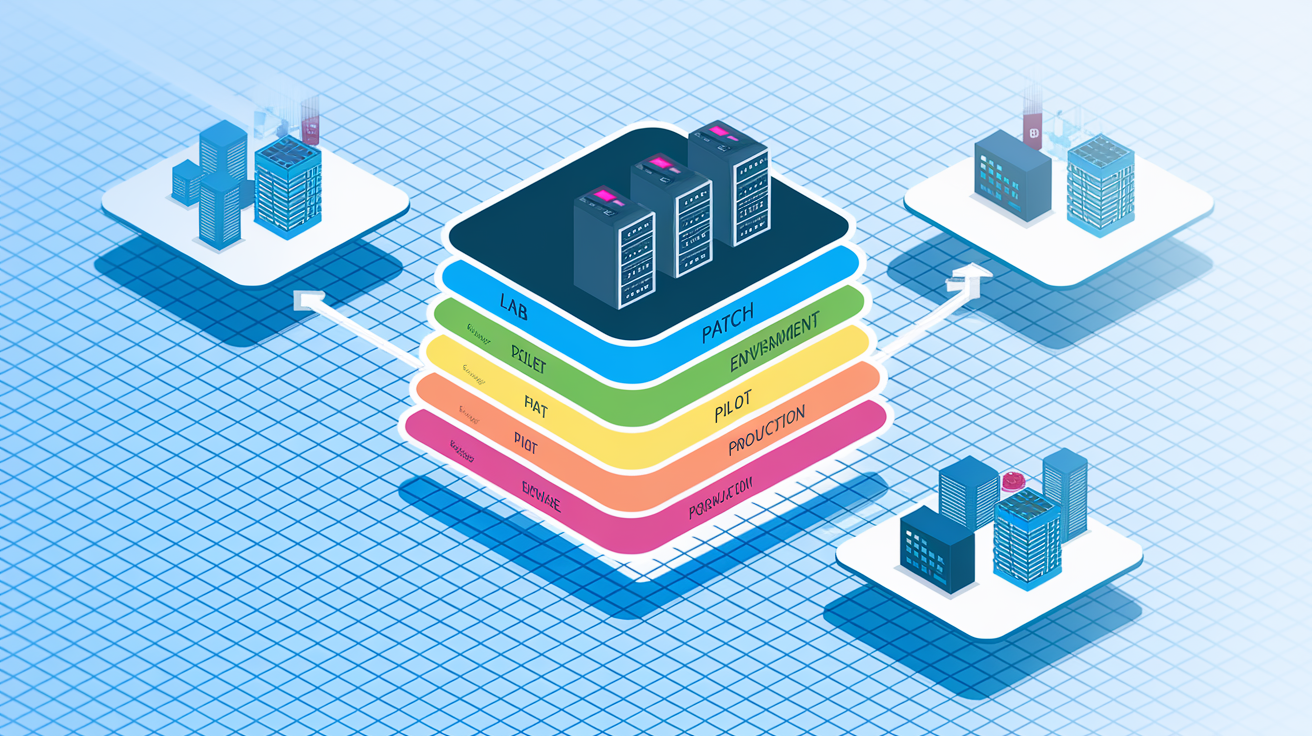
Once a vendor publishes a patch, the clock shifts from vendor development to customer deployment. Enterprise environments rarely push zero-day fixes directly to production without staged validation, even when the vulnerability is critical. The risk of introducing a breaking change or service disruption has to be balanced against the risk of leaving systems exposed.
Organizations typically start by replicating the production environment in a controlled test lab, applying the patch to representative workloads, and monitoring for regressions, performance degradation, or compatibility issues with third-party integrations.
After successful lab validation, patches move into a phased rollout. The first production deployment often targets a small subset of non-critical systems or a single geographic region, letting security and operations teams confirm stability under real user load. If nothing breaks within 24 to 72 hours, the patch expands to broader production segments, eventually reaching all affected systems. This staged approach reduces the blast radius of any unforeseen problems but extends the total deployment window, sometimes stretching critical zero-day remediation to weeks even when the vendor patch is available within days.
Lab testing means replicating the production environment, applying the patch, and verifying functionality, performance, and integration compatibility. Phased pilot deployment pushes the patch to a small, non-critical production subset and monitors for 24–72 hours. Expanded rollout gradually deploys to additional production segments, prioritizing high-risk or internet-facing systems. Monitoring and validation continuously track system behavior, security logs, and performance metrics throughout the rollout. Post-deployment audit confirms patch coverage across all affected assets and scans for any remaining unpatched instances.
Risk Mitigation Before and During Patch Release

While waiting for a vendor patch or during the deployment window, organizations need to reduce the exploitability and impact of the zero-day. Disabling the affected feature or component is often the fastest mitigation when the functionality isn’t mission-critical. If a zero-day sits in a rarely used API endpoint or a legacy protocol, administrators can disable it at the application, firewall, or gateway level. This approach eliminates the attack vector entirely but requires clear understanding of which systems and users depend on the feature.
Configuration-based protections offer a middle ground when disabling functionality isn’t feasible. Web application firewalls can be tuned to block specific request patterns associated with known exploits, and intrusion prevention systems can drop traffic matching the zero-day signature. Network segmentation and least-privilege access controls limit lateral movement, reducing what an attacker can reach even if initial exploitation succeeds. Data minimization, tokenization, and non-reversible storage reduce the value of data exfiltrated during a breach, lowering the business impact if a zero-day is exploited before patching completes.
Increasing monitoring and detection coverage during the zero-day window helps security teams identify exploitation attempts in real time. Enhanced logging on affected systems, tuned SIEM rules for anomalous behavior, and threat intelligence feeds that publish indicators of compromise allow defenders to detect and contain attacks before significant damage occurs. These compensating controls don’t eliminate the vulnerability, but they reduce the probability of successful exploitation and limit the blast radius if a breach does occur. For widely deployed components like Java, where long-term vulnerability is expected, treating the software as persistently risky and layering continuous monitoring becomes an operational necessity.
Disable affected components by turning off vulnerable features, APIs, or protocols that aren’t essential to operations. Apply configuration-based protections using WAF rules, IPS signatures, and firewall policies to block known exploit patterns. Enforce network segmentation and least privilege to limit lateral movement and reduce accessible data if initial compromise occurs. Increase monitoring and detection by deploying enhanced logging, SIEM correlation rules, and threat intelligence feeds to catch exploitation attempts in real time.
Final Words
In the action, we covered typical zero‑day patch timelines (hours to 90 days), what speeds them up or slows them down, and how major vendors usually respond.
We walked through real case studies, enterprise rollout steps, and interim mitigations your team can use now.
Use the zero day vulnerability patch timeline as a planning tool: prioritize critical fixes, test in stages, monitor for exploits, and keep communication clear. With structured processes and the right mitigations, you can reduce risk and act faster when a zero‑day appears.
FAQ
Q: How quickly are zero-day exploits patched?
A: Zero-day exploits are patched within a wide range—often 24 hours to 90 days—depending on severity, active exploitation, vendor workflow, and required testing; the riskiest bugs can receive emergency fixes in days.
Q: What is your timeframe for patching critical vulnerabilities?
A: Our timeframe for patching critical vulnerabilities is typically 24–72 hours for emergency fixes and 14–30 days for coordinated releases, depending on testing, compatibility needs, and whether the flaw is actively exploited.
Q: What is the zero-day vulnerability lifecycle?
A: The zero-day vulnerability lifecycle is discovery, proof-of-concept or exploit development, disclosure or active exploitation, vendor notification, patch development, release, and deployment—timing varies by complexity and exploit activity.
Q: What is the most famous zero-day vulnerability?
A: The most famous zero-day vulnerability is debated; notable examples include Heartbleed (OpenSSL), Stuxnet (industrial control systems), and EternalBlue (Windows SMB), each widely publicized and highly disruptive.