Controversial: Salesforce didn’t launch its CRM in 1999 — the public product arrived in 2000.
The company formed in March 1999 and built a working prototype that year, but the browser-based, subscription CRM went live at San Francisco’s Regency Theatre in 2000.
That public launch proved CRM could be delivered over the web with no installation or server setup, and it sparked the shift from expensive on-premise installs to cloud subscriptions.
This piece lays out the exact year, the founding timeline, and why 2000 is the real turning point for cloud software.
The Exact Year Salesforce First Launched Its CRM Platform

Salesforce got its start in March 1999, but the actual product didn’t go live until 2000. Marc Benioff, Parker Harris, Frank Dominguez, and Dave Moellenhoff spent that first year building the prototype and setting up the business. The real moment came when they unveiled the platform at San Francisco’s Regency Theatre, letting customers sign up and access CRM tools through any browser. No installation. No server setup. Just log in and go.
That distinction between founding and launch matters. 1999 was about building. 2000 was about proving the whole thing could work outside a Telegraph Hill apartment. The delivery model became the story: browser access and subscription pricing instead of expensive perpetual licenses and clunky client-server installs. It’s what separated Salesforce from everyone else selling CRM at the time, and it’s why the company became the blueprint for cloud software in general.
Founding year: March 1999 in a one-bedroom apartment on Telegraph Hill, San Francisco.
Founding team: Marc Benioff (full time from July 1999), Parker Harris, Frank Dominguez, Dave Moellenhoff.
Public product launch: 2000 at the Regency Theatre with subscription-based browser access.
“No Software” branding: Positioned Salesforce as the first major cloud/SaaS alternative to on-premise CRM incumbents.
Cloud-based CRM model: Eliminated the need for local servers, manual upgrades, and traditional perpetual licenses.
Early Salesforce CRM Foundations and 1999 Development Timeline

The earliest version of Salesforce came together in a small San Francisco apartment during the dot-com boom. Benioff left Oracle and went all-in on Salesforce in July 1999. The founding team had a working prototype within the first month. By late 1999, the company had grown to around 10 people and moved into an 8,000-square-foot office at Rincon Center. Hiring moved fast enough that desks started showing up in hallways while the team scrambled to get the product ready for public release.
Timing cut both ways. Venture money flowed freely, but skepticism about subscription software ran deep. Most people believed enterprise software required thick clients and multi-year implementation cycles. Salesforce bet the opposite. That friction actually helped. Early adopters who wanted to escape those traditional burdens became the first customers and the loudest advocates.
| Month | Milestone | Location | Team Size |
|---|---|---|---|
| March 1999 | Company founded; development begins | One-bedroom apartment, Telegraph Hill | 4 founders |
| July 1999 | Marc Benioff transitions full time | Apartment | ~4–6 |
| ~August 1999 | First working prototype completed | Rincon Center (new office) | ~10 |
| November 1999 | Rapid hiring; desks overflow hallways | Rincon Center (~8,000 sq ft) | ~15+ |
The 2000 Public Launch of Salesforce’s Cloud CRM Platform
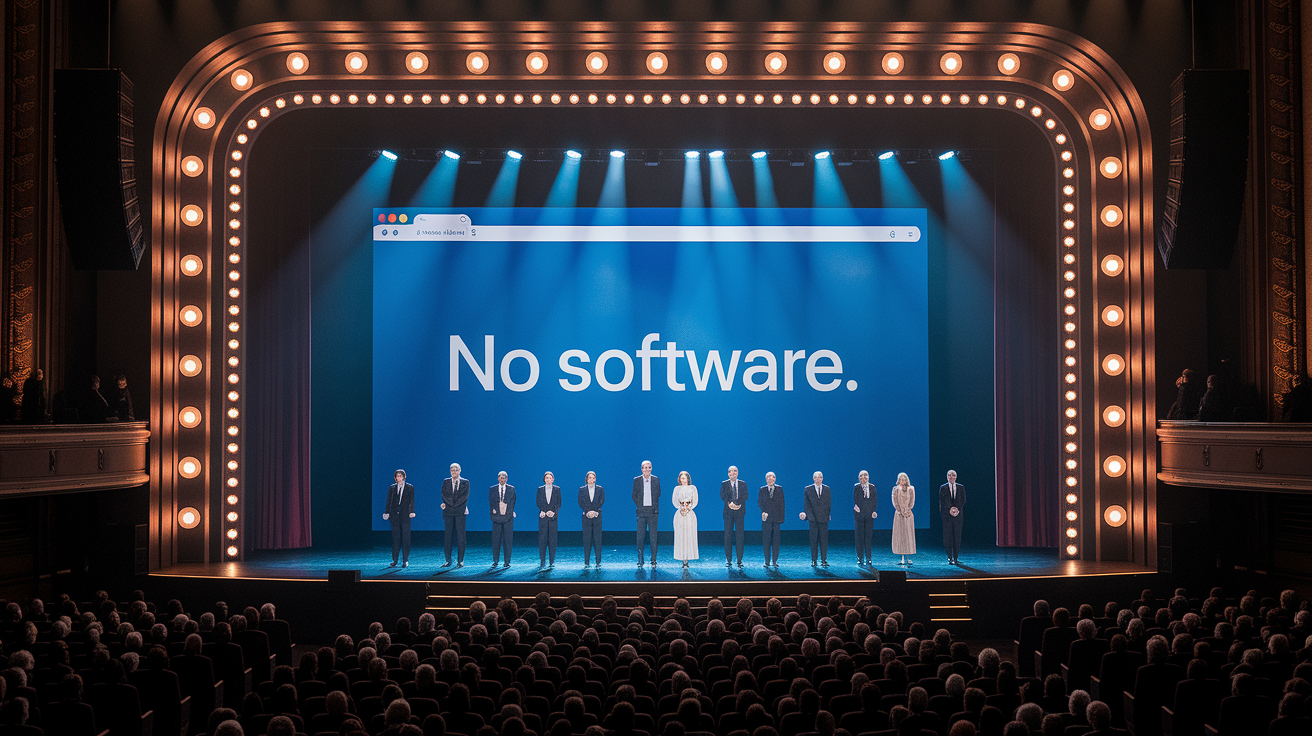
The Regency Theatre event in 2000 introduced the first browser-accessible CRM with subscription pricing. Customers paid a recurring fee and logged in through any web browser. No hardware procurement. No lengthy IT projects. No version-control nightmares when updates arrived. Salesforce handled infrastructure, uptime, and patches. Customers managed leads, contacts, and opportunities.
The “No Software” campaign drove the whole thing home. Salesforce printed the phrase on protest signs, handed them out at competitor conferences, and framed the launch around liberation from software headaches. The message resonated with small and mid-sized businesses that couldn’t afford Siebel’s multi-million-dollar implementations. It also planted doubts among IT leaders tired of managing on-premise systems.
Subscription pricing changed the revenue model too. Customers paid monthly or annually per user. That aligned Salesforce’s incentives with ongoing satisfaction rather than upfront deal size. It meant the company had to prove value every renewal cycle, which pushed product development toward usability, reliability, and customer success. Those principles became central to the SaaS business model across industries.
Early Growth After the CRM Launch and Salesforce’s 2000–2004 Milestones

After the 2000 launch, Salesforce moved quickly to prove the cloud model could scale. The company relocated to One Market Street in San Francisco by November 2000 to handle a growing customer base and team. Early sales focused on small businesses and departments within larger enterprises. Groups that could adopt new software without lengthy procurement cycles or board approvals. That grassroots approach built momentum and reference customers faster than traditional enterprise sales.
Dreamforce started in 2003 as a customer conference at the Westin St. Francis Hotel. Just over 1,000 people registered. The agenda included 52 presentations. The event established a pattern Salesforce would repeat for decades: gather customers, developers, and partners in one place to share roadmaps, announce features, and build community. Dreamforce attendance became a proxy for the platform’s reach, growing from hundreds to tens of thousands within a few years.
Competition with Siebel Systems defined much of this era. Siebel dominated on-premise CRM, but its implementation timelines stretched months or years. Licensing costs put it out of reach for most mid-market companies. Salesforce positioned itself as the faster, cheaper, and simpler alternative. When Siebel launched its own hosted CRM offering in response, it validated Salesforce’s thesis that cloud delivery was the future, even if incumbents struggled to execute the shift.
Office expansion: Moved to One Market Street (November 2000) to support rapid customer and team growth.
Dreamforce 2003: First annual conference at Westin St. Francis with 1,000+ attendees and 52 presentations.
Customer base: Built early traction with small businesses and departmental buyers inside large enterprises.
Siebel competition: Positioned as a faster, lower-cost cloud alternative; Siebel’s own hosted response validated the model.
AppExchange groundwork: Early platform work during 2003–2004 set the stage for the 2005 marketplace launch.
Revenue model proof: Subscription renewals demonstrated that customers stayed when the product delivered ongoing value.
How Salesforce’s CRM Evolved Into a Full Cloud Platform (2005–2012)
Salesforce started expanding beyond core CRM in 2005 when it became clear customers wanted to extend the platform for workflows the standard product didn’t cover. AppExchange, Apex, Visualforce, and Force.com turned Salesforce from a single application into a development environment where third parties and customers could build, share, and sell their own tools. That shift created a network effect. The more apps available, the more valuable the platform became to new buyers.
AppExchange and the Beginning of the Ecosystem
AppExchange launched in 2005 as a marketplace for business apps. Think eBay or iTunes, but for CRM extensions. Developers could list apps, customers could browse and install them with a few clicks, and Salesforce gained a library of specialized solutions without building everything in-house. Early listings included industry-specific tools, integrations with accounting systems, and workflow extensions. The marketplace model also introduced a revenue-sharing structure that turned independent developers into Salesforce partners with a financial stake in the platform’s growth.
Apex and Visualforce
In 2006, Salesforce introduced Apex and Visualforce. Apex let developers write server-side logic that executed inside Salesforce’s multi-tenant environment. Visualforce enabled teams to design custom pages that matched their branding or workflow needs. Together, these tools meant customers could tailor the platform without forking the codebase or losing access to upgrades, a persistent problem with on-premise customization.
Force.com and Cloud Platform Era
Force.com debuted at Dreamforce 2008 as a Platform-as-a-Service offering. Salesforce claimed Force.com could accelerate app development by roughly four times compared to conventional methods, thanks to built-in database services, user authentication, and automated scaling. The announcement positioned Salesforce as more than a CRM vendor. It was now a platform company competing with Microsoft, Oracle, and emerging cloud infrastructure providers. Service Cloud arrived in 2009 to handle customer support and case management. Marketing Cloud took shape in 2012 through a series of acquisitions: Radian6 for social listening ($326 million), Buddy Media for social marketing ($745 million), and ExactTarget for email and digital marketing ($2.5 billion). Combined, those three deals totaled roughly $3.6 billion and established Salesforce as a multi-cloud platform covering sales, service, and marketing.
Salesforce CRM in the Mobile, Lightning, and Developer Era (2013–2018)
Mobile access became a priority in 2013 when Salesforce launched Salesforce1, a platform designed for mobile app development. The shift acknowledged that sales reps, service agents, and marketers needed CRM data on phones and tablets, not just desktop browsers. Salesforce1 unified mobile development under a single framework. The company started measuring success by mobile usage metrics alongside traditional web analytics.
Trailhead launched at Dreamforce 2014 as a free learning platform with modules, projects, and gamified credentials called Superbadges. The goal was to lower the barrier for administrators, developers, and business users who wanted to learn Salesforce without expensive training courses. Trailhead also addressed a talent gap. Enterprises adopting Salesforce needed skilled workers, and Trailhead created a pipeline of people who could configure, customize, and manage the platform. Lightning Experience rolled out in the summer of 2015 and officially launched at Dreamforce later that year. The new UI modernized the look, introduced a component-based architecture, and made page customization more flexible through drag-and-drop tools. Lightning also marked a shift toward Flow as the preferred automation tool, eventually leading to the 2021 retirement announcement for Workflow Rules and Process Builder. By 2016, Dreamforce attendance hit roughly 170,000, with an additional 15 million viewers via Salesforce Live streaming.
| Year | Product/Feature | Impact | Target Users |
|---|---|---|---|
| 2013 | Salesforce1 mobile platform | Unified mobile app development; enabled field access to CRM data | Sales reps, service agents, mobile-first teams |
| 2014 | Trailhead learning platform | Free training modules and gamified credentials; expanded skilled user base | Admins, developers, business users |
| 2015 | Lightning Experience UI | Modernized interface and component-based customization; improved UX | All users, especially admins and developers |
| 2016 | Dreamforce attendance peak | 170,000 in-person attendees plus 15 million streaming viewers | Customers, partners, developers, ecosystem |
| 2016 | Flow automation prominence | Set stage for 2021 retirement of Workflow Rules and Process Builder | Admins, automation specialists |
AI’s Role in the Continued Evolution of Salesforce’s CRM (2016–Present)
Salesforce announced Einstein AI at Dreamforce 2016, embedding machine learning across Sales Cloud, Service Cloud, and Marketing Cloud. Einstein added predictive lead scoring, automated case classification, personalized email recommendations, and image recognition for visual search. The pitch was simple: surface insights without requiring data science expertise, and automate repetitive decisions so teams could focus on high-value tasks.
Einstein evolved through partnerships and internal development. An OpenAI collaboration powered Einstein 1 and Einstein Copilot, which brought conversational AI and generative capabilities into workflows. The release of ChatGPT in 2023 accelerated customer demand for integrated AI features. Salesforce responded by weaving AI into sales forecasting, service chatbots, marketing content generation, and developer code assistance. Einstein Copilot acted as a conversational layer across the platform, letting users ask questions in natural language and receive answers pulled from CRM data, third-party integrations, and configured business rules.
Einstein AI launch (2016): Embedded machine learning for predictive insights, automated case routing, and personalized marketing.
Einstein 1 and OpenAI partnership: Enabled generative AI, conversational interfaces, and Einstein Copilot across sales, service, marketing, commerce, and development.
Post-ChatGPT demand (2023): Substantially increased customer requests for AI-driven automation, natural-language interaction, and intelligent recommendations.
Current AI scope: Covers lead scoring, opportunity forecasting, support case classification, email personalization, image recognition, content generation, and code assistance.
Major Acquisitions That Expanded Salesforce Beyond Core CRM
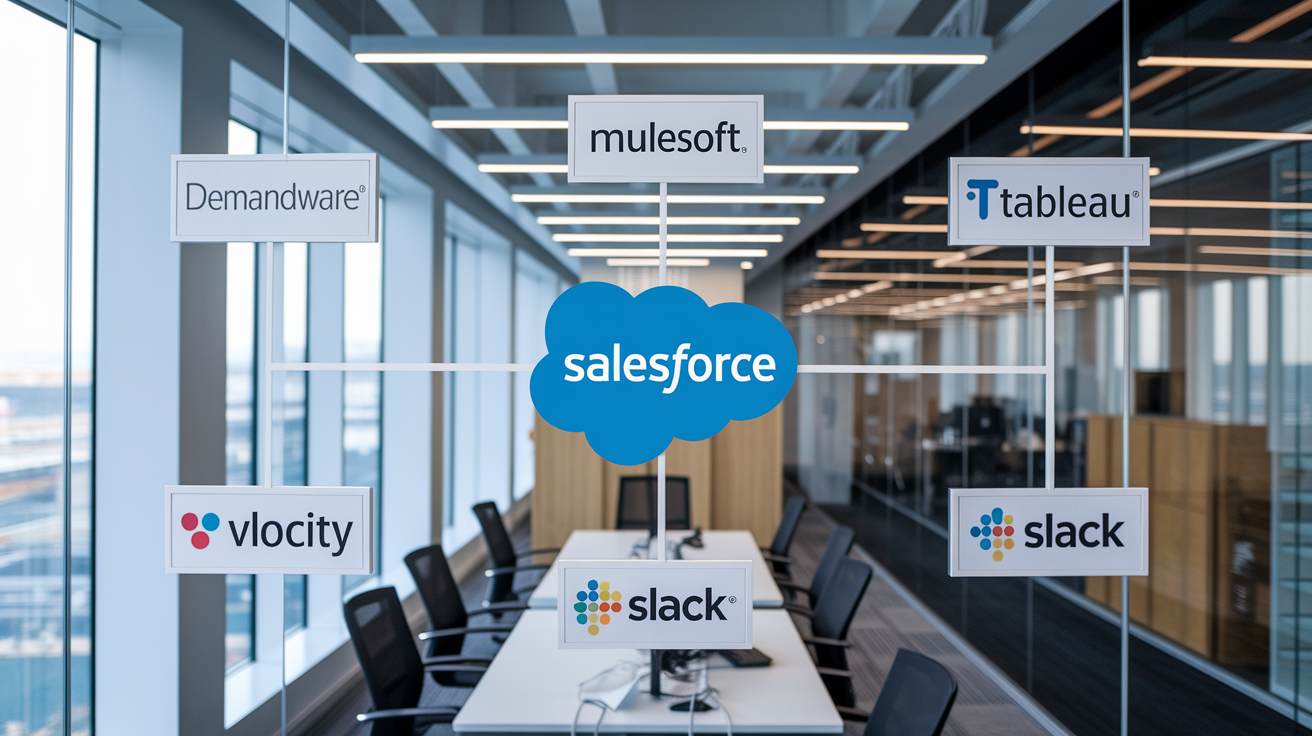
Salesforce used acquisitions to enter new markets and add capabilities that would take years to build organically. Demandware brought e-commerce tools in 2016 for roughly $2.8 billion, giving Salesforce a Commerce Cloud offering. MuleSoft arrived in 2018 for $6.5 billion, adding integration middleware that let enterprises connect Salesforce to legacy systems, databases, and third-party APIs. Tableau joined in 2019 for $15.7 billion, becoming the analytics and visualization layer that eventually replaced Einstein Analytics as CRM Analytics.
Vlocity came aboard in February 2020 for $1.33 billion and became the foundation for Salesforce Industries, vertical solutions for healthcare, financial services, manufacturing, and other sectors. Slack closed in mid-2021 for $27.7 billion, the largest acquisition in Salesforce’s history. Slack integrated with Flow, Apex, and other platform services to create a collaboration hub tied directly to CRM data, cases, opportunities, and workflows. Together, these deals shifted Salesforce’s identity from CRM vendor to a multi-product platform covering commerce, integration, analytics, industry solutions, and team collaboration.
| Acquisition | Year | Price | Strategic Impact |
|---|---|---|---|
| Demandware | 2016 | ~$2.8B | Added Commerce Cloud for e-commerce and retail |
| MuleSoft | 2018 | $6.5B | Integration middleware for connecting legacy and cloud systems |
| Tableau | 2019 | $15.7B | Data visualization and analytics (later CRM Analytics) |
| Vlocity | 2020 | $1.33B | Vertical solutions for industries (healthcare, financial, manufacturing) |
| Slack | 2021 | $27.7B | Collaboration platform integrated with CRM workflows and automation |
How the 1999–2000 CRM Launch Shaped the CRM Industry

Salesforce’s 2000 launch normalized subscription-based cloud software across the enterprise. Before Salesforce, most CRM vendors sold perpetual licenses and required customers to manage their own servers, upgrades, and integrations. The SaaS model flipped that arrangement. Vendors handled infrastructure and updates while customers paid predictable recurring fees. Within a few years, nearly every CRM vendor either launched a cloud version or acquired one, validating Salesforce’s thesis that on-premise software would lose ground to browser-based alternatives.
The shift also changed how businesses evaluated CRM. Instead of multi-year implementation projects with six-figure upfront costs, companies could start with a small pilot, test the platform with real users, and scale gradually. That flexibility attracted mid-market buyers and departmental teams inside large enterprises, creating a bottom-up adoption pattern that bypassed traditional IT gatekeepers. Economic impact projections from Salesforce and third-party analysts showed the ecosystem generating $1.6 trillion in new business revenue and 9.3 million jobs by 2024, with ecosystem revenues predicted to grow almost six times larger than Salesforce itself.
SaaS normalization: Moved CRM from on-premise licenses to subscription cloud services, influencing Oracle, Microsoft, SAP, and smaller vendors.
Business model change: Replaced upfront license fees and implementation projects with predictable monthly or annual per-user pricing.
Adoption pattern shift: Enabled bottom-up, departmental pilots that grew into enterprise-wide deployments without lengthy procurement cycles.
Ecosystem growth: Projected $1.6 trillion in new business revenue and 9.3 million jobs by 2024, with partner and app revenues outpacing Salesforce’s own by a factor of six.
Final Words
In 2000, Salesforce publicly launched its CRM at the Regency Theatre, turning a 1999 startup into the first mainstream cloud-based CRM with a “No Software” pitch. That launch moved customer relationship management from on-prem software to subscription cloud access and kicked off years of rapid product and platform growth.
If you’re wondering when did salesforce launch crm, the public debut was 2000 after the company formed in 1999. That shift reshaped how companies buy and build CRM and set up a cloud-first future worth following.
FAQ
Q: When did Salesforce CRM come out?
A: Salesforce CRM publicly came out in 2000; the company was founded in March 1999 and unveiled a browser-based, subscription CRM at the Regency Theatre under the “No Software” cloud‑first message.
Q: What is the #1 CRM in the world and who is Salesforce’s biggest competitor?
A: The #1 CRM in the world is widely considered Salesforce by market share, and its biggest competitor is Microsoft Dynamics 365, with Oracle CX, SAP, and HubSpot also major rivals.
Q: Why is Salesforce falling?
A: Salesforce can fall when revenue growth slows, guidance misses expectations, macroeconomic cuts reduce software spending, or investors worry about acquisition costs and competition; watch earnings, guidance, and customer metrics.