Was PayPal reborn in 2015, or just shuffled on a corporate balance sheet?
It became an independent public company on July 20, 2015, when it started trading as PYPL on NASDAQ after a nine-month spin-off from eBay.
That morning didn’t disrupt users, but it changed PayPal’s leadership, strategy, and ability to chase mobile payments, merchant tools, and new partners.
Investors, merchants, and eBay shareholders felt the shift.
This piece explains the exact date, why independence mattered, and what to watch next.
Pinpointing the Exact Date PayPal Became an Independent Company
PayPal became independent on July 20, 2015. That’s when it started trading as its own company on NASDAQ under the ticker PYPL. The move ended a thirteen-year run under eBay, which had bought the payment processor back in 2002 for $1.5 billion in stock. On that Monday morning, PayPal officially went back to being a publicly traded company with its own board, executives, and game plan.
The announcement came in September 2014, when eBay’s board said the two businesses would split into separate public companies. The decision followed months of pressure from activist investors and internal debates about where each company needed to go. eBay shareholders got one share of PayPal for every eBay share they owned, creating two separately traded entities without anyone needing to buy or sell anything.
The transition happened fast once the separation date hit. Trading kicked off immediately under the new ticker, with PayPal’s leadership and operational setup already running. The company kept its San Jose headquarters and continued serving its merchant and consumer base without any service hiccups. For customers and merchants, nothing changed on July 20, 2015, even though the corporate structure had completely shifted.
Exact date of independence: July 20, 2015
Ticker and exchange: PYPL on NASDAQ
Relationship history with eBay: Acquired in October 2002 for $1.5 billion, ran as eBay subsidiary for thirteen years
Immediate structural outcome: PayPal became a standalone public company with independent governance, strategic control, and financial reporting
Key PayPal History Leading Up to Independence
PayPal’s story starts with Confinity, a software security company founded in December 1998 by Max Levchin, Peter Thiel, and Luke Nosek in Palo Alto. The company initially focused on cryptography and security for handheld devices, but switched gears toward digital payments after launching a service that let users send money via email and PalmPilot. The early product caught on quickly, especially among users doing small transactions and splitting costs. But the company needed cash and scale to compete in the emerging online payments space.
Confinity merged with X.com in March 2000, teaming up with Elon Musk’s online banking startup. Musk had launched X.com in March 1999 with the goal of building a full-service internet bank. The merger brought together complementary tech and customer bases, but also sparked internal fights over product direction and who should run things. Musk initially led the combined company, but by October 2000, Peter Thiel took over as CEO after disagreements about technology choices and strategy. The company decided to focus exclusively on the payment service instead of broader banking features.
X.com got rebranded as PayPal in June 2001, reflecting the shift to payments only. The timing made sense because the service was exploding on eBay, where sellers and buyers adopted PayPal as a faster, simpler alternative to mailing checks or money orders. By the end of 2000, PayPal had passed 1 million users. Growth took off throughout 2001 as eBay transactions drove adoption, with some reports citing nearly 10 percent daily user growth during peak periods. That rapid expansion set things up for PayPal to go public less than a year later.
PayPal’s Early IPO and eBay Acquisition Before Independence
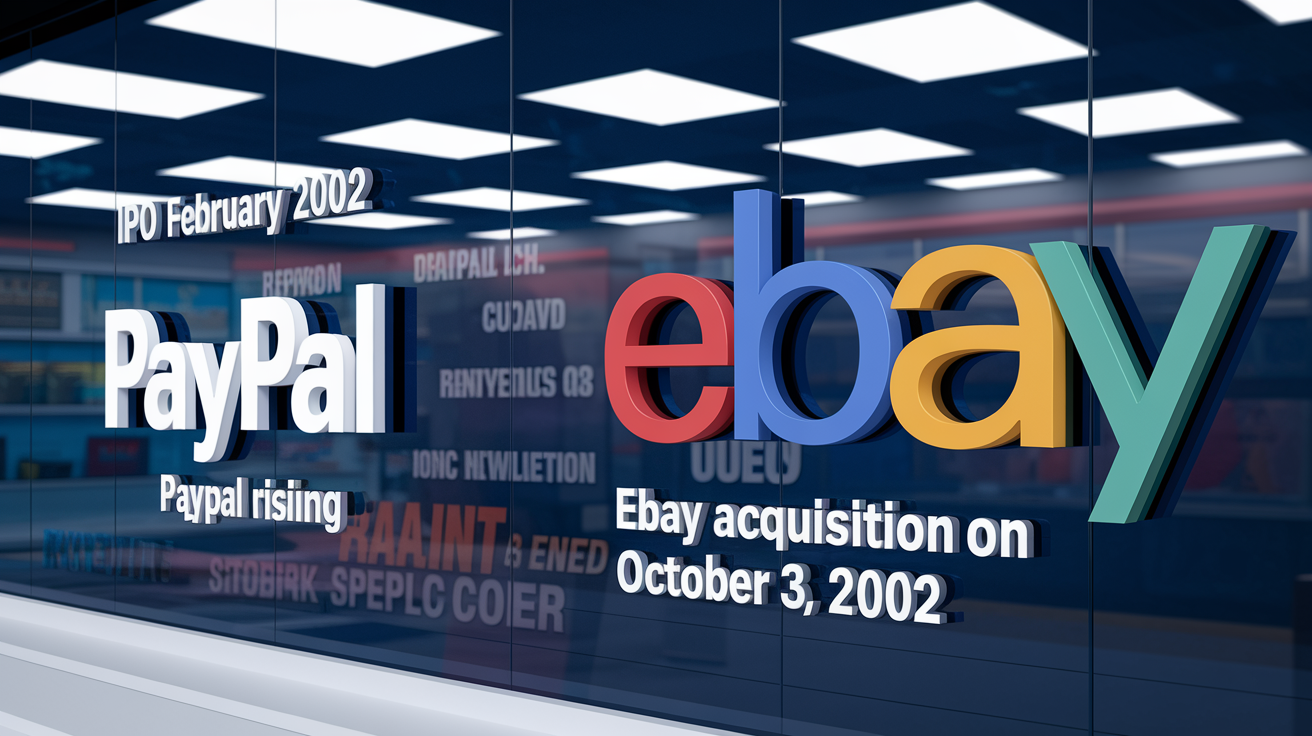
PayPal completed its IPO in February 2002, raising over $61 million and debuting on NASDAQ. Shares opened at $13 and climbed more than 50 percent on the first day, reflecting strong investor confidence in the company’s growth and position in online payments. The IPO came during a cautious period for tech stocks after the dot-com crash, but PayPal’s clear revenue model and rapid user adoption made it an attractive bet for investors hunting for profitable internet businesses.
The company’s importance to eBay was already obvious by IPO time. PayPal processed roughly 40 percent of all transactions on eBay’s marketplace, making it the default payment method for millions of buyers and sellers. eBay had tried to build its own payment system called Billpoint, but it never gained the same trust or adoption. Losing PayPal to a competitor or watching it integrate more deeply with rival marketplaces would’ve been a huge risk to eBay’s transaction ecosystem.
eBay moved fast to acquire PayPal, closing the deal on October 3, 2002, for $1.5 billion in eBay stock. The acquisition gave eBay direct control over the payment layer of its marketplace and killed the risk of PayPal favoring other platforms. For PayPal, the deal provided access to eBay’s global infrastructure, regulatory expertise, and balance sheet, speeding up international expansion and product development. The acquisition worked well for over a decade. Eventually though, the two companies’ growth paths diverged enough that separation made sense again.
The Corporate Separation Process That Made PayPal Independent

The formal separation kicked off with eBay’s announcement in September 2014 that the board had approved a plan to spin off PayPal into an independent public company. The announcement triggered regulatory filings, governance changes, and operational prep that took nine months to complete. eBay filed detailed documentation with the SEC outlining the spin-off structure, financial history, and pro forma projections for both companies as standalone entities.
Regulatory approval required coordination with financial authorities in multiple jurisdictions, since PayPal operated as a licensed money transmitter and payments processor in dozens of countries. The company set up a new board of directors, separate executive compensation structures, and independent financial reporting systems. Dan Schulman, who’d joined as PayPal’s president in 2014, became CEO of the independent company. The separation didn’t require a shareholder vote under Delaware corporate law, but eBay communicated extensively with investors about the rationale and mechanics throughout the process.
On July 17, 2015, eBay distributed PayPal shares to existing shareholders on a one-to-one basis. Each eBay shareholder got one share of the new PayPal for every share of eBay held as of the record date. The distribution was structured as a tax-free transaction for U.S. shareholders. Trading started on July 20, 2015, with PayPal operating under its own ticker and eBay continuing as a separate marketplace company. Both entities confirmed the separation was complete and all governance, operational, and financial systems were running independently.
Announcement timing: September 2014, nine months before separation became effective
Regulatory steps: SEC filings, multi-jurisdiction money transmitter license reviews, financial authority coordination
Shareholder distribution: One PayPal share for each eBay share held, distributed July 17, 2015
Board restructuring: New independent board formed, Dan Schulman appointed CEO of standalone PayPal
Confirmation procedures: Trading began July 20, 2015, both companies issued statements confirming operational independence
Why PayPal Became an Independent Company
The rationale for the spin-off centered on the diverging needs and competitive pressures facing PayPal and eBay by 2014. PayPal needed flexibility to compete with fast-growing rivals like Stripe, Square, and Apple Pay, all of which were aggressively targeting merchant services, mobile payments, and point-of-sale systems. Staying inside eBay limited PayPal’s ability to partner with eBay’s marketplace competitors, including Amazon, Alibaba, and other large e-commerce platforms. Independence removed the conflict of interest and let PayPal pursue partnerships and integrations that would’ve been strategically problematic under eBay ownership.
eBay’s core marketplace business had different priorities and a slower growth trajectory than PayPal’s payments business. While eBay focused on improving its marketplace experience and competing with Amazon, PayPal needed to invest heavily in mobile tech, international expansion, and emerging payment methods like cryptocurrency and digital wallets. Activist investors, including Carl Icahn, publicly argued that separating the two companies would unlock value by letting each pursue its own strategy without compromise. The argument gained traction as payment industry consolidation accelerated and tech shifts created new opportunities that required speed and focus.
Competitive pressure: Stripe, Square, and Apple Pay were capturing merchant and consumer payment volume. PayPal needed agility to respond.
Innovation needs: Mobile commerce, digital wallets, and new payment methods required dedicated investment and product focus.
Merchant service expansion: Independence enabled PayPal to serve eBay’s competitors and broaden its merchant base without internal conflicts.
Mobile and global ambitions: Faster decision-making and capital allocation became possible once PayPal operated as a standalone entity with its own board and strategy.
PayPal on NASDAQ: PYPL and Market Reaction to Independence

PayPal’s debut as PYPL on July 20, 2015, drew strong interest from investors who viewed the company as a high-growth fintech play with exposure to mobile payments, e-commerce expansion, and global digital commerce trends. The stock opened with a market cap that quickly surpassed eBay’s, reflecting investor confidence that PayPal’s payment infrastructure and consumer brand had more upside potential than eBay’s marketplace business. Analysts highlighted PayPal’s scale, with over 169 million active accounts at the time of separation, and its position as the leading online payment processor in the U.S. and Europe.
Early trading showed sustained momentum as investors digested PayPal’s financials and growth outlook. The company reported strong mobile payment volume growth, driven by its integration with thousands of mobile apps and the rising popularity of peer-to-peer services like Venmo, which PayPal had acquired as part of its 2013 Braintree purchase. Revenue growth rates in the mid-teens and expanding merchant adoption signaled that PayPal could sustain profitability while investing in new payment technologies and international markets.
Market sentiment stayed positive through the end of 2015, with PYPL shares appreciating as PayPal demonstrated its ability to operate independently and execute on strategic priorities. The stock’s performance validated the spin-off thesis, showing that investors valued PayPal’s flexibility and growth potential more than the operational synergies it had shared with eBay. The separation also allowed clearer financial reporting, making it easier for analysts and investors to model PayPal’s business without disentangling it from eBay’s marketplace metrics.
| Date | Event | Market Response |
|---|---|---|
| July 20, 2015 | PYPL begins trading on NASDAQ | Strong opening, market cap quickly exceeds eBay’s valuation |
| August 2015 | First earnings report as independent company | Revenue growth and mobile metrics beat expectations, stock rises |
| December 2015 | End of first half-year as standalone entity | PYPL up significantly from spin-off price, analysts raise price targets |
PayPal Independence Timeline: From Founding to 2015 Split

The path from Confinity’s founding to PayPal’s 2015 independence spanned nearly seventeen years and included multiple ownership changes, strategic pivots, and market expansions. The timeline below captures the key corporate events that shaped PayPal’s trajectory and led to its separation from eBay.
December 1998: Confinity founded in Palo Alto by Max Levchin, Peter Thiel, and Luke Nosek. Initial focus on security software for handheld devices.
March 1999: Elon Musk founds X.com, an online banking startup.
March 2000: Confinity and X.com merge. Combined company led by Musk.
October 2000: Peter Thiel becomes CEO after leadership transition. Company shifts focus exclusively to payments.
June 2001: X.com rebrands as PayPal, reflecting the dominance of the payment product.
February 2002: PayPal completes IPO on NASDAQ, raising over $61 million. Shares rise more than 50 percent on opening day.
October 3, 2002: eBay acquires PayPal for $1.5 billion in stock. PayPal becomes an eBay subsidiary.
2003–2014: PayPal expands globally under eBay ownership, adds mobile services, acquires Braintree and Venmo, and grows to over 152 million active accounts.
September 2014: eBay announces plan to spin off PayPal into an independent public company.
July 20, 2015: PayPal begins trading as PYPL on NASDAQ. Separation from eBay is complete.
PayPal After Becoming an Independent Company
Independence gave PayPal the freedom to pursue acquisitions, product launches, and partnerships that would’ve created conflicts of interest under eBay ownership. The company moved quickly to expand its merchant services footprint, acquiring Xoom in 2015 for international money transfers and iZettle in 2018 to strengthen its presence in European mobile point-of-sale systems. These acquisitions broadened PayPal’s capabilities beyond online checkout, positioning it to compete in physical retail and cross-border payments. The company also invested heavily in tech infrastructure, upgrading its platforms to handle higher transaction volumes and support real-time payments.
Venmo became a strategic priority after independence, with PayPal focusing on monetizing the peer-to-peer app through merchant acceptance, debit cards, and in-app commerce features. Venmo’s transaction volume grew rapidly, reaching $270 billion by 2025, and the app evolved from a social payment tool into a broader financial platform with cashback rewards and direct deposit capabilities. PayPal also entered the cryptocurrency market in 2020, letting users buy, sell, and hold Bitcoin, Ethereum, and Litecoin directly within their PayPal accounts. The crypto feature later expanded to include the ability to use cryptocurrency for payments at millions of merchants, positioning PayPal as a bridge between traditional finance and digital assets.
By December 2024, PayPal reported 434 million active accounts, over 36 million merchants, and a presence in more than 200 markets. Total payment volume reached $1.68 trillion in 2024, with net revenues of $31.8 billion. The company launched new products like Fastlane, a faster checkout system designed to cover more than 80 percent of global transaction volume by 2027, and PayPal Open, a unified merchant offering rolling out in the U.S. with plans to expand to the U.K. and Germany. Under CEO Alex Chriss, PayPal initiated a strategic overhaul focused on profitable growth, operational efficiency, and deeper integration of artificial intelligence into fraud detection and customer service.
Post-2015 Product and Feature Expansion
After independence, PayPal rolled out a series of products designed to capture emerging payment trends and consumer behaviors. One-Touch payments simplified checkout by letting users complete transactions with a single click, reducing friction and cart abandonment rates. The company expanded its mobile wallet capabilities, integrating with Apple Pay and Google Pay to ensure PayPal stayed accessible across platforms and devices. PayPal Credit, a digital line of credit offered at checkout, gave consumers financing options for larger purchases, competing directly with traditional credit cards and buy now, pay later services.
The addition of cryptocurrency services in 2020 marked a significant expansion into digital assets. Users could buy, sell, and hold Bitcoin, Ethereum, Litecoin, and Bitcoin Cash directly within their PayPal accounts, with the ability to use crypto for payments at participating merchants. PayPal later integrated stablecoins to enable faster, lower-cost cross-border transfers, addressing a key pain point in international remittances. The company also launched a PayPal stablecoin, PYUSD, tied to the U.S. dollar and designed for payments and transfers within the PayPal ecosystem.
Buy now, pay later became another focus area, with PayPal introducing installment payment options at checkout for purchases over a certain threshold. The feature competed with standalone BNPL providers like Affirm and Klarna, using PayPal’s existing merchant relationships and consumer base. PayPal’s Honey acquisition in 2019 added browser-based coupon discovery and price tracking tools, creating a shopping utility that drove incremental transaction volume and strengthened merchant data insights. Together, these product expansions transformed PayPal from a simple online payment processor into a diversified financial services platform.
Final Words
in the action: PayPal became an independent, publicly traded company on July 20, 2015, listing on NASDAQ as PYPL.
The article traced the path from Confinity and X.com through the 2002 IPO, eBay’s acquisition, the 2014 split announcement, the separation process, and PayPal’s post‑spin product and market moves.
If you were wondering when did paypal become independent company, the short answer is July 20, 2015, and the spin‑off let PayPal accelerate into mobile payments, crypto, and merchant services — a positive growth story that’s still unfolding.
FAQ
Q: Was Elon Musk the owner of PayPal before, and is PayPal run by him now?
A: Elon Musk was an early owner: he founded X.com which merged into PayPal, but he wasn’t the sole owner, and PayPal is not run by Musk today.
Q: What is the $600 rule on PayPal?
A: The $600 rule on PayPal refers to IRS reporting that can require payment processors to issue Form 1099‑K when an account receives over $600 in gross payments for goods or services in a year; check current IRS guidance.
Q: Which is safer, PayPal or Venmo?
A: PayPal and Venmo share core security features, but PayPal is generally safer for purchases because it offers stronger buyer protections; Venmo is geared toward person-to-person transfers and has fewer purchase protections.